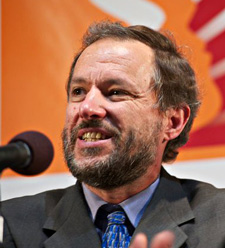
Pope Benedict, good or bad?

By Jonathan Power

Dean Acheson, the distinguished US Secretary of State who coined such phrases as “Britain has lost an empire but not yet found a role” also once said: “Moral talk is fine preaching for the Final Day of Judgement, but it was not a view I could entertain as a public servant.” No wonder he could justify the use of the nuclear bomb on Japan.

The last four Popes, including Benedict who has just announced his retirement, would never have supported the Hiroshima bombing. Neither did they support the wars in Vietnam, Iraq and Afghanistan. They believed in moral talk here and now.

“Moral talk” led Pope John Paul to wage a long and successful fight against communism in his homeland, Poland. Indeed, many say that victory was the catalyst for the fall of communism in the rest of Eastern Europe and the Soviet Union itself.

“Moral talk” led to Pope John, the great reformer, to use his position to tell President Lyndon Johnson to his face that the Vietnam war was immoral.

Benedict is cut of the same cloth, with some interesting shades of emphasis. Read More »

Room for optimism in Iran and the P5-plus-1 talks

By Farhang Jahanpour*

Iran and the P5-plus-1, which includes the United States, will meet again on 26 February in Kazakhstan. This is the first time that the two sides will meet in an atmosphere of continuing mutual suspicion since the third round of talks held in Moscow on 18-19 June 2012 ended in stalemate.

Iran believes that the West, particularly the United States, is using the talks as a pretext to increase the sanctions until Tehran bends to its will; whereas Washington holds that Iran is prolonging the talks in order to continue its uranium enrichment with the aim of producing a nuclear weapon. The fact of the matter is that neither side is sincere in their remarks and both sides are engaged in a cat and mouse game trying to use the talks for domestic purposes and for pursuing other goals, rather than finding a mutually acceptable solution to Iran’s nuclear program.Read More »

Nepal – Six years of “transition”

By Johan Galtung

From Kathmandu, Nepal

Three huge revolts in Asia in the last decades came to an end: the anti-Confucian cultural revolution in China 1967-76, the anti Phnom Penh Khmer Rouge revolution in Cambodia 1975-79, and the anti-feudal monarchy anti-caste maoist People’s War in Nepal that lasted 10 years from 13 February 1996, followed by 18 days of effective nonviolence in the streets of Kathmandu in 6-24 April 2006. The King abdicated.

Transcend mediated in May 2003, and identified, through dialogues with the parties, eleven deep faultline conflicts as roots of violence…Continue here

http://s7.addthis.com/js/250/addthis_widget.js#pubid=ra-4e9ecaf669e1e638

What the Syrian death tolls really tell us

By Sharmine Narwani

http://s7.addthis.com/js/250/addthis_widget.js#pubid=ra-4e9ecaf669e1e638

Unreliable data can incite and escalate a conflict – the latest UN-sponsored figure of 60,000 should not be reported as fact.

Less than two months after the UN announced “shocking” new casualty figures in Syria, its high commissioner for human rights, Navi Pillay estimates that deaths are “probably now approaching 70,000”. But two years into a Syrian conflict marked by daily death tolls, the question arises as to whether these kinds of statistics are helpful in any way? Have they helped save Syrian lives? Have they shamed intransigent foes into seeking a political solution? Or might they have they contributed to the escalation of the crisis by pointing fingers and deepening divisions?

Continue reading in The Guardian, February 15, 2013

Urgent UN Press Statement: Release Palestinian Hunger Strikers Now

By Richard Falk

The following press statement was issued 13 February 2013 under the auspices of the UN Human Rights Council in my capacity as Special Rapporteur for Palestinian Territories Occupied since 1967.

This nonviolent resistance to unlawful and abusive detention practices by Israel is a human rights outrage that should be the occasion of media attention and a worldwide outcry.

I encourage all who can to exert pressure on Israel before these individuals die in captivity. They are currently reported to be in grave condition. Please use all social networking tools to alert contacts.

**********************************

Press Statement – UN expert calls for the immediate release of three Palestinian detainees on hunger strike held by Israel without charges

GENEVA (13 February 2013) – United Nations Special Rapporteur Richard Falk today called for the immediate release of three Palestinian detainees held without charges by Israel. Mr. Falk expressed deep concern for the fate of Tarek Qa’adan and Jafar Azzidine, who are on their 78th day of hunger strike, and Samer Al-Issawi, who has been on partial hunger strike for over 200 days.

“Continuing to hold Mr. Qa’adan, Mr Azzidine and Mr. Al-Issawi under these
conditions is inhumane. Israel is responsible for any permanent harm,” warned the independent expert designated by the Human Rights Council to monitor and report on Israeli rights violations in Palestine. “If Israeli officials cannot present evidence to support charges against these men, then they must be released immediately.”

“Mr. Qa’adan and Mr. Azzidine are reportedly on the verge of death, with the threat of a fatal heart attack looming,” the expert noted, recalling that both men were arrested on 22 November 2012 and began their hunger strikes on 28 November, after being sentenced to administrative detention for a period of three months. They were transferred to Assaf Harofi Hospital near Tel Aviv on 24 January 2013 after their conditions deteriorated sharply.

This is the second time that Mr. Azzidine and Mr. Qa’adan have undertaken hunger strikes against administrative detention, since they took part in the mass hunger strike of Palestinians from 17 April to 14 May 2012. Mr. Qa’adan had been released after 15 months of detention on 8 July 2012 and Mr. Azzidine had been released on 19 June 2012 after three months of detention, before being re-arrested.

“Israel must end the appalling and unlawful treatment of Palestinian detainees. The international community must react with a sense of urgency and use whatever leverage it possesses to end Israel’s abusive reliance on administrative detention,” urged the Special Rapporteur.

Mr. Falk noted that Israel currently holds at least 178 Palestinians in administrative detention.

END of statement

Beyond the haunted imagination

By Richard Falk

Ever since atomic bombs were exploded over the Japanese cities of Hiroshima and Nagasaki in the closing days of World War II, end-of-the-world forebodings have been present in Western cultural consciousness. In the background of such thinking is the religious anticipation of a day of judgment when life in earth will be replaced by the consignment of everyone then living to either the hell of damnation or the heaven of salvation.

The first type of end time thinking is based on the fear that the Promethean gift of technological innovation when carried to its omega point will produce a big bang terminal moment in the human experience. The second kind of end time thinking imagines that the gift of planetary life was a testing time for the human species that would end with endless punishment for the many and eternal rewards for a few, and was divinely programmed in a fatalistic manner beyond human capacity to control or alter.

We live now amid both types of end time thinking, a realization made more troublesome because such alarmist patterns of awareness, while rather widespread, have not generated any strong reactive movement based on prudence and preservation. Instead, all of us avert our eyes most of the time, and most manage to look away all the time often with the help of drugs and denial. Only a few are able to fix their full gaze on the impending cosmic wreck without turning away.

One of those few is a poet named C.K. Williams who in an essay, “Nature and Panic,” Read More »

The Mali Blowback – More to come?

By Stephen Zunes

The French-led military offensive in its former colony of Mali has pushed back radical Islamists and allied militias from some of the country’s northern cities, freeing the local population from repressive Taliban-style totalitarian rule. The United States has backed the French military effort by transporting French troops and equipment and providing reconnaissance through its satellites and drones. However, despite these initial victories, it raises concerns as to what unforeseen consequences may lay down the road.

Indeed, it was such Western intervention—also ostensibly on humanitarian grounds—that was largely responsible for the Malian crisis in the first place.

The 2011 NATO military intervention in Libya effort went well beyond the UN Security Council mandate to protect civilian lives, as the French, British and U.S. air forces—along with ground support by the Saudi and Qatari dictatorships—essentially allied themselves with the rebel armies. The African Union—while highly critical of Qaddafi’s repression—condemned the intervention, fearing that the resulting chaos would result in the Libya’s vast storehouse of arms might fueling local and regional conflicts elsewhere in Africa and destabilize the region.

This is exactly what happened.Read More »

Hillary Clinton’s legacy as Secretary of State

By Stephen Zunes

Zunes challenges what he calls “the myth that Hillary Clinton is a figure who deserves support or admiration for her role of Secretary of State, or that she deserves another opportunity for influencing US foreign policy.”

Hillary Clinton leaves her position as Secretary of State with a legacy of supporting autocratic regimes and occupation armies, opposing enforcement of international humanitarian law, undermining arms control and defending military solutions to complex political problems. She was appointed to her position following eight years in the US Senate, during which she became an outspoken supporter of the invasion and occupation of Iraq, lied about Iraq’s military capabilities to frighten the public into supporting the illegal war, unleashed repeated attacks against the United Nations, opposed restrictions on land mines and cluster bombs, defended war crimes by allied right-wing governments and largely embraced Bush’s unilateralist agenda.

Despite this, Clinton is receiving largely unconditional praise from liberal pundits and others for her leadership, some even claiming that she is some kind of role model for young women! Continue

First published at truthout, February 7, 2013

Iran and the Cuban nuclear missile crisis

By Jonathan Power

It’s always better to talk than be super-tough. But Iran’s supreme leader, Ayotollah Ali Khamenei, last week firmly rejected the US attempt to resume negotiations over its suspected nuclear bomb making.

This is nothing short of disastrous. The Ayotallah must know that now Barack Obama has been re-elected not only has he got much more room to compromise but he has effectively seen off the attempt of Benjamin Netanyahu, the Israeli prime minister, to persuade the US to attack Iran.

The Ayotallah probably thinks by going eyeball to eyeball with the US he is going to win more than even Obama is prepared to give. This is nonsense and the attitude of both sides reminds me of the negotiating tactics of President John Kennedy and Soviet Premier, Nikita Khrushchev, during the Cuban missile crisis in 1963 which nearly brought the superpowers to a nuclear war.Read More »

An indispensable book on Palestine/Israel

By Richard Falk

Fast Times in Palestine: A Love Affair with a Homeless Homeland
By Pamela Olson (Berkeley, CA: Seal Press)

I realize that without knowing it, I have long waited for this book, although I could not have imagined its lyric magic in advance of reading. It is a triumph of what I would call ‘intelligent innocence,’ the great benefits of a clear mind, an open and warm heart, and a trustworthy moral compass that draws sharp lines between good and evil while remaining ever sensitive to the contradictory vagaries of lives and geographic destinies.

Pamela Olson exhibits an endearing combination of humility and overall emotional composure that makes her engaged witnessing of the Palestinian ordeal so valuable for me as I believe and hope it will be for others.

Early on, she acknowledges her lack of background with refreshing honesty: “Green and wide-eyed, I wandered into the Holy Land, an empty vessel.” But don’t be fooled. Olson, who had recently graduated from Stanford, almost immediately dives deeply into the daily experience of Palestine and Palestinians, with luminous insight and a sensibility honed on an anvil of tenderness, truthfulness, and a readiness for adventure and romance. Read More »