The USA – What Next?

By Johan Galtung

March 21, 2016 Washington, DC

Nobody knows. But under US presidentialism presidents matter; close to a dictatorship for one administration. That is where democracy–for, by if not of the delegates, it seems–enters; with a painstaking nomination process, like nothing in the rest of the world. And then the elections in November, after party conventions in July.

There are three parties in the USA: Democrats, Republicans; and Democrats in the South, loyal to the party leadership DNC and vice versa, Southern Baptist conservative, traditionally for blacks, women, working class, minorities (Southern Republicans are white Anglo men). Very different from Yankee democrats up in the North producing Bernie.

So we get a South-North gradient Hillary-Bernie, with exceptions. However, there is also an age gradient for both genders even if more for men: the older the more Hillary, the younger the more Bernie. If, likely, Hillary is nominated, Bernie will leave an imprint on US politics and many states in the North, and more so as time passes. But socialism, age and vague foreign policy rule him out as president.Read More »

Boko Haram in Nigeria

By Jonathan Power

If there is one man in Africa who combines kindness, authoritarianism of right and rationed proportions with nevertheless a deep commitment to democracy, business proficiency learnt on his now large-scale farms, political nous that outsmarts all competitors, a demanding Christian belief, honed while he was in prison for 3 years under the military dictatorship and a not overdone portion of charisma, it is Olusegun Obasanjo, the man who returned Nigeria, Africa’s most populated country and largest economy, to democracy twice and was himself the elected president for 8 years from 1999 to 2007.

No wonder a majority of Nigerians consider the Obasanjo years as the best in Nigeria’s history.

I have to say in my 40 years of being a writer on foreign affairs and interviewing over 60 heads of government he is the one who has impressed me the most, for sheer brainpower, idealism and wisdom.

Boko Haram, the Islamic fundamentalist group who has terrified the poor northern part of Nigeria – and are believed to have close contact with ISIS – came on to the scene after Obasanjo was out of office. Still, he has been very much in touch with the situation and twice, at least, tried to arbitrate between the movement and the government. This is what he had to say to me recently about the situation:

“Boko Haram is not simply a menace based on religion or one directed to frustrate anybody’s political ambition. It is essentially a socio-economic problemRead More »

European immigrants must adjust too

By Jonathan Power

Was the cultured and sophisticated Italian writer, Oriani Fallaci, speaking for the large numbers of working class people who end up being the ones who usually play host to immigrants, when she wrote in a leading liberal newspaper, Corriere della Serra, of her experience of trying to get rid of Somali immigrants living in a tent, performing all their bodily functions next to Florence’s cathedral?

“I don’t go singing Ave Marias or Paternosters before the tomb of Mohammed. I don’t piss or shit at the feet of their minarets. When I find myself in their countries I never forget that I am a guest and a foreigner. I am careful not to offend them with clothing or behaviour that are normal to us but inadmissible to them. Why should we respect people who don’t respect us? Why should we defend their culture or presumed culture when they don’t respect ours. I want to defend our culture and I say that I prefer Dante Alighieri or Omar Khayyam. And the sky opens. They crucify me ‘Racist, racist’.”

Of course she sounds like that. Nevertheless, her thoughts (if not so elegantly expressed, are shared by probably hundreds of thousands of Europeans. (In Eastern Europe it is probably millions.)

When Muslim leaders publicly burnt Salman Rushdie’s “Satanic Verses” or youths in Marseilles burnt down synagogues Read More »

TFF PressInfo # 367: Will the EU become a criminal union tomorrow?

By Jan Oberg

The EUropean Union – a criminal? The EU that has peace as it’s top goal and received Nobel’s Peace Prize? The EU with Schengen and Dublin? The EU with “European” values, humanism and mission civilisatrice that tells others how to live in accordance with international law and in respect for human rights?

We live in times where little shall surprise us anymore. The answer to the question – will EU become a criminal in international law terms? – will be answered on March 17 and 18 when the EU Council meets to decide whether or not to carry through the agreement with Turkey about how to handle refugees.

Amnesty International knows what it is all about. AI uses words such as “alarmingly shortsighted”, “inhumane”, “dehumanising”, “moral and legally flawed” and “EU and Turkish leaders have today sunk to a new low, effectively horse trading away the rights and dignity of some of the world’s most vulnerable people.”

And “By no stretch of imagination can Turkey be considered a ‘safe third country’ that the EU can cosily outsource its obligations to,” says Iverna McGowan, Head of Amnesty International’s European Institutions Office.

When Amnesty International expresses itself this way, we should listen very very carefully. I do and I’ve signed Amnesty’s Open Letter to Swedish prime minister Löfvén protesting that Sweden too may join this inhuman and law-violating agreement with Turkey. Hurry up, it is tomorrow!

Behind every refugee stands an arms trade, stands militarism. Read More »

TFF PressInfo # 366: Russian Withdrawal from Syria: Could it be the beginning of the end?

By Farhang Jahanpour

On Monday 14 March, in a surprise move and without any warning to Western leaders, President Vladimir Putin ordered the withdrawal of the “main part” of Russian forces from Syria, and instructed his diplomats to speed up the push for peace. “The effective work of our military created the conditions for the start of the peace process,” he said. “I believe that the task put before the defense ministry and Russian armed forces has, on the whole, been fulfilled.”

He added that with the participation of the Russian military, Syrian armed forces “have been able to achieve a fundamental turnaround in the fight against international terrorism.”

According to Western reports, Russian forces are already being prepared for flights back to Russia and equipment is being loaded onto cargo planes.

Although President Putin’s sudden announcement has given rise to a great deal of surprise and some false assumptions in the mainstream Western media and among political pundits, his decision is a timely, bold and constructive move that may result in some positive developments in the long-running catastrophe in Syria.

One of the reasons for the negative and cynical comments about the Russian move is that in five months President Putin has achieved more in halting the advance of the terrorists in Syria than the West had achieved in five years, if indeed it had been the West’s real intention to defeat the terrorists.

The Syrian uprising started with demonstrations on 28 January 2011 in Damascus and Aleppo in the wake of the “Arab Spring” in Tunisia and Egypt.Read More »

Two ways of looking at the race for the American presidency

By Richard Falk

#1: as an incredibly dumbing down of the political process, turning the presidential campaigns for the nomination as heavily financed shadow shows, hiding special interests and money management, all about selling the candidate by boast and bluster;

#2: as pre-revolutionary ferment, mobilizing the young, and confronting the established order, finally, with non-establishment choices between the radical right of Trump & Cruz and the moderate social democratic left of Sanders.

This tedious struggle for political prominence and historical name recognition is being played out against a backdrop of the three pillars of America’s global role: the Pentagon, Wall Street, and Israel.

No candidate has managed to shake the pillars, although this time around Sanders has at least launched a genuine attack on the Wall Street pillar, and Trump has gestured toward what might be a mild push against the Israel pillar. This alone makes Sanders and Trump the first outsiders to compete seriously for a run at the White House.

Of course, since Sanders has done so much better than expected, Clinton makes some noises as if she is also taking on Wall Street, but as her unreleased transcripts of her gilt talks at Goldman-Sachs no doubt confirm, no one think she means it, and she doesn’t. This is her way of harmlessly sparring with the man from Vermont until she locks up the machine-driven nomination.

When we look at the candidates from a Hollywood central casting point of view, we have to wonder who is running the show, especially on the Republican side.

Senator Ted Cruz appears to be a credible reincarnation of Tomás de Torquemada, Read More »

A pope, a patriarch, a spiritual revolution

By Johan Galtung

The first editorial here at Transcend of March 3 2008, “50 Years of Fidel Castro” celebrated a political revolution that changed the world, and spelt the end of US-Western imperialism. This editorial celebrates a spiritual revolution that may also change the world, spelling the end of Western materialism, and spread from there.

We are talking about processes, not events, and of structures and cultures more than of actors.

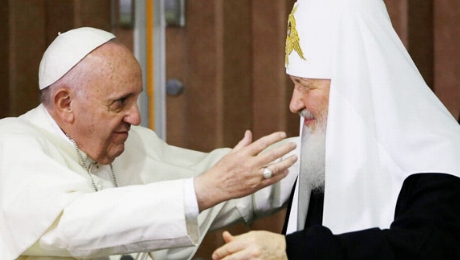
Again, Cuba played a major role, as meeting place between two major parts of Christianity, Catholic and Orthodox. In the Great Schism of 1054 they had excommunicated each other; and the Roman empire had split Catholic/Orthodox in 395. Fidel’s Catholic brother and successor Raúl was a condition for this historic meeting for peace; so was the meeting between Putin–an Orthodox Christian–and Francis in June 2015. However, not many pairs of brothers rival the two Castros in shaping history.

They met, Pope Francis of the Catholic Church and Patriarch Kirill of Moscow and all Russia – after earlier meetings between popes and the patriarch of Constantinople – with a Joint Declaration on 12 Feb 2016 in 30 articles. There were 17 quotes from the Bible; showing that they are “brothers in the Christian faith”, “pained by the loss of unity”, “divided by wounds caused by old and recent conflicts”. Not from the Bible are the many references to “the Most Holy Mother of God, Virgin Mary, and the saints we venerate”. Problematic for Protestants.

The bulk of the Joint Declaration is about the fate of Christians in the Middle East, meaning mainly Orthodox; like “the Metropolitans of Aleppo, Paul and John Ibrahim, who were taken in April 2013, to make every effort to ensure their prompt liberation”. However, together they “invite our Churches in Ukraine to work towards social harmony”.

They also jointly argue strongly against abortion and euthanasia, and in favor of “respect for the dignity of the individual called into being according to the Creator’s plan”. Do not destroy God’s creation.Read More »

Is Islam violent?

By Jonathan Power

Is Islam violent? ISIS in Syria and Iraq. In Pakistan, there is Lashkar-e-Taiba and the attempted murderer of the schoolgirl, Malala Yousafzai. Immigrant Moroccan men roughly pushing women and fondling them in the crowd in Cologne. Murderous bombs in Paris. Ayan Hirsi Ali, a Somali female author who was raised a Muslim, writes, “Violence is inherent in Islam- it’s a destructive, nihilistic cult of death. It legitimates murder.”

The late Harvard professor, Samuel Huntington, argued that in the later years of the last century and the early years of this an uncannily high percentage of the world’s violent conflicts took place between Muslims and non-Muslims: Turks versus Greeks, Russians versus Chechens, Bosnian Muslims and Albanians versus Serbs, Armenians versus Azeris, Uighurs versus Han Chinese, Indian Hindus versus Muslims, and Arabs versus Jews.

Yet most Muslims don’t commit acts of violence. If Islam is intrinsically violent then roughly a billion believers either do not understand their own religion, or are too cowardly or unfaithful to follow its precepts. That is my sarcasm but, indeed, this is what the violent Islamists say.

Westerners have a tendency to create myths about the teachings of Mohammed in the Koran. An outrageous one is the claim that an adulterous woman should be stoned. But the only teaching in any world major religion advocating stoning can be found in the Jewish Old Testament. (Paradoxically, the Jews haven’t practiced this for millennia but Saudi Arabia does today.)

Scholars like Huntington have given the impression that Islam is a much more violent religion than Christianity.

But another point of view is Professor John Owen’s. He writes in his book, Confronting Political Islam: “A broad view of the history of the Middle East suggests that Islam is much like other religions. It is marked by times and places of conquest and brutality, but also by times and places of peace……Christendom has had its sustained spasms of violence, both to outsiders with the Crusades and fellow believers, as in the Counter Reformation and the Inquisition”. And we should add in as in World War 1 and 2.

We shouldn’t forget that Mohammad Khatami, a former president of Iran, repeatedly condemned the 9/11 attacks and declared that suicide bombers wouldn’t go to heaven.

However, the fact is that Mohammed behaved in a very different way than Jesus. He was more in line with the sometimes violent and warlike Old Testament Jewish leaders. In 630 AD Mohammed himself led his troops to conquer Mecca. By the time of his death two years later most of the Arabs of the western part of Arabia were Muslims by conquest.

Within 20 years of Mohammed’s death the Muslims had conquered large parts of the Roman Empire and had absorbed the almighty Persian. Within a 100 years Mohammed’s followers had established an empire greater than Rome at its zenith. By the thirteenth and fourteenth centuries Islam had spread as far east as India, Indonesia and parts of China. In Africa it was introduced on the back of the slave trade.

In total contrast the Christians submitted themselves to the lions rather than fight and not until the Emperor Constantine converted to Christianity some 300 years after Jesus’ death did Christianity take on the role of running a state with all its well-embedded military traditions.Read More »