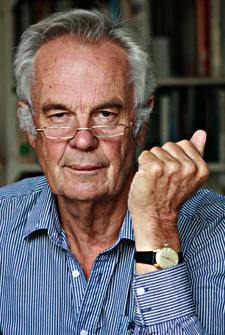
Obituary – Dietrich Fischer 1941-2015

By Christina Spännar & Jan Oberg

Our dear friend and TFF Associate since 1985, professor Dietrich Fischer, died today, October 18, 2015.

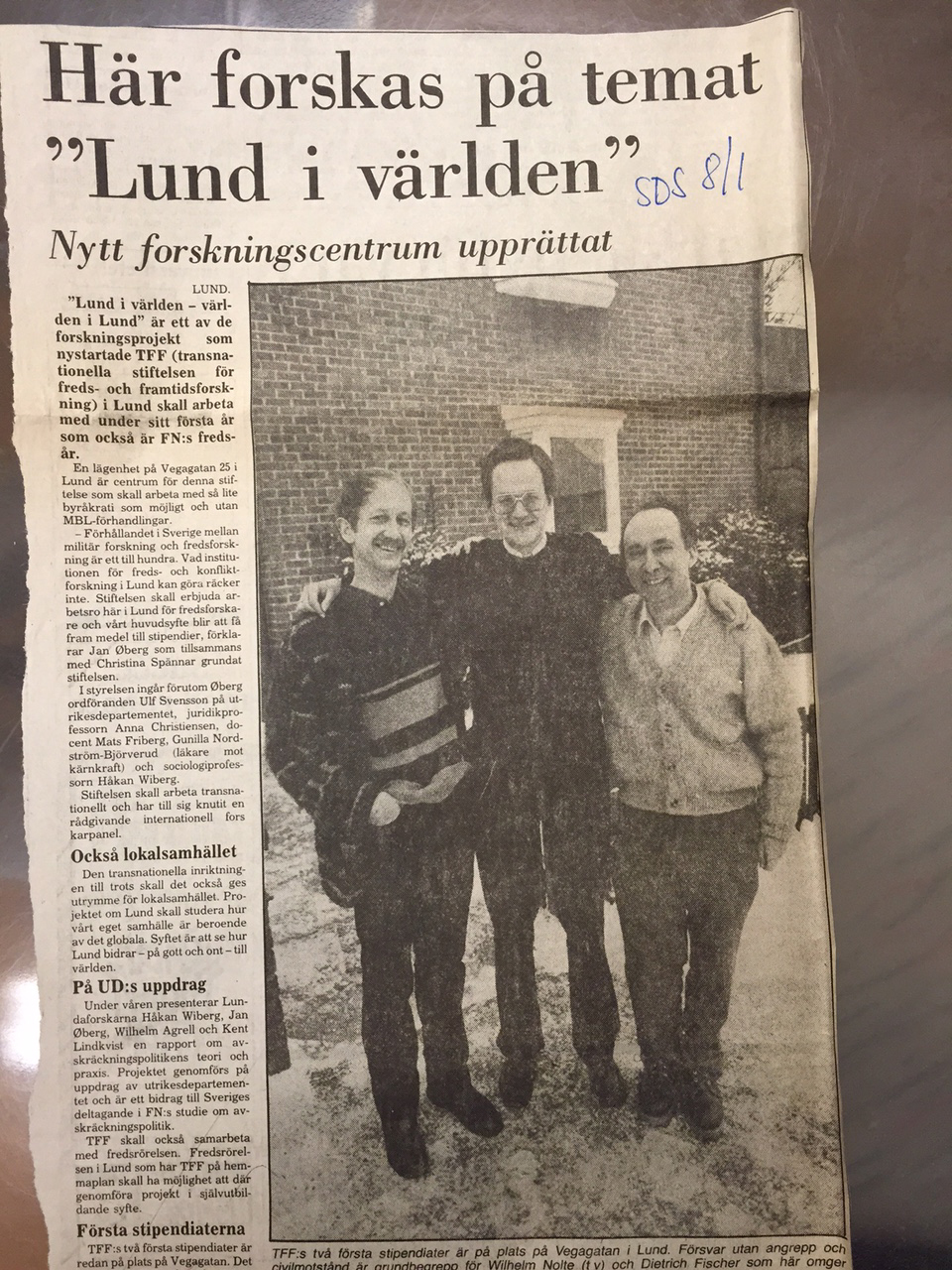
We met Dietrich through another dear friend Johan Galtung and, together with then West German lieutenant-colonel Wilhelm Nolte, Dietrich became the first scholar-in-residence at TFF in Lund in 1986. That lead to Fischer, Nolte and Oberg’s “Winning Peace. Strategies and Ethics for A Nuclear-Free World published in 1989.”

The two scholars came and worked for periods at TFF, went back home to re-write and then back to Lund – no emails and Dropbox at the time. We met, worked, ate, drank, did excursions and played with our children together. That’s how we did it.

And here’s the local newspaper from January 8, 1986:

Wilhelm Nolte, Jan Oberg and Dietrich Fischer

Dietrich was a genius in defensive defence thinking, Read More »

The Axis of Evil

By Johan Galtung

Do you remember the Axis of Evil – Iraq-Iran-North Korea?

George W. Bush, or his speechwriter rather, concocted that axis in 2002 as focus for a global war on terror. The key term is “evil”–not “enemy”, “hostile”–the connotation being “possessed by Satan”. The proof is opposition to a USA chosen by God, as God’s Own People, as “In God we trust”. To exorcise Satan only violence works.

In 1953 North Korea under Kim Il Sung did not capitulate to the USA, only cease-fire, the first US non-victory since 1812. Very evil.

In 1978-79, Iran, by the Khomeini Islamic revolution, decolonized Iran from US dominance and evicted the shah, who had been installed by a US-UK (CIA-MI6) coup in 1953; in fact undoing 1953. Very, very evil.

On 17 May 1987 Saddam Hussein, used by the USA to fight Iran with no gains for Iraq, fired on a US vessel (USS Stark incident). Very, very, very evil.

However, for a USA, never questioning bringing US style democracy and US free market to all countries in the world, this was not seen as others having their own goals. It was seen as exactly that, evil.Read More »

Islam and the West: Roads to peace

By Johan Galtung

Alfàs del Pi, Spain – International Center for Conflict Solution – Seminar 11-13 September

The prospects are dim. Both focus on the worst in the Other, not on the best. Islam justifies terrorist violence – bombs, decapitation – as revenge with moderation; West justifies state terrorist violence – bombing, droning, sharp-shooting all over – as preventive violence. Killing ratio: like 1:99. Both are escalating in a violence race.

West is Christian-secular with secularisms–humanism, liberalism, marxism–sharing with Islam and Christianity occidental singularism and universalism, the only truth, valid for all, at all times. A miracle that we have had only the terrible Crusades 1095-1291.

One reason was geographical, in space: Islam in deserts and on islands, Christianity in the temperate zone; today both are all over. Another reason was historical, in time: Christianity in Antiquity, Islam in the Middle Ages, Christianity-secularism-colonialism-West in Modernity. Enters post-Modernity: Islam’s turn to be predominant.

Empty cathedrals and churches in Western societies with much loneliness and alienation; in Islam overfilled mosques with intense togetherness and direct sharing. The contradiction is bridged by massive conversion to Islam, more so the more loneliness; and by turning against one’s country if it joins the USA killing Muslims.

The predictable emergence of an Islamic State, Read More »

Peace Studies Epistemology: Descartes-Vico-Daoism; And Europe

By Johan Galtung

Keynote, European Peace Research Association – Tromsö, Norway, 7 Sep 2015

Epistemology is the branch of philosophy dealing with valid knowledge; and the focus of this conference is peace in Europe. We live in a wonderful world blessed with many civilizations each with an epistemology, and in a continent with rich diversity. My task is to draw on some of this, and apply it to the peace politics of Europe.

René Descartes, in Discours de la Méthode, Leiden 1637, had four basic rules; accepted, mainly unwittingly, by (North)Western science:

1. never to accept anything for true not clearly known to be such;
2. to divide difficulties examined into as many parts as possible;
3. start with the simplest and easiest, ascend to the more complex, pay attention to the asymmetric relation of antecedence and sequence;
4. make enumerations and reviews to assure that nothing was omitted.

Giambattista Vico, in Scienza Nuova, Napoli 1725: anti-Descartes for only reflecting empirical reality, not human ability to create new reality. Vico is a macro-historian, inspiring Marx, with three stages in human history, divine-heroic-human, envisaged by “poets” in the Greek sense of “creators”. He became the guru of historians, easily making the mistake of focusing only on the creativity of the powerful.

Daoism, thousands of years old, views reality in terms of holism and dialectics:…

Continued here.

TFF PressInfo # 345 – Nobel Peace Prize and Lawsuit

Lund, Sweden, October 10, 2015

The Nobel Peace Prize 2015 is certainly a little step in the right direction to honour at least parts of Alfred Nobel’s will.

It doesn’t violate the Will of Alfred Nobel which has happened so many times before.

And it’s good that the new chairperson made explicit reference to Nobel’s Will since the Committee has, for years, ignored the intentions and the criteria in it.

It’s good too that it was oriented toward civil society and dialogue rather than governments and violence.

But it is still a far cry from Nobel’s international vision of a world in which there is much less militarism, armament, armies and warfare.

This is what media and many others have still not understood well. As long as somebody nice gets is – Malala last year – everything seems fine.

The Will is very short and should be read by those who report or comment professionally Read More »

Nobel Prize: Lawsuit against the misappropriation of funds

Dear Editor

News release – October 6, 2015

RE: Nobel Foundation – lawsuit against misappropriation of funds – violating intended antimilitarist purpose of the Nobel peace prize

The controversy over peace prizes disconnected from the specific peace vision of Alfred Nobel is now coming to a head in a lawsuit initiated by Mairead Maguire, a Nobel laureate; David Swanson, USA; Jan Oberg, Sweden; and the Nobel Peace Prize Watch.

None of the members of the Board of the Nobel Foundation had responded when the time limit set in a notice of litigation expired on Tuesday.

The plaintiffs have retained attorney Kenneth Lewis, Stockholm, to have the Stockholm City Court declare the prize to the EU an illegal use of the Foundation’s funds.

In December 2012 the members of the Board of the Nobel Foundation did not heed protests from four Nobel laureates, Mairead Maguire, Perez Esquivel, Desmond Tutu, and the International Peace Bureau, who in a letter had warned that “The “EU is clearly not ‘the champion of peace’ that Alfred Nobel had in mind when he wrote his will.”

– There can be many views on the EU as a contribution to peace, says one of the plaintiffs, Mairead Maguire, of Northern Ireland, but there can be no doubt that the Union has a military approach that is the opposite of the peace ideas Nobel wished to support. Our lawsuit is not against the EU, but for Nobel’s wonderful and visionary ideas of world peace and security through global co-operation, building trust, and abolition of armaments.

The evidence is clear that Nobel Read More »

Pluses and minuses of Obama’s foreign policy

By Jonathan Power

So Putin on Monday met Obama. They are going to cooperate against ISIS, the world’s worst problem. President Vladimir Putin says we should not be surprised to see Russian jets working cooperatively – even coordinating – with the US on missile attacks.

Even with both powers working in tandem it will be uphill work. ISIS has attracted over 30,000 foreign fighters, according to a UN Security Council report. At least 2,000 from Russia and ex-Soviet territories are in their number. (In contrast to Russia the US is more threatened by domestic, non-Muslim, terrorists than Muslim extremists.)

Will rapprochement over Syria and ISIS wind the clock back to the benign US-Russia relationship that was begun with President Barack Obama’s early “re-set” which led to, among other things, a significant agreement on reducing nuclear arms?Read More »

The Pope’s challenge to white America.

By Jonathan Power

September 22nd 2015.

The pope will cause waves in America during his visit this week. Invited to speak before Congress by the Speaker of the House of Representatives, John Boehner, he’ll arrive right at the time that the Republican candidates for president are touting ideas that are anathema to Pope Francis.

He detests the cruder aspects of capitalism and the consumer life style so rife in America. The culture of Wall Street and its banks, in particular their performance in precipitating the crash of 2007 and their rush to avoid culpability, he finds distasteful.

Nor has he much time for those who turn their back on the needs of the poor, the unemployed, the discriminated against, those unnecessarily imprisoned or the migrant.

Nor will American political leaders find him giving any support for the kind of wars fought by the US since 9/11. The Republicans will find him way to the left, except on the issue of abortion.

The Pope is unlikely to rattle through the statistics but I’m sure he knows what the facts are.

The US now ranks lowest among affluent nations in how it spreads its wealth. It has the worst poverty, the lowest life expectancy, the highest rate of infant mortality and the shortest (or non-existent) maternity leave among the world’s richest 21 nations.

It is nearly the worst in its mental health provisions, the degree of child poverty and its numbers of obese.Read More »

Making peace arrive in Ukraine – bring in the UN

By Jonathan Power

September 15th 2015.

On the last day of last month right wing demonstrators, mostly from neo-fascist movements, hurled themselves against the police in Kiev’s Maidan square, the same place where in February 2014 a more heterogeneous group of demonstrators effectively ousted President Viktor Yanokovych. A grenade was thrown and three people died and 120 were hospitalized, mostly policemen.

In an address to the nation President Poroshenko blamed the clashes on nationalistic forces, calling their actions “a stab in the back”. Finally the Western powers raised a voice of condemnation, although over the last year they have made little criticism of the rightist militias and parties.

That is perhaps because it would interfere with their narrative – that the demonstrators that overthrew Yanukovych were of a liberal, democratic hue. The overwhelming majority were. But the ignored fact is that the people who led the crowd and fired the bullets when the demonstrations turned ugly were these very same rightists.

Some of the leaders of the neo-Nazi organisations, especially Svoboda, went on to be appointed to senior positions in government and parliament.

The BBC’s Ukraine correspondent, David Stern, reported on September 1st: “The explosion in Maidan comes weeks after another armed incident involving volunteer militia with ties to the extreme right – a shoot out between members of the so-called Right Sector and the local police in south-western Ukraine. Although the militias have been nominally integrated into government structures, many wonder how much control Kiev actually exercises.”

The main gripe of the protestors is that Read More »

Guatemala, country of evil

By Jonathan Power

September 8th 2015.

Guatemala on Sunday held a reasonably honest presidential election.

But it is probably not the end of the brutal saga of the country- 36 years of continuous murder, mayhem, abductions, disappearances, rapes and genocide that have kept on rolling, chapter after chapter. Labour leaders, villagers and peasants, students and churchmen, journalists and human rights activists have been killed by death squads. This is a Harry Potter saga with bullets.

Few countries have suffered as much as Guatemala. More people were killed in the 36 years of civil war than in all of the rest Latin America put together, more than in the civil wars in Colombia, El Salvador, Honduras, Nicaragua and Peru and the bloody coup d’etats in Chile, Argentina, Uruguay and Brazil.

A UN investigation in Guatemala reported that far more guerrillas had died than government forces, by a factor of 9. The Commission estimated that the number of persons killed or disappeared “as a result of fratricidal confrontation” reached a total of 200,000. The State, it concluded, “deliberately magnified the military threat of the insurgency. The vast majority of the victims were not combatants, but civilians. A quarter of all victims were women”.

Most of the weaponry and political support for the government came from the US. When Congress cut off military aid in the 1980s President Ronald Reagan asked Israel to take over. During the most intense period of the civil war, Guatemalan soldiers dropped into Indian villages on Israeli-made Arava Transports and did their killing with Uzi rifles.

As Stephen Kinzer, a former New York Times journalist and author of a seminal book on the United Fruit Company, wrote last week, “Guatemala was horrifically brutalized by Spanish conquerors. It became a nation dominated by rich landowners who continued oppressing the Indian majority. Early in the 20th century the Boston-based United Fruit Company became the country’s most powerful force. Read More »