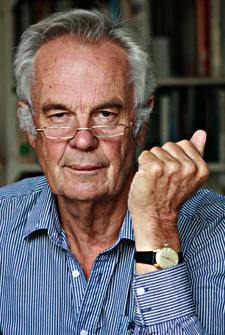
Jimmy Carter: A life up and down

By Jonathan Power

“ The lives of all politicians end in failure”. So said Enoch Powell, a maverick former cabinet minister in the British government.

Of recent US presidents Jimmy Carter has not been alone in failure. Think of George W. Bush (Iraq war). Bill Clinton (Monica Lewinsky and a wasted last term). George H.W. Bush (messing up the economy and laying the foundation along with Clinton for the great economic crash of 2007). Ronald Reagan (missing the chance with Soviet president Mikhail Gorbachev to create the nuclear-free world that he offered). Jimmy Carter (driving out the Soviet army and thus initiating the war in Afghanistan, laying the groundwork for both Al-Qaeda and ISIS). Richard Nixon (Firing up the Vietnam War and had to resign in disgrace).

And now Barack Obama. Despite some important achievements he has allowed his flawed policy on Ukraine to lead to a dangerous confrontation with Russia.

Back to Jimmy Carter who, according to the man himself, appears to be dying.

I had a tangential responsibility for his election. Read More »

TFF PressInfo # 335 Greek debt and West-Russia-China-Japan

By Johan Galtung

The game is dirty and has lasted 70 years. It came with the idea of development as imitating, but not catching up, with the West, for all states, including the deluge of states due to decolonization.

The formula for big profit is simple: give credit to a country poor enough not to be able to pay it off quickly, yet not so poor that it cannot go on servicing the loan for years. To be worthwhile the project must be capital-intensive, like (air)ports and highways to the (air)ports for import-export, assembling cars–something for the rich. Investment to lift up people in misery, or ravished nature, makes no sense: the poor need very little capital and can only pay back in labor, whereas nature pays back but is not capitalized.

Ideally, the country asks for more credit to service the first, and a second, third loan is then offered at higher interest. Till the debt is non-sustainable; the debtor country is then squeezed dry.

Then comes the time for debt relief, provided the profit made on investment in debt exceeds the debt forgiven.

From Agence France Presse comes a study: Germany made € 100 billion on the Greek crisis since 2010 – amounting to 3% of the GDP – on the difference between interests paid to German banks and the interest they paid; from German banks to ECB 1%, to German banks from debtors, say, 6%.

Germany’s share of the total bailout package to Greece – with the latest for payment due August 20 – is € 90 billion, meaning a € 10 billion profit if Greece cannot be squeezed further. The money flowing into Greece is to keep banks, not people, afloat. And to benefit USA, France and the Netherlands, but to a lesser extent than Germany.

This is the way the Third World has been treated by the USA-based IMF and the World Bank; what is new is EU treating a fellow EU member like a Third World country (or worse).

Next in line is Ukraine, Read More »

U.S. lawmaker is warmaker…

House Democrat Hastings calls for war authorization against Iran
Jan Oberg comments on lawmakers being warmakers and on the – dangerous – decline of the U.S. Empire.
Thanks for sharing if you like and sorry that I look even worse on this video than in reality…


Down with war, Up with Europe

By Jonathan Power

Mankind got rid of African slave trading. It got rid of dueling. It got rid of torture. In some European countries it was abolished over 200 years ago. Even in the Second World War the allies did not systematically use torture. Regrettably, when President George W. Bush came to power, torture was reinstated – a reminder that although there has been progress it can slip back. Likewise, slavery has found new life with the rise in child and female trafficking.

As for war it is abundantly clear that since the end of the Second World War the number of conflicts and battlefield deaths has gone sharply down. Some of the most distinguished military historians now think that the age-old connection between war and states may be on its way out.

The European Union has shown the way. The part of the world that used to be the most violent has effectively banned the clash of arms. Between 1648 and 1789 the European powers fought 48 wars. Even when there seemed to be peace, as when no wars were fought between 1871 and 1914, the colonial powers fought both each other abroad and the natives who they colonized. The British army was at war in some part of the world throughout the entire nineteenth century.

Then came the carnage of World War 1. Read More »

Norway Revisited: Two Crises – An Oil Slick – And ?

By Johan Galtung

Norway, on top of the UN indicator of good life for years, is now hit by two different crises; one for the less developed aspect and one for the more developed. Yet the citizens are protected by a massive oil slick, the biggest sovereign fund in the world, the Government Pension Fund for an aging population when oil dries out. For only 5 million inhabitants, $178,000/capita, and growing.

First crisis: Third World monoculture—oil/gas–hit by the world markets; from over $ 100 per barrel to under 50 recently. A crisis of over-supply and also of under-demand, less than expected: toxic fossil fuels do the same to the lungs of Planet Earth as smoking to the lungs of humans. Green alternatives strong in Germany, China, coming in USA.

A generation was needed for the smoking truth to penetrate, but smoking survived in the Third World – for some time. We will get the same for addiction to fossil fuels, from denial to abstention, with collective decisions. So far, most action is coal focused – including the Norwegian oil fund no longer investing – time is coming for oil.

With falling prices, demand insecure, and 1/3 of employment being oil-dependent, unemployment is rising. In February 4.1% of the about 2,730,000 total were unemployed, rising to 8% (Klassekampen, KK 12 May 15). The powerful oil branch claims it is all temporary, soon the prices will go up. Official optimism, hoping it will be self-fulfilling.

Second crisis: Read More »

Why a simple life matters

By Kamran Mofid

The Path to peace and happiness lies in the simple things in life

Ever wish you had a few more hours in the day so you could get everything done you need to get finished?

What if, instead of always trying to do more, we slowed down a little and embraced a slower paced life. What if we didn’t try to do everything, but slowed down and concentrated only on the things that are truly valuable and important to us.

A slower paced life introduces margin and gives us more awareness about how we spend our time. Slow doesn’t happen naturally. In fact, our lives tend to pile more and more on because we rarely remove commitments even if we add new ones. It’s almost like that old computer that just keeps piling on junk and virus’ until it gets so slow it needs a reformat or a trip to the trash can. Is your life ready for a reboot? Are you ready to embrace a slower paced life?

Continued here…

Hiroshima and the Dangers of a New Cold War

By Farhang Jahanpour

On the anniversary of the first use of nuclear weapons on Hiroshima and Nagasaki it is important to look back at the reasons for those barbaric acts and to look forward to what needs to be done.
The First and the Second World Wars were the most devastating wars ever waged in history. Nevertheless, although those wars killed tens of millions of human beings and destroyed many cities, the end of the Second World War witnessed the use of a new category of weapons by the United States that have the potential to end human civilization as we know it.

Grotesquely called ‘Little Boy’, the bomb that flattened Hiroshima on 6 August 1945, was a uranium bomb that killed between 130,000-140,000 civilians instantly, and many thousands later. ‘Fat Man’ that blasted Nagasaki three days later, was a plutonium bomb and killed about 70,000 people instantly.

There has been a great deal of debate about whether the use of those bombs was necessary to force Japan’s surrender and to end the war. While these debates seem archaic and a part of history, nevertheless, it is important to see whether those weapons were necessary from a military point of view, or whether they had other purposes, something that would have relevance for us today.

First of all, it is remarkable that those two bombs were dropped on two non-military targets, and the vast majority of those killed were civilians.

The two bombs were of two different types, one was a uranium and the other a plutonium bomb. They constituted the two most horrendous single instances of mass slaughter in the history of the world, yet they have not received the attention that they deserve and appropriate lessons have not been learned. It is important to point out these facts to American citizens who have been kept mainly in the dark regarding their past history.

The Germans have apologized to the Jews and to the Poles for Nazi atrocities. The Japanese have apologized to the Chinese and the Koreans, and even to the United States for failing to break off diplomatic relations before attacking Pearl Harbor. The Russians have apologized to the Poles for atrocities committed against civilians, and to the Japanese for abuse of prisoners.

The Soviet Communist Party even apologized for foreign policy errors that “heightened tension with the West.” Pope John Paul II apologized for the Catholic Church’s past behavior towards the Jews. Britain has apologized for slavery. The Australian prime minister has apologized for the treatment of the aborigines.

Yet up till now there has not been an American apology for those two horrendous acts of genocide in Japan. Read More »

TFF PressInfo # 333 – Look at nuclear weapons in new ways!

By Jan Oberg

It’s absolutely necessary to remember what happened 70 years ago in Hiroshima and Nagasaki, see the movies from then, listen to the survivors, the hibakusa. But it isn’t enough for us to rid the world of these crimes-against-humanity weapons. And that we must.

Hiroshima and Nagasaki is history and it is also the essence of the age you and I live in – the nuclear age. If the hypothesis is that by showing these films, we create opinion against nuclear weapons, 70 years of every more nuclearism should be enough to conclude that that hypothesis is plain wrong.

There is a need for a frontal attack on not only the weapons but on the nuclearism – the thinking/ideology on which they are based and made to look ‘necessary’ for security and peace.

Nuclear weapons – only for terrorists

At its core, terrorism is about harming or killing innocent people and not only combatants. Any country that possesses nukes is aware that nukes can’t be used without killing millions of innocent people – infinitely more lethal than Al-Qaeda, ISIS etc. Since 9/11 governments and media have conveniently promoted the idea that terrorism is only about small non-governmental groups and thus tried to make us forget that the nuclear ‘haves’ themselves practise state terrorism and hold the humanity hostage to potential civilizational genocide (omnicide).

Dictatorship

No nuclear state has ever dared to hold a referendum and ask its citizens: Do you or do you not accept to be defended by a nuclear arsenal? Nuclear weapons with the omnicidal -kill all and everything – characteristics is pure dictatorship, incompatible with both parliamentary and direct democracy. And freedom.

Citizens generally have more, or better, morals than governments and do not wish to see themselves, their neighbours or fellow human beings around the world burn up in a process that would make the Holocaust look like a cozy afternoon tea party. In short, nuclear weapons states either arrange referendums or must accept the label dictatorship.

The idea that a few hundred politicians and military people in the world’s nuclear states have a self-appointed right to play God and decide whether project humankind shall continue or not belongs to the realm of the civilisational perverse or the Theatre of the Absurd. Such people must run on the assumption, deep down, that they are Chosen People with a higher mission. Gandhi rightly called Western civilisation diluted fascism.

Unethical

Why? Because – simply – there can be no political or other goal that justifies the use of this doomsday weapon and the killing of millions of people, or making the earth uninhabitable.

Possession versus proliferation

The trick played on us all since 1945 is that there are some ‘responsible’ – predominantly Christian, Western – countries that can, should, or must, have nuclear weapons and then there are some irresponsible governments/leaders elsewhere that must be prevented by all means from acquiring them. In other words, that proliferation rather than possession is the problem. However, it is built into the Non-Proliferation Treaty, NPT, that those who don’t have nuclear weapons shall abstain from acquiring them as a quid pro quo for the nuclear-haves to disarm theirs completely.

That is, the whole world shall become a nuclear-weapons-free zone (NWFZ).

Those who have nuclear weapons provoke others to get them too. Possession leads to proliferation.

The recent negotiations with Iran is a good example of this bizarre world view: the five nuclear terrorist states, sitting on enough nukes to blow up the world several times over and who have systematically violated international law in general and the NPT in particular, tell Iran – which abides by the NPT and doesn’t want nuclear weapons – that it must never obtain nuclear weapons. Simultaneously, they turn a blind eye to nuclear terrorist state, Israel’s 50+ years old nuclear arsenals.

And it is all actively assisted by mainstram media who seem to lack the knowledge and/or intellectual capacity to challenge this whole set-up – including the racist belief structure that “we have a God-given right and are more responsible than everybody else – particularly non-Christians…”

But what about deterrence?

You’ve heard the philosophical nonsense repatedly over 70 years: Nuclear weapons are good to deter everyone from starting the ‘third world war’. That nukes are here to never be used. That no one would start that war because he/she would know that there would be a mass murder on one’s own population in a second strike, retaliation. But think! Two small, simple counterarguments:

a) You cannot deter anyone from doing something unless you are willing to implement your threat, your deterrent. If A knows that B would never use his nukes, A would not be afraid of the retaliation. Thus, every nuclear weapons state is ready to use nukes under some defined circumstance; if not there is no deterrence whatsoever.

b) The United States has long ago done two things (as the only one on earth): 1) decided on a doctrine in which the use of small nukes in a conventional role is fundamental, thus blurring the distinction between conventional and nuclear weapons; 2) its missile defence (that it also wants in Europe) is about preventing a second strike back – shooting down retaliatory missiles – so it can start, fight and win a nuclear war without being harmed itself. Or so it can hope.

There are many other aspects – but let’s mention just one more:

Nuclear weapons have already caused wars

The war on Iraq is a good example. If Iran will be bombed – which can’t be excluded at all – it’s about nuclear weapons. Ukraine is about expanding nuclear-based NATO and nuclear-based EU right up to the border of Russia. The enemy image of North Korea – where war can also not be excluded in the future – is mainly about it being a nuclear weapons state. The conflicts surrounding Israel are intimately connected with its nuclear weapons threatening everyone – non-nuclear – around it.

Hope

No, let’s rid the world of this civilisational mistake. Nuclearism and nuclear deterrence is the world most dangerous ideology comparable to slavery, absolute monarchy and cannibalism that we have decided – because we are humans and civilised and can think and feel – to put behind us.

There is no co-existence possible between nuclear weapons on the one hand and democracy, peace and civilisation on the other.

It’s time to regai hope by looking at all the – civilised – non-nuclear countries and follow their example. Thus, 99% of the southern hemisphere landmass is nuclear weapons free. 60% of the 193 states, with 33% of the world population, are included in this free zone.

And here are the countries which have contemplated to obtain – but decided to abstain from – nuclear weapons (including those who have had them and gotten rid of them): Sweden, Switzerland, Yugoslavia, South Africa, Libya, Austria, Mongolia, Ukraine, Kazakhstan, Japan, Antartica, the Seabed, Outer Space. Finally, dozens of countries have the technical capacity but would not dream of joining the nuclear club.

The West, the U.S. in particular, that started the terrible Nuclear Age should now follow the far majority of humanity, apologise for its nuclearism and move to zero.