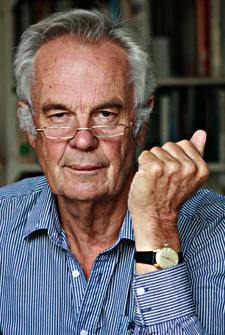
Oxi or Nai? Oxi !

By Johan Galtung

At the time of starting writing this editorial the referendum is on, so is the TV. Those two Greek words are all over. But the outcome is unknown; it will be known at the time of finishing the editorial.

However, could the most important aspect of the referendum be the referendum itself, not the outcome? The idea of asking people, the very demos in a democracy, even at the risk of losing, resigning?

The most aggressive creditor against Greece, Germany, did not dare to do that over the Euro entry. They decided for a people they knew were against, hiding behind Hitler’s use of a referendum as demagogy.

Any OXI-NAI outcome means a new departure. With no party below, say, 1/3, serious attention has to be paid to both sides’ narratives.

Let us be clinical about that bad EU-Greece relation.

There is a deep culture: another Christianity, with “optimism in the longer run”, another alphabet. They relate across deep gaps.

There is a deep structure: the division ofRead More »

The nemesis of race

By Johan Galtung

We have been revisited, not only Charleston SC, not only the USA; the whole world by the shocking massacre in the iconic Emanuel Church. It hit this aging Norwegian male deep in the heart; once a young man, sociology professor at Columbia University, NY, as American as any with that passport, deeply involved in the desegregation conflict in Charlottesville, VA. Like millions others now trying to come to grips with this enormity of history moving backward to comprehend, searching for “how could it have been avoided”; any solution anywhere?

Using an old tested method, “what does this remind me of”, Anders Behring Breivik, a fellow Norwegian, came up. On 22 July 2011, first a bomb at a government building killing seven, then a massacre of young laborites at an island, killing 69 more. Having researched the case, I see him located in a triangle with his pure, blond and blue-eyed Norway of believers in true Christianity in one corner, threatened by Muslim invasion; the traitors to that society–the Labor government, the laborites in the second, and in the third corner those who stand up, do something against the Muslim menace: Israel, the hard Zionists.

Obsessed, it worked in and on him till the calling comes, only I have understood this, it falls upon me to do the unspeakable, to unleash history from its shackles by forcing people to see the Truth, starting with the enemy in our own camp, not Muslims, the traitors.

The psycho-pathology driving him was not childhood traumas but conflict polarization, Read More »

A deal with Iran this week?

By Jonathan Power
June 30th 2015.

According to the New York Times, “Ayatollah Ali Khamenei, who has the final word on all public matters in Iran, last week demanded that most sanctions be lifted before Tehran has dismantled part of its nuclear infrastructure and before international inspectors verify that the country is beginning to meet its commitments.”

“US Secretary of State John Kerry says the United States was prepared to ease sanctions before it fully resolves what, exactly, Iran’s nuclear scientists have been working on in secret for more than a decade.

‘We’re not fixated on Iran specifically accounting for what they did at one point in time or another,” Mr. Kerry said. “It’s critical to us to know that going forward, those activities have been stopped, and that we can account for that in a legitimate way.’”

So in the final days of negotiations on Iran’s nuclear program – meant to have been concluded on Tuesday but Read More »

TFF PressInfo # 328 – With another approach, we would have a deal with Iran today

By Jan Oberg

There could have been a deal with Iran today – to the benefit of everybody – if the nuclear issue had been approached in a fair, principled and visionary manner from Day One.

If there will be no deal later, one of the most important possible agreements in contemporary international history will have been lost, the risk of war will increase and the Iranians will suffer. And the United States and the EU (here France and Germany) will move further down in terms of relative global power and up in terms of self-isolation.

On the day of no deal, perhaps the Five Ps + Germany should spend a moment on self-reflection: What could we have done differently?

To the trained conflict- and peace-making eye, 99% of the Western commentators have failed to point out the benefits of a deal and, instead, devoted their creativity to find all kinds of possible negative aspects, details and – of course – on how the West should demand even more. They’ve suggested “red lines” at absurdum.

The fundamental a-symmetry of this whole conflict eludes them – or is conveniently left unmentioned.

At the table sit the five largest nuclear weapons powers which have, de facto and de jure, for decades completely and systematically ignored the provisions of the Non-Proliferation Treaty, NPT, and have repeatedly broken international law and conducted wars. They would never allow the type of inspections on their own territory that they demand of Iran. The U.S. issues threats – and plan a war – Iran has never threatened the U.S. And so on and so forth.

Absent from every nuclear discussion is Israel and other nuclear-armed countries which, in contrast to Iran, are not members of the NPT and have a record of warfare and occupation.

Imagine a world in which we had seen negotiations, for real, about reducing the possession of nuclear weapons as a quid pro quo of proliferation – exactly as stated in the NPT.

Imagine that we had required Iran to abstain from getting nuclear weapons as a quid pro quo of a promise by the nuclear “haves” that they would reduce their arsenals. Indeed, imagine that the United States which is Second to None in putting up demands on everybody “or else … and all options remain on the table” had promised the world that it would do something too to further the accepted and UN-based goal of general and complete nuclear disarmament. Imagine the recent NPT Review conference had resulted in something decent in a world order perspective. Indeed, imagine some kind of mutuality, fairness, and equivalence in the whole approach.

The approach was wrong from Day One. It was built on military and structural power, not on intellectual power.

What stands between the parties is Read More »

TFF PressInfo # 327 – Burundi heading for catastrophe with the world’s eyes wide shut

By Jan Oberg

The elections taking place in Burundi are no elections. The African Union, the European Union, NATO, BRICS and everybody else must know that by now. They are all turning their heads, pretending they just don’t see. When it comes to Burundi, the much celebrated Western concern about human rights and democracy is conventiently put aside.

However, since April developments in Burundi have taken only one direction: towards dictatorship and civil war and, in the worst of cases, a new genocide. If Burundi avoids that it’ll be by miracle and I shall be happy beyond words to be proven wrong.

Had this country had oil, important minerals or a significant strategic position – or had Burundi been situated in Europe – I am in no doubt that NATO countries would have conducted a “humanitarian” intervention already.

Now when a genuine humanitarian intervention is urgently needed to stop the descent into a hell and save about 10 million people from it, no one is doing anything but issuing hand-wringing, lame and woefully inadequate statements and appeals.

And by staying away from monitoring these “elections” and documenting the fraud they lend de facto support the emerging dictatorship.

Across social media TFF has so far posted 87 Burundi Warnings based on media reports. It has as issued its own warnings (see below) based on an long-term experience with Burundi that few have. Of among 4000 media recipients, two have shown any interest.

TFF has been engaged over 13 years (1999-2012) in that country. It’s work has covered a series of projects with leading civil society organisations, teaching at a university, work with media and consultancy with the Ministries of Higher Education and of Foreign Affairs.

That was when there was hope.

We did it because the rest of the world was interested only in neighbouring Rwanda, gave it all the attention and aid, the important embassies, Hollywood movies and books and because the world commemorated only its genocide, not Burundi’s. The two countries were once one and the problems the same.

And we did it because the peace process in Burundi was promising – at the time much more promising than Rwanda’s.

I met Pierre Nkurunziza shortly after he became President. At the time Read More »

TFF PressInfo # 326 – Outrageus attempt at killing a deal with Iran

By Jan Oberg

Internal elite power games in Washington are now putting Middle Eastern and global stability and peace at stake.

Here is the latest attempt at killing a deal with Iran that, to the sensitive reader with a minimum of knowledge of foreign policy and of the Iranian civilization, is little but one long argument for warfare on Iran in nobody’s interest – certainly also not in the interest of the citizens of Israel. 

Is it just because it is summer time that intellectuals, media commentators and diplomats as well as friends and allies of the US conveniently keep generally silent at such irresponsible statements – and the many before it?

Don’t they understand that the nuclear issue as such – not proliferation but possession – is humanity’s most important and that Iran has been the object of revengeful harrassment since 1953 and punished for years for not having nuclear weapons?Read More »

The US’s wrong priorities on terrorism

By Jonathan Power

Were the killings in the church in Charleston terrorism, meant to intimidate the black population of America? Of course they were. Moreover, they were a reflection of the still widespread white hatred for America’s first black president, Barack Obama.

Indeed, as the New York Times editorialized last week, “The main terrorist threat in the US is not from violent Muslim extremists, but from right-wing extremists. (Many of them anti-black.) Just ask the police”. The New York Times has studied 382 police forces and 74% reported extremism by whites. Severe Muslim extremism was only 3% of the total.

The number of violent plots carried out by international terrorists remains very low and most attempts were disrupted. ‘

Last year not one US citizen at home died from international terrorism.Read More »

Pope Francis: Spiritual, Liberating Theology

By Johan Galtung

What a gift to humanity, this Pope!

To choose global climate change as a major theme of his papacy is in the spirit of the times. What is revolutionary, and he uses that word often, is the focus on the poor. Climate change–including the long trend global warming over and above some lulls and local variations–has a clear class address, goes beyond making him the spiritual world leader.

The Pope talks about filth covering the earth, and about greed stimulated by corporate capitalism and consumerism as major causes underlying the technicality of CO2 release. The Pope also mentions the freshness of the gospels, including the unambiguous stand of Jesus for the poor in Matt 6:24–God vs Mammon–Matt 13:12–our economic system, and Matt 19:20-24 about giving one’s riches to the poor.

Pope Francis follows in his footsteps. Simply beautiful.

But there is more to it: a general theological discourse from the same continent as this non-Italian Pope: Liberation Theology. Gustavo Gutiérrez, Leonardo Boff, Miguel d’Escoto–Peruvian, Brazilian, Nicaraguan, from the major parts of the Latin Americas–now in their 80s have been rehabilitated. D’Escoto was foreign minister of the Sandinista government and one-year president of the UN General Assembly.

However, the rehabilitation has moved on, into the Caribbean, to the Latin American country that made world history, Cuba, and to the two Castros. Read More »