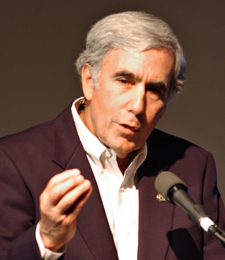
Civilization dialogue as a way of life

By Johan Galtung

Civilization: there are six sources of inspiration today, vying for the attention of a humanity looking for goals and means. Two of them are Western secular, liberal and Marxist, defining to a large extent the USA and the former Soviet Union, but not identical with them. Two of them are Oriental amalgams of civilizations, the Japanese Shinto-Confucian-Buddhist civilization, trying to be Western liberal, and the Chinese Daoist-Confucian-Buddhist civilization with strong elements of Western liberal and Western Marxist. And two of them are in-between: the Islamic and the Buddhist civilizations.[i]

Dialogue: it simply has to happen. Read More »

Pakistan is fighting for its very existence

By Jonathan Power

There is an “in” political word – “blowback”. Pakistan certainly has it. We can also call it “the chickens coming home to roost” or the “sins of the fathers visited upon the children”. The question is can the new prime minister, Nawaz Sharif, do anything about it? His predecessor wasn’t able to do much and neither could the military government of General Pervez Musharraf which preceded him. Now we have to see if Sharif can find a solution. If he fails Pakistan might rip itself apart.

“Blowback” is happening because the shots are increasingly being called in political life by the extremist Islamist fighting units that the now threatened Pakistan political establishment itself created.Read More »

Geopolitical winds blow in China’s direction

By Richard Falk

Among those who comment influentially from the sidelines of power, there are new trends visible in thinking about American foreign policy. The most salient of these concerns is a shift away from the post-9/11 counter-terrorist agenda to a new phase of mainstream policy advocacy that emphasizes the renewed strategic importance of geopolitical rivalry among leading sovereign states. There is also a shift away from the temptations of military intervention and regime change as a favored Western tactic for sustaining influence in the post-colonial world.

There is a realization, at least temporarily, that adventures in military intervention, whether Afghanistan, Iraq, or Libya, are just that – ‘adventures,’ if not fiascos. And costly too, rarely a success even when overwhelming military superiority is brought to bear.

After the Vietnam War there emerged a similar reluctance to intervene overseas that was derisively labeled ‘the Vietnam Syndrome.’ It endured for more than a decade being finally overcome by the low-casualty victory in the Gulf War. I think it is safe to assume that for the rest of the Obama presidency, barring a major unforeseen development, that both counter-terrorism and military intervention will occupy a much lower place on the foreign policy agenda. This observation does not mean that such issues will disappear from view, as the recurrent debate on Syria shows. It does argue that they will be treated by political leaders as Gordian Knots, and addressed only warily and tangentially.

But power centers abhor a geopolitical vacuum. Read More »

Is China becoming a democracy?

By Jonathan Power

Last week, plans for constructing a nuclear processing plant in the Guangdong province in China were shelved after demonstrations. The people spoke and the authorities caved in. The demonstrators engaged in nothing more than what the organisers called “an innocent stroll”. Yet they defeated a project that would have provided enough fuel for 50% of China’s atomic energy needs.

Along with the growing power of village democracy in quite a few parts of China is something happening? Unless one is a high profile dissident you can complain all you want on the internet about most of the deficiencies of the time, except the party leadership itself. Many newspapers are staffed in part by liberal journalists who are constantly looking for opportunities to report honestly.

This suggests that what the then Chinese premier, Wen Jiabao, said in London in 2011 has the making of truth: “Tomorrow’s China will be a country that fully achieves democracy, the rule of law, fairness and justice. Without freedom there is no real democracy.”Read More »

The U.S.’s Afghan exit depend on a Syrian one

By Sharmine Narwani

Washington’s options in Syria are dwindling – and dwindling fast.

Trumped up chemical weapons charges against the Syrian government this month failed to produce evidence to convince a skeptical global community of any direct linkage. And the US’s follow-up pledge to arm rebels served only to immediately underline the difficulty of such a task, given the fungibility of weapons-flow among increasingly extremist militias.

Yes, for a brief few days, Syrian oppositionists congratulated themselves on this long-awaited American entry into Syria’s bloodied waters. They spoke about “game-changing” weapons that would reverse Syrian army gains and the establishment of a no-fly zone on Syria’s Jordanian border – a la Libya. Eight thousand troops from 19 countries flashed their military hardware in a joint exercise on that border, dangling F-16s and Patriot missiles and “superb cooperation” in a made-for-TV show of force.

But it took only days to realize that Washington’s announcement didn’t really have any legs.

Forget the arguments now slowly dribbling out about why the US won’t/can’t get involved directly. Yes, they all have merit – from the difficulties in selecting militia recipients for their weapons, to the illegalities involved in establishing a no-fly zone, to the fact that more than 70% of Americans don’t support an intervention.

The single most critical reason for why Washington will not risk entering the Syrian military theater – almost entirely ignored by DC policy wonks – may be this: the 2014 US military withdrawal from Afghanistan.

“Help, we can’t get out”Read More »

Lessons from the U.S.-Korea nuclear crisis

By David Krieger

The high-profile nuclear crisis on the Korean Peninsula, pitting the reigning heavyweight nuclear champion, the United States, against the bantamweight nuclear contender, North Korea, is not finished and is deadly serious. The posturing and exchanges that the world has been witnessing are capable of spiraling out of control and resulting in nuclear war. Like the Cuban Missile Crisis more than half a century ago, this crisis demonstrates that nuclear dangers continue to lurk in dark shadows across the globe.

This crisis, for which the fault is shared by both sides, must be taken seriously and viewed as a warning that nuclear stability is an unrealistic goal. The elimination of nuclear weapons, an obligation set forth in the Non-Proliferation Treaty and confirmed by the International Court of Justice, must be a more urgent goal of the international community. The continued evasion of this obligation by the nuclear weapon states makes possible repeated nuclear crises, nuclear proliferation, nuclear terrorism and nuclear war.

Lessons can be drawn Read More »

Pakistan’s democracy versus militant Islam

By Jonathan Power

One small step forward for Nawaz Sharif, the new election winner, but one big step forward for Pakistan. The Islamist parties and their militant, sometimes violent, followers have won so few votes they will play no significant role in parliament. The overwhelming majority of Pakistan’s ethnically disparate population has made it clear that they identify with secular politics.

Hussein Haqqani writes in his insightful new book on Pakistan that “Most Pakistanis would probably be quite content with a state that would cater to their social needs, respect and protect their rights to observe religion and would not invoke Islam as its sole source of legitimacy.”

If Pakistan’s democracy were allowed to play a central role -as seems to be happening at the moment- hopefully the Islamist tail will no longer be allowed to wag the Pakistani dog. For years, particularly under military rule, the Islamists, not least the militant, dogmatic part of them, have been allowed to set too much of the agenda. In foreign policy issues, such as the argument with India over the possession of Kashmir and support for the Taliban in Afghanistan, they have long acted outside the rule of law, but with the support of the military’s intelligence service, the notorious ISI.

As in eighteenth century France when the revolution consumed its own children, so have the Pakistani militants become not just the country’s nightmare but the army’s too despite all the support the ISI has given them. When General Pervez Musharraf was president, leading a military government, he narrowly escaped assassination by militants three times.

Musharraf was never able to get on top of the paradox the military over decades had created for itself – supporting the Islamists while being threatened by them.Read More »

An octogonal world

By Johan Galtung

Let us try a look at the world from above, right now. There is so much drama unfolding. Is there a Big Picture? Of course there is, we all have one, so here is one effort, imgaine it as The Octagon, consisting of these eight big states or regions:

1) USA, 2) Russia, 3) India, 4) China, 5) OIC (the Organization of Islamic Conference, the 57 Muslim countries), 6) EU (27), 7) Africa (AU, African Union, 54 countries) and 8 ) CELAC, Latin America and the Caribbean, 33 countries). We might add Israel and Japan to the USA if the criterion is willingness to go to war with and for the USA – but Israel wants the USA to fight its wars, and Japan, even with Japanese hawks more than willing to join the nuclear club, is still bound by the constitution depriving Japan of the right to war. So they work for a new constitution with an emergency article that could justify a military take-over. Ominous. Hopefully Germany does not follow suit.Read More »

China’s under-reported positive behaviour

By Jonathan Power

China is a sitting duck. Not that long ago, as far as most of the rest of the world was concerned, it was almost a closed, mysterious, society. Now it is wide open. The bad is there for all to see. Last year the New York Times published an in-depth investigative series of long articles on the secret wealth of the family of Prime Minister Wen Jiabao. It proved that it is possible to peel off the layers and look beneath.

China’s new found relative openness has allowed an open season on the shooting range. The targets are legion – corruption, nepotism, nationalism, maladministration, growing inequality, environmental degradation, over assertive foreign policy and the military build up. Western critics enjoy popping off at them.

Much of what the critics say is true. But much is exaggerated. And much is ignored, in particular what is positive.Read More »

Abenomics and the State of Japan

By Johan Galtung

From Kyoto, Japan

When Prime Minister Shinzo Abe was forced out of office on September 2007 his focus had been on a strong foreign policy, against the peace Article 9 in the constitution, rewriting history and patriotic education, but not on economic improvement. This time Abe has added strong economics, dubbed abenomics; including the hyper-capitalist TPP, Trans-Pacific Partnership. Not to irritate the US, Abe-LDP (Liberal Democratic Party) sees itself as the guardian of Japan’s security against China and North Korea.

On April 4 the Bank of Japan announced a policy of QE, “quantitative easing” – Orwellian for printing money–doubling the circulating money to 270 trillion yen in two years to turn Japan’s 0.3% deflation to 2% inflation. With so much yen around devaluation follows, making Japan more competitive. With the Bank of Japan buying state bonds, public works could follow, for employment. With both, economic growth.

As a consequence the dollar soared, from 76 yen some years ago to 100; the Nikkei market index soared to above 13,000 for the first time since August 2008, and Abe’s approval rating to 70%. So far so good.

And then, what happens? The hope is to regenerate the golden 1960-70-80s Japan. But both the world and Japan have changed.Read More »