Would Alfred Nobel laugh or cry at the 2016 Prize: A Norwegian diplomacy rescue operation?

By Jan Oberg

1. In my view it is well within the will of Alfred Nobel to reward people who negotiate a peace agreement. In this perspective this year’s choice is better than several from the latest years.

2. That said, it is quite obvious that the Committee has deviated from its mandate in another respect. Nobel’s wish and will is about something already done that deserves to be rewarded.

This years’ choice – like, say, that of Al Gore and Obama – is a clear example of the Nobel Committee sliding into another role: that of influencing world events in the future. (And grossly exaggerate its own importance in Realpolitik terms beyond symbolic, normative celebrations and solemn words).

One indication that the Committee by its choice this year wants to influence the future is that visitors to its website can vote on whether or not they believe that the award will help the peace process in Columbia.

3. Why reward only one person, the government side? To award only one party to a peace agreement borders on the absurd.

Why did the Committee choose deliberately to not recognize and award the FARC side? Although I am not an expertRead More »

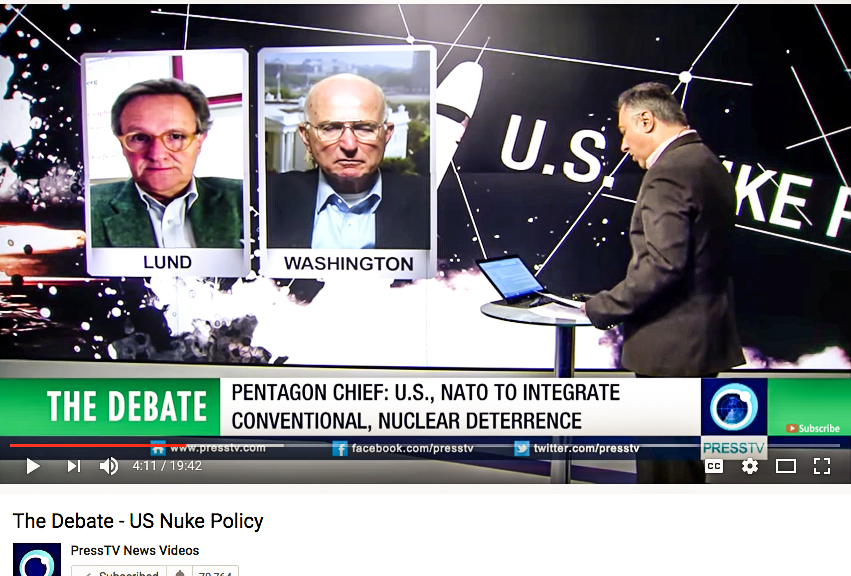
U.S. nuclear weapons – two very different world views

By Jan Oberg

Last night I had the opportunity to discuss nuclear weapons with an experienced, high-ranking security analyst who has been both a military, a scholar, an assistant secretary of defence, presidential adviser, a corporate man and now a think tank member, Lawrence J. Korb.

We were discussing the issues touched upon in this and this article.

I would assume that the debate – facilitated by Iran’s PressTV in an excellent manner – is illustrative of the degree to which the world can be seen from different perspectives and how different we can perceive words such as law, legality, ethics, security, deterrence and peace.

I assume also that the debate illustrates the difference between a systems-embedded interpretation of the world and an independent or free perception, including what can and must be changed and what doesn’t have to change to make the world a better place.

Enjoy!

TFF PressInfo # 389: Ukraine as the border of NATO expansion

And why Russia doesn’t have to be a threat to the West

By Jan Oberg

TFF Series ”The New Cold War” # 7

If the Ukraine conflict is the centerpiece of the new 2nd Cold War, it is essential to ask: What really happened? What did NATO countries do to cause it? What did Russia do to cause it?
And – if you live in the West, in particular: Did we really have to end in this situation given Russia’s significant weakness over 25 years?
This article argues that the superior West could have played its cards differently and it’s time for self-critical soul-searching and just a little living yourself into the shoes of the other.
If peace rather than war is your true aim.

There was a beginning and a framework

The Ukraine conflict has a 25-years history. Instead of dissolving NATO, the alliance was expanded. Relieved from there being a Soviet Union and a Warsaw Pact, the alliance went as fast it could to do all it wanted. Remember, a series of WW III scenarios has been written in which that war would start with some uncontrollable event in Yugoslavia. Now it could be chopped up – freely and without risk. Serbia was bombed and Kosovo carved out without a UN mandate whatsoever (1999).

How did they think about that in the Kremlin at the time, one must wonder?

Clinton literally did not give a damn about all the promises made to Soviet leader Gorbachev by US leaders such as Bush, James Baker and German leaders including Hans-Dietrich Genscher. (Yes, they were not written down but confirmed by those involved and present).

He began the expansion of NATO in 1994 – in Georgia (see what I refer to elsewhere in this series). All around a Russia on its knees Americans were placed in the offices of prime ministers, defence and foreign ministers – I saw it myself in former Yugoslavia – and met CIA people in Croatia disguised as humanitarian workers. And had a long conversation with the representative of the US in Tblisi in 1994. Historical moment!

The bad Christians, the Orthodox, were the Serbs and Russians and Greeks – all should be antagonized and the good guys in Yugoslavia were those who had been on the fascist side in WWII – the leaderships in Croatia, Muslims in Bosnia and the Kosovo Albanians. The Serb minority that had lived 400 years as a minority in the Croatian republic were, in the common Western discourse, invaders masterminded by strongman Slobodan Milosevic – whom Clinton without hesitation called the new ’Hitler of Europe’.

Ukraine was – and remains – what its name says: the border areas (like Krajina in Croatia). This is where NATO can establish itself as little as Chruschev could get away with deploying nukes in Cuba – considerably further away from the US, but anyhow.

Imagine – with a little bit of empathy (not necessarily sympathy) how Washington would react if today Putin’s Russia was 12 times stronger militarily than the alliance-free US (NATO dissolved 25 years ago) and tried with his alliance of 27 other members to make Canada or Mexico the 29th member. Perhaps most people in the US and Europe would have some sympathy for the negative reaction of Washington. Rand remember, Trump wants to build a wall to Mexico…

The main reason, it is stated again and again, in the Western press, NATO and other political circles is: Ukraine and Crimea. The lie about Putin’s aggression on Ukraine is told so many times that it is becoming the truth. Just see these two recent articles by Newsweek as two of hundreds of articles.

Here’s the chosen story in politics and media alike

The narrative is simplified beyond recognition and goes like this:

Putin (there is always just one top guy in Western eyes and it is one leader at the top like Milosevic, Mohamed Farah Aideed, Saddam Hussein, Moammar Khaddafi, al-Assad) is a bad guy and you know that because out of the blue his suddenly annexed Crimea. By that he changes the borders of Europe and then he gets his disguised soldiers into Eastern Ukraine – a Ukraine that we, in contrast to Bush Senior, care very very much about today.

We care so much about it that Read More »

TFF turns 31: Flashbacks and vision

By Jan Oberg

It’s 31 years today – September 12 – that Christina Spännar and I founded TFF and gathered experts and friends from many walks of life and world corners and set out to make a difference.

1985 were in the midst of European peace and anti-nuclear activities and a moment of history when one could begin to feel the Soviet Union and the Warsaw Pact cracking, fragmenting and giving way to something new.

Whatever survives this long under very very difficult circumstances of independence and freedom in our world must have some qualities.

During these more than three decades, we’ve been witnesses to world history in international affairs such as the end of the first Cold War with the fall of the Soviet Union and the Warsaw Pact, the dissolution of Yugoslavia, the genocide in Burundi and Rwanda, NATOs expansion as well as 9/11, the War On Terror and – sadly – all the failed wars in Afghanistan, Iraq, Libya and Syria to just mention a few.

But we have also seen the world order change, the trend towards a multipolar world, the betterment after the end of formal colonialism, people living longer and better, the rise of non-Western powers, the good sides of globalisation and modern communication technology etc.

We’ve done research – everything we do is research-based – public education, academic courses, mediation in major conflicts such as Kosovo and a lot of outreach: Social media, videos, media commentaries etc. And we still remember how we sent out newsletter that we had typed on thin stencils and manifolded on a stencil printer, the pages sorted and put into envelopes with address labels. The kids in our street helped us and got some good food (or child labour!) and we could do 1100 in one day in the basement and bring them to the post office the next. Then came the fax machine…

Those were the days.

Today about 10.000 people all over the world get TFF PressInfo several times a month; while it does take a couple of hours to edit and format, they go out in one batch within a couple of minutes at the click of a button. And we are later told who and how many have opened them or clicked on their links!

TFF was among the first academic institutions to actively use the Internet, Read More »

TFF PressInfo # 388: The War On Terror – A predictable fiasco

By Jan Oberg

This coming Sunday marks the 15th anniversary of what could be called the most counter-productive, if not stupid, war in modern history: The War On Terror. Today that war is much much more dangerous to the world’s future than the terrorists it is allegedly supposed to hunt down. And it has caused thousands of times more suffering, death and destruction – at least a million innocent people killed.

It’s not a war on terrorism but on terrorists and that is as smart as trying to fight all diseases by killing patients. It’s a war fought without any consideration of the one big question: Why did they do it and why do they do it? Media and politics only asking: Who did it? How was it done? Where? How to respond?

Without an intelligent, comprehensive diagnosis of 9/11 it could only go wrong. And it has.

The next problem was that ‘terrorism’ was suddenly defined by states as anything non-state that threatens society and states. Governments and the UN (which consists of them) conveniently omitted terrorism as a term for what states do and have done on a regular basis and on a much larger scale. Such as the nuclear balance of terror.

About 400 people were killed annually and worldwide before 9/11 according to US State Department statistics – reporting of that stopped in 2004 when figures soared after the War On Terror gained momentum. However, according to the 2015 Global Terror Index – the number is now 32,000 – and the far majority killed outside the West. So, the problem has increased exactly 80 times(!)

And the Western leaders who continue this war has no idea about how to stop it or do something more productive and intelligent to the world. Primitive tit-for-tat and disproportional responses has substituted what was once called statesmanship.

And it was predictable that it would be a fiasco!

Many both inside and outside the U.S. came up with Read More »

Criminalize the arms trade into hotspots

Jan Oberg comments on PressTV to Noam Chomsky’s criticism of Western support to terrorist groups in the Middle East.

Oberg maintains that the War on Terror is stupid in the sense of producing more of what it is supposed to combat and that arms traders – private as well as state – should be held accountable for their crimes, not only politicians and militaries.

Arms deliveries into hot spots ought to be criminalized too.

TFF PressInfo # 385 – How did Western Europe cope with a much stronger Soviet Union and Warsaw Pact?

By Jan Oberg

TFF Series ”The New Cold War” # 6

How did Western Europe survive the much stronger Soviet Union & Warsaw Pact 30-40 years ago? A pact that had about 70% of NATO’s military expenditures where today’s Russia has 8%? How did we get on after the Soviet invasion of Hungary and Czechoslovakia – and a Union with much more global military and political influence?

Europe did so through a well-maintained military capacity, or superiority, technical superiority and, of fundamental importance to security – confidence-building measures (CBM).

And through a political leadership by personalities who knew what the 2nd World War had implied and why it must never happen again. One towering figure of course being Willy Brandt, the German chancellor who had himself been a refugee in Norway during the war.

CBMs were meant to both uphold a high level of war-fighting capacity while also seeking military early information/warning, attending each other’s military exercises, etc. They resulted in the establishment of the very important OSCE – Organisation for Security and Co-operation (then C for Conference) in Europe with the Helsinki Final Act of 1 August1975. It contained politico-military, economic, environmental and human rights dimensions – ’baskets’ that were seen as related to each other and which served as dialogue points between the two blocs.

The visionary President Urho Kekkonen of Finland was credited as the main architect of the CSCE – and his Finland was neutral but upheld a co-operation agreement with the Soviet Union.

Finland was also the only country in the European space that could show opinions polls according to which the people felt equidistant to both blocs.

The simple but brilliant idea was this: We need dialogue to feel secure. It was also called Detente. And it implied a disarmament dimension – negotiations about how to mutually scrap weapons in a measured and verifiable manner that both sides had decided they no longer needed.

These negotiations included not only conventional weapons but also the arsenals of nuclear weapons.

In the domain of nuclear weapons, the Non-Proliferation Treaty, NPT, was signed in 1970 and carried four very important provisions:

1) the world shall move towards general and complete disarmament and the nuclear weapons shall be abolished;
2) those who have nuclear weapons shall negotiated them down, in principle to zero and
3) as a quid pro quo for that all non-nuclear weapons shall abstain from obtaining nuclear weapons – and
4) countries who want nuclear energy shall be assisted to introduce this civilian energy technology.

All this happened in the era of Detente and CBM. How had that become possible? Read More »

Nominate someone for the Livia Prize for nonviolent conflict-resolution

The Livia Foundation was initiated by The Danish Centre for Conflict Resolution with an aim to enhance its efforts to directly address conflicts in societies through nonviolent interventions – in Denmark and beyond.

The name LIVIA refers to the olive twig, an ancient symbol of ‘approaching peacefully’. Also, at the end of the biblical flood, a dove returned to Noah’s Ark with the twig from an olive tree to signify ‘end of troubles’.

The Livia Foundation aims to create hope by promoting nonviolent conflict resolution in the world:

• making visible all the courageous, nonviolent efforts in evidence on all continents;
• supporting projects and individuals who demonstrate that severe social conflicts can be efficiently resolved through a wealth of ideas and dialogue;
• inspiring politicians, media, organizations and the general public to apply constructive, nonviolent approaches to conflict resolution
• creating conflict preparedness, locally and internationally Economy and organization

The LIVIA Foundation has raised app. DKK 700.000 or well over US$ 100.000. The bulk of these funds is spent on awards and other events, while DKK 250.000 is tied up as the foundation’s statutory capital in the Merkur Bank.

The capital comes from personal donations, from the author fees of the book ‘Conflict and Contact’, from foundations and from the Centre for Conflict Resolution.

The Livia Foundation is a civic, non-political, non-religious, non-profit initiative. We work to promote new ways to support creative, constructive nonviolent conflict resolution.

The foundation is headed by its Board assisted by a large number of active persons, who are particularly active around the prize awards. All are volunteers.

More about Livia and who has been awarded its Prize earlier here.

The worldwide examples of nonviolent action are admirable, but only rarely do they reach the front pages of the media.

This is where the Livia Foundation is working to make a difference:

We will make the life-affirming ideas and solutions known to a larger public, by drawing attention and giving a voice to people working within creative conflict resolution.

Else Hammerich, TFF Associate and former TFF Board member, has been in the forefront of both the Centre’s and the Livia Foundation’s establishment and TFF is proud to help promote knowledge about it and identifying the best possible candidates for the Livia Prize.

See at the end of this presentation how you may nominate someone for this prestigious Prize. Read More »

TFF PressInfo # 384: The Clintons celebrated – but likely disastrous for the world

By Jan Oberg

Hillary Rodham Clinton was nominated last night by the Democratic Party as its candidate for the U.S. Presidency. She may well win on November 8.

What a tragedy for Western democracy that the leader of what is still called the free, democratic world cannot produce better candidates than Trump and Clinton through a disgustingly commercialized and corrupt political process where candidates like Jill Stein – did you ever hear of that candidate? – doesn’t have a chance because she cannot mobilize the funds.

As a European intellectual with a life-long commitment to peace and democracy, I find little reason to celebrate.

And why the total focus on a few individuals at the top but not the structures that will run them both, such as the Military-Industrial-Media-Academic Complex (MIMAC); the cancer in many societies, including Russia, that President Eisenhower warned the world about in his farewell speech already in 1961?

How short the media memory! Hillary Clinton’s nomination celebrated all over the mainstream press as a victory for the party – preventing it from splitting – and for all women.

But how can people – women in particular – really believe in such genderism: that she will be a better president for the US and the world because she’s a woman? Hasn’t the world learnt anything from the inverse racism:that Obama would be a great president because he is black?

How blind the media to militarism, war and other violence: Not one media focuses on the Clinton’s well-documented fascination with violence and war.

It’s time to refresh the memory of the Clintons:

Bill Clinton’s record

From 1994 BC broke all promises made by his predecessors and other Western politician to Gorbachev about “not expanding NATO an inch”. He started out in Tblisi, Georgia. I happened to be there, spoke with the U.S. representative to the country and got a sense what was coming. Later too in Yugoslavia.

There is a straight line from that fatal arrogance to today’s Second Cold War in Europe, Ukraine having – predictably – to be the this-far-and-no-longer country of that mindless and reckless expansion that should never have happened.

BC’s interventionist record is also forgotten: He bombed in Afghanistan, Sudan, Iraq, Bosnia, Kosovo and Serbia – the latter much much worse from any point of view than the Russian annexation of Crimea. It was based on the fake Rambouillet “talks” between Serbs and Kosovo-Albanians, his public lies about there being an ethnic cleansing of all Albanians in Kosovo coming from Slobodan Milosevic whom he called a new Hitler.

No such plan was ever found – and I know a bit about it because I was a goodwill adviser both to three governments in Belgrade and to the non-violent Kosovo-Albanian leadership under Ibrahim Rugova.

It was Clinton’s Secretary of State, Madeleine Albright, who masterminded much of it and is on record for saying that it was politically justifiable that the sanctions on Iraq had killed 500.000 innocent people. And they continued.

And she, having survived as a refugee child in Belgrade, Serbia, with her Czechoslovakian family during the Second World War and spoke Serbian is on record for hatred of the Serb people.

Conveniently, the West has forgotten it all. BC is such a charming man (who just told us at the reality show-like democratic convention how much he loves his wife).

His administration was one of the most militarist.

Hillary Clinton’s record

There is no excuse for having forgotten her record. GFrom 2009 to 2013, she served as Secretary of State under Obama, the US president who has been engaged in warfare during more days than any other US President according to the New York Times.

HC has supported all the wars she could and she was a mastermind of the war in Libya. One remembers the film clip showing her happiness at Khadafi’s death.

She is a Cold Warrior, anti-Russia, anti-Putin Russians will be great for fighting Putin.

Her war-promoting record is as long as it is well-documented.

The most solid documentation is that of professor Stephen Zunes. Read More »