A pope, a patriarch, a spiritual revolution

By Johan Galtung

The first editorial here at Transcend of March 3 2008, “50 Years of Fidel Castro” celebrated a political revolution that changed the world, and spelt the end of US-Western imperialism. This editorial celebrates a spiritual revolution that may also change the world, spelling the end of Western materialism, and spread from there.

We are talking about processes, not events, and of structures and cultures more than of actors.

Again, Cuba played a major role, as meeting place between two major parts of Christianity, Catholic and Orthodox. In the Great Schism of 1054 they had excommunicated each other; and the Roman empire had split Catholic/Orthodox in 395. Fidel’s Catholic brother and successor Raúl was a condition for this historic meeting for peace; so was the meeting between Putin–an Orthodox Christian–and Francis in June 2015. However, not many pairs of brothers rival the two Castros in shaping history.
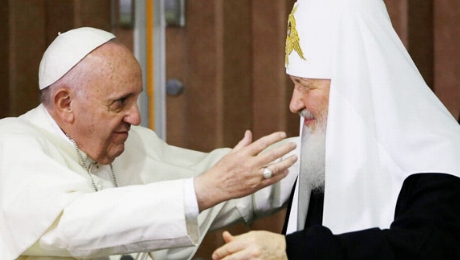
They met, Pope Francis of the Catholic Church and Patriarch Kirill of Moscow and all Russia – after earlier meetings between popes and the patriarch of Constantinople – with a Joint Declaration on 12 Feb 2016 in 30 articles. There were 17 quotes from the Bible; showing that they are “brothers in the Christian faith”, “pained by the loss of unity”, “divided by wounds caused by old and recent conflicts”. Not from the Bible are the many references to “the Most Holy Mother of God, Virgin Mary, and the saints we venerate”. Problematic for Protestants.

The bulk of the Joint Declaration is about the fate of Christians in the Middle East, meaning mainly Orthodox; like “the Metropolitans of Aleppo, Paul and John Ibrahim, who were taken in April 2013, to make every effort to ensure their prompt liberation”. However, together they “invite our Churches in Ukraine to work towards social harmony”.

They also jointly argue strongly against abortion and euthanasia, and in favor of “respect for the dignity of the individual called into being according to the Creator’s plan”. Do not destroy God’s creation.Read More »

Human Rights – A permanent challenge

By Johan Galtung

Concluding Remarks, Colloque, Université Catholique Lyon, 5-6 Feb 2016

The Universal Declaration of Human Rights of 10 December 1948 – the two Conventions of 16 November 1966 are international law – was edited by a committee of Men; Older, White, Bourgeois, Lawyers, French: MOWBLF!

Nothing about women’s and children’s rights; wait till the 1980s.

The perspective focuses on individuals, not collectives, peoples.

There are no rights to access to toilet, nor to sexuality: well-mannered bourgeois do such things but do not talk or write about it. Art. 27.2 even protects remuneration for professionals like themselves.

The “human rights=legal claims” discourse defines underdog goals but is silent on topdog goals: status quo. Their justification: “If they rise, they will treat us the way we treated them”. Revenge. In a conflict discourse, all parties have to be heard, for solutions.

But the legal discourse is DMA–Dualist-Manichean-Armageddon; two parties, rights vs wrongs, final battle in the Supreme Court. No accommodation to legitimate concerns of the losing side. The winner takes all.

And they were French. What does, or did, that mean? Read More »

Religious Fundamentalism-Extremism-Violence

By Johan Galtung

To navigate these difficult conceptual waters we need some rules. Here are three suggestions (the violence can be direct – as sometimes prescribed by the Abrahamic religions – or structural as by Hinduism):

1. Anchor “religious fundamentalism” in religious scriptures taken literally according to the fundamentalists, not as “interpreted”;
2. Anchor “extremism” in violent action, verbal or physical;
3. Anchor “religious extremism” in violent action justified-legitimized by religious scriptures, by fundamentalists or not.

Fundamentalism has to do with inner faith, belief. Extremism has to do with outer violence against Other, and against Self (like flagellation for being a sinner). Keep them separate. And be careful.

We can have fundamentalism without extremism. The fundamentalist may believe much, beyond the beliefs of others, yet not cross the border to violence. We may say: let him-her do so; it is not obvious that fundamentalists are more violent than non-fundamentalists.

We can have extremism without fundamentalism. Most people exercising violence believe in nothing, beyond “doing their job”.

There are two criteria for “religious extremism”:Read More »

Around the world: Problems and remedies

By Johan Galtung

Let us have a look, and see what can be done.

[1] Economies. NYSE is falling; China is consuming, with problems; the West blames China, not itself, for all. The truth is over-reliance on one commodity, oil-gas, hitting vulnerable economies doubly. Steep fall in price: $120-130 to $30-20, close to 1973 from $1 to $10. Steep fall in demand for that globally toxic product; a sign of rationality (but, the other globally toxic product, derivatives for speculation?) The currencies of oil-producers tumble. stocks fall; in Norway to the tune of half the state budget in three weeks (Finansavisen 21Jan 2016).

And over-reliance on trade with vulnerable economies.

Remedies: To become less vulnerable, through [1] more self-reliance nationally and locally, indeed for basic needs like food, [2] fully-fledged economies with primary-secondary-tertiary-quaternary (care for people and nature) sectors. Simple, sustainable rules.

Beyond that: import-export, but with a wide range of countries.

[2] Inequality: The Master, Atkinson’s, analysis of the catastrophic consequences, both high up and low down, is the best. Spiritual aspect is hopelessness, apathy with no project low down; high up ego-centrism devoid of solidarity as project. Sick societies. In 2010 388 persons owned as much as half of humanity, in 2014 80, end 2015 62 (Oxfam).

Remedies: Lift the bottom up, FDR New Deal, welfare states, the Chinese way. Publish the ratio CEO:workers earnings; make above 10:1 illegal, punish, boycott. More cooperatives with CEO-workers rotation.

[3] The third industrial revolution: robotization. Frankenstein’s monster is coming. Another consequence will be massive unemployment.

Remedies: Humans, sapiens-faber-ludens, are creative, productive and playful. We are all three. But we may need life-long guaranteed income for all, covering all basic needs. Humans will reconquer the production, wrestle it from unnecessary-unwanted robots, and enjoy life.

[4] Davos. There they are, those who brought us these problems. Read More »

Police mediation: And idea whose time has come

By Johan Galtung

The state system emerged in the 17th century, with institutions for force. One was for internal and one for external use: the national police and the national military, national standing for the dominant nation in the states. The role of the police was to protect elites against theft and violence by the people; crimes by the law. And the role of the military was to protect the states against each other. Both police and military occasionally initiated violence.

The description just given still holds very well for the USA. “Banking scandals” give us insight in class-conscious “justice”. Police patrol the streets, not the boardrooms. And no arrests.

But wars between states are now dwindling. They yield to wars between dominant and other nations within states, and dominant and other civilizations in the world; using state and non-state terrorism.

How did “modern” elites get these ideas? From intellectuals.

They picked Thucydides who told them that wars there will always be, and von Clausewitz who trivialized them, from Hobbes who told them that people are born violent and have to be controlled, and Machiavelli who told them that the prince has to be feared, not loved.

Or they decided themselves and picked intellectuals to confirm.

The military had an agenda: fight for victory, unconditional surrender of the other side, dictate the terms; call it peace.

The police had an agenda: detect, arrest, court, confession, sentence, punishment; call it justice. Theory: individual and general prevention, punishment not to do it again and as a warning to others.

All false, all nonsense. And wars and crimes are still with us.Read More »

Improving democracy

By Johan Galtung

Democracy is rule–decision-making–by the consent of the people, the demos. There is a very good argument: the people will suffer the consequences. Hence rule of, by, and for the people.

But the problem is: which level dominates the decision-making?

Level [4] national (government-parliament-courts); [3] regional (provinces-departments), [2] local (LAs, municipalities), level [1] individuals?

In theory [1] is primary, basic, sovereign; in practice level [4]. Through elected representatives, packaged in electoral districts; representing individual preferences, packaged in party programs.

Comment, from Germany: “The sovereignty comes from the people – and never comes back” (“vom Volke raus, und kommt niemals zurück“).

The representatives kindly open a window every 4 years or so, 8-12 hours, 1-2 days, for the people to confirm or disconfirm the government. so the degree of democracy looks like 1-2 days out 4 x 365 = 1460 (+1): around 1 per mille.Read More »

Syria – Minding the minds (II)

By Johan Galtung

Baher Kamal, in – And All of a Sudden Syria! writes:

“The “big five” /the UN veto powers/ have just agreed /Res 2254 of 18-12-2015/– time to end the Syrian five – year long human tragedy – they waited until 300,000 innocent civilians were killed–4,5 million humans lost as refugees and homeless at home, hundreds of field testing of state-of-the-art drones made, and daily US, British, French and Russian bombing carried out”.

But no Chinese bombing.

One term in the resolution, road map, already spells failure. There is another reason: missing issues. But something can be done.

Roads twist, turn and may be far from straight. Traveling a road is a linear, one step or mile-stone after another, process, by the map. The West loves linearity; as causal chains (“falling dominoes”) from a root cause; as deductive chains from axioms; as ranks from high to low.

However, is that not how the world is, moving in time, causes-effects, axioms-consequences, rank, power, over others? Are roads not rather useful? They are. Is there an alternative to a road map? There is.

One step after the other in time is diachronic. An alternative would be synchronic; at the same time. Let us call it a cake map.Read More »

Twenty pious wishes for 2016: Mind the minds

By Johan Galtung

According to UNESCO, wars start in the minds of men. Well, something–like unsolved conflicts and unconciled traumas–passes minds on the way to war. But UNESCO got the unintended focus on male humans right.

Minds matter, above all pre-programmed minds. This New Year 2016 editorial minds minds and mind-sets, the set minds. For peace culture.

1. A case: New York Times editorial 30 Dec 2015, “The Importance of Retaking Ramadi”. Being the capital of a governorate–IS uses them as building blocks–this was a major military victory. However, the mind-set of the writer confuses retaking space with retaking minds. Sunni Arab minds. “Liberated” by a Shia army and infidel US bombs? They might even be against both. The military come and go. Minds often stay.

2. Can we map minds? Well, to standard world maps with 200 states at least add maps of 2000 nations, showing those who would like to be more together, like in federations and confederations, and less, more apart, like in states. Nations are more cultural. Closer to “mind”.

3. The military have maps of hardware capability; “hammers in search of nails”. An example of intention: Pentagon had in the early 1960s “Project Camelot” to map with public opinion data revolutionary ideas. At least add maps of capacity for doing good to others, not only harm.Read More »

Anglo-America, EU, West: A prognosis of decline

By Johan Galtung

Thanks dear Oxford students for the Xmas gift, challenging the cult of Cecil Rhodes–colonialist, classist, racist. He was also an Aryan supremacist, like Hitler but for the Anglo-Saxon variety, against the German (and often criticized in this column).

The commemorative plaque has been removed. The statue may follow.

Maybe also the “Rhodes Scholarship”, as ‘certificate of excellence?’

Much will join Cecil Rhodes and another racist, Woodrow Wilson, down the drain. Like Western economic supremacy. In 1980 the G7 (USA-Canada-UK-Germany-France-Italy-Japan) had 62% of Gross World Product, BRICS had 15%. In 2015, only 35 years later, G7 is halved and BRICS doubled; at 31% in 2020, a comfortable lead for BRICS is predicted; 34% against 29% (International Spectator). West “Out-competed”.

But what happens is deeper than share of GWP. Or USA losing wars. Or decreasing US political clout. With only US cultural power left.Read More »

China versus Russia versus USA: Xi versus Putin versus Obama

By Johan Galtung

From very high up three major countries-states stand out clearly: China, the most populous; Russia, the largest; USA, the most military. With three leaders, Xi, Putin, Obama, with much power on their hands.

And here is the key hypothesis, presumably more right than wrong: China-Xi: positive peace; Russia-Putin: negative peace; USA-Obama: war.

We have in mind China – also a region – building relations for reasonably mutual and equal benefit with China all over the world, spinning Asia-Europe-Africa together in a road-rail-ship-air Silk network available to all (with major mistakes in the South China Sea).

We have in mind Russia – itself also a region – calling to Russia leaders in violent conflict from all over the world, seeking cease-fires and accommodation (making itself a major mistake in Syria).

And we have in mind USA – more than a state, less than a region – since WWII ended killing more than 20 million people in 37 countries:

Afghanistan, Angola, Argentina, Bangladesh, Bolivia, Brazil, Cambodia, Chad, Chile, China, Colombia, Cuba, Democratic Republic of Congo, Dominican Republic, East Timor, El Salvador, Grenada, Guatemala, Haiti, Honduras, Hungary, Indonesia, Iran, Iraq, Israel-Palestine, Korea North-South, Laos, Nepal, Nicaragua, Pakistan, Panama, Paraguay, Sudan, Vietnam, Yugoslavia Not included: daily USA mass shootings.

And weaving the world together with the incredible internet (making a major mistake, using it for spying, betraying us all).Read More »