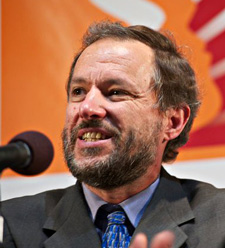
Nuclear weapons are not instruments of peace!

By Richard Falk

A few days ago I was a participant in a well-attended academic panel on ‘the decline of violence and warfare’ at the International Studies Association’s Annual Meeting held this year in San Diego, California. The two-part panel featured appraisal of the common argument of two prominent recent publications: Steven Pinker’s best-selling The Better Angels of our Nature: Why Violence has Declined and Joshua Goldstein’s well-researched, informative, and provocative Winning the War on War: The Decline of Armed Conflict Worldwide.

Both books are disposed to rely upon quantitative data to back up their optimistic assessments of international and domestic political behavior, which if persuasive, offer humanity important reasons to be hopeful about the future. Much of their argument depends on an acceptance of their interpretation of battlefield deaths worldwide, which according to their assessments have declined dramatically in recent decades. But do battlefield deaths tell the whole story, or even the real story, about the role and dangers of political violence and war in our collective lives?Read More »
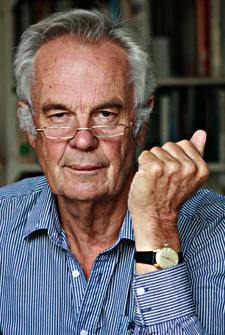
Ignore the markets – or how to really defeat the economic crisis

By Jonathan Power

What have these eleven countries in common – Finland, Norway, Canada, Japan, Poland, Turkey, Australia and, to a lesser extent, the US, Russia, Sweden and Denmark? They have not put themselves through the economic purge and their economies are growing at a reasonable rate. Not for them savage cuts in social services and public investment combined with lower wages. They have kept their economies purring. They are pro-Keynesian – a policy attributed to John Maynard Keynes, the most brilliant economist of the last century, in an age when there were many brilliant economists, both of the left, the middle and the right.Read More »

Why Europe is not yet a ‘Culture of Peace’

By Richard Falk

It is undoubtedly true that the greatest unacknowledged achievement of the European Union (EU) is to establish ‘a culture of peace’ within its regional enclosure for the 68 years since 1944. This has meant not only the absence of war in Europe, but also the absence of ‘war talk,’ threats, crises, and sanctions, with the single important exception of the NATO War of 1999 that was part of the fallout from the breakup of former Yugoslavia.

This was undertaken by the American-led alliance both to accomplish the de facto independence of Kosovo from Serbian rule, to ensure the post-Cold War viability of NATO, to reinforce the lesson of the Gulf War (1991) that the West could win wars at low costs due to their military superiority, and to rescue Albanian Kosovars from a possible humanitarian catastrophe at the hands of their Serb oppressors.Read More »

For a denuclearized Middle East

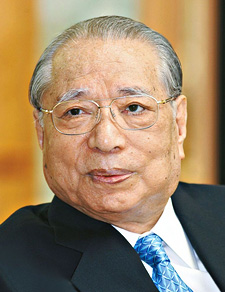
By Daisaku Ikeda (*)
© IPS 2012

TOKYO, Mar (IPS) – In recent months, the dispute over the nature and intent of the Iranian nuclear development programme has generated increasing tensions throughout the Middle East region. When I consider all that is at stake here, I am reminded of the words of the British historian Arnold Toynbee, who warned that the perils of the nuclear age constituted a “Gordian knot that has to be untied by patient fingers instead of being cut by the sword.”

Amidst growing concerns that these tensions will erupt into armed conflict, I urge the political leaderships in all relevant states to recognize that now is the time to muster the courage of restraint and seek the common ground on which the current impasse can be resolved. Read More »

India uphill or downhill?

By Jonathan Power

When the distinguished foreign policy expert, former US National Security Adviser, Zbigniew Brzezinski, told me a couple of years ago that he worried about the stability of India I thought he was way off track. Living in Calcutta at the time, democracy seemed to be thriving and both the state of West Bengal and most of the country were very clearly developing fast.

But that was before the crises of the last year. One major financial scandal has followed another. Read More »

Military intervention in Syria is a bad idea

By Stephen Zunes

Although the impulse to try to end the ongoing repression by the Syrian regime against its own people through foreign military intervention is understandable, it would be a very bad idea.

Empirical studies have repeatedly demonstrated that international military interventions in cases of severe repression actually exacerbate violence in the short term and can only reduce violence in the longer term if the intervention is impartial or neutral. Other studies demonstrate that foreign military interventions actually increase the duration of civil wars, making the conflicts longer and bloodier, and the regional consequences more serious, than if there were no intervention. In addition, military intervention would likely trigger a “gloves off” mentality that would dramatically escalate the violence on both sides.Read More »

Hana Shalabi’s hunger strike has ended, but not her punishment

By Richard Falk

As with Khader Adnan, Israel supposedly compromised with Hana Shalabi on the 43rd day of her hunger strike in protest against administrative detention and her abysmal treatment. But Israel’s concept of ‘compromise’ if considered becomes indistinguishable from the imposition of a further ‘vindictive punishment.’

How else to interpret Israel’s unlawful order to coercively exile (not technically deportation because she is being sent to a location within occupied Palestine) Hana Shalabi for three years to the Gaza Strip, far from her home village of Burqin in the northern part of the West Bank, and more significantly, far from her grief-struck family? Read More »

The hypocrite, the fanatic, or Obama?

By Richard Falk
While the headline deals with the Presidential candidates, Falk reflects also on the essence of democracy itself and on whether the US can at all be called a democracy.

The American electorate is facing a presidential election in which there is almost no prospect of a constructive debate. On the Republican side the campaign for the nomination has exhibited the clash of irresponsible and reactionary views, slightly relieved by the libertarian Ron Paul who at least counsel against militarism and the death dance with Israel.

All the Republican presidential hopefuls, except Paul, exhibit a craven distaste for reality when they attack Obama for being insufficiently pro-Israeli, as if 95%+ is insufficient. Such a posture, whether meant seriously or not, expresses contempt for the intelligence and common sense of the American citizenry.Read More »

The face of the crisis – and some alternatives

By Johan Galtung

From Madrid, Universidad Nacional de Educación a Distancia-UNED, Foro Los Nuevos Problemas Sociales, 24 Mar 2012

Here is one of the hidden faces of the economic crisis:

(¶C/¶t) + (¶C/¶S)rS + (1/2)(¶2C/¶S2)q2S2 = rC

The famous Black-Scholes equation to find the “correct price” for financial derivatives. Based on partial derivatives over time, this is classical calculus for continuous change; useful within a zone of stability, but not at the edge of that zone, the tipping points explored in René Thom’s catastrophe theory years earlier.

Black-Scholes is intellectually like calculating increasing speed of an accelerating car heading for a wall or an abyss. But, with warnings, no 1997 “Nobel Prize in Economics” (actually a Swedish State Bank’s prize honoring Alfred Nobel)? And one year later their company “Long Term Capital Management” had lost $100 billion and collapsed. The trade in derivatives is now at $1 quadrillion a year (15 zeros), ten times the industrial economy of the whole 20th century. Many got rich, but the system collapsed. Maybe prison would have been more adequate for intellectual sloppiness?Read More »

Way to end war in Afghanistan

By Jonathan Power

After the Soviet Union invaded Afghanistan in 1979 and got totally bogged down there was a joke circulating in Moscow. “Why are we still in Afghanistan? Answer: We are still looking for the people who invited us”.

Zbigniew Brzezinski, architect of US policy in Afghanistan when he was President Jimmy Carter’s national security advisor, was convinced Afghanistan would become the Soviet Union’s Vietnam. In fact the Soviet Union’s Vietnam has become America’s Afghanistan.

There is truth in both these cynical observations. And there are lies, distortions and self-delusion built into the narrative. Only Russia has been more or less honest. Under President Mikhail Gorbachev it decided to cut its losses and withdraw and was open about the reason it did so.

Today the debate in the US is contorted. Read More »