
By Johan Galtung
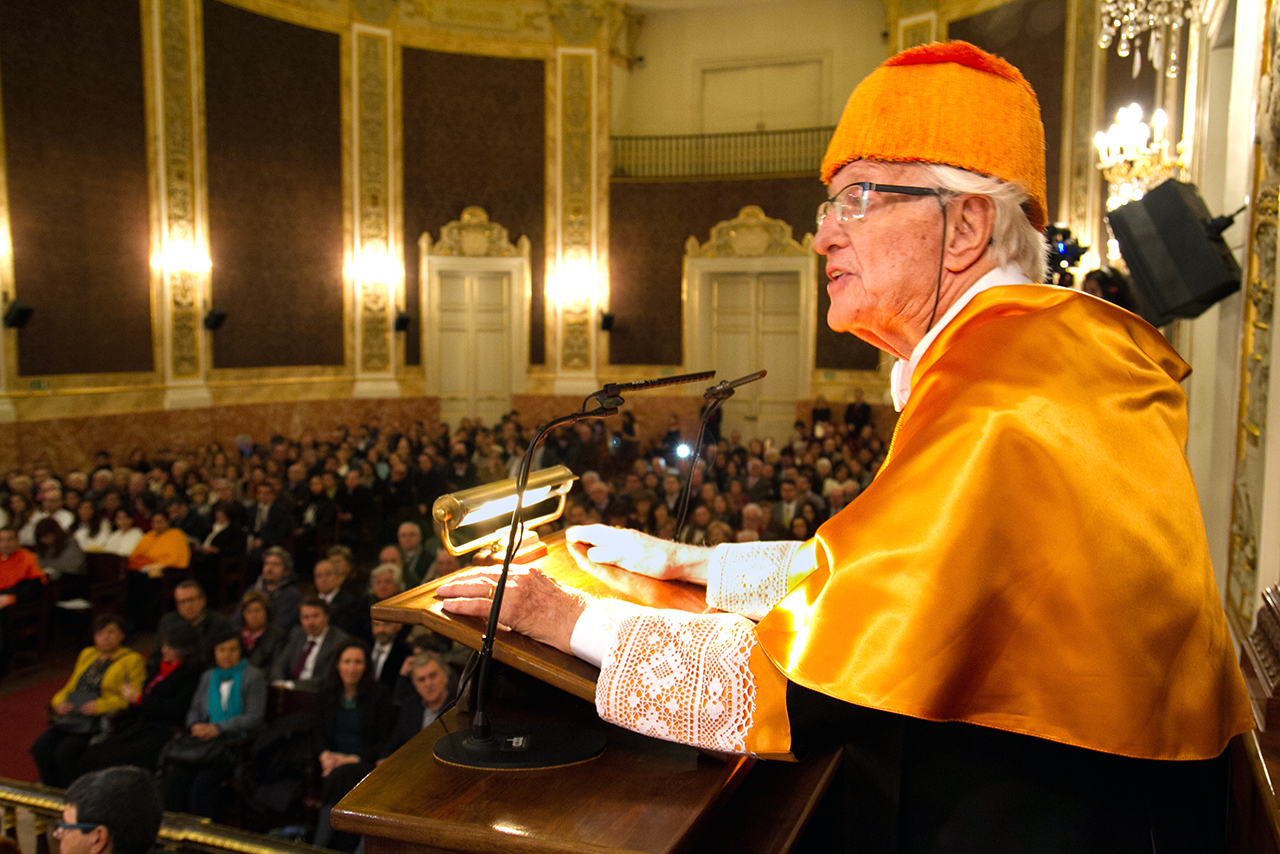
Receiving Dr Honoris Causa, Universidad Madrid Complutense, 27 Jan 2017
Dear Rector, dear Jury!
I receive this great honor bestowed upon me in deep gratitude and pride, promising to try to live up to it.
I will now share with you some words about how I got launched on the track for which you honor me, peace studies and peace practice.
Like so many, I felt desperate about the wars in our enlightened century and continent and asked, Why? What can we do to avoid this suffering, not only the wounded and dead, but the countless bereaved?
From my family I knew a little about health studies and had been struck by the fruitful distinction between cause and symptom. The symptom is on the surface of the body, like fever; but the root cause is deeper down, inside, a sepsis. A major breakthrough. “Treat the cause, not the symptom” became a new rationality. Cooling the body makes some sense, but it isn’t the cure; and even less treating a swollen ankle that could be a symptom of a serious heart illness.
My illness was war, my wellness was peace.
Was war a cause with horrible effects with nobody really winning, or could war be a symptom of something deep down in the “body politic”, a “root cause”? Of something preceding war and violence in general, which if removed would also remove, or at least reduce, war and violence? But what?
This was important because if we accept violence as the root cause then we link it to the human body or humanity as such, not only as innate, but as inevitable. We would have to learn to live with it and with its effects, some of them summarized in “war breeds war”.
War rhetoric actually pointed in two directions: “someone blocking what we are entitled to” and “revenge for unjust wars against us”. The first points to conflict, “incompatible goals”; the second to trauma, “wounds from past violence”. I have stayed with those two.
This liberates human nature from being the cause Read More »



 TFF Associates Blog 2011-2017