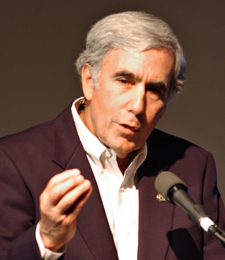
Den nye verden

Af Jan Øberg

Den nuværende periode i menneskehedens historie vil blive svær at forklare for fremtidens historikere – hvis der da findes nogle.

Hvordan kunne det gå så skridt så hurtigt og på alle fronter for dén Vestverden, der efter 2. verdenskrig stod med alle kortene på hånden? Hvordan kunne det amerikanske imperium, der byggede på frihed og demokrati, overhovedet styrte sammen dér tilbage i 2026?


Den vestlige NATO-baserede verden kunne ånde lettet op da Sovjetunionen og Warszawapagten var blevet opløst i 1989. Den havde vundet ideologisk – ingen ville siden have sovjetkommunisme – og økonomisk – Rusland producerede ingen attraktive forbrugsvarer – og militært.

Ruslands militærudgifter var bare 8% af NATOs mod Warszawapagtens 75% af NATO førhen.

Den Kolde krig forsvandt lykkeligt nok uden Varm Krig eller atomvåbenbrug. En ny verden blev mulig. Ondskabens imperium, som præsident Reagan havde kaldt Kreml-systemet, var borte. Alle talte om fredens ”dividende”.

Men kun godt 25 år senere var verden gennemsyret af angst,Read More »

Russia-NATO games in Europe

October 26, 2016

Yet another example of how tension build up in this New Cold War situation – instead of doing what we did during the first Cold War: trying confidence-building measures.

Today too BBC announced that the US will deploy – permanently – 300 US soldiers to norther Norway, a break with Norway’s policies since it became a NATO member. And Reuters brought the news that NATO will deploy thousands of new soldiers in the Baltic countries and in Poland and, next year, planes to Romania – on top of the reinforcements already made.

The above short interview contains comments on these dangerous steps too.

TFF PressInfo # 390 – Ten articles on the new Cold War and a reflection

By Jan Oberg

Lund, October 26, 2016

Over the last four month, ten articles about the new Cold War have been published on the TFF Associates blog. And on our social media you’ll find hundreds of brilliant, informative posts written by others.

While this new Cold War is certainly different from the first Cold war that ended in 1989, we are not in doubt that there is a new such tragic war and that the risk of military confrontation between Russia and NATO countries in Europe has increased.

We also happen to think it could have been avoided.

This Cold War has to do with, among many other things, NATO’s counterproductive expansion since 1994, the way Yugoslavia broke down and was broken up, with Ukraine and now Syria as well as – perhaps surprisingly to some – the rapidly diminishing political power and legitimacy of the West in the emerging world order.

A reflection on how security politics and media contribute to the closing of the open society

The increasing symbiosis between the political and the leading mainstream media of the Western world implies that, grosso modo, Russia is blamed for having caused this new situation. While Russia is certainly not innocent and it usually does take two to conflict this blame is rather a sign of diminishing capacity (knowledge) and will (economic and intellectual independence and courage) to ask critical questions that now characterise the corporate media.

Defence and security political news coverage, journalistic processing, editing and commentaries have sunk to an intellectual level that is considerably lower than during the first Cold War. The entire field is given low priority by editors. Domestic issues, sports, entertainment, lifestyle etc. have made it to the top.

Out of sync with the globalising world, most media do with 1-2 pages about global affairs out of, say, 40-50 pages and they base this material on the same handful of Western news bureaus.

The double checking of a variety of sources, versatility and multi-perspective coverage are things of the past and we see more uniformity and more subjectivity in the news media coverage than ever.

Add to this that both Russia and NATO countries engage in media management, or propaganda (tax payers footing the bills) which squeezes out comprehensive knowledge and unbiased analyses as well as critical angles on one’s own policies and actions.Read More »

The simple act of pushing a button

By David Krieger

“Since the appearance of visible life on Earth, 380 million years had to elapse in order for a butterfly to learn how to fly, 180 million years to create a rose with no other commitment than to be beautiful, and four geological eras in order for us human beings to be able to sing better than birds, and to be able to die from love.

It is not honorable for the human talent, in the golden age of science, to have conceived the way for such an ancient and colossal process to return to the nothingness from which it came through the simple act of pushing a button.”


I recently came across this quotation by the great Colombian novelist Gabriel Garcia Marquez, the author of One Hundred Years of Solitude and recipient of the 1982 Nobel Prize for Literature. The quotation is from a 1986 speech by Garcia Marquez entitled “The Cataclysm of Damocles.”

In the short quotation, he captures what needs to be said about nuclear weapons succinctly, poetically and beautifully. With a few deft literary brushstrokes, he shows that the journey of life from nothingness to now could be ended with no more than “the simple act of pushing a button.”


The button is a metaphor for setting in motion a nuclear war, which could Read More »

Trump visits Putin

By Jonathan Power

October 25th 2016

I have a fantasy. Donald Trump wins. He goes to Moscow on his first trip as president and gives President Vladimir Putin a bear hug and they go hunting in the forest, Soviet style.

When they emerge they have shot a couple of bears and have had a good lunch laid out for them by acolytes at which they have discussed the matters of the world.

They give a press conference. They have decided to re-start negotiations on major nuclear arms reductions and both say they unilaterally are immediately ridding themselves of a 1000 missiles each.

They have found a way to implement autonomy for eastern Ukraine, as done in Scotland, which Trump with his Scottish golf courses knows well. Ukraine can work towards both a trade agreement with the EU and the Russian-backed Eurasian Economic Union. Russia was always happy about such an arrangement, but many Ukrainians weren’t and only wanted an EU arrangement. This was the trigger for the uprising in Kiev and Western support for the powerful revolutionary movements that had a fascist pedigree.

Dealing with Syria is both simpler and more difficult – difficult because of the intensity of the fighting and the multi-nation interests and easier because neither Russia nor the NATO powers want to see a clash over a relatively small part of the global population – Syria’s population is 9 million, about the same as one of America’s eastern states.

In the forest they agreed to stop using Russian warplanes backing President Bashar al-Assad, the US to stop aiding anti-Assad guerrillas and both to concentrate on defeating ISIS. In return the US would invite Russia to share its airbase in Qatar. The civil war opponents would be left alone to fight. UN mediation would continue.

Trump has a point in wanting rapprochement with Russia.

At the moment Read More »

Living longer, but less meaningful lives?

By Johan Galtung
On UN Day and his own 86th birthday

The last one hundred years life expectancy has increased by about 25%-from near 80 to near 100-in some countries. But, instead of increasing playful childhood, education, work and retirement by 25%, the age of retirement has moved much less than the age at death. That deprives masses of older people with experience and wisdom of productive work, of being useful, meeting others constructively; reducing them to being playful–bridge or golf as case may be–and just keeping alive.

Homo sapiens as homo ludens not homo faber. Longer, but emptier lives.

A crime against humanity if there ever was any. However, with two clear remedies: continue working self-employed with pension as salary, or find meaning in dedication to something beyond oneself, some cause, volunteer work. That should be planned well in advance before entering a “career” that peaks before, or at, retirement; the rest being downhill even steeply.

Life is expansion from a fertilized egg to a mature human being and contraction to ever narrower space around oneself till time is up. Western history has many narratives about expansion from some little point to a full-blown empire and contraction to ever narrower spaces. The two model each other with empire expansion giving meaning to life, and contraction, death of empires making life meaningless, with waves of massive suicide ending the Habsburg, Nazi, Apartheid empires. Hitler, in 1940 the head of the largest European empire ever, in 1945 only of his bunker, may have been a suicide model. But it was deeper.

We are now living the accelerating history of the end of the US empire,Read More »

9 Reasons That Nobel Peace Prize to Juan M. Santos Was a Wrong Decision

By Johan Galtung

Alfaz, , Spain 13 October 2016

[1] Only the government side got the prize 7 October, not FARC; the same mistake as the 1971 prize only to Willy Brandt, not also Brezhnev and the 2000 prize to Kim Dae-jung, not also to North Korea. It takes (at least) two to make a handshake; one hand is only shaking the air.

[2] The agreement does not include ELN guerrilla and para-militaries, fighting against and for the status quo, with no indication they will continue doing so; possibly filling in for FARC and the government.

[3] Is the deal symmetric with both sides abstaining from violence, or rather asymmetric, disarming only FARC and bringing demobilized guerrilleros back to “normal” life, not also parts of the army?

[4] Crimes have been committed by all sides in Colombia–crimes mostly by omission by the government, and crimes of violence by commission by all parties–and justice is now not being served.

[5] The prize confuses cease-fire with peace, unlike the 1998 prize to Nelson Mandela and Willem de Klerk not only for cease-fire but for solving the underlying conflict of South Africa: equal dignity through democracy, by One Person-One Vote regardless of the skin color.Read More »

India and Pakistan still fight over Kashmir

By Jonathan Power

October 18th 2016.

In the middle of last month Pakistani militants moved across the “line of control” that separates Pakistan-controlled Kashmir from the Indian-controlled part. The two countries have been at loggerheads about the title to this gorgeously beautiful state, now bereft of tourism and much income, since independence.

In recent years guerrilla activity has died away and most observers thought that the Pakistani army was seriously clamping down on its own sponsored guerrillas. The indications were that the government truly wanted rapprochement with India. And India too with Pakistan.

However, not everybody in India thinks so positively. Professor Brahma Chellaney noted in the Japan Times recently, “India’s response to Pakistan’s military strategy to inflict deaths by a thousand cuts through terrorist proxies was survival by a thousand bandages”.

This time Indian did not take it lying down. It said that Indian special forces made multiple strikes on terrorist launch pads. (Pakistan said there had only been cross border firing.)

Surprisingly, India has made no move to designate Pakistan as a state sponsor of terrorism or to declare bounties on the heads of prominent UN-designated terrorists who still operate openly in Pakistan – not the same one who killed 150 school children last year but other similar movements.

India is conducting, to the ire of Chellaney, only “a silent war”. He goes further and says that “if in a year’s time (when things have hopefully cooled off) India returns to “peace talks” with Pakistan it will be crystal clear that India’s biggest enemy is India”.

Strong words and I profoundly disagree with him.

At last, very belatedly, Read More »