Is Africa going downhill?

By Jonathan Power

October 11th 2016.

Africa up or down? After 10 years of quite remarkable growth across the continent most countries are experiencing a downturn, with average growth nearer 3.75% than 5% as before.

Nigeria, the continent’s most populous country with its largest economy, was at one time growing year after year at 7+%. Now it looks like it’s heading for recession and a growth rate pointing to zero.

It has been hit by a six-fold whammy – oil prices sharply down, the effects of the great recession in the industrialised countries, the Chinese economy slowing, bad economic and foreign exchange policies under the relatively new president, Muhammadu Buhari, increased corruption under his predecessor, Goodluck Jonathan, and the war against Boko Haram in the far north.

Nevertheless, Nigeria’s non-oil sector- agriculture and manufacturing- improved steadily until 2015, but now has plateaued. Some economists have said that since that Nigerians can’t get richer from oil they are being forced to diversify.

Most African countries don’t have such a string of problems. Star performers, such as Tanzania, Uganda, Kenya, Senegal, Rwanda, Mauritius, Ghana and Ivory Coast, have avoided much of this turbulence. They have benefited from low oil prices, good economic policies, wise investment, an emphasis on industrialisation and an ability to attract foreign aid. Also from the lack of wars.

Although the number of wars across the continent has fallen sharplyRead More »

Israel’s self-obsession

By Jonathan Power

October 4th 2016.

The many world leaders who gathered in Jerusalem last week for the funeral of Shimon Peres, the former president of Israel, are safely ensconced back home. They will not bother much to think about Israel again until the next Palestinian uprising. But the Israelis will continue to only think about themselves.

The Israelis are obsessed with themselves, with their history, with the present time and with their destiny. Every nation has some of this but Israeli navel gazing is something else. At this level of intensity it makes compromise difficult and condemns Israel to political paranoia and limitless inflexibility.

The Israeli notion that they can have this land and no one else can is so anachronistic by any contemporary standards that it is amazing that outside powers, whether they be the US, the EU or Russia, have given its arguments the time of day.

If every ethnic group in the world asserted so vigorously truly ancient yearnings to exclusive possession the world would become totally chaotic in short time. Where would the white North Americans or South Americans be?

Should Russia return to the rule of Mongolia, the seat of Genghis Khan’s Mongols? It was they who laid down the boundaries, more or less, of the modern Russian state. What if China grabbed back Taiwan?

If the Israelis want to believe that Temple Mount Read More »

Would Alfred Nobel laugh or cry at the 2016 Prize: A Norwegian diplomacy rescue operation?

By Jan Oberg

1. In my view it is well within the will of Alfred Nobel to reward people who negotiate a peace agreement. In this perspective this year’s choice is better than several from the latest years.

2. That said, it is quite obvious that the Committee has deviated from its mandate in another respect. Nobel’s wish and will is about something already done that deserves to be rewarded.

This years’ choice – like, say, that of Al Gore and Obama – is a clear example of the Nobel Committee sliding into another role: that of influencing world events in the future. (And grossly exaggerate its own importance in Realpolitik terms beyond symbolic, normative celebrations and solemn words).

One indication that the Committee by its choice this year wants to influence the future is that visitors to its website can vote on whether or not they believe that the award will help the peace process in Columbia.

3. Why reward only one person, the government side? To award only one party to a peace agreement borders on the absurd.

Why did the Committee choose deliberately to not recognize and award the FARC side? Although I am not an expertRead More »

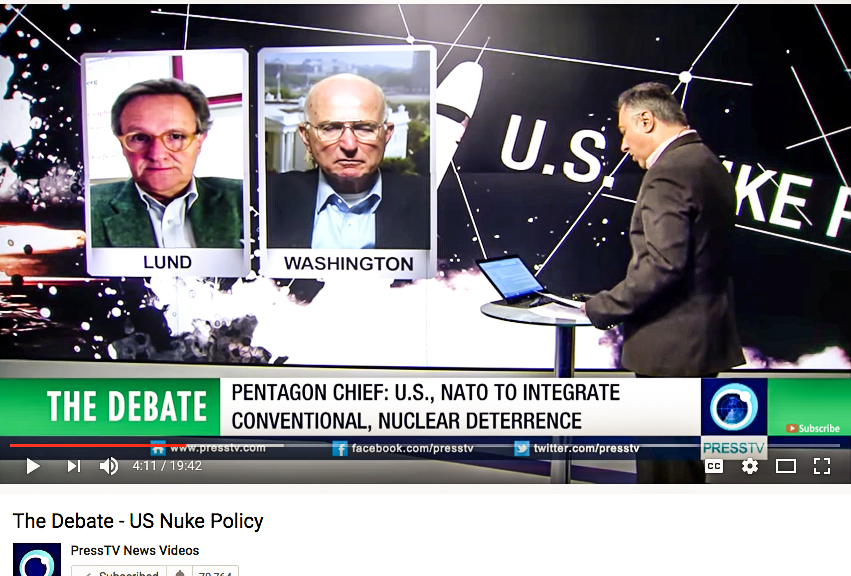
U.S. nuclear weapons – two very different world views

By Jan Oberg

Last night I had the opportunity to discuss nuclear weapons with an experienced, high-ranking security analyst who has been both a military, a scholar, an assistant secretary of defence, presidential adviser, a corporate man and now a think tank member, Lawrence J. Korb.

We were discussing the issues touched upon in this and this article.

I would assume that the debate – facilitated by Iran’s PressTV in an excellent manner – is illustrative of the degree to which the world can be seen from different perspectives and how different we can perceive words such as law, legality, ethics, security, deterrence and peace.

I assume also that the debate illustrates the difference between a systems-embedded interpretation of the world and an independent or free perception, including what can and must be changed and what doesn’t have to change to make the world a better place.

Enjoy!

More war or more peace?

By Jonathan Power

September 27th 2016

The last war in the Western hemisphere came to an end yesterday with the signing of the formal peace treaty between Colombia and the FARC rebels, a conflict that has raged on and off for 50 years.

Fortunately, the cities have been spared overt destruction – it was the army and individuals who were targeted.

In Syria, even though the war has lasted only 5 years, in some cities, such as Aleppo, the bombing and fighting have wrought almost total destruction.

Is the world going to hell in a handbag? If one looks at Colombia the answer is “no”. Moreover, Latin America has long been the most peaceful of all continents. Only East Asia rivals it. Africa after decades of civil wars, at one time being the most violent of all the continents, is increasingly peaceful.

If one looks at the Middle East – Syria, Iraq and Yemen the answer is a loud “yes”.

So too in South Asia- in Afghanistan and to a certain extent in Pakistan and in Kashmir, divided between India and Pakistan.

This last three years the “yeses” have it. For the first time since the end of the Cold War and the subsequent fast fall in regional conflicts the number of those killed in war has taken a sharp turn up.

In 2010, such had been the rate of fall in conflicts since the end of superpower competition, when mucking and muddling in the Third World was an everyday habit, the number of wars reached a record low.

Since then they have started to Read More »

TFF PressInfo # 389: Ukraine as the border of NATO expansion

And why Russia doesn’t have to be a threat to the West

By Jan Oberg

TFF Series ”The New Cold War” # 7

If the Ukraine conflict is the centerpiece of the new 2nd Cold War, it is essential to ask: What really happened? What did NATO countries do to cause it? What did Russia do to cause it?
And – if you live in the West, in particular: Did we really have to end in this situation given Russia’s significant weakness over 25 years?
This article argues that the superior West could have played its cards differently and it’s time for self-critical soul-searching and just a little living yourself into the shoes of the other.
If peace rather than war is your true aim.

There was a beginning and a framework

The Ukraine conflict has a 25-years history. Instead of dissolving NATO, the alliance was expanded. Relieved from there being a Soviet Union and a Warsaw Pact, the alliance went as fast it could to do all it wanted. Remember, a series of WW III scenarios has been written in which that war would start with some uncontrollable event in Yugoslavia. Now it could be chopped up – freely and without risk. Serbia was bombed and Kosovo carved out without a UN mandate whatsoever (1999).

How did they think about that in the Kremlin at the time, one must wonder?

Clinton literally did not give a damn about all the promises made to Soviet leader Gorbachev by US leaders such as Bush, James Baker and German leaders including Hans-Dietrich Genscher. (Yes, they were not written down but confirmed by those involved and present).

He began the expansion of NATO in 1994 – in Georgia (see what I refer to elsewhere in this series). All around a Russia on its knees Americans were placed in the offices of prime ministers, defence and foreign ministers – I saw it myself in former Yugoslavia – and met CIA people in Croatia disguised as humanitarian workers. And had a long conversation with the representative of the US in Tblisi in 1994. Historical moment!

The bad Christians, the Orthodox, were the Serbs and Russians and Greeks – all should be antagonized and the good guys in Yugoslavia were those who had been on the fascist side in WWII – the leaderships in Croatia, Muslims in Bosnia and the Kosovo Albanians. The Serb minority that had lived 400 years as a minority in the Croatian republic were, in the common Western discourse, invaders masterminded by strongman Slobodan Milosevic – whom Clinton without hesitation called the new ’Hitler of Europe’.

Ukraine was – and remains – what its name says: the border areas (like Krajina in Croatia). This is where NATO can establish itself as little as Chruschev could get away with deploying nukes in Cuba – considerably further away from the US, but anyhow.

Imagine – with a little bit of empathy (not necessarily sympathy) how Washington would react if today Putin’s Russia was 12 times stronger militarily than the alliance-free US (NATO dissolved 25 years ago) and tried with his alliance of 27 other members to make Canada or Mexico the 29th member. Perhaps most people in the US and Europe would have some sympathy for the negative reaction of Washington. Rand remember, Trump wants to build a wall to Mexico…

The main reason, it is stated again and again, in the Western press, NATO and other political circles is: Ukraine and Crimea. The lie about Putin’s aggression on Ukraine is told so many times that it is becoming the truth. Just see these two recent articles by Newsweek as two of hundreds of articles.

Here’s the chosen story in politics and media alike

The narrative is simplified beyond recognition and goes like this:

Putin (there is always just one top guy in Western eyes and it is one leader at the top like Milosevic, Mohamed Farah Aideed, Saddam Hussein, Moammar Khaddafi, al-Assad) is a bad guy and you know that because out of the blue his suddenly annexed Crimea. By that he changes the borders of Europe and then he gets his disguised soldiers into Eastern Ukraine – a Ukraine that we, in contrast to Bush Senior, care very very much about today.

We care so much about it that Read More »

The Future of Europe: The capacity to integrate, for dialogue and to generate

By Maired Maguire

“War is illegal and immoral, it has to end and it can be ended.’

Speech at the international meeting “Thirst For Peace”, Assisi September 18-20, 2016. Promoted by Community of Sant Egidio and Diocese of Assisi and Franciso Families.

Dear Friends,

I am happy to be here at this International Meeting and I would like to thank our hosts, for their invitation to attend. I have always been inspired by the lives of St. Francis and St. Clare, whom I believe are Icons of Christian Gospel Peace and Nonviolence.

Francis the man of action, steeped in empathy and love for all, and Clare a woman of prayer, whose love of God led her into the depth of mysticism and peace.

Francis and Clare lived in a time of violence and war, yet they choose to live the nonkilling/nonviolence of Jesus. Francis as a youth fighting in his local military, knew well how to wield a sword, yet he choose to follow the command of Jesus to Peter, when he told him to put up his sword and healed the Soldier’s ear.

He left the military to live in poverty and service, and together with Clare, and his followers refused to take up arms. Francis and Clare, in the midst of much feudal violence, choose to follow the Christian nonviolence manifesto ‘the Sermon on the Mount’.

For many people in Europe and the world, challenged by growing violence and injustice, the lives of these two great 13th century Saints gives us hope and inspiration.

Pope Francis, following in the steps of St. Francis, gives us all hope as he challenges us to work for the abolition of the death penalty, ending poverty, the arms race, nuclear weapons, and environmental destruction, etc.,

However, I believe we need a clear renunciation of the ‘just war’ theory (a phoney piece of morality in the words of the late Fr. John L. McKenzie) and I add my voice to those appealing to Pope Francis for an Encyclical on Peace and Nonviolence, calling Christians to rejection militarism and war and to follow a Peace theology in keeping with the teachings of the Nonviolent Jesus.

This would give great Spiritual leadership not only to Europe but to Humanity.

I believe Europe todayRead More »

The state of the world – by journalists

By Johan Galtung

Journalists, physicians and mediators have one thing in common: they are expected to ask questions. Having worked as a journalist for some time for the Norwegian Broadcasting Corporation, having a medical family background, and having worked nearly 60 years as a mediator, my obvious conclusion has been for journalists to ask the kind of questions mediators ask, like:

• What does the Middle East look like where you would like to live?
• What is the situation right now?
• Was there a good time, what went wrong, what could have been done?
• What is the worst that happened, and the worst that could happen?

Journalists should not mediate – they are not trained for that. But they could make the world more ready for mediation, also by readers-listeners-viewers.

People will answer, and give interesting answers.

Of decision-makers journalists could also ask questions like:…

Continue reading here…

More US hostility towards China?

By Jonathan Power

September 20th 2016

The two American presidential candidates give the impression of being rather hostile towards China. This is counterproductive.

“The US should not adopt confrontation as a strategy of choice. In China, the US would encounter an adversary skilled over the centuries in using prolonged conflict as a strategy and whose doctrine emphasizes the psychological exhaustion of the opponent. In an actual conflict both sides possess the capabilities and ingenuity to inflict catastrophic damage on each other. By the time any such hypothetical conflagration drew to a close, all participants would be left exhausted and debilitated. They would then be obliged to face anew the very task that confronts them today: the construction of an international order in which both counties are significant components”.

Henry Kissinger who wrote this four years’ ago, was the architect, along with his boss, President Richard Nixon, of the US’s rapprochement with China which led to Communist China taking up its seat on the Security Council and to full diplomatic recognition.

But these days China has begun to feel the old Soviet paranoia that it is being not only contained but encircled. The US of President Barack Obama has been giving it a hard time. The dispute over the ownership of the islands in the East and South China Seas is profoundly threatening for most members of China’s governing elite. Indeed they are right to feel partially encircled.

China has no friends to the east and to the south, except North Korea. To the west it has Read More »