Police mediation: And idea whose time has come

By Johan Galtung

The state system emerged in the 17th century, with institutions for force. One was for internal and one for external use: the national police and the national military, national standing for the dominant nation in the states. The role of the police was to protect elites against theft and violence by the people; crimes by the law. And the role of the military was to protect the states against each other. Both police and military occasionally initiated violence.

The description just given still holds very well for the USA. “Banking scandals” give us insight in class-conscious “justice”. Police patrol the streets, not the boardrooms. And no arrests.

But wars between states are now dwindling. They yield to wars between dominant and other nations within states, and dominant and other civilizations in the world; using state and non-state terrorism.

How did “modern” elites get these ideas? From intellectuals.

They picked Thucydides who told them that wars there will always be, and von Clausewitz who trivialized them, from Hobbes who told them that people are born violent and have to be controlled, and Machiavelli who told them that the prince has to be feared, not loved.

Or they decided themselves and picked intellectuals to confirm.

The military had an agenda: fight for victory, unconditional surrender of the other side, dictate the terms; call it peace.

The police had an agenda: detect, arrest, court, confession, sentence, punishment; call it justice. Theory: individual and general prevention, punishment not to do it again and as a warning to others.

All false, all nonsense. And wars and crimes are still with us.Read More »

The fifth anniversary of the Egyptian Uprising

By Farhang Jahanpour

Since achieving their independence from Western colonialism, most Arab countries have never experienced events such as they have seen during the past few years. The demonstrators in Tunisia got rid of their autocratic ruler in a remarkably short time.

And the events in Egypt starting exactly five years ago today (25 January, 2015) spelled the end of Hosni Mubarak’s regime. The fire of revolutions and uprisings spread to other Arab countries, and are still continuing.

Although those revolutions have not yet led to any lasting democracy or improvements in the lives of their citizens, nevertheless, what has happened during the past five years cannot be reversed, no matter how hard the autocratic rulers try to set the clock back.

For better or worse, the Arab world is undergoing profound changes, which will affect both the lives of Arab citizens and the relations between those countries and the rest of the world for a long time to come.

Let us remember that the Prague Spring began on 5 January 1968, but it took more than another two decades for East European countries to achieve their independence and a greater degree of democracy. The Prague Spring was short-lived, as was the Arab Spring, but the spark that it ignited never died.

The spark of the revolution in Tunisia was an Read More »

TFF PressInfo 355: The deeper reason Syria negotiations are doomed

By Jan Oberg

Negotiations were supposed to start in Geneva today, January 25. The media is full of analyses of why it won’t happen and how virtually everybody disagrees with everybody else about who should be there and who should not. That’s all surface, however.

Objectively speaking is it of course hugely difficult. No one would envy chief UN envoy, Italian-Swedish diplomat Staffan de Mistura. That said, a totally different perspective may be helpful:

It has to do with a simple distinction that few still in the international community are able to make – that between the conflict and the violence in the conflict zone. Almost all conflicts can be mitigated or solved – but the more violence infused into the conflict (and the longer it lasts), the more difficult it will be to find a solution – because on top of the original conflict you build anger, sorrow, wish for revenge, traumas and justifications for counter-violence.

It’s a simple as that.

Everybody confuses the two – the underlying conflict that should have been addressed from Day One and the violent means that should not have been delivered from outside in the shape of arms, ammunition and bombings.

However, the world’s decision-makers continue – seemingly unable to learn – to put weapons before peace.

The Syrian conflict had to do with peaceful demonstrations, an authoritarian human rights violating national leadership, an environmental crisis that had made people migrate into cities; it had to do with an immensely complex history, society with many groups and fractions – and with the interests of neighbouring countries. And it came in the wake of failed wars and weaponization/wars of Afghanistan, Iraq and Libya.

And all conflicts have to do with grievances, incomptaible goals and wishes, fears, trauma, economic and other structures as shaped through history – and they have to do with the West’s historical influence – most violent and detrimental – in the region.

All of it is left aside. The focus is on nine other amateurish, superficial matters – see below.

So, yes, turmoil all over the place – but also something somebody somewhere should have learned something from. They did not. They put the outdated military “security and stability” before peace – and lost it all.

The Western world – read US/NATO, Russia joining later – un/anti-intellectually brought it all on the old hopelessly false and counterproductive formula’s 9 elements: Read More »

TFF PressInfo # 354: Open Letter – Political responsibility in the Nuclear Age

By Richard Falk, David Krieger and Robert Laney

Prefatory Note
What follows here is An Open Letter to the American People: Political Responsibility in the Nuclear Age. It was jointly written by Richard Falk in collaboration with David Krieger and Robert Laney. The three of us have been long connected with the Nuclear Age Peace Foundation, NAPF.

The NAPF focuses its effort on the menace posed by nuclear weaponry and the urgency of seeking nuclear disarmament. The nuclear agreement with Iran and the North Korean nuclear test explosion are reminders of the gravity of the issue, and should serve as warnings against the persistence of complacency, which seems to be the prevailing political mood judging from the policy debates that have taken place during the early stages of the 2016 presidential campaign.

This complacency is encouraged by the media that seems to have forgotten about nuclear dangers since the end of the Cold War, except for those concerned with proliferation of the weaponry to countries hostile to the United States and the West (Iran, North Korea).

Our letter proceeds on the assumption that the core of the problem is associated with the possession, development, and deployment of the weaponry, that is, with the nine nuclear weapons states. The essence of a solution is to eliminate existing nuclear weapons arsenals through a phased, verified process of nuclear disarmament as legally mandated by Article VI of the Non-Proliferation Treaty (1968).

We would be grateful if you could help us reach the widest possible audience through reposting and dissemination via social media networks.*

• •

Dear fellow citizens:

By their purported test of a hydrogen bomb early in 2016, North Korea reminded the world that nuclear dangers are not an abstraction, but a continuing menace that the governments and peoples of the world ignore at their peril. Even if the test were not of a hydrogen bomb but of a smaller atomic weapon, as many experts suggest, we are still reminded that we live in the Nuclear Age, an age in which accident, miscalculation, insanity or intention could lead to devastating nuclear catastrophe.

What is most notable about the Nuclear Age is that we humans, by our scientific and technological ingenuity, have created the means of our own demise. The world currently is confronted by many threats to human wellbeing, and even civilizational survival, but we focus here on the particular grave dangers posed by nuclear weapons and nuclear war.

Even a relatively small nuclear exchange between India and Pakistan, with each country using 50 Hiroshima-size nuclear weapons on the other side’s cities, could result in a nuclear famine killing some two billion of the most vulnerable people on the planet. A nuclear war between the U.S. and Russia could destroy civilization in a single afternoon and send temperatures on Earth plummeting into a new ice age.

Such a war could destroy most complex life on the planet. Despite the gravity of such threats, they are being ignored, which is morally reprehensible and politically irresponsible.

We in the United States are in the midst of hotly contested campaigns to determine the candidates of both major political parties in the 2016 presidential faceoff, and yet none of the frontrunners for the nominations have even voiced concern about the nuclear war dangers we face. This is an appalling oversight. It reflects the underlying situation of denial and complacency that disconnects the American people as a whole from the risks of use of nuclear weapons in the years ahead.

This menacing disconnect is reinforced by the media, Read More »

Hope for peace in Afghanistan?

By Jonathan Power

Yesterday in Kabul the so-called Quadrilateral Coordination Group – comprising representatives from Afghanistan, Pakistan, China and the US – met to hold discussions on a roadmap to peace in Afghanistan.

A former Taliban senior official said that “military confrontation is not the solution” and that a “political solution” was needed to end the war in Afghanistan. “The motivation for peace talks was very weak in the past,” Mohammad Hassan Haqyar said. “But now the situation has changed and the parties seem to have a readiness for dialogue.”

Speaking before the meeting, Sartaj Aziz, the shrewd foreign affairs adviser to Pakistan’s prime minister Nawaz Sharif, said that “the primary objective of the reconciliation process is to create conditions to bring the Taliban groups to the negotiation table and offer them incentives that can persuade them to move away from using violence as a tool for pursuing political goals”.

Some have compared these negotiations to those between the Vietcong and the Americans Read More »

Improving democracy

By Johan Galtung

Democracy is rule–decision-making–by the consent of the people, the demos. There is a very good argument: the people will suffer the consequences. Hence rule of, by, and for the people.

But the problem is: which level dominates the decision-making?

Level [4] national (government-parliament-courts); [3] regional (provinces-departments), [2] local (LAs, municipalities), level [1] individuals?

In theory [1] is primary, basic, sovereign; in practice level [4]. Through elected representatives, packaged in electoral districts; representing individual preferences, packaged in party programs.

Comment, from Germany: “The sovereignty comes from the people – and never comes back” (“vom Volke raus, und kommt niemals zurück“).

The representatives kindly open a window every 4 years or so, 8-12 hours, 1-2 days, for the people to confirm or disconfirm the government. so the degree of democracy looks like 1-2 days out 4 x 365 = 1460 (+1): around 1 per mille.Read More »

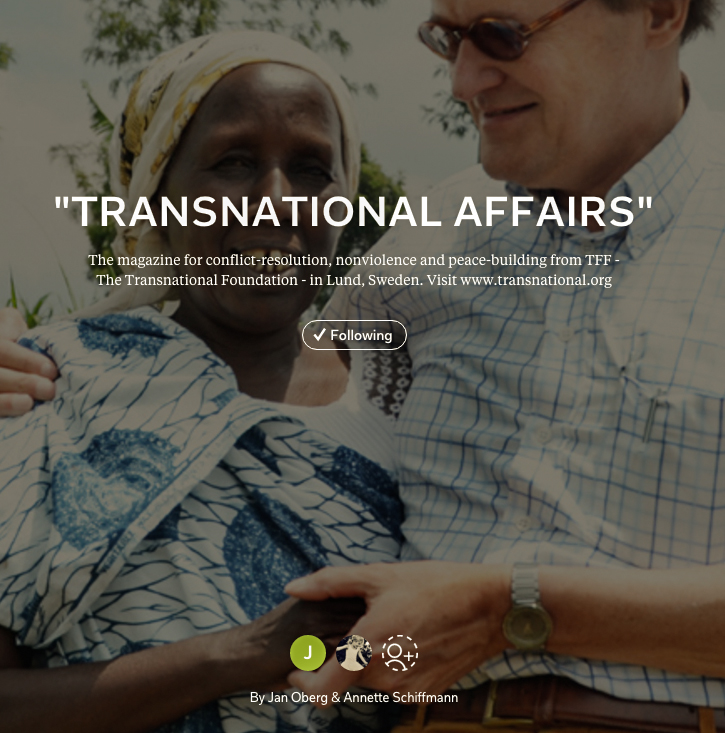
TFF PressInfo # 353: “Transnational Affairs” – TFF launches new online “flip” magazine

Lund, Sweden, January 18, 2016

Today, on Martin Luther King Jr. Day, TFF launches its new online “flip” magazine, “Transnational Affairs”.

Social media posts may soon be forgotten, too far down your feed to find.

We now curate them – 10-15 a day – at “Transnational Affairs” and include other important debate articles, blog posts, analyses and videos you’ll only find here.

That’s why you should click “follow” on this magazine – and Like it too – a treasure trove of quality materials for the concerned citizen, media person, student and researcher.

We curate “Transnational Affairs” to help you understand – easily flipping – what happens in our troubled world and what could be done to make it much better.

“Transnational Affairs” reflects the diversity of TFF’s work and themes – such as peace by peaceful means, nuclear issues, Iran, Syria, Burundi, the Balkans, non-violence, UN matters, world order change, the weakening of the U.S. Empire, refugee and why and how war can be replaced by more intelligent methods.

“Transnational Affairs” is based on our 30 years in business and our commitment to truly independent research and public education.

Furthermore, it’s a completely new and exciting way of browsing on your tablet or phone – you “flip” the magazine’s content.

Learn, be inspired, act – begin here. There are already 560 articles…

Obama’s success in foreign policy

By Jonathan Power

Make no mistake Barack Obama is going to go down in history as one of the great American presidents.

At home he has confronted poverty, ill-health, racism, gun laws, unemployment, immigration and the criminal justice system – with amazing tenacity, sometimes to great effect, even though the Republicans have fought him tooth and nail over every attempt at reform.

The economy is striding along, shaming Europe. Abroad he has had to struggle on multiple fronts – more than any other recent president. There are problems, especially in the Middle East, that would – and will – defeat any president. But there is a clear narrative running through Obama’s foreign policy, one that makes a lot of sense.

What is most clear is the honouring of the commitment he made in his Nobel Peace Prize speech at the onset of his presidency to lowering America’s propensity to use its military might.

His presidency began with his attempt to get relations with Russia back on an even keel. A good deal was made with President Vladimir Putin on further mutual reductions in nuclear arms.

He concluded the withdrawal of the majority of American troops in Afghanistan and Iraq (170,000 down to 1,000 in Iraq and 100,000 down to 10,000 in Afghanistan).

Later came his frustrating – and frustrated – effort to Read More »

Syria – Minding the minds (II)

By Johan Galtung

Baher Kamal, in – And All of a Sudden Syria! writes:

“The “big five” /the UN veto powers/ have just agreed /Res 2254 of 18-12-2015/– time to end the Syrian five – year long human tragedy – they waited until 300,000 innocent civilians were killed–4,5 million humans lost as refugees and homeless at home, hundreds of field testing of state-of-the-art drones made, and daily US, British, French and Russian bombing carried out”.

But no Chinese bombing.

One term in the resolution, road map, already spells failure. There is another reason: missing issues. But something can be done.

Roads twist, turn and may be far from straight. Traveling a road is a linear, one step or mile-stone after another, process, by the map. The West loves linearity; as causal chains (“falling dominoes”) from a root cause; as deductive chains from axioms; as ranks from high to low.

However, is that not how the world is, moving in time, causes-effects, axioms-consequences, rank, power, over others? Are roads not rather useful? They are. Is there an alternative to a road map? There is.

One step after the other in time is diachronic. An alternative would be synchronic; at the same time. Let us call it a cake map.Read More »

Can cyber warfare prevent wars?

By Gunnar Westberg

Can cyber warfare prevent wars?

This is a call for information. An appeal to people who know more abou cyber warfare!

As long as there are armies the threat of war remains.

As long as there are nuclear weapons the threat of extermination of mankind from nuclear war remains.

It is sometimes said that nuclear weapons will be with us until we find something more effective.

Could cyber warfare be an alternative?

The U.S. together with Israel delayed the development of the uranium enrichment facilities in Iran through the use of a virus introduced into the centrifuges. Iran may have been behind a cyber attack on computers in Saudi Arabia that interfered with oil refineries and oil transport.

Can cyber warfare prevent a military attack? Here an attempt to illustrate the idea:Read More »