TFF PressInfo # 351: The Nobel Foundation taken to court on the Peace Prize

Lund, December 10, 2015

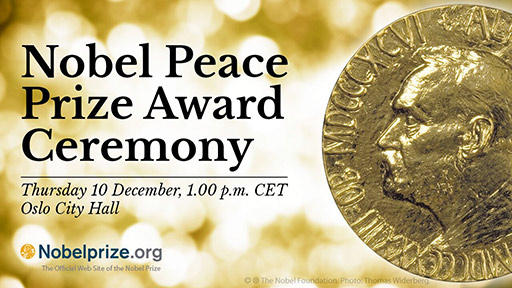
On the day of the Nobel Peace Prize Award Ceremony at Oslo City Hall

To whom it may concern, including the media

We know – and Alfred Nobel knew – how devastating war and arms races are, and how little security we get for all the money we spend on military forces.

The campaign to reclaim the Nobel Peace Prize is first and foremost a campaign to revive the idea that global peace requires global cooperation on disarmament and replacing the law of force with the force of law. Every day more and more of us see, from the Middle East warfare, from the refugee crisis, and many other chilling reminders, the mandatory urgency of a change in world politics.

Alfred Nobel decided to give one fifth of his fortune for a prize to promote disarmament and resolution of all conflicts through negotiations and legal means, never through violence.

Can such a prize, with a so clearly stated goal, be turned to serve the opposite idea and be given again and again to recipients who promote arms races and believe in militarism and war?

This question will soon be answered, after Mairead Maguire, Jan Oberg, Davis Swanson, and Lay Down Your Arms took the case to the Stockholm District Court on Friday 4th of December 2015. Here is the full text of the summons.
and all other relevant information is available at the Nobel Peace Prize Watch.

Test case: the award to the European Union in 2012

The court case will test one of the most obvious violations of the Nobel idea Read More »

The Nobel Foundation Summons, Dec 4, 2015

Mairead Maguire, Jan Oberg, Davis Swanson, and Lay Down Your Arms took the case against the Nobel Foundation and thereby indirectly the Nobel Committee in Oslo to the Stockholm District Court on Friday 4th of December 2015.

Full text of the summons

Stockholm, December 4, 2015

Stockholm City Court
Box 8307
104 20 Stockholm

Our ref
8112/L

PETITION FOR A SUMMONS
[BRIEF TO OPEN CASE]

Plaintiffs
1. Mairead Maguire
2. Jan Öberg
3. David Swanson
4. Lay Down Your Arms/Nobel Peace Prize Watch

Counsel
Advokat Kenneth Lewis
Lewis & Partners Advokatbyrå AB
Box 2104
103 13 STOCKHOLM

Respondents
1. Marcus Storch
Grevgatan 65, lgh 1401
11459 STOCKHOLM

2. Göran K Hansson
Sankt Eriksgatan 14, lgh 1304,

112 39 STOCKHOLM

3. Lars Heikensten

Odengatan 75

11322 STOCKHOLM

4. Peter Englund
Dragarbrunnsgatan 63 C
753 20 Uppsala

5. Tomas Nicolin
Karlavägen 11, lgh 1603
114 24 Stockholm

6. Kaci Kullman Five
Lille Toppenhaug 4
1353 Baerums Verk
Norge

7. Staffan Normark
Långängsvägen 27
182 75 Stocksund

Case
Board members´ liability to compensate the Nobel Foundation according to the Foundations Act (1994:1220)

Forum
Ch. 10 Art. 14 Rättegångsbalken (Civil Procedure Act)

As the retained counsel of Mairead Maguire, Jan Öberg, David Swanson and Lay Down Your Arms (Below plaintiffs) I hereby apply for summons of Marcus Storch, Göran K Hansson, Lars Heikensten, Peter Englund, Tomas Nicolin, Kaci Kullman Five, and Staffan Normark and will present these

CLAIMSRead More »

Peace journalism – is it working?

By Johan Galtung

Short answer: No. The Paris event triggered war journalism; no peace journalism was observed. To doubt that anti-IS violence will work is not peace journalism, only war journalism with question marks.

Peace journalism was conceived in the 1960s as a reaction to foreign news negativism, and focus on actors and elite people/countries. Not as advocacy of peace, but as journalism about peace; like war journalism is not advocacy of war, but indispensable journalism about war, reporting what happens, and who is winning. It can be done well or not, and often becomes propaganda for one side, in national more than local and global media (with Anglo-American accent, however).

Thus, peace journalism was never a substitute for war journalism. The idea was to have both, complementing each other. Read More »

A ceasefire in the War On Drugs?

By Jonathan Power

Not that long ago in Britain Sherlock Holmes could quite legally sit by the fire with his pipe and sniff cocaine. If friends wanted to join him they could, without fear of a police raid, smoke marijuana. Opium was used for those in unbearable pain and could be bought without a doctor’s prescription. (Alas, most people in very poor countries then and today have never been able to afford any pain relief. Too many die in agony.)

Historically, it is the British who have the worst record on drugs. When the British controlled India they became the largest drug trafficker the world has ever seen, transporting opium from India to China, forcing Chinese ports open so they could win addicts among the mass market of the poor.

These days, when it comes to alcohol and tobacco, in most societies the degree of control is subject to fierce debate Read More »

TFF PressInfo # 350 – The West will lose to ISIS – too

By Jan Oberg

Lund, Sweden, November 30, 2015

French president Hollande has declared war – war on terror, George W. Bush style. Like September 11, 2001 wasn’t a war, Paris November 13 wasn’t a war. It was a criminal act.

The war on terror has been an exceptionally stupid war.

In the years before 9/11 about 400 people died worldwide by terrorist attack. The Global Terror Index informs us that 32.600 died in 2014 – 80 times more!

And, still, the only answer everywhere is: More war on terror.

The only – intelligent – exception is Italy whose PM has announced that Italy is going to counter terrorism by investing billions of Euros in culture, art and creativity – showing the world what civilisation is.

Politicians and the mainstream media seemingly try to make us believe – as if we were uneducated – that we in the West are the main victims and innocent victims at that. We are neither.Read More »

Burundi – to stop another genocide

By Jonathan Power

November 24, 2015

The United Nations Security Council has adopted a resolution strongly condemning the escalating violence in Burundi. It paves the way for the UN to send in thousands of blue-helmeted peacekeepers.

The resolution, which was passed unanimously, condemns the wave of killings, arrests and human rights violations. It requests that Secretary-General Ban Ki-moon reports within 15 days – i.e. on Friday the 27th – on options for increasing the UN presence in Burundi.

There are fears of a Rwandan-style genocide in Burundi, which like Rwanda has a long history of tribal distrust and, on occasion, hatred, although there are many intermarriages. At least 240 people have been killed there since protests began in April.

Since independence from Belgium in 1962 it has been plagued by tension between the dominant Tutsi minority and the Hutu majority.

The ethnic violence sparked off in 1994 made BurundiRead More »

Violence in and by Paris: Any way out?

By Johan Galtung

Atlanta, Georgia, USA

The atrocity in Paris seems to trigger the word “terrorism” with a higher frequency than ever, in the media, from the politicians. Doing so, they sign their intellectual capitulation: trust me, I am not going to try to understand anything. Watching politicians on 56 US TV channels in Georgia there was not a single word analyzing why?; like underlying conflicts and traumas.

Nor conciliation and solution. Only a description of what? – the horrible violence. And what to do: more violence, war. With a question mark though: Will it work?

The whole Western world was living up to the old French saying – Cet animal est très méchant, quand on le bat, il se defend. (That animal is very vicious, when you beat it, it defends itself). Look at centuries of French/Arab-Muslim relations and find one-way beating, killing, conquest, colonialism, exploitation, France using them in wars against Turkey and against Germany promising freedom and breaking their promises, raw post-colonial colonialism, no respect for their wishes to be the masters in their own house, like now in Mali.

Using them for menial jobs in France, if they speak French. At the bottom of society, shocked when the French school system treats them equally and they climb upwards, like African-Americans when they gained access to the US school system. And eventually to US society, after a century of Jim Crow and the civil rights movement.

France is now in that phase. Do not assume that 350 million Arabs – 1,650 million Muslims – will take more beating hands down. Read More »

The Failure of U.S. foreign policy in the Middle East

By Richard Falk

Prefatory Note: What follows is a modified version of the Morton-Kenney annual public lecture given at the University of Southern Illinois in Carbondale on November 18, 2015 under the joint sponsorship of the Department of Political Science and the Paul Simon Public Policy Institute.

The Failure of U.S. Foreign Policy in the Middle East

While focusing on the ‘failure’ of American foreign policy in the Middle East it is relevant to acknowledge that given the circumstances of the region failure to some degree was probably unavoidable. The argument put forward here is that the degree and form of failure reflected avoidable choices that could and should have been corrected, or at least mitigated over time, but by and large this has not happened and it is important to understand why.

This analysis concludes with a consideration of three correctible mistakes of policy.

It is also true that the Middle East is a region of great complexity reflecting overlapping contradictory features at all levels of political organization, especially the interplay of ethnic, tribal, and religious tensions internal to states as intensified by regional and geopolitical actors pursuing antagonistic policy agendas. Additionally, of particular importance recently is the emergence of non-state actors and movements that accord priority to the establishment and control of non-territorial political communities, giving primary legitimacy to Islamic affinities while withdrawing legitimacy from the modern state as it took shape in Western Europe. Comprehending this complexity requires attention to historical and cultural background, societal context, and shifting grand strategies of geopolitical actors.

I.

From many points of view American foreign policy in the Middle East has been worse than a disappointment. It has been an outright failure, especially in the period following the 9/11 attacks of 2001. Even such an ardent supporter and collaborator of the U.S. government as Tony Blair, the former Prime Minister of the United Kingdom, has acknowledged as much in a recent set of comments where he basically says that the West has tried everything, and whatever the tactics were relied upon, the outcome was one of frustration and failure. Read More »

School mediation – problems and solutions

By Johan Galtung

The world wave of mediation has reached school systems all over; in some countries less, in others more. Like in Spain, as evidenced by this heavily oversubscribed seminar on school mediation. When asked to express what they want to see happen in schools, the most frequent answer was convivencia, living togetherness. In one word, not as a composite concept. Like in Japanese, the one word is kyosei.

What does it mean, concretely? I would interpret it as positive peace at school. Something behavioral: cooperation for mutual and equal benefit. Equity. Something attitudinal, emotional resonance, I enjoy your joy, I suffer your suffering: Empathy. Harmony.

But the school is a big, holistic place. Not only children, but also adults, teachers and staff. And parents. Positive togetherness within and between all these four groups? A huge order.

Many simplify this to togetherness among children, and not positive, only less negative. Less bullying, to protect victims – parents demand that – and to use teacher time for teaching, not keeping discipline–the staff demands that. However, it all hangs together.

In addition, simplification runs against another big world wave of two values: diversity and equality, against homogeneity-verticality. Read More »

Bombing ISIS is not the solution

By Jonathan Power

November 17, 2015

The Barbarians are not at the gate. There is no need for a rush to war as the French president, Francois Hollande, suggests.

The Americans did this after 9/11 and raced into Afghanistan with the intention of eliminating Al-Qaeda. They failed and they are still in Afghanistan – America’s longest war ever. They have become bogged down in fighting Afghani movements including the Taliban. Some of the Taliban may have hosted Al Qaeda for a while, but accounts suggest they weren’t happy about it. They certainly don’t today.

In Harvard University’s magazine, “International Security”, Professors Alexander Downs and Jonathan Monten report they have studied over 1000 military interventions over many years. It is very rare that there has been success.

Bogged down, bogged down. These two words should resonate in every Western (and Russian) leaders’ head. Vietnam, Iraq, Afghanistan, Lebanon and Libya. (Also Russia in Afghanistan and in Chechnya).

There is such a long list of failure. Give one good reason why it should be different this time.

Think of Read More »