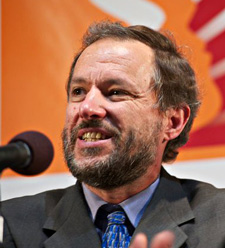
Gaza: 7th year of unlawful blockade

By Richard Falk

Prefatory Note: I am posting a press release of yesterday, 14 June 2013, to take note of the start of the seventh year of the Israeli blockade. After the Mavi Marmara incident, 31 May 2010 and the more recent November ceasefire agreement between Israel and the Gaza government there was an undertaking to ease the blockade with respect to the flow back and forth of people and goods, but the situation remains desperate for the civilian population of Gaza that remains essentially locked into the Gaza Strip where economic destitution has reached epidemic extremes and where the water is mostly unfit for human consumption. The international community, and its main leaders, have commented adversely on the blockade, but nothing happens! It is this sense of powerlessness that is undermining the legitimacy and relevance of the United Nations to the suffering of the Palestinian people, and with particular relevance to the extreme ordeal of the civilian population of Gaza.

Continue…

Special Rapporteur’s report on Occupied Palestine

By Richard Falk

Prefatory Note: What follows below is the text of the report presented on 10 June 2013 to the Human Rights Council. It offers an overview of the situation from the perspective of human rights and international humanitarian law in occupied Palestine. Both Israel and the United States boycotted the session, presumably to express their displeasure with the report and my role as Special Rapporteur. UN Watch distributed a defamatory resolution calling for my dismissal from the position, and the United States delegate, Ambassador Donahue, called for my resignation. No government formally endorsed the UNW resolution, and so it was never acted upon, while I took the occasion of the press conference to confirm my unwillingness to resign, and on the contrary, to continue to do my best to reflect as honestly as possible the realities confronting the Palestinian people from the perspective of international law. In the open debate the European Union represented criticized what was called the inappropriate failure to limit my report to ‘law and facts,’ pointing particularly to what was described as ‘the political’ in paragraph 7. In that paragraph the report offers some comments on the futility of securing the Palestinian right of self-determination by way of resuming direct negotiations; by expressing such skepticism about the diplomatic track, the EU apparently regarded the assessment as political, but to my mind it was an appropriate comment on why the prospects for protecting and realizing Palestinian fundamental rights under international law are likely to remain in total eclipse.

The text below can be read in its formal context by using the link to the actual document to be found on the Human Rights Council website.
Continue…

Why Arabs need Iran

By Sharmine Narwani

In 2011, when Arab revolts began to sweep the Middle East and North Africa, the view from Washington and its closest allies was one of concern. How would the removal of mostly pro-Western dictatorships affect the balance of power in the region? More importantly – how to prevent these events from boosting Iran’s influence?

Two years on, the regional competition for influence is in full throttle. In its sights – among many other developments – are recent efforts by Iran and Egypt to upgrade their relationship.

The spoilers will have none of it. Said Steven A. Cook last week on the website of that most prestigious of US institutions, the Council on Foreign Relations (CFR): “Other than some quick cash and subsidized energy, there is nothing that Tehran can offer Cairo that will, in the long run, be to Egypt’s benefit.”

He has it entirely wrong. “Quick cash and subsidized energy” can only be used to describe the superficial offerings of countries like Saudi Arabia and Qatar, both vying for influence in this new Egypt.

There is no contest whatsoever between that kind of assistance and what Iran can bring to the table. Iran has achieved its economic independence the hardest way imaginable…

Continue

Reinventing Fascism

By Johan Galtung

The atrocious Second World War left behind lasting damage by lowering our standards for what is marginally acceptable. War is bad; but if it is not nuclear, the limit has not yet been reached. Fascism is bad; but if it does not come with dictatorship and the elimination of a category of people, the limit has not yet been reached. Hiroshima, Hitler, Auschwitz are deeply rooted in our minds, distorting them.

Hiroshima makes us disregard the state terrorism against German and Japanese cities, killing citizens of any age and gender. And Hitler and Auschwitz make us disregard fascism as the pursuit of political goals by means of violence and the threats of violence. It takes two to make a war, by whatever means. But it takes only one to make fascism, against one’s own people, and/or against others.

What is the essence of fascism? Read More »

What Obama will see in Africa this week

By Jonathan Power

In June,1994, Nelson Mandela, South Africa’s first black president, spoke at a summit meeting of the Organisation of African States: “We must face squarely that there is something wrong in how we govern ourselves. It must be said that the fault is not in our stars but in ourselves.” At last Africa seems to have taken his words of wisdom to heart.

This week President Barack Obama will be in Africa to see for himself how most of Africa over the nine years since that speech has taken the high road.

One by one throughout the 1990s governing elites began to come to their senses. Twenty-five States established multi-party democracies.

Approximately two-thirds of the people of Africa own a mobile phone. In many African countries phone technology is ahead of Europe and North America. Read More »

Up and up in the developing world

By Jonathan Power

Never in the history of mankind have the living conditions and prospects of so many people changed so dramatically and so fast.

The birthplace of the Industrial Revolution, Great Britain, took 150 years to double its output. The US which industrialised later took 50 years. Both countries had a population of less than 10 million when they industrialised. Today China and India with populations over a billion each have doubled their output in less than 20 years – and many other developing countries have done as well.

According to the UN’s recent Human Development Report– which everyone should read on line – it is more exciting than most novels – reports that by 2050 Brazil, China and India will account for 40% of the world’s output. The combined incomes of eight developing countries – Brazil, Argentina, China, India, Indonesia, Mexico, South Africa and Turkey – already equals that of the USA.

Their success is boosting the fortunes of many of the poorer countries, not least in Africa, because of higher levels of trade, investment and capital inflows and, perhaps most critically, India’s sale of affordable medicines and medical equipment.

The most important engine of growth of the developing South is their own domestic markets.Read More »

Turkey getting stuck again?

By Johan Galtung

From Istanbul

Turkey did the impossible, moving almost without violence from a military secular dictatorship to a civilian Sunni majority democracy. Turkey got unstuck. Sarkar’s circulation of elites at work: military elites, then religious-intellectuals, then business, then ordinary people–and once again the military. Second cycle.

Big Business would knock at the door, as it did in the Thatcher-Reagan revolution of the mid-1980s. Hence, not surprising that a big mall was one of the projects, together with an opera, a mosque and a monument from the Ottoman period for the Taksim Square-Gezi Park project. Every element a gift for Istanbul’s 14 million inhabitants. But, at the expense of a park, green nature, lungs, in that part of Istanbul.

Whether it escalated from this point to an extra-parliamentary confrontation between the winners (Justice and Development Party-AKP) and losers (Republican People’s Party-CHP) of the last two elections – the losers carrying much of the infelicitous past – or the other way round, or both, can be and is debated here.

Other processes are going on. Syria. Read More »

The last colony: Beyond dominant narratives on the Western Sahara roundtable

By Stephen Zunes

This is one of seven pieces in Jadaliyya’s electronic roundtable on the Western Sahara. Moderated by Samia Errazzouki and Allison L. McManus, it features contributions from John P. Entelis, Stephen Zunes, Aboubakr Jamaï, Ali Anouzla, Allison L. McManus, Samia Errazzouki, and Andrew McConnell.

Western Sahara is a sparsely-populated territory about the size of Italy, located on the Atlantic coast in northwestern Africa, just south of Morocco. Traditionally inhabited by nomadic Arab tribes, collectively known as Sahrawis and famous for their long history of resistance to outside domination, the territory was occupied by Spain from the late 1800s through the mid-1970s. With Spain holding onto the territory well over a decade after most African countries had achieved their freedom from European colonialism, the nationalist Polisario Front launched an armed independence struggle against Spain in 1973. This—along with pressure from the United Nations—eventually forced Madrid to promise the people of what was then still known as the Spanish Sahara a referendum on the fate of the territory by the end of 1975.
More…

Whose ‘Two State’ solution? End game or intermission?

By Richard Falk

From many sources there is a widespread effort to resume a peace process that has in the past led to failure, frustration, and anger, and often to renewed violence. The newly appointed American Secretary of State, John Kerry, is about to make his fifth trip to Israel since the beginning of 2013, insisting that the two sides try once more to seek peace, and warning if this doesn’t happen very soon, the prospects for an agreed upon solution will be postponed not for just a year or two, but for decades.

Kerry says if this current effort does not succeed, he will turn his attention elsewhere, and that the United States will make no further effort. So far, aside from logging the air miles, seems perversely to be responsive to Tel Aviv’s demands for land swaps to allow settlement blocs to be incorporated into Israel and to promote further Palestinian concessions in relation to security arrangements, and totally unresponsive to Ramallah’s demands for some tangible signs from the Israeli government that resumed negotiations will not be another slammed door. In this vein, Kerry’s most ardent recent plea was at the Global Forum, an annual event organized under the auspices of the American Jewish Committee. Kerry told this audience that they possessed the influence to make the peace talks happen.

Somewhat surprisingly, even Marwan Barghouti writing from prison, Read More »

Today the world was blessed with a new hero: Edward Snowden

By Jan Oberg

Spontaneous thoughts at having seen this interview three times in a row.

One moral individual standing up for true democracy and freedom against one of the most evil systems the world has ever seen.

The Guardian: “Snowden will go down in history as one of America’s most consequential whistleblowers, alongside Daniel Ellsberg and Bradley Manning. He is responsible for handing over material from one of the world’s most secretive organisations – the NSA.

In a note accompanying the first set of documents he provided, he wrote: “I understand that I will be made to suffer for my actions,” but “I will be satisfied if the federation of secret law, unequal pardon and irresistible executive powers that rule the world that I love are revealed even for an instant.”

I am deeply moved by Edward Snowden. Very deeply. Such civil courage. Such moral awareness. Such knowledge. Such intellectual clarity. Such determination combined with the humility of serving a higher cause.

Do I at all understand what this one single, determined individual is up against? How he dares? No, I don’t think I do. It is too great, too unique, too rare in a world of so much opportunism and “somebody else must do what must be done”.

I’m reminded of Gandhi’s dictum that “A burning passion coupled with absolute detachment is the key to all success.”

Today the world was blessed with a hero of such proportions that it is hard to believe it is true. As long as there is an Ellsberg, a Manning and now a Snowden – and thousands of other courageous unsung heroes fighting for a better world, I will not abandon my hope.

For years I have ended my courses and public lectures by saying that I don’t believe much in peace movements but I believe that every human being is, potentially, a peace movement. Snowden is yet another living proof of this.

– Jan Oberg