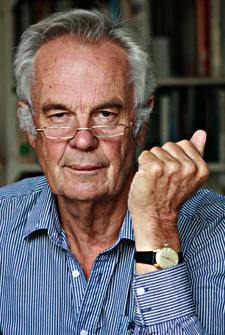
Who is left? Who is right?

By Jonathan Power

It goes back to the French revolution of 1789. At the Revolutionary Convention the most radical of the insurgents decided to seat themselves on the left side. “Why not on the other side, the right side, the place of rectitude, where law and the higher right resided, when man’s best hand could be raised in righteous honour?” wrote Melvin Lasky in Britain’s intellectual monthly, Encounter. “Anyway they went left, and man’s political passions have never been the same.”

When Oskar Lafontaine, the West German finance minister, broke with Chancellor Gerhard Schroder in the early days of the last Social Democratic government, he explained it was “because my heart beats on the left.” The right could never say that, even David Cameron, prime minister of Britain, who likes to make out that he is liberal, at least on the environment and foreign aid. When Humpty-Dumpty insisted on his own “master-meanings” he reassured Alice, “When I make a word do a lot of work like that, I always pay it extra…….”

Those who want to study the ambiguities and contradictions of intellectual leftists Read More »

Beyond the haunted imagination

By Richard Falk

Ever since atomic bombs were exploded over the Japanese cities of Hiroshima and Nagasaki in the closing days of World War II, end-of-the-world forebodings have been present in Western cultural consciousness. In the background of such thinking is the religious anticipation of a day of judgment when life in earth will be replaced by the consignment of everyone then living to either the hell of damnation or the heaven of salvation.

The first type of end time thinking is based on the fear that the Promethean gift of technological innovation when carried to its omega point will produce a big bang terminal moment in the human experience. The second kind of end time thinking imagines that the gift of planetary life was a testing time for the human species that would end with endless punishment for the many and eternal rewards for a few, and was divinely programmed in a fatalistic manner beyond human capacity to control or alter.

We live now amid both types of end time thinking, a realization made more troublesome because such alarmist patterns of awareness, while rather widespread, have not generated any strong reactive movement based on prudence and preservation. Instead, all of us avert our eyes most of the time, and most manage to look away all the time often with the help of drugs and denial. Only a few are able to fix their full gaze on the impending cosmic wreck without turning away.

One of those few is a poet named C.K. Williams who in an essay, “Nature and Panic,” Read More »

Forget ‘normal’ politics

By Richard Falk

Political life is filled with policy choices that are made mainly on the basis of calculations of advantage, as well as reflecting priorities and values of those with the power of decision. In a constitutional framework of governance the rule of law sets outer limits as to permissible outcomes. The legitimacy of the decision depends on adhering to these procedural guidelines, and the fact that if the societal effects turn out badly it can be corrected by altering the ‘law.’

Of course, all sorts of special interests behind the scene manipulate this process, and the public debate mirrors these pressures. The results of highly contested policy choices usually reflect the power structure (class, race, ideology) more than they do the outcome of rational detached assessments of the public good.

At present, the national public good in the United States is being held hostage to the lethal extremism of the gun lobby as led by the National Rifle Association (NRA), Read More »

Zero Dark Thirty – ZD30 – and American exceptionalism

By Richard Falk

ZD30 is the film narrative that tells the dramatic story of the special forces operation that on May 2, 2011 located and killed Osama Bin Laden in a compound on the outskirts of the Pakistani city of Abbottabad, which is not far from Islamabad.

It is directed by the prominent director, Kathryn Bigelow, who had won big Hollywood awards for her brilliant 2008 film, Hurt Locker, about the impact of combat experience in Iraq on the American soldiers taking part. She knows her craft, and ZD30 is captivates an audience due to its screenplay, virtuoso acting, taut plot, vividly contoured characters, insight into the mentality of CIA operatives and their bosses, and the evidently realistic portrayal of grisly torture scenes.

These filmic virtues have been displaced by a raging controversy as to whether ZD30 endorses torture as a valued and effective tool against extremist enemies of the United States and seems to imply that torture was instrumental in the successful hunt for Bin Laden.

Certainly President Obama claimed and received much credit in the United States for executing this mission, and it has received very little critical scrutiny. It is hard to calculate the impact of this strike that killed Bin Laden on the 2012 election, but it many believe it made a crucial difference, at least psychologically, and particularly in relation to the outcome in swing states and with respect to the last minute decisions reached by independent voters.Read More »

Change happens – But How, Why, When and Where?

By Johan Galtung

A century ago humanity, particularly in the West, was at the beginning of a major revolution, from horse culture to car culture. Today there are still (FAO-UN Food and Agriculture Organization, 2008) 59 million horses, but (2010) more than 1 billion cars (in 1986 only half of that). In other parts of the world, like Japan and China, there was a revolution to cars, but from bicycles–Beijing went from 6 million bicycles to 4 million cars over a period of 20 years, only from 1990. Japan had an intermediate scooter stage–like in India, Southeast Asia–less so in China.

Imagine 19th century in the West: horses everywhere. Read More »

Walkers of the World Unite!

By Jonathan Power

When first running for president Barack Obama was made to feel uncomfortable on national television when an inquisitor attempted to pin him down on the inconsistencies of his non-smoking pledge. Clearly Obama had some trouble in not, as he put it, ”falling off the wagon”.

But, maybe, he should get completely off the wagon. It was reported that in the inauguration parade gas-guzzling SUVs were not used. But why did he not go a little bit further and insist that everyone walk?

Here is a man who likes to go to the gym every day, but a 45 minutes walk would do the job just as well and set a car-crazed world the example it needs. We have had bicycling heads of state or government before – look at Queen Beatrix of Holland and today David Cameron, the prime minister of Britain, when he was leader of the opposition cycled to the House of Commons. So why not a walker? That is what Cameron has now become.Read More »

A New Year’s wish: Go beyond !

By Johan Galtung

Yes, go beyond, transcend! That is our message, New Year or not.

Take the US school shootings. The National Rifle Association’s vice president on TV: “the only person who can stop a bad person with a gun is a good person with a gun”. That statement struck many cords.

There is the deep US culture of Dualism – two kinds of people – and Manicheism – one bad, one good. There is Armageddon in the class room, the teacher or resident police pulling out the gun–bigger, better, more accurate–for the final battle, for the final and only solution. The NRA is riding on this DMA (Dualism/Manicheism/Armageddon) ground swell from below, and so are millions of others. It is concrete, feasible, and could start January 2013.

There is confirmation from above: this is US foreign policy. The only way to stop a bad country with arms is a good country with arms; the only way to stop evil terrorism from below is good state terrorism from above. Balance of power, countless bases, search and destroy.

We agree about the critical focus: school shootings–the USA committing suicide! – must not happen. But what do we know empirically to be constructive, creative? The answer is wrapped in ambiguity.Read More »

Mohammad and the wild, marginal men of the Muslim world.

By Jonathan Power

The wild demonstrations that last week burst out in many places in the Middle East, Pakistan, Afghanistan, Sudan and other places will not be the last and neither were they the first to protest Western insults of the prophet Mohammad. Much more serious were the ones that erupted in 1988 following the publication of Salman Rushdie’s novel, “The Satanic Verses”, and seven years ago the protests and threats that followed the publication of satirical cartoons in a Danish paper, mocking Mohammad.Read More »

Pros and Cons of solidarity with the Palestinian people

By Richard Falk

The posture of solidarity with the struggle of ‘the other’ is more complex than it might appear at first glance. It seems a simple act to join with others in opposing severe injustice and cruelty, especially when its reality is experienced and witnessed first-hand as I have for several decades in relation to the Palestinian struggle.

I was initially led to understand the Palestinian (counter-) narrative by friends while still a law student in the late 1950s. But my engagement was more in the spirit of resisting what Noam Chomsky would later teach us to call ‘indoctrination in a liberal society,’ a matter of understanding how the supposedly objective media messes with our mind in key areas of policy sensitivity, and none has turned out in the West, especially in North America, to be more menacingly stage managed than the presentation of Palestinians and their struggle, which merge with sinister forms of racial and religious profiling under the labels of ‘the Arab mind’ and ‘Muslim extremism.’ Read More »

UN Alliance of Civilizations, Istanbul Partners Forum

By Richard Falk

The UN Alliance of Civilization (AOC) was initiated by Kofi Annan in 2005 while he was Secretary General of the UN with the joint sponsorship of Turkey and Spain, with its principal center of operations in Istanbul. It was formed under the dark skies that existed after the 9/11 attacks, and seeks to provide an alternative narrative to that of inter-civilizational war, that starkly negative scenario of Islam versus the West associated with the inflammatory views of Bernard Lewis and Samuel Huntington that continues to provide fuel for Islamophobia that burns ever more brightly in Europe and North America.

It was several years since I had heard as many references to Huntington’s ‘clash of civilizations’ thesis as I did during the discussions and presentations at the Istanbul Forum, which was opened by speeches made by Recep Tayyip Erdogan, the Prime Minister of Turkey, and Ban Ki Moon, the current UN Secretary General.

The primary rationale for the AOC is to provide a ‘platform’ for inter-civilizational dialogue that explores differences among civilizations, but seeks to promote mutual undertstanding and respect, even affection and celebration. Read More »