Pope Francis visit to Palestine

By Richard Falk

Pope Francis’ visit to the Holy Land raises one overwhelming question: What is the nature of religious power in our world of the 21st century? Can it have transformative effects’?

Media pundits and most liberal voices from the secular realm approve of this effort by Francis to seek peace through the encouragement of reconciliation, while dutifully reminding us that his impact is only ‘ceremonial’ and ‘symbolic’ and will not, and presumably should not, have any political consequences beyond a temporary cleansing of the political atmosphere.

The June 6th prospect of Mahmoud Abbas and Shimon Peres praying together in the Vatican as a step toward a peaceful end of the long struggle is, I fear, an ambiguous sideshow. For one thing, Peres as President of Israel is about to leave the office, and in any event, his position exerts no discernible influence on the head of state, Benjamin Netanyahu, or the approach taken by Israel in addressing Palestinian concerns.

It has long been appreciated that Peres is less than he seems, and beneath his velvet globe is a steel fist. Also, Abbas, although the formal leader of the Palestinian Authority and Chair of the PLO, is a weak and controversial leader who has yet to establish a unity government that includes Hamas, and finally provides political representation for the long suffering population of the Gaza Strip within global venues.

Yet it would be a mistake to ignore the significance, symbolically and materially, of what Pope Francis’ visit to Palestine heralds. Read More »

Peace Studies: Ten Basic Points

By Johan Galtung

Foreign Policy Studies, University of Malmö, Sweden

Thanks for wanting a summary of key points in “Galtung Peace Studies”. I was just honored with a “Lifetime Award” by world sociology, 60+ years; in short, time for summary with an author’s caveat: no substitute for reading books.

[1] 1951: Peace studies=peace theory+peace practice; applied science, with an explicit value–peace–with practice-indicative theories and theory-testing practice; like health studies, unlike social sciences. Model: peace to violence as health to illness; Diagnosis-Prognosis-Therapy produced health by weakening pathogens-strengthening sanogens; try the same for peace by weakening bellogens-strengthening paxogens. Mantra: through interdisciplinary, international, interlevel research.

[2] Like in illness violence=suffering of body-mind-spirit, also of the bereaved; unlike in illness, an intended act of commission, a perpetrator-victim relation, a crime, epitomized by aggressive war. Body wounds may be healed but stigma, shame, humiliation, hopelessness, hatred, fear, revenge may settle in mind and spirit as trauma. To judicial approaches, sentence and punishment–against theft of cherished property, violence to the body and sexual violence – add victim – and context-oriented approaches like having less property, more company, no provocation and context-oriented approaches as for instance un-uniformed citizens as vigilantes in public space, etc.

But the antidote to violence is peace: a structure of positive interaction, a culture of nonviolence, focus on the positive in the yin/yang of others and on change from violent to peaceful relations, rather than on party attributes; relations carry more causal weight and are irreducible to attributes: see relation logic-buddhism-daoism.

[3] Peace was liberated from the state focus to cover five levels:Read More »

TFF PressInfo: Psyko-politik i tiden för imperiets nedgång

Av Jan Öberg

Lund , Sverige – 23 maj 2014

Tiden för rationell politik, om begreppet någonsin funnits, är över .

”Realpolitik” har blivit en blandning av marknadsförda ord, propaganda och ledare som gör uttalanden som gränsar till absurd teater. Tunnare och tunnare länkar till Realiteten.

Detta är vad som händer när man förnekar nedgången.

Alla imperier går ner. Det amerikanska imperiet är på nedgång. Makrohistoriker (se t.ex. British Arnold Toynbee’s 12–volymarbete 1934-1961) berättar att det finns många skäl till att imperier faller:

• militarism med konstant krigföring;

• överutvidgning – försöka kontrollera mer än vad du kan hantera;

• förlust av legitimitet i andras ögon;

• strukturella ekonomiska kriser;

• moraliskt förfall;

• förlust av intellektuell och teknisk innovation;

• andra maktstrukturer ökar i styrka över tid och göra saker på nya, kreativa sätt .

Efter 1945 ansågs USA vara starkt på en rad olika maktdimensioner: militär, ekonomi, politik, legitimitet, kultur, innovation. Idag är de bara nummer ett på den militära dimensionen. När alla andra indikationer går ner, blir militären en stor börda som bara accelererar nedgången.

USA är på tillbakagång och i förnekelse. Så är även de flesta av dess allierade och sympatisörer .

Deras utrikes politiska beslutsfattare verkar tro att allt är bra och de kan ändå leda och forma världen enligt deras intresse och världsbild. Det är fortfarande i grunden en missionär .

Här är några delar av vad den består av:Read More »

TFF PressInfo: Psycho politics in the age of imperial decline

By Jan Oberg

Lund, Sweden – May 23, 2014

The time of rational politics, if it ever existed, is over.

”Realpolitik” has become a mixture of marketing soundbites, propaganda and leaders making statement that borders on the Theatre of the Absurd. Thinner and thinner links to Real-ity.

This is what happens when decline in being denied.

All empires go down. The U.S. empire is in decline. Macro historians (see e.g. British Arnold Toynbee’s 12-volume work 1934-61) tell that there are many reasons when empires fall:

• militarism with constant warfare;

• overextension – trying to control more than you can manage;

• loss of legitimacy in the eyes of others;

• structural economic crisis;

• moral decay;
• loss of intellectual and technological innovation and

• simply other powers gaining strength over time and doing things in new, creative ways.

After 1945 the U.S. was considered strong on many power dimensions: military, economics, politics, legitimacy, culture, innovation. Today, it is only clearly Number One on the military dimension. When all the other indicators go down, the military becomes a huge burden and only accelerates the decline.

The U.S. is in decline and denial. So are most of its allies and sympathizers.

Its foreign policy-makers seem to assume that everything is fine and they can still lead and shape the world according to their interest and worldview. It remains fundamentally a missionary.

Here is some elements of what it consists of:Read More »

Citizens versus subjects in a democratic society: The American case

By Richard Falk

“Have we agreed to so many wars that we can’t

Escape from silence?…”

Robert Bly, “Call and Answer”

In my understanding silence is passivity as a way of being. Silence can be much more than the avoidance of speech and utterance, and is most poignantly expressed through evasions of body, heart, and soul. Despite the frustrations and defeats of the period, America was different during the years of the Vietnam War and the civil rights movement.

It was then that alienated gun-wielders assassinated those among us who were sounding the clearest calls for justice and sending messages of hope. In a perverse reaction, Washington’s custodians of our insecurity went to work, and the sad result is this deafening silence!

I have long felt that most American ‘citizens’ increasingly behave as ‘subjects,’ blithely acting as if a love of country is exhibited more by obedience than conscience.

In my view the opportunity to be a citizen is a precious reality, a byproduct of past struggles. Genuine citizenship remains possible in the United States, but has become marginal, and is not much in evidence these days. I am identifying the citizen as an ethically sensitive and responsible member of a political community, most significantly of a sovereign state. In contrast, the subject conceives of upright standing in a political community by the willingness to go along with the group and to obey the directives of government and those exercising formal authority.

The moral substance at the core of genuine citizenship only exists if the political structure allows opposition without imposing a severe punishment. If citizenship is possible, then it automatically gives rise to responsibility to act accordingly, that is, by honoring the imperatives of conscience. Read More »

Peace Economics: Making Money Doesn’t Need to Hurt

By Jelena Mair

Business and Peace are not mutually exclusive. Business does play a crucial role in society. More so, business impacts and depends upon its surrounding. It impacts the
social well-being of people and planet, whether intentionally or unintentionally, both locally and globally through the chosen ways of operation and production.

Equally, does business play a key role in contributing to economic development, peace and stability in the areas where it operates. Business provides jobs and revenue to local markets; sets examples of sustainable business practices and can provide support for various social programs through strategic social investment.

In short, business is an inherent aspect of our society, and therefore, if we are striving for a more peaceful and sustainable world, for-profit private enterprises are the most crucial actors in achieving this goal. Read More »

Som broar över mörka vatten – ett integrationsprojekt

Av Christina Spännar & Vibeke Bing

Kanske du associerar TFF med Jugoslavien, Burundi, Irak, Iran, ickevåld och fredsdebatt? Men vi har i tre år också arbetat med frågor kring integration med tonvikten lagd på ensamkommande barn från Afghanistan. Insatsen här har letts av författarna av denna projektsammanfattning.

Vi är stolta över att nu publicera bloggen Som Broar Över Mörka Vatten där allt material finns. Projektet har finansierats av Arvsfonden.

“När vi åkte gummibåt över Turkiets hav till Samos i Grekland greps vi av Grekiska poliser. Poliserna kastade alla våra kläder i havet och gjorde små hål i vår båt.” Ali

“På kvällen satt vi i en båt. Vi åkte till Grekland. På vägen till Grekland fick vi problem med båten. En polisbåt kom och klippte sönder en del av motorn. Vi paddlade med händerna och fyra åror.” Hassan

Vi lever i en märklig tid. Framför våra ögon pågår en stor migrationsvåg av ensamma barn. Något liknande har inte hänt sedan de finska vinterkrigsbarnen kom till Sverige på 40-talet.

De barn, som utan föräldrar, nu flytt hit undan krigets fasor har gjort en annan resa. De kommer från länder vi inte vet mycket om. Vilka är dessa barn och ungdomar, vad tänker de på och hur är livet i Sverige? Vi har lärt känna och lyssnat till några av dem. De är alla från Afghanistan.

Hur deras berättelser kommit till och vad de har att säga kan man läsa i denna rapport, som summerar tre års projektarbete. Här kan man också få veta hur vi sökt arbetsformer som kan underlätta den svåra etableringsfasen.

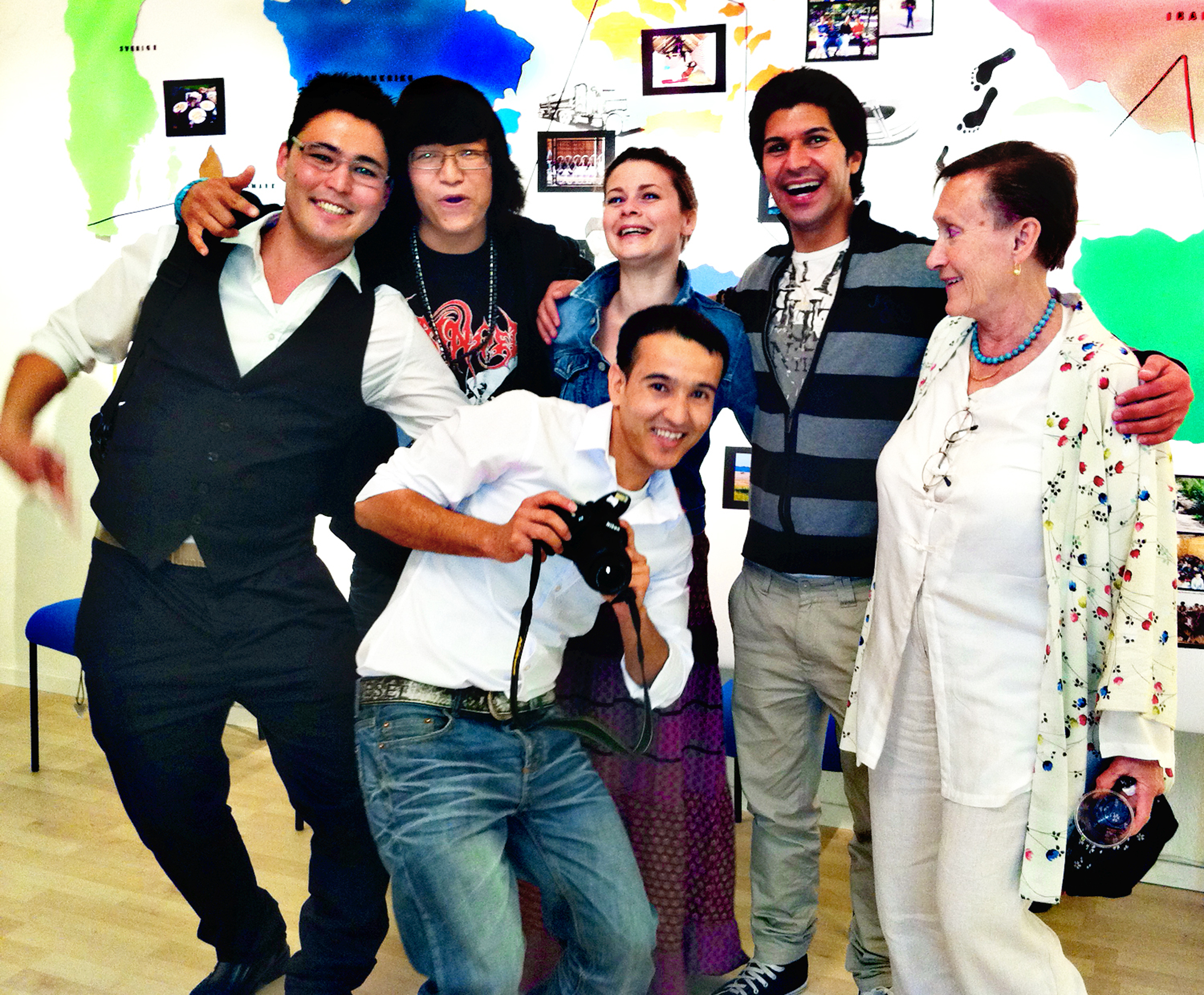
Vid öppnandet av en utställning

Vi berör också det komplicerade i att återförenas som familj.

Vi vänder oss till alla som arbetar med barn, ungdomar och föräldrar. Men också till alla som är nyfikna på vad som sker i vår samtid.
Känns läsningen tung – bläddra vidare till pojkarnas berättelser och det öppnas en ny värld.

En av de unga sammanfattar vår tid tillsammans såhär:

– “Jag har fått hjälp, ni har fått hjälp, vi hade kul!”

Det är bara att instämma!

Vibeke Bing
Projektledare, folkhälsovetare
vibeke@vibekebing.se
076-6451147
0304-663396

Christina Spännar
Projektledare, sociolog
christina.spannar@telia.com
070-1450171
046-129249

Sammanfattning av projektet

Som broar över mörka vatten – ett integrationsprojekt har haft som övergripande syfte att stärka människor i övergångsskeden i livet. Målgrupper har varit nyblivna föräldrar, ensamkommande flyktingbarn/ungdomar samt föräldrar som kommit till Sverige som flyktingar eller som anhöriginvandrare till ensamkommande flyktingbarn och ungdomar.

De övergångsskeden som stått i fokus är att bli förälder och att migrera. I det senare fallet handlar det om att bryta upp från ett socialt sammanhang och finna sig till rätta i ett nytt. I migrationsprocessen ingår ofta också att återförenas som familj efter år av splittring.

Projektet kan liknas vid ett träd, Read More »

Humorous nonviolent actions

By Majken Sørensen

Photo Jonas Jonzon

During martial law in the early 1980’s in Poland, graffiti in favour of the illegal trade union Solidarity was quickly painted over by the authorities. This left “blobs” on the walls, so that everyone knew that this was covered graffiti. Activists who identified with a new group called Orange Alternative started to work on these “blobs” by giving them arms and legs so that they became little elves. According to Kenney, who has written about the Orange Alternative and its place in the fall of the communist regimes in central Europe, elves made passers-by “consider the point of the struggle over wall space, and wonder why little elves were threatening to the communists”.(1)

Several years later, the elves came to life at an Orange Alternative happening on Children’s day, 1 June 1987, one of the happenings which became what Kenney calls a “catalyst” for the Orange Alternative. An invitation to the happening was distributed at schools and universities around the city of Wroclaw, and almost 1,000 young people showed up. There they got a red cap, and then they were elves.

Since it was Children’s day, the elves handed out candy to people, danced and sang children’s songs. When the police started to take some of the elves to the police cars they followed without protesting, kissing the police and throwing candy out through the windows. Then the crowd started to shout “Elves are real”. Accounts of this surreal celebration of Children’s day went around Poland in the underground press, providing new images of what protest could look like. (2)

Are activists more creative now?

Sometimes I hear people say that there is so much more humour and creativity in activism now than there was previously. Maybe they are right, but I’m not convinced. The more you start to look for humour and talk to experienced activists about it, the more your will find, also 40 years ago. However, humour is fleeting and difficult to catch.Read More »

The West contracting to “Middle Ages”? Fine!

By Johan Galtung

Alfaz, Spain

An optimistic prediction held by some; but what does it mean?

Let us define that “middle” as thousand years, 250-1250, from the start of the West Roman Empire declining (completed in 476 – 500), to the rise of the Hanseatic League transalpina as another Europe (completed around 1500 with protestantisms, Luther-Zwingli-Calvin; Anglicans).

Apart from the Crusades, 1095-1291, an early introduction to the “Modern Period”, this was a peaceful time in Europe due to the integrative forces of the “Holy Roman Empire of the German Nation” – not Holy, not Roman, not German they say – and the Vatican – Holy? – hm; Roman? Yes. 217 of the 266 popes Italian, so far; No. 2: 16 French.

The Kings ruled by intermarriages, and the Popes by theocracy, in harmony till the 11th century investiture conflict: who appoints the bishops!? The war on Islam, the Crusades 1095-1291 (Pope Urban II) was also used to unify Church and State; and also against Orthodox Christians after the schism in Christianity in 1054 (Pope Leo IX).

Europe contracting into about 500 smaller entities, duchies etc., self-centered, self-reliant, self-sufficient, living lives centered on Afterlives through salvation. “Middle”, between what and what?Read More »

The geopolitics of education for peace *

By Johan Galtung

60 years of peace theory and peace practice can be summarized in

EQUITY x HARMONY
PEACE = ________________________

TRAUMA x CONFLICT

Four theory foci, four policy tasks, and four education topics. Any true education should prepare for practice, guided by general theory.

Moving from denominator right to numerator left, this means:

* mediating acceptable and sustainable conflict solutions;

* conciliating parties locked in traumas from the past;

* empathizing with all parties divided by social/world faultlines;

* building cooperation for mutual and equal benefit.

Mediation is verbal, based on dialogues with the parties, but the four tasks are very concrete, practical. For doers not only talkers; for practical people like officers. Hence the Big Question: is peace theory-practice-education compatible with the military mind – however defined, and there are many military cultures in the world–or not?Read More »