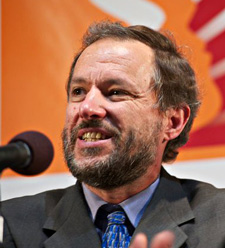
The deep crisis of democracy

By Johan Galtung

Partyocracy-Technocracy-Autocracy-Bankocracy…?

There is a crisis in the Western or more particularly the Indo-European political system – for reasons to be made clear. The system is referred to as “democracy”, meaning rule with the consent of the ruled; of, by and for the people. In practice this is interpreted as multi-party national elections for a national assembly, and majority rule in its two major forms, presidential and parliamentary democracy. The minority is given the role as “loyal opposition”.

The sovereign, people, are given choices not between positions on issues, but “platforms”, issue-bundles; and not between candidates, but candidate-bundles, “lists”, designed not by the parties, but by executive committees, officers, even by one officer, the boss. And this choice the sovereign can make only once every four years when a power window opens one or two days, 8-10 hours, called elections.

The system is better referred to as partyocracy than democracy, a reason that we often talk about “political class”, “political elites”, etc. Read More »


Forget ‘normal’ politics

By Richard Falk

Political life is filled with policy choices that are made mainly on the basis of calculations of advantage, as well as reflecting priorities and values of those with the power of decision. In a constitutional framework of governance the rule of law sets outer limits as to permissible outcomes. The legitimacy of the decision depends on adhering to these procedural guidelines, and the fact that if the societal effects turn out badly it can be corrected by altering the ‘law.’

Of course, all sorts of special interests behind the scene manipulate this process, and the public debate mirrors these pressures. The results of highly contested policy choices usually reflect the power structure (class, race, ideology) more than they do the outcome of rational detached assessments of the public good.

At present, the national public good in the United States is being held hostage to the lethal extremism of the gun lobby as led by the National Rifle Association (NRA), Read More »

The world’s freedom – up or down?

By Jonathan Power

The Cold War ended and the good times began – the big powers stopped using their veto in the UN Security Council, the number of wars fell dramatically, human rights improved all over the world including in Russia and the number of democracies increased substantially.

Where have all the flowers gone? The veto has returned. The number of civil wars has started to rise again. The number of democracies has begun to decrease. Perhaps better human rights practices are still holding their ground – in China they are improving slowly, including a more open press and more freedom for academics in the universities, but in Russia after some opening up under the presidency of Dimitri Medvedev freedoms are now retreating under Vladimir Putin. The Arab Spring continues its uncertain course with Egypt awash with uncertainty. Only in Tunisia does freedom seem secure.

Freedom House has a long history of measuring progress on some of the key human rights indicators- democracy, freedom of the press and the courts. It has produced some interesting results in its new report.Read More »

Egypt: Between a rock and a hard place

By Richard Falk

I have had the opportunity to be in Cairo three times for brief visits in the last 20 months, the first a few weeks after the departure of Hosni Mubarak on February 11, 2011, the second in February of 2012 when the revolutionary process was treading water, and this third one over the course of the previous ten days.
What is striking is how drastically the prevailing mood and expectations have changed from visit to visit, how fears, hopes, and perceptions have altered over time, and why they are likely to continue to do so.

I. The Overthrow of Mubarak

On the first visit, shortly after the extraordinary exploits in Tahrir Square that started on January 18, 2011, there was a spirit of stunned amazement that made it seem as though the ‘Arab Spring’ was a genuine historical phenomenon of epic proportions and that Egypt had become the core site of a new post-Marxist radical politics that relied on militant nonviolence and a radical ethos of transformation, but avoided ideology and hard power tactics.

Gandhi and Gene Sharp were most often invoked as the inspirational influences, not Lenin, Mao, Castro. Read More »

Top ten of the great dictators

By Jonathan Power

Thankfully neither candidate for US president is threatening “a war against dictators”. If George W. Bush had been allowed a third term – as President Franklin Roosevelt was in the 1940s – then who knows where he and his Machiavellian vice-president, Dick Cheney, might have led us.

Not for them the observation of General Colin Powell, when he was the US military’s top commander, who said “I am running out of demons”. They managed to find demons all over the place and doubtless if they were in power would have found many more. According to the new issue of World Policy Journal there are at least 10 living dictators who have all the reins of power in their own hands, controlling not just government but the law and the media. The Journal ranks them according to these criteria plus the percentage of the national income spent on the military, the prison population per capita and length of time in power.

Surprise, surprise. Read More »

The Democratic Convention – Soviet-style and denial

By Johan Galtung
From Charlotte, NC-USA – 5 September 2012 [i]

The Democratic National Convention, DNC, floated into oblivion with no debate – Soviet style, hallelujah, amen – with no mention of overt wars with 5-6 Muslim countries; of covert wars by drones and SEALs-US Navy’s Sea, Air and Land Teams with many others; and the war on terror. Like the Republican National Convention, RNC, squeezing out Ron Paul, who argued for no bases, no wars, no support to Israel.Read More »

Democratic leaders undermine Israeli-Palestinian peace and their own procedures

By Stephen Zunes

In a stunning violation of its own rules, the wishes of the majority of delegates at its national convention, and positions taken by the United Nations and virtually every country in the world, the Democratic Party leadership pushed through an amendment to its platform early during its proceedings on Wednesday, with barely half the delegates present and without allowing for any discussion or debate, stating that Jerusalem “is and will remain the capital of Israel” and should be “undivided.”

The language, as foreign policy analysts noted, is in “in direct opposition to longstanding U.S. policy on Jerusalem” that the status of the city should be determined by talks between the Israelis and Palestinians, both of whom desire Jerusalem as their capital, and that the city should not be unilaterally recognized as the capital of either Israel or Palestine until then. Read More »

California State Assembly seeks to stifle debate on Israel

By Stephen Zunes

A new resolution casts such a wide net over anti-Semitism that it includes legitimate opposition to Israeli policies.

The California State Assembly has just passed a bipartisan resolution (HR 35) by voice vote which constitutes a serious attack on academic freedom and the rights of students and faculty to raise awareness about human rights abuses by U.S.-backed governments. While purporting to put the legislature on record in opposition of anti-Semitism on state university campuses, it defines anti-Semitism so widely as to include legitimate political activities in opposition to Israeli government policies. Read More »

Conspiracies: Theories and hypotheses

By Johan Galtung

Conspiracies exist. They are a part of social reality, have always been, and will always be; as confirmed conspiracy theories, as unconfirmed conspiracy hypotheses, as suspicions, as allegations.

As usually conceived of, conspiracies involve several persons or actors; the plan of action is kept secret or at least not made public, except afterwards if it is successful. Conspiracies are about power[i] – economic-cultural-political-military — and are usually negative for somebody.

Let us start by criticizing this definition.Read More »

Toward a new geopolitics?

By Richard Falk

During the Cold War the main geopolitical optic relied upon by policymakers and diplomats was associated with a bipolar structure of hard power. There were supposedly two superpowers with overwhelming military capabilities compared to all other sovereign states, and each controlled an alliance of subordinate states that staked their survival on global crisis management and territorial containment skills of either the United States or the Soviet Union.

This framework was an extreme version of the balance of power system that had sustained global order in the West with mixed results during prior centuries. The Cold War nuclear version of the balance of power was frighteningly vulnerable to accident or miscalculation creating a lingering illusion that the current possession of nuclear weaponry on the part of nine sovereign states is a tolerable and stable situation in global affairs.Read More »