TFF PressInfo 276 – Ceasefire in Eastern Ukraine: Now withdrawal by Russia, the UN in and NATO out

By Jan Oberg, TFF co-founder

Jan Oberg

Lund, Sweden September 3, 2014 – 11:30 CET.

As announced just a few minutes ago, the Ukrainian and Russian president have agreed to what the first reports call a permanent ceasefire in Eastern Ukraine.
That’s indeed the best piece of news from that region.

It places the NATO Summit in Wales this Thursday and Friday in a new light.

The ceasefire must be solidified
However, an agreement over a phone is only a beginning; the devil is in the details. Secondly, there is no mention – yet – of the East Ukrainian fighters are on board this agreement.

Time for UN peacekeeping
Third, a credible ceasefire should be monitored by neutral observers and competent people. The only ones who can do that is the UN peace-keepers – perhaps with some staff also from Russia and Ukraine.Read More »

Make Russia a friend again

By Jonathan Power

August 26th 2014.

In his magisterial book “Europe”, Norman Davies writes, “Europe is a relatively modern idea. It gradually replaced the earlier concept of ‘Christendom’ in a complex intellectual process lasting from the fourteenth to the eighteenth centuries.”

Jean Monnet, the founder of the European Union, said, “Europe has never existed. One has to genuinely create Europe”.

“For more than 500 years”, continues Davies, “the cardinal problem in defining Europe has centred on the inclusion or exclusion of Russia. Throughout modern history the Orthodox, autocratic, economically backward but expanding Russia has been a bad fit.”

Nevertheless, Empress Catherine the Great announced in 1767 in St Petersburg that “Russia is a European state”. Dostoevsky, at the poet Pushkin’s funeral, eulogised Europe. “Peoples of Europe don’t know how dear to us they are.”

Muscovy has been an integral part of Christendom since the tenth century. Moreover, one can see that since Pushkin’s time Russia has created a larger part of the Western high cultural heritage than any other single European country and far much more than America. Think of the ballet (the best in the world by far) and the Bolshoi and Mariinsky theatres- and their protégés from Nureyev to Anna Netrebko. Think of composers: Tchaikovsky, Mussorgsky, Rimsky-Korsakov, Borodin, Stravinsky and Shostakovich. Think of the novel, poetry and drama: Tolstoy, Gogol, Chekov, Turgenev, Anna Ahmatova as well as Pushkin and Dostoevsky.

Lenin identified closely with Europe. Only under Stalin did Russia move away from Europe. In more recent times both Mikhail Gorbachev and President Vladimir Putin have talked of wanting to belong to the “Common European Home”- one day members of the European Union.Read More »

TFF PressInfo: Support Richard Branson’s Ukraine dialogue initiative

TFF PressInfo 273

By Jan Oberg, TFF co-founder

Jan Oberg

Lund, Sweden August 22, 2014

We are drifting towards a new Cold War. The reason isn’t substance because there is no reason we should not be able to live in peace in Europe – if we want and educated ourselves in handling problems.

No, the reason is the woefully incompetent way in which politicians and media focus on violence and ignore the underlying conflict and civil means – yes yes, of course there are exceptions.

Escalation doesn’t create peace

Here is just one example – NATO S-G Anders Fogh Rasmussen and NATO’s supreme commander General Breedlove (funny name given his anything but loving views coming rather from a Strangelove …) in the Wall Street Journal.

They tell you about all the escalation they have already done Read More »

Rusland, EU og sanktionerne

Af Jens Jørgen Nielsen

Betragtninger 7. august, 2014

Vi lever i en interessant tid. Og den er ikke kedelig. Mange faste forestillinger ændrer sig. Det slår mig, at EU politikere og ditto amerikanske ved meget lidt om både Rusland og verden. Som EU borger kan jeg med beklagelse konstatere, at EU ikke har nogen politik i forhold til Rusland. Og højstemt forargelse og at snakke amerikanerne efter munden tæller ikke som en egentlig politik.

Hvilke forestillinger har EU politikerne haft om slutspillet i Ukraine? Hvilke forestillinger har de haft om virkningerne af sanktionerne? Hvilken viden og forståelse af hvilket land Rusland er, har de samme politikere haft?

Det er som om dæmonisering af Putin har gjort det ud for en politik. Jeg opfordrer ikke her til at man skal elske Putin. Men jeg opfordrer for det første til at finde ud af, hvad man ønsker med Rusland og for den sags skyld også med Ukraine. For det andet, at man gør sig overvejelser over, hvad sanktionerne betyder på både det lange og korte sigt.

Hvad har mangelen på overvejelser over egne interesser og mangelen på analyse af sanktionernes virkning ført til? Read More »

TFF PressInfo: Cold War warnings 1998 – 2014

By Jan Oberg

Jan Oberg

Lund, Sweden August 11, 2014

Quality research leads to better predictions

One criteria of quality research is that it predicts the future better than incompetent research.

Because TFF is independent of governments and coroporations it doesn’t have to take political considerations or exclude certain theories, concepts or values. This free research enabled it over the years to make fairly precise predictions about for instance former Yugoslavia, the Iraq war and East-West relations.

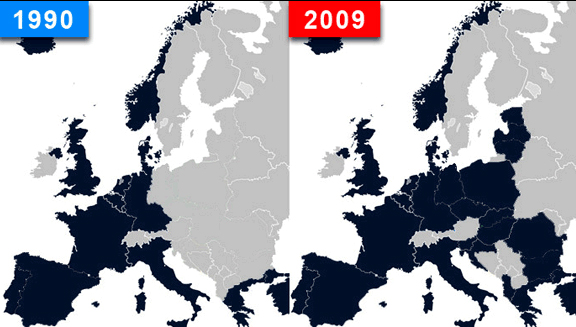
In 1998 – 16 years ago – we warned that NATO’s expansion would lead to future problems with Russia. Read it here.

NATO should never have been expanded

We backed this prediction up with 46 arguments and argued that so many other things would be wiser than containing Russia from the Baltic republics to Georgia – a strategy pursued by Bill Clinton in contravention of all promises given to the Soviet Union/Russia at the end of the Cold War about ten years earlier.

That counterproductive and insensitive expansion has now hit Ukraine. A new Cold War is gathering over Europe. It should have been predicted by advisers, intelligence agencies, big research institutes and columnists.

But it wasn’t.

At the end of the Cold War, NATO/the West got everything it could ever wish – and without war. But it wanted more: keeping Russia down, making NATO bigger and “peace-making” as well as finding new enemies to keeping its Military-Industrial-Media-Academic Complex (MIMAC) alive and well: Saddam, Milosevic, the Muslim world, terrorism and – now re-cycling – Russia.Read More »

TFF PressInfo: EU elections – To perform rather than live democracy

By Jan Oberg

Lund, Sweden, June 3, 2014

Fears has been expressed in Europe about the recent EU parliament voting pattern. Instead of the fear and denouncing the winners we should ask: What causes such an outcome?

My short answer is this: Democracy itself is in deep crisis. It has become performance or ritual rather than something genuinely lived.

Two things stand out – one, the increase in votes going to nationalist, populist, right-wing and anti-Muslim parties as well as Euro-skeptics – particularly in Denmark, France, Greece and Britain.

Secondly, the voter turnout has fallen from 62 per cent in 1979 to 43% in 2009 and this year it increased only 0.09% in spite of the EU Commission’s attempt to increase it.

So while people struggle around the world for democracy, only 43% of the EU citizens find it meaningful to go and vote every 4th year. How tragic for an EU that tries to promote democracy everywhere, even by military force.

It is understandable that the two mentioned factors is a combination that make many in Europe – the seat of two world wars, NATO and some of the most armed and two nuclear-weapons states – concerned. Perhaps the rest of the world should be at least as concerned? Other countries such as Hungary and Spain have, on different dimensions, moved in a worrying authoritarian political direction.Read More »

The EU foreign policy: Ten wishes

By Johan Galtung

Speech given in Brussels to the European External Action Service, Free University, October 8, 2013

The EU is in a crisis mainly of its own making. Some of it is economic and can be solved by strict control on speculation, separating savings and investment banks, by gradual debt forgiveness, by lifting the bottom up, the most miserable communities, by the GIPSI (Greece, Italy, Portugal, Spain, Ireland) countries cooperating, by stimulating agricultural cooperatives with direct sales points, etc. But much of it is political; the EU has become invisible on the world scene, incapable of a foreign policy building peace and security, also much too tied to US and Israeli fundamentalisms and too anti-Islamic.

The following are some ideas about steps that can be taken.

The EU glittering success as a peace zone is much needed in zones of war and where war threatens: the Middle East, Central Asia, East Asia. A Middle East Community, of Israel with five Arab neighbors (Lebanon, Syria, Jordan, Palestine, Egypt); a Central Asian Community of Afghanistan with eight neighbors (Iran, Pakistan, five former Soviet republics, Ashad Kashmir) with open borders (crucial for the Pashtuns and others); and a North East Asia Community (with two Chinas, the two Koreas, Japan, Mongolia and the Russian Far East (now with Khabarovsk as capital) could all benefit from EU opening its archives, telling how it all happened, sharing a major learning experience for humanity.

A United Regions added to the UN but with no veto powers, of the EU, AU, SAARC, ASEAN and the coming Latin America and the Caribbean, Organization of Islamic Cooperation, Middle East, Central Asia, North East Asia could take shape and become a key tool of global governance.

EU and Crisis Management. There are many of them, and there will be more crises given the legacy of colonialism constructing countries, putting together what did not belong together, dividing what did. An example are the four Sykes-Picot colonies: Iraq and Palestine for England, Lebanon and Syria for France, built-in catastrophes, now exploding. The EU will have to recognize the responsibility of some members, and then listen to what all the parties want, trying to arrive at a bridging perspective. Generally speaking, two approaches:

* federation within, with high autonomy for the nations and democracy within each part – but not an all over “one person one vote” which would result in the majority dictatorship of the most numerous nation;

* confederation, community, between, with open borders for nations that belong together to travel freely.

For Syria this would mean both respecting the Sunni majority and the minorities protected by Shia rule, with a two-chamber parliament, territorial for the provinces and non-territorial for the nations, with veto rights in matters concerning their identity. EU should send well trained mediators to the crisis area to understand the parties, and facilitate dialogue between them at the local level, many places.

EU and the use of military force. Should be Chapter 6 peace-keeping, not Chapter 7 “peace enforcement” (a contradiction in terms). Given the strong attachment to their goals of autonomy, a ceasefire with no image of a solution will be used for rest, smuggling of arms and redeployment; the road to ceasefire passes through a vision of a solution, not vice versa. The role of peace-keeping is to prevent violence, not to use it, and with that in mind peace-keepers should have military expertise and weapons for self-defense; some police training for crowd control; nonviolence training; some mediation training to know how to understand and facilitate dialogues; be 50% women more focused on human relations, less on control; and be so numerous that we can talk about a blue carpet, not only blue helmets.

EU-Third World, mostly former colonies: time is overdue for some reconciliation. Just compensation for the genocide and sociocide–killing social structures and cultures–is out of question, but joint understanding is not. Mutually acceptable textbooks about that period would be very useful, building on the German experience rewriting text books for reconciliation.

West-Islam. At the political level Turkey should become member, making Istanbul a hub for positive West-Islam relations. North Cyprus should be recognized; all of Cyprus – unitary state, federation or confederation – should be an EU member. A dialogue of civilizations could aim at combining Western pluralism with Muslim closeness and sharing for mutual benefit. The Western approach to the Catholic-Protestant divide might be useful for Shia-Sunni understanding.

Russia. Historically the many invasions were from West to East with two exceptions: Russia hitting back after Napoleon and Hitler. There is room for reconciliation based on such facts rather than the paranoid use of the image of Russia, like of China, as peril.

China. The main Silk Road was not a track in the desert and the mountains but a major Buddhist-Muslim East Asia-East Africa sea lane for 1000 years, 500-1500; destroyed by the Portuguese and the English in the name of their Kings. Time for reconciliation – including gunboat “diplomacy”, opium export, and colonization of Macao-Hong Kong is overdue. And an EU recognizing Israel partly because of two thousand years old history might also recognize some Chinese ocean rights with a much more recent history–in no way leaving out joint Chinese-ASEAN ownership of some of the islands, and joint Northeast Asian Community in due time of Senkaku-Diaoyu islands, and others, with their EEZs.

Eurasian Partnership. The EU is a peninsula on the Eurasian continent; increasingly connected by excellent railroad links mainly built by the Chinese, coming ever closer together. This is the time to add an Eurasian orientation to a Trans-Atlantic one, today in abeyance, waiting for he USA to recover and stop spying on the world.

All this is feasible: with realism in the brain and idealism in the heart.

Originally published at Trancend Media Service here.

Nationalism is a dangerous thing

By Jonathan Power

Former British prime minister, Margaret Thatcher, would never have agreed with her French counterpart, the late President Francois Mitterand, who said “Nationalism is war”. To her nationalism was necessary and good and she felt much as Mitterand’s predecessor, Charles de Gaulle, who said of the French nation,“it comprises a past, a present and a future that are indissoluble.”

But the nationalism that Thatcher fought for was a largely negative force. It antagonized the other members of the European Union. She did not believe her country could learn from them how to carry out economic reform without severe social disruption. She went to war with Argentina without trying to enlist the US as a mediator because it lent towards Argentina’s side.

One can date European nationalism from the Treaty of Westphalia in 1648 Read More »

NATO nukes forever! Or?

By Gunnar Westberg, TFF Board member

In 1984 we, a group from IPPNW Sweden, met with the Norwegian general Tönne Huitfeldt, at that time Chief of the military Staff of NATO. He was a man with great confidence in himself and in the military system. “General Huitfeldt”, we asked, “when you work with your scenarios in the NATO Headquarters, with the destruction of the world through a nuclear world war looming as the outcome, are you not scared?”. “Oh no, never”, he said. “the Russians are as rational as we are. They will never let it go too far. I am never scared”.

Well, we were. And are.Read More »