End Game in Ukraine?

By Jens Jorgen Nielsen
Written September 25, 2014

It should never have come to this horrible situation in Ukraine. The local population of Donetsk, Lugansk, Slavyansk and other eastern Ukrainian cities is living through a true nightmare. Residential areas are being bombed, shelled and burned. Non-combatants i.e. elder, women and children are lying dead in the streets. We’re talking about thousands of deaths. No water supply, no heating, no security – this is the grim reality for the population.

700.000 Eastern Ukrainians have already escaped from the war scene, most of them are living in refugee camps in Russia. It is worth noting that they have not fled to Kiev or elsewhere to the west.

Surprisingly the Western media hardly pay any attention to the horrors in Eastern Ukraine.

But that is not all. Ukraine is in total disruption socially, politically and not least economically and financially. Furthermore, the mental scars in Ukraine will continue for at least one generation ahead.

But again that is not all. The European Union suffers as well – in several ways. Read More »

A hard fist inside a velvet glove

By Jonathan Power

Despite Ukraine, Syria, Iraq, Libya, Afghanistan, Israel/Palestine and Southern Sudan the world is a lot more peaceful than it was at the end of the Cold War and shows no sign of returning to the bad old days when there were some 25 wars going on every year. Now it is down to about a dozen.

The task today is to keep that number going down – a difficult job when the outbreak of conflict in Syria, Libya and Ukraine have turned the graph upwards a few notches for the first time.

Protagonists in political quarrels tend to push the non-violent activists to one side – as they have done in Syria, Libya, Gaza and Ukraine.

This is not a good tactic as these situations have clearly shown. In Syria whole parts of cities have been reduced to rubble. Likewise in Gaza. In Ukraine this is starting to happen.

In the current issue of Foreign Affairs Erica Chenoweth and Maria Stephan argue that the prospects for civil resistance to bring about political change are commonly undersold.Read More »

TFF PressInfo 277 – After all this, what?

A couple of messages to NATO’s Summit

By Jan Oberg, TFF co-founder

Jan Oberg

Lund, Sweden September 5, 2014.

Yugoslavia then and now

TFF’s first report from Yugoslavia from September 1991 carried the title, After Yugoslavia – What? It is now one of 127 reports and articles in the huge research and policy blog – Yugoslavia – What Should Have Been Done?

It contains the equivalent of 2000 book pages authored by Johan Galtung, Jan Oberg and Hakan Wiberg. All articles are published as they were written at the time. For anyone to see whose analyses stood the test of time.

We opened this blog two days ago – on the 23rd year of TFF’s first of some 70 peace missions into the war zones.

While it is important to analyse the world, it is more important to criticise it and most important to search – and re-search – alternatives to it. Thus the title. You are kindly invited to browse.

Such work is not only of historical interest. It carries a message for the future – as does all good research.

While inner factors were certainly dominant, the West – in its misguided attempt at playing peace maker – Read More »

TFF PressInfo 276 – Ceasefire in Eastern Ukraine: Now withdrawal by Russia, the UN in and NATO out

By Jan Oberg, TFF co-founder

Jan Oberg

Lund, Sweden September 3, 2014 – 11:30 CET.

As announced just a few minutes ago, the Ukrainian and Russian president have agreed to what the first reports call a permanent ceasefire in Eastern Ukraine.
That’s indeed the best piece of news from that region.

It places the NATO Summit in Wales this Thursday and Friday in a new light.

The ceasefire must be solidified
However, an agreement over a phone is only a beginning; the devil is in the details. Secondly, there is no mention – yet – of the East Ukrainian fighters are on board this agreement.

Time for UN peacekeeping
Third, a credible ceasefire should be monitored by neutral observers and competent people. The only ones who can do that is the UN peace-keepers – perhaps with some staff also from Russia and Ukraine.Read More »

Make Russia a friend again

By Jonathan Power

August 26th 2014.

In his magisterial book “Europe”, Norman Davies writes, “Europe is a relatively modern idea. It gradually replaced the earlier concept of ‘Christendom’ in a complex intellectual process lasting from the fourteenth to the eighteenth centuries.”

Jean Monnet, the founder of the European Union, said, “Europe has never existed. One has to genuinely create Europe”.

“For more than 500 years”, continues Davies, “the cardinal problem in defining Europe has centred on the inclusion or exclusion of Russia. Throughout modern history the Orthodox, autocratic, economically backward but expanding Russia has been a bad fit.”

Nevertheless, Empress Catherine the Great announced in 1767 in St Petersburg that “Russia is a European state”. Dostoevsky, at the poet Pushkin’s funeral, eulogised Europe. “Peoples of Europe don’t know how dear to us they are.”

Muscovy has been an integral part of Christendom since the tenth century. Moreover, one can see that since Pushkin’s time Russia has created a larger part of the Western high cultural heritage than any other single European country and far much more than America. Think of the ballet (the best in the world by far) and the Bolshoi and Mariinsky theatres- and their protégés from Nureyev to Anna Netrebko. Think of composers: Tchaikovsky, Mussorgsky, Rimsky-Korsakov, Borodin, Stravinsky and Shostakovich. Think of the novel, poetry and drama: Tolstoy, Gogol, Chekov, Turgenev, Anna Ahmatova as well as Pushkin and Dostoevsky.

Lenin identified closely with Europe. Only under Stalin did Russia move away from Europe. In more recent times both Mikhail Gorbachev and President Vladimir Putin have talked of wanting to belong to the “Common European Home”- one day members of the European Union.Read More »

TFF PressInfo: Support Richard Branson’s Ukraine dialogue initiative

TFF PressInfo 273

By Jan Oberg, TFF co-founder

Jan Oberg

Lund, Sweden August 22, 2014

We are drifting towards a new Cold War. The reason isn’t substance because there is no reason we should not be able to live in peace in Europe – if we want and educated ourselves in handling problems.

No, the reason is the woefully incompetent way in which politicians and media focus on violence and ignore the underlying conflict and civil means – yes yes, of course there are exceptions.

Escalation doesn’t create peace

Here is just one example – NATO S-G Anders Fogh Rasmussen and NATO’s supreme commander General Breedlove (funny name given his anything but loving views coming rather from a Strangelove …) in the Wall Street Journal.

They tell you about all the escalation they have already done Read More »

Rusland, EU og sanktionerne

Af Jens Jørgen Nielsen

Betragtninger 7. august, 2014

Vi lever i en interessant tid. Og den er ikke kedelig. Mange faste forestillinger ændrer sig. Det slår mig, at EU politikere og ditto amerikanske ved meget lidt om både Rusland og verden. Som EU borger kan jeg med beklagelse konstatere, at EU ikke har nogen politik i forhold til Rusland. Og højstemt forargelse og at snakke amerikanerne efter munden tæller ikke som en egentlig politik.

Hvilke forestillinger har EU politikerne haft om slutspillet i Ukraine? Hvilke forestillinger har de haft om virkningerne af sanktionerne? Hvilken viden og forståelse af hvilket land Rusland er, har de samme politikere haft?

Det er som om dæmonisering af Putin har gjort det ud for en politik. Jeg opfordrer ikke her til at man skal elske Putin. Men jeg opfordrer for det første til at finde ud af, hvad man ønsker med Rusland og for den sags skyld også med Ukraine. For det andet, at man gør sig overvejelser over, hvad sanktionerne betyder på både det lange og korte sigt.

Hvad har mangelen på overvejelser over egne interesser og mangelen på analyse af sanktionernes virkning ført til? Read More »

Putins Rusland er ikke som Sovjet

Af Jens Jørgen Nielsen

Billedet af Rusland i de vestlige medier er i dag næsten mere dystert end under den kolde krig. Mange tror, at russerne lever i fattigdom og ufrihed i evig angst for Putins rædselsregime, præget af få censurerede medier. Rusland skulle angiveligt være ved at falde sammen og borgerne længes efter de friheder, som vesten kan tilbyde.

Putin skulle angiveligt være nervøs for, at den ukrainske ’demokratiske’ revolution skulle sprede sig til Rusland. Derfor skal vi i vesten entydigt støtte Kiev regeringen og den ikke-parlamentariske opposition i Rusland. Mange vestlige politikere mener, at vi økonomisk skal isolere Rusland.

EU og USA fokuserer i disse tider på at straffe Rusland og Read More »

TFF PressInfo: Cold War warnings 1998 – 2014

By Jan Oberg

Jan Oberg

Lund, Sweden August 11, 2014

Quality research leads to better predictions

One criteria of quality research is that it predicts the future better than incompetent research.

Because TFF is independent of governments and coroporations it doesn’t have to take political considerations or exclude certain theories, concepts or values. This free research enabled it over the years to make fairly precise predictions about for instance former Yugoslavia, the Iraq war and East-West relations.

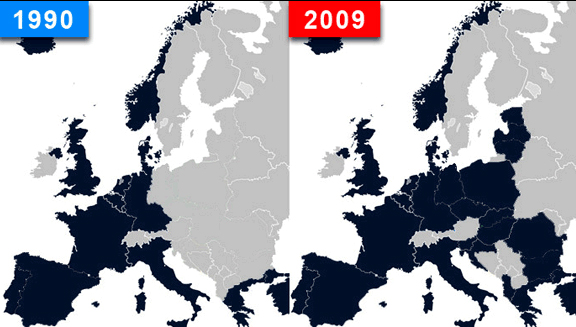
In 1998 – 16 years ago – we warned that NATO’s expansion would lead to future problems with Russia. Read it here.

NATO should never have been expanded

We backed this prediction up with 46 arguments and argued that so many other things would be wiser than containing Russia from the Baltic republics to Georgia – a strategy pursued by Bill Clinton in contravention of all promises given to the Soviet Union/Russia at the end of the Cold War about ten years earlier.

That counterproductive and insensitive expansion has now hit Ukraine. A new Cold War is gathering over Europe. It should have been predicted by advisers, intelligence agencies, big research institutes and columnists.

But it wasn’t.

At the end of the Cold War, NATO/the West got everything it could ever wish – and without war. But it wanted more: keeping Russia down, making NATO bigger and “peace-making” as well as finding new enemies to keeping its Military-Industrial-Media-Academic Complex (MIMAC) alive and well: Saddam, Milosevic, the Muslim world, terrorism and – now re-cycling – Russia.Read More »

The West is threatening Russia

By Jonathan Power

What would the conservative president, Ronald Reagan, have done if the Ukraine debacle had happened on his watch? I suspect he would have made sure it didn’t devalue relations between the US and Russia.

It wasn’t him nor his vice-president, George W.H Bush, who inflamed relations with a post-Cold War Russia, it was his successor the liberal, Bill Clinton, who, together with a supine EU membership, decided to expand NATO right up to Russia’s doorstep, despite a solemn US promise given personally to the Soviet president, Mikhail Gorbachev, by George H. W. Bush’s secretary of state, James Baker, that it wouldn’t.

And today President Barack Obama won’t say clearly and out loud that the US doesn’t expect that Ukraine will ever join NATO, a move that could de-escalate the crisis faster than you could say: “At last Obama understands where President Vladimir Putin is coming from”.Read More »