The global power imbalance

By Johan Galtung

Dear Reader: This editorial 444 – the number calls for attention – is dedicated to a global overview, the world “right now”, so unstable with imbalances everywhere that what we are living is fluxes and jumps.

Let us start with two major relations: Nature-human, the US-the Rest.

Look at the human-nature relations.

We are used to being on top, killing and taming animals, protected against many of nature’s hazards including micro-organisms. But nature comes up with ever smaller viri, and larger, or more, tsunamis and earthquakes, and an erratic climate.

We oscillate between blaming ourselves, including military scheming, and the anthropomorphic “Mother Nature is angry” (Evo Morales).

If nature is angry, she has good reasons for a good riddance of us. And we are slow at a deeper human-nature relations respecting and enhancing both.

Nature is on top and our natural sciences are simply not good enough, taken by surprise all the time. Meteorology is good at covering the whole Beaufort wind range from 0-12; others not.

Maybe we have desouled nature and besouled ourselves too much to establish our own Herrschaft (rule, dominance), at the expense of Partnerschaft (partnership).

Unless this changes, imbalance with nature on top, and surprises, will continue.

Maybe the opposite holds for the US-Rest imbalance; that US exceptionalism serves USA as badly as humans above nature serves us?Read More »

Perhaps economic stagnation is a good thing?

By Jonathan Power

August 16th 2006

The announcement was made yesterday – August 15 – by Japan’s Finance Ministry: In the last quarter of the year the Japanese economy grew at an annualised rate of 0.2%. “One wonders if the economy will remain at a standstill for the rest of the year”, the Financial Times asks.

But then Japan’s economy has been becalmed for 30 years. Even though the government has poured billions of dollars into the economy it has had only a small effect in boosting demand.

One wonders when the government will give up and what happens then – another decade of minimal growth? If that is what happens how much does it matter? To the Japanese themselves it seems not that much. By and large they are contented with their lot.

The rest of the word may be worried as a powerful country is importing less and less. It does not contribute to world economic growth as it did before when its fast growing economy progressed at Chinese rates from a much higher base.

Some American and European economists are worrying that the Japanese “disease” will spread before long among all the leading economies. Indeed it could be argued that with Europe in the doldrums – apart from Sweden and Poland – and the US economy not steaming ahead as it once did, this may be already happening.

The former US Treasury Secretary Larry Summers has said that the world faces looming “secular stagnation” – a persistent period of low growth, low inflation and low interest rates.

But is this such a bad thing if the cost of living also falls? Read More »

Can China threaten the West?

By Jonathan Power

August 2nd 2016.

How far behind the West is China? Is its economy still booming so it could within 20 years overtake America? Is its military becoming of such a strength it will take the big decision to confront the US navy in the South China Sea?

While it is obvious that the Chinese leadership is much more far sighted and cautious than, say, Donald Trump, can one conclude with 100 % certainty that potentially dangerous clashes won’t occur?

The communist leadership believes that before long it will be the world’s biggest economy. Yet if one looks at national income per head it is way down the league table of economic achievers. Size is not everything. Moreover, if one starts from a low base, as China did before the paramount leader, Deng Xiaoping, introduced capitalism in 1978, fast rates of growth, as reported in government statistics, overstate what is happening in many parts of the country.

Away from the booming coastal areas China is extraordinarily backward, with the countryside and smaller towns looking like, at best, Central America, at worst India.

The US, Japan, South Korea and Europe will always have the technological edge. It’s true for most things that the West can do better whatever China does. Compared with past rising powers – Read More »

Hillary Clinton and Her Hawks

By Gareth Porter

Focusing on domestic issues, Hillary Clinton’s acceptance speech sidestepped the deep concerns anti-war Democrats have about her hawkish foreign policy, which is already taking shape in the shadows, reports Gareth Porter.

As Hillary Clinton begins her final charge for the White House, her advisers are already recommending air strikes and other new military measures against the Assad regime in Syria.

The clear signals of Clinton’s readiness to go to war appears to be aimed at influencing the course of the war in Syria as well as U.S. policy over the remaining six months of the Obama administration. (She also may be hoping to corral the votes of Republican neoconservatives concerned about Donald Trump’s “America First” foreign policy.)

Last month, the think tank run by Michele Flournoy, the former Defense Department official considered to be most likely to be Clinton’s choice to be Secretary of Defense, explicitly called for “limited military strikes” against the Assad regime.

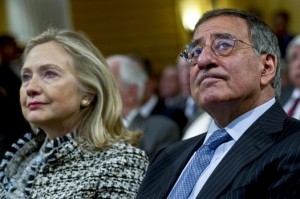
And earlier this month Leon Panetta, former Defense Secretary and CIA Director, who has been advising candidate Clinton, declared in an interview that the next president would have to increase the number of Special Forces and carry out air strikes to help “moderate” groups against President Bashal al-Assad. (When Panetta gave a belligerent speech at the Democratic National Convention on Wednesday night, he was interrupted by chants from the delegates on the floor of “no more war!”

Defense Secretary Leon Panetta with Secretary of State Hillary Clinton at NATO conference in Munich, Germany, Feb. 4 (Official Defense Department photo)

Flournoy co-founded the Center for New American Security (CNAS) in 2007 to promote support for U.S. war policies in Iraq and Afghanistan, and then became Under Secretary of Defense for Policy in the Obama administration in 2009.

Flournoy left her Pentagon position in 2012 and returned to CNAS as Chief Executive Officer. She has been described by ultimate insider journalist David Ignatius of the Washington Post, as being on a “short, short list” for the job Secretary of Defense in a Clinton administration.

Continue reading here…

TFF PressInfo # 384: The Clintons celebrated – but likely disastrous for the world

By Jan Oberg

Hillary Rodham Clinton was nominated last night by the Democratic Party as its candidate for the U.S. Presidency. She may well win on November 8.

What a tragedy for Western democracy that the leader of what is still called the free, democratic world cannot produce better candidates than Trump and Clinton through a disgustingly commercialized and corrupt political process where candidates like Jill Stein – did you ever hear of that candidate? – doesn’t have a chance because she cannot mobilize the funds.

As a European intellectual with a life-long commitment to peace and democracy, I find little reason to celebrate.

And why the total focus on a few individuals at the top but not the structures that will run them both, such as the Military-Industrial-Media-Academic Complex (MIMAC); the cancer in many societies, including Russia, that President Eisenhower warned the world about in his farewell speech already in 1961?

How short the media memory! Hillary Clinton’s nomination celebrated all over the mainstream press as a victory for the party – preventing it from splitting – and for all women.

But how can people – women in particular – really believe in such genderism: that she will be a better president for the US and the world because she’s a woman? Hasn’t the world learnt anything from the inverse racism:that Obama would be a great president because he is black?

How blind the media to militarism, war and other violence: Not one media focuses on the Clinton’s well-documented fascination with violence and war.

It’s time to refresh the memory of the Clintons:

Bill Clinton’s record

From 1994 BC broke all promises made by his predecessors and other Western politician to Gorbachev about “not expanding NATO an inch”. He started out in Tblisi, Georgia. I happened to be there, spoke with the U.S. representative to the country and got a sense what was coming. Later too in Yugoslavia.

There is a straight line from that fatal arrogance to today’s Second Cold War in Europe, Ukraine having – predictably – to be the this-far-and-no-longer country of that mindless and reckless expansion that should never have happened.

BC’s interventionist record is also forgotten: He bombed in Afghanistan, Sudan, Iraq, Bosnia, Kosovo and Serbia – the latter much much worse from any point of view than the Russian annexation of Crimea. It was based on the fake Rambouillet “talks” between Serbs and Kosovo-Albanians, his public lies about there being an ethnic cleansing of all Albanians in Kosovo coming from Slobodan Milosevic whom he called a new Hitler.

No such plan was ever found – and I know a bit about it because I was a goodwill adviser both to three governments in Belgrade and to the non-violent Kosovo-Albanian leadership under Ibrahim Rugova.

It was Clinton’s Secretary of State, Madeleine Albright, who masterminded much of it and is on record for saying that it was politically justifiable that the sanctions on Iraq had killed 500.000 innocent people. And they continued.

And she, having survived as a refugee child in Belgrade, Serbia, with her Czechoslovakian family during the Second World War and spoke Serbian is on record for hatred of the Serb people.

Conveniently, the West has forgotten it all. BC is such a charming man (who just told us at the reality show-like democratic convention how much he loves his wife).

His administration was one of the most militarist.

Hillary Clinton’s record

There is no excuse for having forgotten her record. GFrom 2009 to 2013, she served as Secretary of State under Obama, the US president who has been engaged in warfare during more days than any other US President according to the New York Times.

HC has supported all the wars she could and she was a mastermind of the war in Libya. One remembers the film clip showing her happiness at Khadafi’s death.

She is a Cold Warrior, anti-Russia, anti-Putin Russians will be great for fighting Putin.

Her war-promoting record is as long as it is well-documented.

The most solid documentation is that of professor Stephen Zunes. Read More »

Are we heading toward global autocracy, ecological collapse and political malaise?

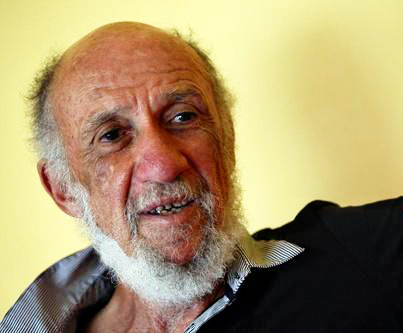
By Richard Falk

What follows are preliminary reactions to both the BREXIT vote and the world according to Trump, but also a commentary on the related alienation of large segments of the public that are being badly served by both the established elites and their demagogic adversaries.

The failures of neoliberalism, the successes of digitization, the scourge of random violence, and more broadly, the dilemmas posed by late modernity are among the root causes of this global crisis of legitimate governance, which is deepened while being mishandled by unprecedented ecological challenges, extremely irresponsible geopolitical leadership, and a variety of ultra-nationalist backlashes against the encroachments of economic globalization.

Imagining the World After the Cold War

After the end of the Cold War there were various projections that tried to anticipate the likely future of the world in broad interpretative strokes. Three of the most influential conjectures by three prominent American authors received attention in the public sphere: those of Francis Fukuyama, Samuel Huntington, and Robert Kaplan.

Fukuyama challenged conventional political imagination with his provocative claim that with the collapse of the Soviet version of state socialism and the triumph of capitalist liberalism the world had reached ‘the end of history.’ It was also somewhat dubious that Fukuyama validated his views by reference to the Hegelian contention that history is made by the march and interplay of ideas rather than through the agency of material forces.

In this respect history came to a supposedly glorious end because there was no grander possible political vision than that of market-based constitutionalism, epitomized by the American political system. Even the most casual observer of the global scene must have noticed the befogged Western optic through which Fukuyama saw the world.

Huntington, no less provocative or biased, although less comforting for the West, anticipated a ‘the clash of civilizations’ as the sequel to the Cold War, especially stressing the confrontation between the liberal West and the non-West or simply ‘the rest.’ His suggestive emphasis was on blood-soaked fault lines between states, civilizations, and peoples associated with Islam and the Western polities descending from the Enlightenment tradition as it unfolded in Europe, taking root in North America and elsewhere.

Kaplan, also punctured the Fukuyama triumphalist tone of geopolitical serenity, by writing Read More »

TFF PressInfo # 383 – Fearology and militarism but the real enemy is us

By Jan Oberg

Published on July 8, 2016, the day of the NATO Summit in Warsaw. It’s the 5th in the TFF Series “The New Cold War”

Russia and NATO have offensive capacities and MIMACs (Military-Industrial-Media-Academic Complex) but NATO’s is a much larger potential threat to Russia than the other way around

Why does an alliance with such an overwhelming superiority shout and scream and see ghosts on the horizon when, in reality, there are none?

Why does it seem to be intellectually unable to see things from the side of its opponent? Is the show of strength in reality a sign of weakness?

*

A threat consists of two main things: An intention to do something negative to you + a capability to actually carry it through – thus I + C.

Whenever NATO S-G Stoltenberg – a person who has gone through a serious personality change – speaks, he says nice things like: NATO does not seek confrontation and none of its moves are directed at Russia. NATO countries just have to protect themselves against Russia which they see as a threat.

Typically the talk is about an actor, a country, a leader – not about issues or trends that challenge the Alliance and certainly not that its own war adventures have weakened it in moral and legitimacy terms.

On their own side, NATO leaders buy none of – similar – Russian peace rhetorics. If you ask them why, they would say: Because as long as the Russians have offensive capabilities, there is also a risk that good/defensive official motives may – within weeks – be turned into an offensive, aggressive stance and we will be attacked. Can’t trust them!

But NATO itself excels in offensive projects, plans and capabilities – such as forward positioning, bases, long-range bomber and fighter planes, Ballistic Missile Defense and nuclear weapons – nuclear weapons are by definition never defensive because of their unlimited destructive capacity and because they can, by definition, not be used on one’s own territory.

To put it crudely: If you have no aggressive intentions directed at anyone – then scrap your offensive capabilities including long-range, particularly destructive and nuclear weapons and preserve only what can be used for defense – i.e. if you are attacked.

Why should you scrap the offensive elements? Because, no matter what you say about your intentions, the other side will see you as potential aggressive because you offensive weapons can reach them: If you don’t plan to come to our territory, then why do you have systems that can reach our territory and create unspeakable destruction on our people and culture??

Upholding offensive arsenals is a clear indicator of the possibility that officially stated defensive intentions can change to the opposite – how should NATO otherwise feel threatened by today’s Russia?

The eternal but non-credible threat needed by MIMAC

There are good-hearted people who believe that countries have competent experts who along a series of indicators measure and judge which security challenge are waiting in the future – and a series analyses of the threat towards their country on this or that time horizon.

The probability of each threat is also evaluated – to help politicians with limited budgets to allocate money to guard against some ‘realistic’ but not all possible/thinkable threats.

The – again very good-hearted – people believe that politicians and the industry then decide about the appropriate national defence, the necessary minimum of what we call a (military) defence policy and other measures to meet the challenges.

Unfortunately, as has been known since the last 50 years – except to politicians and the media – this description of security politics has nothing to do with reality.

Here is how it works, instead.Read More »

TFF PressInfo #381: Much stronger than during the First Cold War. Why is NATO so irrational?

By Jan Oberg

The third article in the TFF series on The New Cold War

We are witnessing a remarkable increase in tension between the US/NATO and Russia these years – and it can not only be explained by whatever we choose to think happened in Ukraine and Crimea. We find a totally new effort on both sides to use social and other media to tell how dangerous “they” are to “us”. There is a clear tendency to “fearology” – to instill fear in the citizens on both sides about the capabilities and intentions of the other side.

We find deeply concerned articles about the possibility of war between the two parties – a quarter of a century after the Berlin Wall tumbled.

Why is the new tension rising in Europe between US/NATO and Russia so manifestly dangerous and – with the exception of the Cuban Missile Crisis worse than during the First Cold War?

On a series of indicators, the political Western world – US/NATO/EU and Christian (Orthodox, Protestant, Catholic with sects) – is becoming weak relative to other players in the global society.

The West has engaged in a series of wars that turned into very costly fiascos – from what followed from Sykes-Picot which turned 100 in May 2016 over Vietnam to the destruction of Afghanistan, Iraq, Libya and Syria.

The West is still the largest economic bloc and the 28 NATO members cover about 70% of the world’s mind-boggling US $ 1700 billion military expenditures. Africa as a continent, BRICS countries – China in particular – are making progress, also in fields where the West has failed; for instance, China has lifted 400 million Chinese out of poverty in a couple of decades. The wealthy West has done nothing of the sort over centuries but produced a grotesquely, perversely unequal income distribution.

Take a look at the graphs linked to this summary page from SIPRI. They will tell you how world military expenditures in constant prices have risen since 1996 even though the Warsaw Pact had been dissolved. In 2015, the US alone stands for 36% of the world’s military expenditures, China for 13% and Russia for4%.

President Obama stated recently that the US military is stronger than the next 8 – here is what he said in his State of the Union Address on January 12th, 2016:

“I told you earlier all the talk of America’s economic decline is political hot air. Well, so is all the rhetoric you hear about our enemies getting stronger and America getting weaker,” Obama said in his last annual State of the Union address Jan. 12, 2016. “Let me tell you something: The United States of America is the most powerful nation on Earth. Period. Period. It’s not even close. It’s not even close. We spend more on our military than the next eight nations combined.”

In spite of these fact that prove the overwhelming and increasing superiority of today’s NATO, we see a constantly increasing propaganda coming out of NATO circles to the effect that NATO is getting weaker and that Russia a formidable, unreliable power just waiting for the next opportunity to invade some country in the West.

Let’s take a look back in time.Read More »