Could it be the world is getting better?

By Jonathan Power

January 13th 2015.

We have much to be glum about at the onset of 2015- the latest is the killings by ultra Islamists of the cartoonists in Paris. But we are brainwashed with bad news. “If it bleeds it leads”. One plane crash is worth more airtime than news that we are winning the fight against early death.

The World Health Organization has some telling facts. Over the last two decades infant deaths have fallen by a half. Measle deaths by three-quarters and both tuberculosis and maternal deaths by a half. AIDs-related illnesses have been cut by over a quarter. In 1960 one in five children died before the age of 5. Today it is one in 20, and falling.

Developing countries have caught up far more quickly in health than in wealth. For instance, Vietnam has the same health as the US had in 1980 but at present the same income per head as the US had in 1920.

Despite the Great Recession of the last six years poverty has plummeted. Although most of that drop has happened in China and India it has also happened in most Third World countries.

Population growth is slowing. Read More »

Paris – and then?

By Johan Galtung

Johan Galtung

January 12, 2015

What happened–known all over the world–is totally unacceptable and inexcusable. As inexcusable as 9/11, the coming Western attack and the Islamist retaliation, wherever. As inexcusable as the Western coups and mega-violence on Muslim lands since Iran 1953, massacring people as endowed with personality and identity as French cartoonists. But to the West they are not even statistics; “military secrets”.

However, the unacceptable is not unexplainable.

In this tragic saga of West-Islam violence, spiraling downwards, the way out is to identify the conflict, what is this violence about, and search for solutions. I wonder how many now pontificating on Paris–a city so deep in our hearts–have taken the trouble to sit down with someone identified with Al Qaeda, simply asking, “what does the world look like where you would like to live?” I always get the same answer: “a world where Islam is not trampled upon but respected.”

“Trampled upon” sounds physically violent. But there are two types of direct violence intended to harm, hurt: physical violence with arm-arms-army; and verbal violence, with words, symbols. For instance with cartoons, with a touch of art giving them some impunity; for some. A human being–body, mind, spirit–can be hit somatically, mentally, spiritually. Maybe symbolic violence even hits more deeply?

The naiveté in blaming the secret police for not having uncovered the brothers on time is crying to the heavens. What happened to Charlie Hebdo was as predictable Read More »

In defense of freedom of expression

By Farhang Jahanpour

The Wednesday edition of Charlie Hebdo (a week after the barbaric attack by two deranged terrorists on its premises) carried a cartoon of Prophet Muhammad, with a caption “Je Suis Charlie”, with a tear drop on his face announcing, “all is forgiven”. It is not clear who is forgiven and for what, but if it refers to the terrorists it certainly is not appropriate.

This time the magazine did not publish only 60,000 copies as it usually does, but three million copies, thanks to the generous help that it has received from various sources and also with the help of cartoonists from all over the world.

Richard Malka, a Sephardic Jew, who saw ten colleagues and four of his co-religionists massacred on that dreadful day, was one of the first to call for the magazine to continue functioning. When asked whether they would publish more cartoons of Muhammad, he replied in an interview with France Info radio on Monday: “Naturally. We will not give in, otherwise all this won’t have meant anything.”

Free speech tops all other considerations

This is as it should be, because in the final analysis freedom of expression tops all other considerations, as it is at the root of all other liberties and the quality of life that we enjoy in democratic societies.

More than three million people demonstrated in Paris and other French cities on Sunday, carrying the sign “Je Suis Charlie”. This did not mean that they agreed with everything that Charlie Hebdo stood for, but they wished to uphold the right of that satirical magazine to express itself freely.

Only a few days before the attacks in Paris, Pen America published a disturbing report on “Global Chilling. The Impact of Mass Surveillance on International Writers”, showing that mass surveillance by the United States and other governments had produced a very negative effect on free expression, leading to self-censorship. It further showed that concern about surveillance was almost as high among writers living in democracies (75%) as it was among those living in non-democratic states (80%). It would be tragic if the killing of a few journalists in Paris were allowed to result in greater self-censorship and to curtail freedom of expression.

The terrorists and those who wish to limit freedom of expression by violent means should learn that far from forcing others to silence, their acts will backfire and will have the opposite effect. If the terrorists intended to help the cause of Muslims in the world, it has had precisely the opposite effect and has intensified a climate of suspicion and cultural clash between Islam and the West.

It should be added that the terrorist outrage was not an Islamic act against Christians, Jews and secularists. It was the act of two terrorists against Muslims, Christians, Jews and people of no faith.

That vile act had nothing to do with Islam

In fact, after the carnage and the resulting anger, it is important to remember that Read More »

TFF PressInfo # 300: “We Are All Charlie” – but is that story so simple?

By Jan Oberg

Jan Oberg

Eleven points as a reflection on the terror in Paris and – not the least – the reactions to it*:

1. What was this an attack on?
Was that attack an attack on freedom of speech as such, on democracy, even on the whole Western culture and lifestyle, as was maintained throughout? Or was it, more limited, a revenge directed at one weekly magazine for what some perceive as blasphemy?

2. Is freedom of expression practised or curtailed for various reasons?
How real is that freedom in the West? Just a couple of days before the Paris massacre PEN in the U.S. published a report – Global Chilling – finding that about 75% of writers report that they are influenced by the NSA listening and abstain from taking up certain subjects or perspectives? Self-censorship, in other words. Finally, most of the political leaders marching in Paris on Sunday January 11 have clamped down on media, such as Turkey and Egypt.

I must admit that I have experienced limitations in the practise of that freedom in my own work with Western media and it is decades ago I draw the conclusion that things like political correctness, ownership, commercial/market considerations and journalists’ need for good relations with power – e.g. to obtain interviews – play a role.

I’ve been on the ground in conflict zones and returned home to see reports so biased to tell very little of what I’ve seen myself. And we’ve recently seen lots of cases from the U.S. academic world where there’s been a clampdown on certain views, pulications, courses and professors – not the least in relation to the Israel-Palestine conflict. Or, you look at the proportions between government fund available for peace research and military research in virtually every Western society; free research is a vital element in the self-understanding of the West. But how much of do we have?

3. Freedom doesn’t mean duty.
Is freedom of expression really 100% irrespective of how much the practise of that freedom is hurtful, offending, humiliating or discriminatory against other peoples, religions and cultures? Even if you can express your opinions freely it is not always what we should do.

I can still abstain from making a remark about somebody’s religious or political beliefs because I see no point in offending that person in regard to something he or she holds dear, even part of the identity. But, sure, I have the right to do so.

Using a right to the maximum isn’t necessarily the wisest or most mature thing to do. I draw the distinction between issues that touch personal identity – e.g. religion, nationality, gende – and other issues. It is neither fun nor wise to make satire on what people are.

One must indeed ask in the – chilling – times we live: What happened to words such as solidarity, respect, empathy and to the values of common humanity? There can be no rights without duties as Mohandas K. Gandhi briliantly expressed it.

4. Are anti-Semitic cartoons OK now?
Why is it so important to some media people and Je Suis Charlie people to accept or practise disdain, blasphemy, ridicule or depict (even naked) Muhamad when we know that Read More »

Cuba – and then what?

By Johan Galtung

Johan Galtung

The immediate reaction to Obama’s Executive Order of 17 December 2014 – re-establishing diplomatic relations, easing travel, swapping prisoners – was a sense of relief: finally correcting a more than 50-year old stupidity. But why now? Later. First, back to June 1960.

We drove from New York to Key West, then a ferry – the captain was Norwegian – to La Habana; we wanted to drive all over, talk with everybody to understand. And the social picture was very clear: black, woman, low class overwhelmingly in favor of the revolution; white, man, middle-upper class ended up in Miami. Why gender? US imperialism was obvious but in addition Cuba was one big brothel for “puritan” US men. And one of the first acts of the revolution was to stop that, liberate the dirt poor girls, organize vocational training – give them dignity.Read More »

Time to prosecute ex-president George Bush

By Jonathan Power

It is John McCain, a former Vietnam warrior and the Republican candidate for president when Barack Obama first won the presidency, who has conducted a long campaign against the US using torture. Last week when the US Senate’s study of the torture used during the Administration of George W. Bush was published he has been one of the very few voices of the right to welcome it.

When the allies won the Second World War the torture of the Nazi regime’s top military commanders was not allowed, even though the detained had plenty of information on who did what. Few argued that torture was necessary to elicit the information required in order to prosecute the Nazi leadership at the Nuremberg war crimes trial (although Churchill had argued earlier that they didn’t deserve a trial and they should be put against a wall and summarily shot).

It was conventional interrogation that produced the information needed.

In the Senate report – which runs to 6,000 pages there are any number of sadistic acts of torture recorded. And, says the report, no information elicited outclassed the same information squeezed from the same subjects by conventional interrogation. Indeed, FBI officials were long critical of the CIA’s brutal approach to interrogation.

America’s image abroad will never be the same. A country that has long trumpeted Read More »

TFF PressInfo 295: Stop torture: Yes to accountability

This petition will be delivered to the U.S. government, the International Criminal Court, the President of the UN General Assembly, the President of the Human Rights Council and the European Court of Justice.

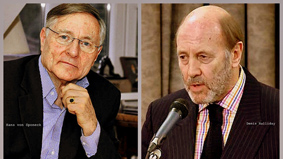
Hans von Sponeck, TFF Associate, and Denis Halliday

Petition initiated by two former UN Assistant Secretaries-General, UN Humanitarian Coordinators for Iraq: Hans von Sponeck and Denis Halliday.

On 9 December 2014, the US Senate released its CIA torture report. The investigation confirmed what globally has been known for many years: the US Central Intelligence Agency and US-outsourced national authorities in Europe, the Middle East and elsewhere have been involved in an extensive range of torture applications.

Compelling evidence has become available, especially since 2001, the beginning of the Afghanistan war, through investigations by the European Parliament and national judicial authorities, as well as two major reports presented by Swiss Senator Dick Marty in 2006 and 2007 to the Council of Europe, on secret CIA detention centres in Europe, the Middle East and elsewhere.

The US Senate report makes it clear that cruel, degrading and inhumane treatment of captives by the CIA and its collaborators have been carried out on a continuous basis.

Such treatment can not be justified in any manner, even if the US Government reservations with which it signed the UN torture convention in 1994 were to be taken into account.

CIA personnel and others wilfully participated in following executive orders and directives thereby violating the UN torture convention and the Geneva Convention III. In this way they have committed serious crimes for which they must be held accountable. Read More »

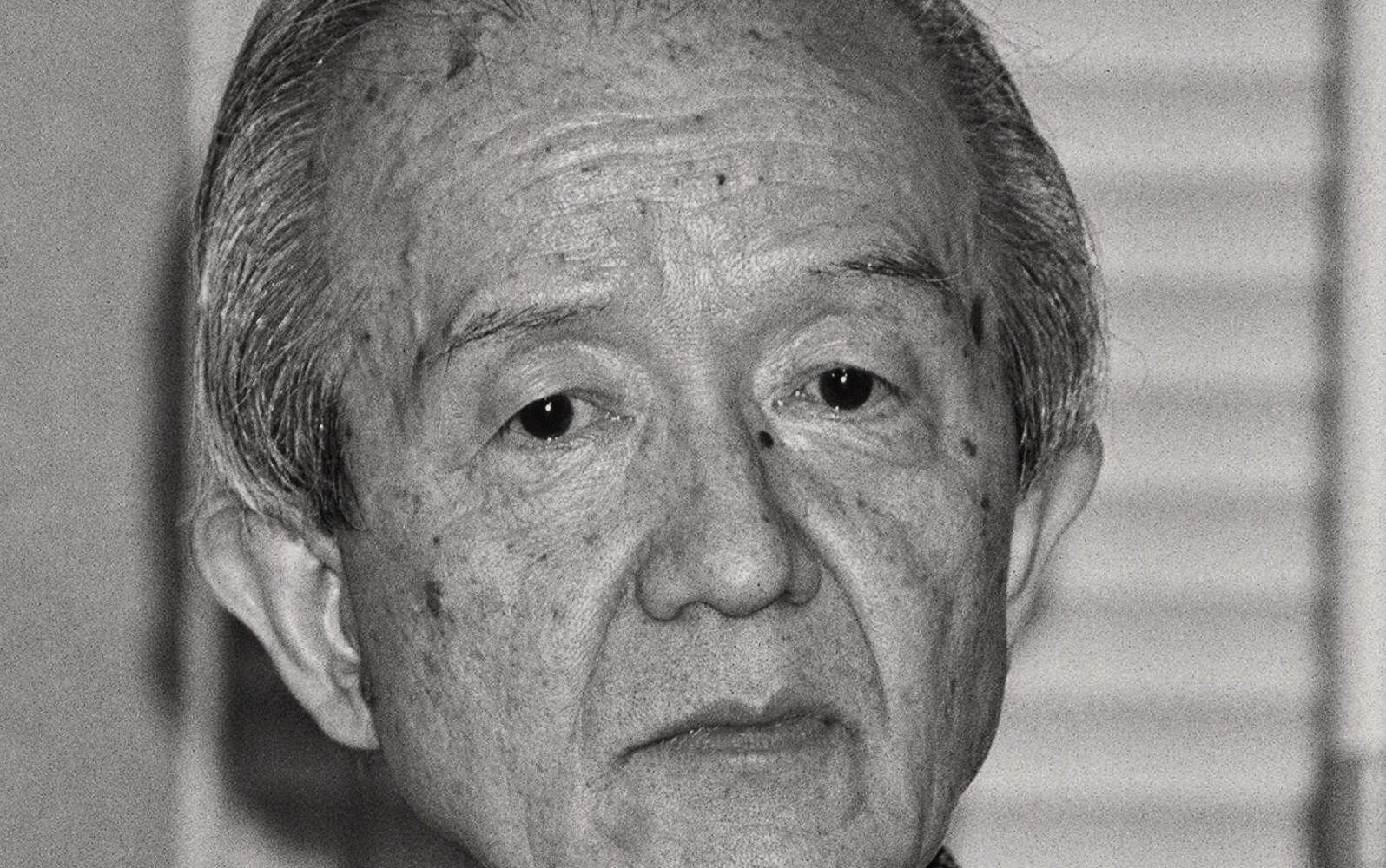
Remembering Yoshikazu Sakamoto 1927-2014 – also former TFF Associate

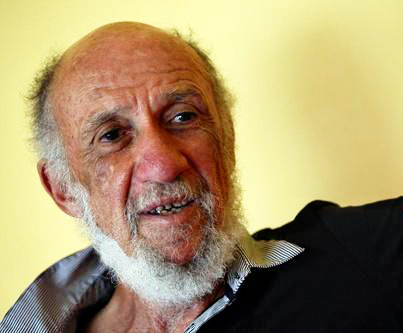
By Richard Falk

Richard Falk

TFF wants to express its gratitude to Yoshikazu Sakamoto who served for many years as TFF Associate.

Prefatory Note

This post is dedicated to my remembrance of Yoshi Sakamoto who died recently. Yoshi was a deeply valued friend and an important public intellectual in Japan who exerted a strong influence on the post-war generation. His political orientation, rejecting extremes of right and left, while questioning the militarist premises of the Cold War and Japan’s willingness to become America’s Asian poodle, gave him a distinctive political profile.

I am sharing these words of appreciation, and hope that anyone from Japan who comes across this text will contact me, especially if they have a way of putting me in touch with either Yoshi’s family or Japanese media. I would like to believe that ‘an American appreciation’ of Professor Sakamoto would be of interest to those who knew and admired him.

I first met Yoshi in the mid-1960s when he came to visit me at Princeton, expressing his concern about the Vietnam War and knowing of my anti-war activism. We bonded quickly and marched in a peaceful demonstration in New York City a few days later, and somehow managed to keep in fairly consistent contact until Yoshi’s death on October 2nd.

Yoshikazu Sakamoto 1927 - 2014
Read More »

Blowback of the foreign jihadists?

By Jonathan Power

Over 15,000 foreign jihadists from 80 countries are believed to be fighting alongside militants in Syria, the CIA says. The Syrian war is estimated to have mobilized more European Islamists than all the foreign wars of the last 20 years combined.

What to do when the jihadists try to return home?

Many of them might be trained to wage jihad against their home countries. The danger is, as Daniel Byman and Jeremy Shapiro write in the current issue of Foreign Affairs, “the returned fighter seasoned by battle acquires a new authority among his old friends and followers on social media – a street cred that allows him to recruit and radicalize others and send them into the fray.”

On the other hand because of the use of social media where the returnee sometimes brags about his exploits and adventures it becomes easy for the intelligence services both to track him down and know who he is trying to reach.

The threat posed by returning jihadists is too often hyped by both Western politicians and the media. Read More »

Civilization clashes Occident-Orient?

By Johan Galtung

Johan Galtung

Kuala Lumpur
IAIS-International Institute of Advanced Islamic Studies & IIUM-International Islamic University of Malaysia

Yes, Islam and Christianity are on old Buddhist lands; with Muslim-Buddhist clashes in Sri Lanka, Myanmar.

Occident is the big space of the three Abrahamic religions Judaism-Christianity-Islam, with the secularisms of the first two, excluding each other. Indonesia-Philippines are in the Occident.

Orient is a big space spanned by Buddhism, which does not exclude others, not even violent state power; hence more complex. There are pure Buddhist countries: Sri Lanka, Thailand, Myanmar, Cambodia, Laos, Vietnam; and mixed Buddhist countries, with other non-exclusive world views: in China with Daoism-Confucianism, in Japan with Kami shinto-Confucianism, and in Korea with Confucianism and Christianity.

The world religioscape started with Read More »