Despite Ukraine, Syria, Iraq, Libya, Afghanistan, Israel/Palestine and Southern Sudan the world is a lot more peaceful than it was at the end of the Cold War and shows no sign of returning to the bad old days when there were some 25 wars going on every year. Now it is down to about a dozen.
The task today is to keep that number going down – a difficult job when the outbreak of conflict in Syria, Libya and Ukraine have turned the graph upwards a few notches for the first time.
Protagonists in political quarrels tend to push the non-violent activists to one side – as they have done in Syria, Libya, Gaza and Ukraine.
This is not a good tactic as these situations have clearly shown. In Syria whole parts of cities have been reduced to rubble. Likewise in Gaza. In Ukraine this is starting to happen.
In the current issue of Foreign Affairs Erica Chenoweth and Maria Stephan argue that the prospects for civil resistance to bring about political change are commonly undersold.Read More »
On September 24 a special session of the Russell Tribunal will examine war crimes allegations against Israel arising from the 50-day military operation that commence on July 8th.
The Tribunal has developed a record of examining the criminality of state actors that enjoy impunity internationally because they are insulated from accountability by what I have called a ‘geopolitical veto’ in this case exercised by the United States and several major European countries.
Where governments and the UN fail to implement international law, there exists a right of peoples to play a residual lawmaking function. It is somewhat analogous to the residual role that the General Assembly is empowered to play when the Security Council is unable or unwilling to perform its primary role in relation to international peace and security.
To fill this normative vacuum the Russell Tribunal has long played made an honorable contribution to what might be called ‘the empowerment of legal populism.’ I encourage attentiveness to this event, including publicizing its occurrence and disseminating the results of its deliberations.
As the announcement below indicates, I am proud to be a member of the jury for the session along with a series of truly distinguished and qualified high profile international personalities known both for their professional achievement and for their principled stands as ‘citizen pilgrims’ dedicated to a humane future shaped by global justice.
Israel’s Crimes in Gaza during Operation Protective Edge – Extraordinary session of the Russell Tribunal
24-25 September – Brussels – Albert Hall, BrusselRead More »
Contrary to much conventional thinking that treats ‘anti-Semitism’ as exclusively a form of ethnic hatred, there is a second kind of attitude that is alleged to be ‘anti-Semitism’ because it is critical, often justifiably so, of Zionism and Israel’s policies and practices.
This second type of supposed anti-Semitism is a tactic deployed to discredit critics of Israel by insisting that criticism of Israel and hatred of the Jewish people should not be distinguished. These two distinct types of anti-Semitism actually work at cross purposes, and although there may be situations of overlap, it is a dangerous confusion to lump them together.
It is rather unusual for even the harshest critics of the behavior of the U.S. Government to be castigated as anti-American except sometimes in the midst of international security crises, but even then such accusations usually reflect the outlook of red neck patriots or extremists who identify with the right wing of American politics.
Also, such accusations, although unpleasant, lack the sting of anti-Semitism, which carries with it an implicit secondary allegation of indifference to the Holocaust, to the Nazi genocide, and to the long history of persecution directed at the Jewish people. In my view this labeling of Israel’s critics as ‘anti-Semites’ is a short-sighted form of unsavory state propaganda, generally implemented overseas by hard core Zionist groups, and partly responsible for an emergent backlash that is being expressed by hatred and hostility toward Jews.
This is a highly sensitive subject matter that is almost certain to be treated emotionally in a manner shaped by strong ideological alignments for or against the way in which Israel has behaved since its contested establishment in 1948 and in relation to attitudes toward close connections between the Zionist movement and the Jewish people.
Type I anti-Semitism is a form of virulent racism,Read More »
There is no doubt that Hamas has exhibited extraordinary resilience under the most difficult of conditions that have bedeviled its period of political leadership in the Gaza Strip that started in 2007.
It also seems clear as persuasively argued by Sandy Tolan in a valuable Common Dreams article – “Blown Chances in Gaza: Israel & U.S. Miss Many Chances to Avoid War”, Aug. 13, 2014 that Hamas pursued multiple initiatives starting in 2006 designed to achieve calm and quiet in its relations with Israel, and that these initiatives, including back channel reassurance about peaceful intentions, were rebuffed without even being acknowledged by either Israel or the United States.
It also seems the case that Israel acted to provoke the three most sustained military onslaughts directed at Gaza since 2008, and in each has relied on disproportionate force, inflicted numerous civilian casualties, and acted in a manner defiant of international humanitarian law.
For these reasons Israel deserves to be treated as an ‘outlaw state’ for reasons set forth by Akbar Ganji and I argued in a two-part article appearing in the online pages of AlJazeera English [“The Outlaw State of Israel,” Aug. 20,21, 2014].
And yet Hamas also has some explaining to do if it wishes to be more widely accepted throughout the world as entitled to full respect as a legitimate political actor. Read More »
Keynote, 25th International Peace Research Association (IPRA) Conference
Istanbul, 11-14 August 2014
We have come of age, at 50; and I am the only surviving founder from 1964 in London, capital of a foggy island in the North Sea. Now we meet in the sunny capital of another empire; bridging three continents. One cloned itself all over; the other was more an Islamic umma, a community of togetherness-and-sharing, with millet islands of tolerance. And now: the superb IPRA program.
Uniting for peace. But we differ, disagree? Incredible how far we can come if we identify and focus on the good and the positive in Kiev, Donetsk and Moscow, or husband and wife in broken marriages rather than what is wrong, and build new relations on that.
Peace is a relation, not attributes of the parties. So also for conferences: focus on the best in paper, praise it; not on the dubious and missing.
Building sustainable peace. My formula in A Theory of Peace is:
Equity X Harmony
Peace = ———————
Trauma X Conflict
Four Roots of Peace
• for positive peace: 1) cooperation for mutual and equal benefit, and 2) empathy for the harmony of sorrow at other’s sorrow and joy at other’s joy;
• for negative peace: 1) reconciling trauma, and 2) resolving conflicts–avoiding violence, through skills.
Expansion of interaction – through means of communication and transportation – with rights and obligations has created vast zones with less direct violence. But without equity: more inequality, more structural violence, killing even more. Identifying violence with bullets is as naive as identifying disease with microbes, overlooking structural diseases like cancer, heart; and overlooking chronic violence, like the security state and security world, by the US National Security Agency. Better: make Ukraine a federation, relate West-North to EU and South-East to Eurasia, with both having access to the other! And clone Snowden.
Through universal values. I know only two for sure, basic to Buddhism: reduce dukkha, suffering, and increase sukha, fulfillment (wellbeing). Emotions more than cognitive values? Yes, hence more basic. Negative and positive peace. Be aware of both-and and neither-nor, the ambiguous and the bland, more frequent than either-or.
Democracy? As rule by the consent of the ruled, maybe; but not as multiparty state elections, too easily corrupted into bankocracy. As dialogue to consensus in smaller units? But many rule themselves or go for those smaller units, uninterested in “states” and “regions”.
Human rights? If enriched with collective, people’s rights, yes; but be careful. They are excellent goal-formulations for underdogs but very one-sided as conflict discourse. Where are the goals of the topdogs? Only to remain on top? Only their perennial “if underdogs come up they will treat us like we treated them?” Or also some justified skepticism about an alternative order with former underdogs on top in a majority democracy, given their numbers? We do not know in advance; give them a hearing – not guaranteed by Human Rights. Solve problems.
To be ruled by somebody of your own kind? Universal. Even if one’s own kind is unkind, it is better than the benevolence of somebody else.
The First World War at 100: To see the Sarajevo’s shots on 28 June 1914 as the cause of the Hapsburg Empire attacking Serbia on 28 July overlooks Austria-Hungary annexing Bosnia-Herzegovina in 1908. The Serbs wanted to be ruled by their own kind. Self-determination was key. Nor was this a world war, all major battles were in Europe (17 of them in the French-Belgian corner). The massive killing was so insane that Europeans pushed it on the world.
The Second European war, rather, the First being the Napoleonic. The First World was, of course, Western colonialism from 4 May 1493 (Pope Alexander VI)–another atrocity to conceal.
IPRA at 50
What we wanted in 1964 was peace research recognized as a social science, member of the UNESCO International Social Science Council, bypassing turf-concerned Western universities. We got it.
Elise Boulding – role of culture, women – very active at the founding, saving IPRA several times afterward. Her husband Kenneth – the Image, stable peace, economic evolution – was in the background and Bert Röling – the youngest judge at the Tokyo Tribunal, disarmament, law for peace–became the first IPRA Secretary General. And then Galtung – at the time the health studies parallel and positive/negative peace.
We were from the world Northwest and IPRA has, like the world, moved East and South, with a Turkish Delight and a Sierra Leone Diamond as secretaries!
Prognosis: we will move on to Islam and China–India still needs time to grow with our Guiding Spirit: Gandhi. Then back to a more modest Northwest, circling on, as we should.
Criminalizing War
Massive murder, dukkha, inequity, disharmony, trauma leading to revenge, solving nothing in the longer run. The 1648 Westphalia Peace stabilized two Christianities at the price of a state system with the “right to war”. That institutional mandate has to go.
A centuries long process – jus ad bellum, jus in bello, human rights – to outlaw war except for defense, peace-keeping and “peace-enforcement” – recently as R2P (Responsibility to Protect) – opens countless loopholes, protected by anonymity and collectivity.
Personalize by naming the massive killers from top politicians to bottom soldiers – Nürnberg, Tokyo. Individualize by making them responsible, maybe following the Trans-National Corporations with amnesty in return for confession-contrition-compensation.
And remove that mandate from the Abrahamic god’s countless massacres via rex gratia dei – the King by God’s grace – transferred to the state – and via vox popoli vox dei – the voice of people being the voice of god–perverting democracies into killing machines.
Be careful! They may kill even more in order not to be arrested.
And we get further with positive and negative peace, and by fighting war as a social evil.
But the three approaches add up. We have work to do!
Originally published by Transcend Media Service here.
Finally, finally the over-long, seven year trial of the leaders of the murderous Khmer Rouge leadership of Cambodia, is over. The two defendants, Nuon Chea and Khieu Samphan, were each given a life sentence.
Of the other three that were tried, one, the ex-foreign minister, Ieng Sary died in 2013, one, Ieng Thirith, the wife of Ieng Sary, was too ill with Alzheimer’s to appear and one, Kaing Guek Eav (“Duch”), voluntarily confessed three years ago and was sent to jail for 35 years.Read More »
Prefatory Note
Below is the text of an Open Letter to the UN Secretary General Ban Ki-moon alleging his inappropriate responses to the carnage and massacres taking place in Gaza, and by his behavior undermining respect for and the authority of the United Nations and international law.
Given such a performance, the challenge posed to the highest ranking UN official is to revise his past comments on the Israeli attack or to resign his office. The peoples of the world, and not just the Palestinians, have a paramount interest in holding morally, legally, and politically accountable the UN and those who lead and represent the organization in response to such breaches of the peace and acts of aggression in accordance with law and justice, and never more so than when such unlawful behavior is directly responsible for a grave humanitarian catastrophe of the kind that has befallen the civilian population of Gaza since July 8.
Instead of supporting Israel spurious claim of acting in self-defense, Mr. Ban Ki-moon should have been using his office to insist on an immediate ceasefire accompanied by the unconditional lifting of the blockade imposed on Gaza since mid-2007 that has constituted the essence of the collective punishment of the 1.8 million people encaged in the Gaza Strip without even a sanctuary for children, women, the disabled, the elderly, non-militants to escape from the combat zone by crossing the border or finding safety within Gaza itself.
The shelling of UN facilities being used to shelter those desperately seeking safety exemplifies Israeli criminal conduct during this savage military operation.
Please read the text below, prepared by Badil (an NGO devoted to Palestinian refugee rights that enjoys a world reputation for the quality of its work and the dedication of its staff) and endorsed by a large number of Palestinian civil society actors; please disseminate this text as widely as possible, and call independently for a response by the Secretary General, as well as further action if a response is not forthcoming.
Open letter to Mr. Secretary-General, Ban Ki-moon: stand for law and justice or resign!
5 August 2014
For humanity and the little remained credibility of international law:
UN Secretary-General, Ban Ki-moon, stand for law and justice or resign!
Secretary-General Ban Ki-moon,
We, the under signed Palestinian human rights and community-based organizations are extremely disappointed by your performance, notably by your biased statements, your failure to act, and the inappropriate justification of Israel’s violations of IHL, which amount to war crimes.
Until today, you have taken no explicit and tangible measures to address the recent Israeli attacks in the occupied Palestinian territory (oPt) since 13 June. Moreover, your statements have been either misleading, because they endorse and further Israeli false versions of facts, or contrary to the provisions established by international law and to the interests of its defenders, or because your words justify Israel’s violations and crimes.
You have undeniably assumed a biased position toward the current attack on Gaza and Israeli violations in the West Bank by failing to clearly condemn Israeli unlawful actions in the OPT, while, on the other hand, not hesitating to accuse – sometimes mistakenly – Palestinian combatant in Gaza of violations of international law.
This bias can be noted in the following excerpts:Read More »
Billedet af Rusland i de vestlige medier er i dag næsten mere dystert end under den kolde krig. Mange tror, at russerne lever i fattigdom og ufrihed i evig angst for Putins rædselsregime, præget af få censurerede medier. Rusland skulle angiveligt være ved at falde sammen og borgerne længes efter de friheder, som vesten kan tilbyde.
Putin skulle angiveligt være nervøs for, at den ukrainske ’demokratiske’ revolution skulle sprede sig til Rusland. Derfor skal vi i vesten entydigt støtte Kiev regeringen og den ikke-parlamentariske opposition i Rusland. Mange vestlige politikere mener, at vi økonomisk skal isolere Rusland.
EU og USA fokuserer i disse tider på at straffe Rusland og Read More »
One criteria of quality research is that it predicts the future better than incompetent research.
Because TFF is independent of governments and coroporations it doesn’t have to take political considerations or exclude certain theories, concepts or values. This free research enabled it over the years to make fairly precise predictions about for instance former Yugoslavia, the Iraq war and East-West relations.
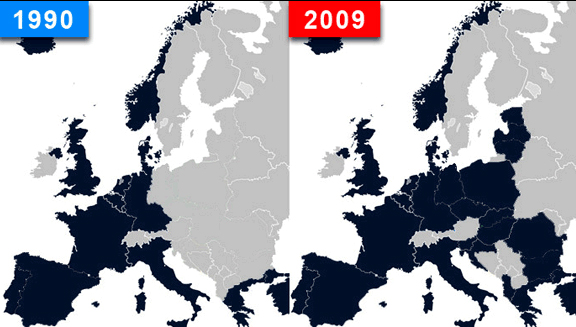
In 1998 – 16 years ago – we warned that NATO’s expansion would lead to future problems with Russia. Read it here.
NATO should never have been expanded
We backed this prediction up with 46 arguments and argued that so many other things would be wiser than containing Russia from the Baltic republics to Georgia – a strategy pursued by Bill Clinton in contravention of all promises given to the Soviet Union/Russia at the end of the Cold War about ten years earlier.
That counterproductive and insensitive expansion has now hit Ukraine. A new Cold War is gathering over Europe. It should have been predicted by advisers, intelligence agencies, big research institutes and columnists.
But it wasn’t.
At the end of the Cold War, NATO/the West got everything it could ever wish – and without war. But it wanted more: keeping Russia down, making NATO bigger and “peace-making” as well as finding new enemies to keeping its Military-Industrial-Media-Academic Complex (MIMAC) alive and well: Saddam, Milosevic, the Muslim world, terrorism and – now re-cycling – Russia.Read More »
A number of Western/NATO politicians – Hillary Clinton foremost among them – and media people have recently introduced a new ethical principle in international affairs:
When A delivers weapons to B, A is responsible for what B does with these weapons. The former Secretary of State and perhaps future U.S. President presents this new ethical principle here on CNN.
This makes a lot of sense to me. Look at it this way:
Here is a young confused boy who has little to look forward to – and less to lose – because his country is falling apart in nasty civil war. He’s been told by some commander, or by his President, that he must hate the enemy; he gets paid for killing off as many as he can. And so he does.
He believes also in what he’s been promised: Fame as a hero upon return – that is, if he returns – and a comfortable life.




 TFF Associates Blog 2011-2017