Slouching toward global disaster

By Richard Falk

There are many disturbing signs that the West is creating conditions in the Middle East and Asia that could produce a wider war, most likely a new Cold War, containing, as well, menacing risks of World War III. The reckless confrontation with Russia along its borders, reinforced by provocative weapons deployments in several NATO countries and the promotion of governing regimes hostile to Russia in such countries as Ukraine and Georgia seems to exhibit Cold War nostalgia, and is certainly not the way to preserve peace.

Add to this the increasingly belligerent approach recently taken by the United States naval officers and defense officials to China with respect to island disputes and navigational rights in the South China Seas. Such posturing has all the ingredients needed for intensifying international conflict, giving a militarist signature to Obama’s ‘pivot to Asia.’

These developments are happening during the supposedly conflict averse Obama presidency. Looking ahead to new leadership, even the most optimistic scenario that brings Hillary Clinton to the White House is sure to make these pre-war drum beats even louder.

From a more detached perspective it is fair to observe that Obama seems rather peace-oriented only because American political leaders and the Beltway/media mainstream have become so accustomed to relying on military solutions whether successful or not, whether dangerous and wasteful or not, that is, only by comparison with more hawkish alternatives.

The current paranoid political atmosphere in the United States is a further relevant concern, calling for police state governmental authority at home, increased weapons budgets, and the continuing militarization of policing and law enforcement.

Such moves encourage an even more militaristic approach to foreign challenges that seem aimed at American and Israeli interests by ISIS, Iran, and China. Read More »

Responding to Megaterrorism after Paris

By Richard Falk

Prefatory Note
The article below is based on an opinion piece published by Middle East Eye on December 1, 2015 under the title “A Different Response to ISIS after Paris.” My modified text places its focus on the originality of megaterrorism and its distinctive challenges, suggesting that the choice of response needs to be extended beyond the iron cage of militarism and vengeance. Also, it is essential for analysts and leaders to envision the response to the response as well as being preoccupied with how best to hit back. Increasingly, American politicians treat the challenge as if playing poker whereas the realities of the situation call for a chess players’ natural disposition to think ahead as many moves as possible. Finally, given the religious and civilizational dimensions of current versions of megaterrorism, it is vital to guard against various manifestations of Islamophobia.

What separates megaterrorism from other more customary forms of terrorism is the theme of this post. It is not possible to give a precise definition of megaterrorism by pointing to a threshold of casualties or the magnitude of response. Each megaterrorist event is decisively shaped by its distinctive sociopolitical and psychological context.

The focus here is to take account of this radical new category of threat posed in a variety of settings, critique the ‘war’ reflex and the war/crime binary, briefly consider alternate paths of response, and recommend risk and cost assessments that take into account adversary responses to the prescribed response. The 21st century experience with responding to megaterrorist events does not create confidence in either most conceptualizations of the challenges being posed or the responsive strategies chosen to be implemented.

The horrific Paris attacks of November 13th challenge the West more deeply in some ways than did the 9/11 attacks 14 years ago. Read More »

Dubbelspelet kring Ukraina

Av Ola Friholt
TFF Associate

Med den uttalade avsikten att underminera Vladimir Putins ställning i Ryssland har Natostaterna och övriga EUstater systematiskt förtigit Kievregimens vägran att följa de avtal den själv skrivit under.

Istället har Ryssland anklagats för dubbelspel och erövrarambitioner. Utvecklingen ser ut så här*:

1. Ukraina förhandlar med EU om ekonomiskt samarbete, vilket skulle innebära att bryta samarbetet med Ryssland. När president Janukovitj av sina ekonomer fick veta vad detta skulle kosta landet, avstod han från att underteckna det framförhandlade EU-avtalet.

2. Detta utlöste Maidanprotesterna, från grupper i västra Ukraina, vilka länge velat ansluta landet västerut. Dessutom deltog Janukovitjanhängare. Skottlossning utbröt från hus omkring torget, med okända skyttar. Detta tolkades som Janukovitjs ansvar.

3. Janukovic och Maidanledarna framförhandlade 21 feb 2014, tillsammans med Frankrikes, Tysklands och Polens utrikesministrar och en representant för Ryssland ett avtal, som gick ut på följande: a. Ömsesidig demobilisering av väpnade grupper.
b. Omedelbart arbete med författningsändringar, först för att begränsa presidentens befogenheter (som tidigare hänt efter den orangea revolutionen 2004).
c. Förhandling av ny författning att antas senast i december 2014.
d. Presidentval ska hållas i december genast efter att författningen antagits.
e. En nationell enhetsregering från båda sidor ska verka fram till valet i december 2014.

4. Underskrifterna på detta avtal ratificerades av Majdanrådet men avvisades av de hårdföra högeraktivisterna, som krävde omedelbar (lagstridig) avsättning av presidenten och förbud mot de två politiska partierna i östra Ukraina, d v s eliminering av den östliga politiska eliten.

5. Den 22 februari grep högerextremisterna makten och avsatte Janukovic som flydde till Ryssland.Read More »

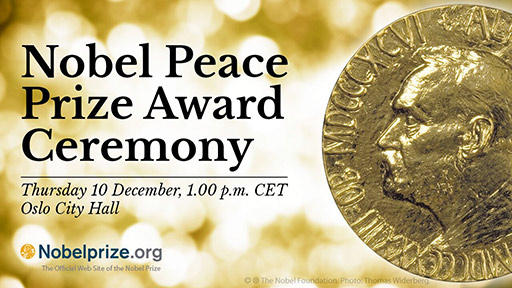
TFF PressInfo # 351: The Nobel Foundation taken to court on the Peace Prize

Lund, December 10, 2015

On the day of the Nobel Peace Prize Award Ceremony at Oslo City Hall

To whom it may concern, including the media

We know – and Alfred Nobel knew – how devastating war and arms races are, and how little security we get for all the money we spend on military forces.

The campaign to reclaim the Nobel Peace Prize is first and foremost a campaign to revive the idea that global peace requires global cooperation on disarmament and replacing the law of force with the force of law. Every day more and more of us see, from the Middle East warfare, from the refugee crisis, and many other chilling reminders, the mandatory urgency of a change in world politics.

Alfred Nobel decided to give one fifth of his fortune for a prize to promote disarmament and resolution of all conflicts through negotiations and legal means, never through violence.

Can such a prize, with a so clearly stated goal, be turned to serve the opposite idea and be given again and again to recipients who promote arms races and believe in militarism and war?

This question will soon be answered, after Mairead Maguire, Jan Oberg, Davis Swanson, and Lay Down Your Arms took the case to the Stockholm District Court on Friday 4th of December 2015. Here is the full text of the summons.
and all other relevant information is available at the Nobel Peace Prize Watch.

Test case: the award to the European Union in 2012

The court case will test one of the most obvious violations of the Nobel idea Read More »

Violence in and by Paris: Any way out?

By Johan Galtung

Atlanta, Georgia, USA

The atrocity in Paris seems to trigger the word “terrorism” with a higher frequency than ever, in the media, from the politicians. Doing so, they sign their intellectual capitulation: trust me, I am not going to try to understand anything. Watching politicians on 56 US TV channels in Georgia there was not a single word analyzing why?; like underlying conflicts and traumas.

Nor conciliation and solution. Only a description of what? – the horrible violence. And what to do: more violence, war. With a question mark though: Will it work?

The whole Western world was living up to the old French saying – Cet animal est très méchant, quand on le bat, il se defend. (That animal is very vicious, when you beat it, it defends itself). Look at centuries of French/Arab-Muslim relations and find one-way beating, killing, conquest, colonialism, exploitation, France using them in wars against Turkey and against Germany promising freedom and breaking their promises, raw post-colonial colonialism, no respect for their wishes to be the masters in their own house, like now in Mali.

Using them for menial jobs in France, if they speak French. At the bottom of society, shocked when the French school system treats them equally and they climb upwards, like African-Americans when they gained access to the US school system. And eventually to US society, after a century of Jim Crow and the civil rights movement.

France is now in that phase. Do not assume that 350 million Arabs – 1,650 million Muslims – will take more beating hands down. Read More »

The Failure of U.S. foreign policy in the Middle East

By Richard Falk

Prefatory Note: What follows is a modified version of the Morton-Kenney annual public lecture given at the University of Southern Illinois in Carbondale on November 18, 2015 under the joint sponsorship of the Department of Political Science and the Paul Simon Public Policy Institute.

The Failure of U.S. Foreign Policy in the Middle East

While focusing on the ‘failure’ of American foreign policy in the Middle East it is relevant to acknowledge that given the circumstances of the region failure to some degree was probably unavoidable. The argument put forward here is that the degree and form of failure reflected avoidable choices that could and should have been corrected, or at least mitigated over time, but by and large this has not happened and it is important to understand why.

This analysis concludes with a consideration of three correctible mistakes of policy.

It is also true that the Middle East is a region of great complexity reflecting overlapping contradictory features at all levels of political organization, especially the interplay of ethnic, tribal, and religious tensions internal to states as intensified by regional and geopolitical actors pursuing antagonistic policy agendas. Additionally, of particular importance recently is the emergence of non-state actors and movements that accord priority to the establishment and control of non-territorial political communities, giving primary legitimacy to Islamic affinities while withdrawing legitimacy from the modern state as it took shape in Western Europe. Comprehending this complexity requires attention to historical and cultural background, societal context, and shifting grand strategies of geopolitical actors.

I.

From many points of view American foreign policy in the Middle East has been worse than a disappointment. It has been an outright failure, especially in the period following the 9/11 attacks of 2001. Even such an ardent supporter and collaborator of the U.S. government as Tony Blair, the former Prime Minister of the United Kingdom, has acknowledged as much in a recent set of comments where he basically says that the West has tried everything, and whatever the tactics were relied upon, the outcome was one of frustration and failure. Read More »

TFF PressInfo # 348 – After 70 years: The UN falls short, and yet…

By Richard Falk

The United Nations turns 70 today. It isn’t “we, the peoples” – it is “we, the governments”. It’s in need of reform but we must also remember that its first Secretary-General Trygve Lie said in 1948 – that it will never be stronger or better than the member states want to make it.

Whatever you think of it, we certainly can’t do without it, nor without its Charter that is still the most Gandhian document, all governments have ever signed.

If its member governments were not so navel-gazing, it would be the best vehicle for global governance – for globalising democracy in a world where the economy and the military as well as communication and culture are all globalizing while politics is still anchored in parliaments in increasingly irrelevant nation-states.

And why not set up a People’s Assembly? Establish UN Embassies in each member state and let people vote for who shall represent their country in the UN?

All doable with a little creativity and good will – for the common good, the common future.

Below, please find the thoughts at the UN’s 70th Anniversary of one of the finest international law and peace experts we have who has also worked with the UN for many years.

– Jan Oberg

Prefatory note

A shorter somewhat modified version of this post was published in Al Jazeera Turka, but only in Turkish translation. The thesis set forth is that the UN has disappointed the expectations of those who took seriously its original promise of war prevention, but that it has over its lifetime done many things that need doing in the world.

It also provided a meeting place for all governments, and has developed the best networking sites for all those concerned with the state of the world and what can be done by way of improvement. The UN System faces an important test in the upcoming Climate Change Conference to be held in Paris at the end of November. The event is billed as the make or break session for the governments of the world to agree finally on a strong enough framework of constraint governing the release of greenhouse gasses to satisfy the scientific consensus.

If Paris is generally regarded as successful, the UN stock will rise steeply, but if it should fail, then its stature and role of the Organization could become even more marginalized. Either way, the UN as of 2015 is a very different kind of political actor than when it was founded in 1945, disappointing to those that hoped for permanent peace and some justice, while pleasing to those that sought from the outset a wider global agenda for the Organization and felt that its best contributions would likely be in a wide range of practical concerns where the interests of major political actors more or less overlap.

After 70 Years: The UN Falls Short, and Yet..

When the UN was established in the aftermath of the Second World War hopes were high that this new world organization would be a major force in world politics, and fulfill its Preamble pledge to prevent future wars. Seventy years later the UN disappoints many, and bores even more, appearing to be nothing more that a gathering place for the politically powerful.

I think such a negative image has taken hold because the UN these days seems more than ever like a spectator than a political actor in the several crises that dominate the current agenda of global politics. This impression of paralysis and impotence has risen to new heights in recent years.

When we consider the waves of migrants fleeing war-torn countries in the Middle East and Africa or four years of devastating civil war in Syria or 68 years of failure to find a solution for the Israel/Palestine conflict or the inability to shape a treaty to rid the world of nuclear weapons, and on and on, it becomes clear that the UN is not Read More »

Making peace arrive in Ukraine – bring in the UN

By Jonathan Power

September 15th 2015.

On the last day of last month right wing demonstrators, mostly from neo-fascist movements, hurled themselves against the police in Kiev’s Maidan square, the same place where in February 2014 a more heterogeneous group of demonstrators effectively ousted President Viktor Yanokovych. A grenade was thrown and three people died and 120 were hospitalized, mostly policemen.

In an address to the nation President Poroshenko blamed the clashes on nationalistic forces, calling their actions “a stab in the back”. Finally the Western powers raised a voice of condemnation, although over the last year they have made little criticism of the rightist militias and parties.

That is perhaps because it would interfere with their narrative – that the demonstrators that overthrew Yanukovych were of a liberal, democratic hue. The overwhelming majority were. But the ignored fact is that the people who led the crowd and fired the bullets when the demonstrations turned ugly were these very same rightists.

Some of the leaders of the neo-Nazi organisations, especially Svoboda, went on to be appointed to senior positions in government and parliament.

The BBC’s Ukraine correspondent, David Stern, reported on September 1st: “The explosion in Maidan comes weeks after another armed incident involving volunteer militia with ties to the extreme right – a shoot out between members of the so-called Right Sector and the local police in south-western Ukraine. Although the militias have been nominally integrated into government structures, many wonder how much control Kiev actually exercises.”

The main gripe of the protestors is that Read More »

TFF 30th Anniversary Benefit Event

Lund, Sweden, September 5, 2015
Updated September 5 and our apologies if you’ve received this before.
We want to catch all and miss no one over all these years.

Dear friend!

We are happy to invite you to the TFF 30th Anniversary Benefit Event !
September 11-12, 2015

Live Lectures by videostream
Exciting lectures on world affairs and peace over two days – See program below.

This is not an invitation to visit the foundation in person.
It is an online, live video streamed event that you will be able to follow from anywhere in the world
Here is the link and it’ll also be shown via Facebook, Twitter and on our website.
And all the lectures will be available later as videos on our own video channels.

Open House at the foundation
Saturday September 12 at 14:00-17:00
It’s at Vegagatan 25 in Lund, Sweden – deadline for your registration September 7.
1. Lectures on-site with live streaming

We’ll shortly tell you the links where you may see it all and where videos will later be available.

Lecture program

Friday September 11

Live, video streamed:

16:00
September 11: Alternatives to the devastating War On Terror – Jan Oberg

17:00
TFF 30 Perspectives – TFF Associates and Board on the better world we dream of – And cheers!

Saturday September 12

Live, video-streamed 10:00-18:00

10:00
Iran And the Nuclear Issues – Gunnar Westberg

11:00
Integration – Why and how? Example: Afghan Youth In Sweden – Christina Spännar, Sweden

12:00
Nuclear abolition is necessary and possible – Gunnar Westberg, Sweden

13:00
West and East: Ukraine and New Cold War? – Jan Oberg

14:00
Human Rights And War Crimes – Jonathan Power, UK/Sweden

15:00
Women, Self-Esteem and Violence – Annette Schiffmann, Germany

16:00
Yugoslavia – What Should Have Been Done? – Jan Oberg (in Memoriam Håkan Wiberg), DK/Sweden

17:00
Media and Peace – Sören Sommelius, Sweden

18:00
Burundi’s Crisis And Possible Ways Out – Burundi expert

2. Open House hours 14-17
Buffet, drinks, coffee and tea, cakes and other sweets.
You must register your visit by September 7 at the latest at TFF30@transnational.org or call 0046 738 525200.

3. Peace with peaceful means
The day is devoted to the – ongoing – struggle for ”peace by peaceful means“ as the UN Charter puts it. Gandhi said that the “means are goals in-the-making”. To realize that noble goal remains the mission of TFF. Today we show you how and promote all related activites with the help of social media and new video technologies.

4. This is a Benefit Event – Your support to TFF please!

TFF is unique in being totally independent of government and corporate funds. It’s people-financed. No one related to TFF has a salary; we’re all-volunteer.
This provides for truly free research and permit us to be critical and constructive and practise our freedom of expression. Not everyone can boast that today!
Wars, nuclear and conventional arms, bombing raids and occupations etc. are financed by your tax money. Sadly and unfairly, no tax funds go to realise the UN norm above.

We think that people who believe that peace is better than violence should also pay something to the research, education and activism in favour of that UN norm.
If you can come to Lund on our big day or sit somewhere following our rich lecture program, we urge you strongly to make a donation. Every day over 30 years, TFF has given the world something useful.

You can do it right in the middle of our homepage – click the “Give” button or under the headline “Support” in the right-hand column where many options exist, including PayPal. It easy, fast and secure!
Cash – but no cheques – can also be donated at the event.* *

Thank you so much!

5. Videos
We’re proud to present the first two short videos – 3 more to come – in which the founders talk about various aspects of 30 years in the service of peace on the basis of questions asked by board member Annette Schiffmann. Watch, comment and subscribe!

The First

The Second

6. Brand new Online Magazine
The announced online magazine launched to mark our Anniversary is now here!

“Transnational Affairs – TFF Magazine for conflict-resolution, non-violence and peace-building”

Excited as we are, we’ll be back to you soon with more details!

Yours truly

Christina & Jan
Founders

* If you are able to come in person, you must register to TFF30@transnational.org or call 0046 738 525200 by Tuesday September 8 at the latest.

* * This does not apply to you if you have already made a donation in 2015.

TFF PressInfo # 343: Can nuclear war be avoided?

By Gunnar Westberg

The Canberra Commission had as members former leading politicians or military officers, among others a British Field Marshal, an American General and an American Secretary of Defence and a French Prime minister.

The commission unanimously agreed in their report in 1996: The proposition that nuclear weapons can be retained in perpetuity and never be used – accidentally or by decision – defies credibility. The only complete defence is the elimination of nuclear weapons and assurance that they will never be produced again.

So that’s it: Nuclear weapons will be used if they are allowed to remain with us. And even a “small” nuclear war, using one per cent or less of the world’s nuclear weapons, might cause a world wide famine leading to the death of a billion humans or more.

Lt Colonel Bruce Blair was for several years in the 1970s commander of crews with the duty to launch intercontinental nuclear missiles. “I knew how to fire the missiles, I needed no permission,” he states. In the 1990s he was charged with making a review for the US Senate on the question: “Is unauthorized firing of US nuclear weapons a real possibility?”

Blair’s answer was Yes, and the risk is not insignificant.Read More »