By chance I was reading César Vallejo’s poem, “Black Stone on a White Stone,” in a translation by Geoffrey Brock, and was struck by the opening stanza:
I’ll die in Paris in the pouring rain
a day I have a memory of already.
I’ll die in Paris—I won’t try to run—
a Thursday perhaps, in Autumn, like today.
Without being literal, I was reminded that I could appraise my death while alive, and not leave a final reckoning to some solemn memorial event in which speakers are challenged to find humorous anecdotes to lighten the occasion, otherwise uttering honorific platitudes quite unrelated to the experiential core of my being.
I had been thinking quite a bit recently about ‘lost causes.’
Recently I gave a lecture at Columbia University on this theme, inspired by Edward Said’s seminal late essay “On Lost Causes” (1997) in which he ties together the ‘nobility of failure’ as portrayed in literature with his own unswerving dedication to the Palestinian struggle for a just peace. On that occasion, Read More »
Considering the year that is about to end is a time to pause long enough to take stock of what went wrong. In the United States not much went right aside from Barack Obama’s surprising initiative to normalize relations with Cuba after more than 60 years of hostile and punitive interaction. Although the sleazy logic of domestic politics kept this remnant of the worst features of Cold War diplomacy in being for a couple of extra decades, it is still worth celebrating Obama’s move, which when compared to the rest of his record, seems bold and courageous.
As well, Obama exhibited a strong commitment to doing more than previously on climate change, using his executive authority to circumvent Congressional unwillingness to act responsibly. Obama’s immigration reform proposals also seem on balance to be positive, although whether they will be implemented remains an open question.
Drifting Toward Cold War II: Remembering World War I
There are several signs of a worsening global setting that seemed to gain an ominous momentum during 2014. Perhaps, worst of all, is a steady drumbeat of anti-Russian rhetoric backed up by Western sanctions, that seems almost designed to produce Cold War II. Read More »
This petition will be delivered to the U.S. government, the International Criminal Court, the President of the UN General Assembly, the President of the Human Rights Council and the European Court of Justice.
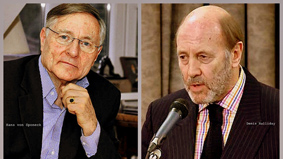
Hans von Sponeck, TFF Associate, and Denis Halliday
Petition initiated by two former UN Assistant Secretaries-General, UN Humanitarian Coordinators for Iraq: Hans von Sponeck and Denis Halliday.
On 9 December 2014, the US Senate released its CIA torture report. The investigation confirmed what globally has been known for many years: the US Central Intelligence Agency and US-outsourced national authorities in Europe, the Middle East and elsewhere have been involved in an extensive range of torture applications.
Compelling evidence has become available, especially since 2001, the beginning of the Afghanistan war, through investigations by the European Parliament and national judicial authorities, as well as two major reports presented by Swiss Senator Dick Marty in 2006 and 2007 to the Council of Europe, on secret CIA detention centres in Europe, the Middle East and elsewhere.
The US Senate report makes it clear that cruel, degrading and inhumane treatment of captives by the CIA and its collaborators have been carried out on a continuous basis.
Such treatment can not be justified in any manner, even if the US Government reservations with which it signed the UN torture convention in 1994 were to be taken into account.
CIA personnel and others wilfully participated in following executive orders and directives thereby violating the UN torture convention and the Geneva Convention III. In this way they have committed serious crimes for which they must be held accountable. Read More »
The First Conference on ”World Against Violence and Extremism” is inaugurated here in Tehran this morning by President Rouhani. His idea was endorsed unanimously by the UN General Assembly last year. This PressInfo was written before I came to Iran.
The last round of negotiations between Iran and the Five Permanent Members of the UN Security Council + Germany about the future possibility that Iran would acquire nuclear weapons should have resulted in no agreement but a 7 months postponement. It is a waste of everybody’s time in one of the most urgent issues on the international agenda.
An a-symmetric conflict
Here are 5 countries bristling with thousands of nuclear weapons themselves and planning to spend trillions of dollars on more and more sophisticated nukes – unanimous in telling a country that does not have nukes to not acquire them: ”What we can’t live without thou shall never have”.
Everybody knows but conveniently omit mention of the fact that Israel is a nuclear weapons power over 50 years with at least 200 nukes in contravention of UN resolutions that the whole region shall be free from such weapons. And it has not signed the Non-Proliferation Treaty.
In rough terms, Iran’s military expenditures is 2-3% of the United States’; with a population ten times that of Israel it spends about the same, and 4% of its GDP where Israel spends 6.
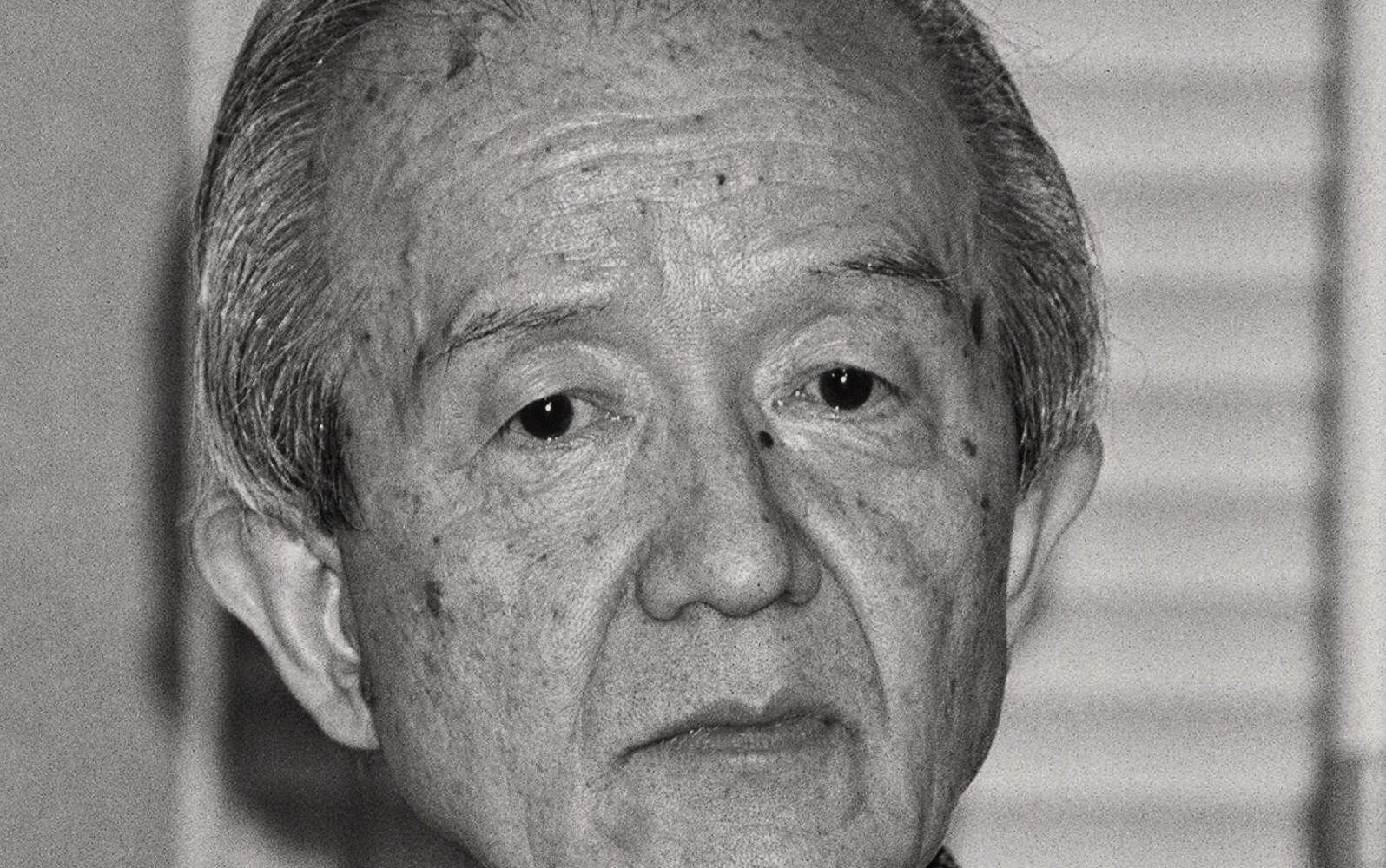
TFF wants to express its gratitude to Yoshikazu Sakamoto who served for many years as TFF Associate.
Prefatory Note
This post is dedicated to my remembrance of Yoshi Sakamoto who died recently. Yoshi was a deeply valued friend and an important public intellectual in Japan who exerted a strong influence on the post-war generation. His political orientation, rejecting extremes of right and left, while questioning the militarist premises of the Cold War and Japan’s willingness to become America’s Asian poodle, gave him a distinctive political profile.
I am sharing these words of appreciation, and hope that anyone from Japan who comes across this text will contact me, especially if they have a way of putting me in touch with either Yoshi’s family or Japanese media. I would like to believe that ‘an American appreciation’ of Professor Sakamoto would be of interest to those who knew and admired him.
I first met Yoshi in the mid-1960s when he came to visit me at Princeton, expressing his concern about the Vietnam War and knowing of my anti-war activism. We bonded quickly and marched in a peaceful demonstration in New York City a few days later, and somehow managed to keep in fairly consistent contact until Yoshi’s death on October 2nd.
Over 15,000 foreign jihadists from 80 countries are believed to be fighting alongside militants in Syria, the CIA says. The Syrian war is estimated to have mobilized more European Islamists than all the foreign wars of the last 20 years combined.
What to do when the jihadists try to return home?
Many of them might be trained to wage jihad against their home countries. The danger is, as Daniel Byman and Jeremy Shapiro write in the current issue of Foreign Affairs, “the returned fighter seasoned by battle acquires a new authority among his old friends and followers on social media – a street cred that allows him to recruit and radicalize others and send them into the fray.”
On the other hand because of the use of social media where the returnee sometimes brags about his exploits and adventures it becomes easy for the intelligence services both to track him down and know who he is trying to reach.
The threat posed by returning jihadists is too often hyped by both Western politicians and the media. Read More »
No matter what you may think of Putin and Russia this is simply not the way international politics should be conducted, particularly not at the personal level. If it wasn’t an offence to children, one would aptly characterise it as childish behaviour.
Western leaders ignored a brilliant opportunity to meet face-to-face with Vladimir Putin and move forward towards mutual understanding instead of signalling that they want a new Cold War.
Western leaders tell us that Russia is a ”threat to the world”. That obviously serves other purposes because you don’t bully someone you genuinely fear.
The G20 Brisbane should be remembered for its show of Western leaders’ personal display of weakness and conflict illiteracy.
Pummelled Putin punching bag
CNN reports that, during the meeting, Putin took ”pummelling” and was treated as a ”punching bag” by Western leaders from he set foot on Australian soil where his Australian host had sent a deputy minister of defence to receive him.
The Guardian reports that the Russian president approached Canadian Prime Minister Harper with his hand outstretched. Harper reluctantly shook it, then said “Well I guess I’ll shake your hand, but I only have one thing to say to you: you need to get out of Ukraine.” ”Bold words” – media called it.
Footage shows Putin sitting alone at a lunch table – like a naughty school boy put in the corner as by his teachers.
President Obama said that we are ”opposing Russia’s aggression in Ukraine which is a threat to the world as we saw in the appalling shoot down in the MH-17”.Read More »
A soon-to-be released report of the US Senate criticizes the CIA under President George W. Bush of conducting torture of Al Qaeda suspects. However, it doesn’t assess the responsibility of Bush himself nor his vice president, Dick Cheney.
According to the Senate Intelligence Committee’s chairwoman, Dianne Feinstein, the 6,000 page report is “one of the most significant oversight efforts in the history of the US.”
The report shows that the CIA did not provide accurate information to Congress and also provided misleading information. The report also concludes that the CIA impeded effective White House oversight and decision-making. While the report was being prepared the CIA penetrated the Senate Committee’s computers, arousing the fury of its members.
Bush and Cheney were deeply involved in initiating the torture program. Read More »
On November 9, it is 25 years the Berlin Wall came down. Seventeen months later, Yugoslavia’s dissolution began and various concepts and policies were introduced that fundamentally changed international politics ever since – more so than the fall of the Wall.
These features can be seen in the conflict (mis)management in later conflicts.
By now we should have accumulated enough evidence of how effective the various ”teatments” of the ”patient” called Yugoslavia were. To put it crudely: A unique country was destroyed – yes from the inside too, but that doesn’t reduce the responsibility of the West/NATO in its role as ”peacemaker”.
Today, Croatia is ethnically much more clean; Kosovo remains a failed state; the constituencies of the Dayton Accords for Bosnia (1995) still won’t live together as one state, as elections have just shown us. Macedonia’s problems have only deepened. The split between Serbia and Montenegro was enigmatic. Today’s Slovenia is the only unit that can be said to be in a better situation now than when part of Yugoslavia.
It is high time we get a critical discussion going of what the international so-called community chose to actually do – no matter the stated intentions – to help bring about peace in former Yugoslavia.
All of it must be re-assessed and lessons must be learned for governments to introduce a little modesty and recognise that they are not born peacemakers but rather war makers. And we need such a debate to go down another road than the one we took since 1999.
TFF maintains that the crisis in and around Yugoslavia is much more significant for international affairs than hitherto assumed because e.g.:
• The international so-called community’s attempt at being self-appointed conflict analysers and peacemakers with no prior education or training right after being Cold War warriors led to miserable results on the ground.
• Closely related: the amateurish idea that conflicts could be understood and treated as two parties, one good and one bad. The bad guys were the Serbs, of course, and Slobodan Milosevic became the new ”Hitler of Europe” after the West had used him as an ally.
• During this crisis Russia was sidetracked and humiliated. But in the Soviet Union era no one would have dared touch the Yugoslav space. Now the West could do what it wanted and Russia could do nothing to oppose it.
• Violent humanitarian intervention was introduced and persuaded many,Read More »
Prefatory Note The post below is a somewhat revised version of a text published by The Nation. I should also point out that in these proceedings in Brussels under the auspices of the Russell Tribunal I served as a member of the jury.
In a special session of the Russell Tribunal held in Brussels on September 24th, Israel’s military operation Protective Edge was critically scrutinized from the perspective of international law, including the core allegation of genocide. The process featured a series of testimonies by legal and weapons experts, health workers, journalists and others most of whom had experienced the 50 days of military assault.
A jury composed of prominent individuals from around the world, known for their moral engagement with issues of the day that concerned their societies, and also the wellbeing of humanity, assessed the evidence with the help of an expert legal team of volunteers that helped with the preparation of the findings and analysis for consideration by the jury, which deliberated and debated all relevant issues of fact and law, above all the question of how to respond to the charge of genocide.
It should be acknowledged that this undertaking was never intended to be a neutral inquiry without any predispositions. It was brought into being because of the enormity of the devastation caused by Protective Edge and the spectacle of horror associated with deploying a high technology weaponry to attack a vulnerable civilian population of Gaza locked into the combat zone that left no place to hide.
It also responded to the failures of the international community to Read More »



 TFF Associates Blog 2011-2017