Lessons from the U.S.-Korea nuclear crisis

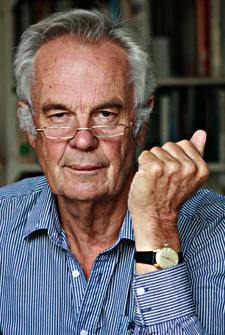
By David Krieger

The high-profile nuclear crisis on the Korean Peninsula, pitting the reigning heavyweight nuclear champion, the United States, against the bantamweight nuclear contender, North Korea, is not finished and is deadly serious. The posturing and exchanges that the world has been witnessing are capable of spiraling out of control and resulting in nuclear war. Like the Cuban Missile Crisis more than half a century ago, this crisis demonstrates that nuclear dangers continue to lurk in dark shadows across the globe.

This crisis, for which the fault is shared by both sides, must be taken seriously and viewed as a warning that nuclear stability is an unrealistic goal. The elimination of nuclear weapons, an obligation set forth in the Non-Proliferation Treaty and confirmed by the International Court of Justice, must be a more urgent goal of the international community. The continued evasion of this obligation by the nuclear weapon states makes possible repeated nuclear crises, nuclear proliferation, nuclear terrorism and nuclear war.

Lessons can be drawn Read More »

America’s war criminals

By Jonathan Power

Someone, somewhere, has to say it – that the U.S. harbours war criminals of its own and they have served not that long ago at the apex of power in the American government.

Alas, no one is going to act like the recently deceased Robert McNamara who served as Secretary of Defence under presidents John F. Kennedy and Lyndon Johnson. In one speech he described himself as a war criminal – for being party to the nuclear bombing of Hiroshima and Nagasaki and for his role in the Vietnam war.

The Obama Administration has to move faster and harder. Last month President Barack Obama implicitly criticised himself for not getting the Guantanamo prison closed. Admittedly to do so has been made very difficult as the Republicans in the Senate have blocked his every move. But he could do more, like transferring some federal courts to Guantanamo.

One wonders if once again if it will all come to nothing, as did the talk that has gone on for decades about prosecuting the former National Security Advisor and Secretary of State to President Richard Nixon, Henry Kissinger.Read More »

US policy weakens Iran’s pro-democracy movement

By Stephen Zunes

While the outcome of the Iranian elections scheduled for June 14 may be hard to predict, it will make little difference as long as power remains firmly in the hands of Ayatollah Khamenei and other hard-line clerics. Indeed, while there are contending factions vying for the country’s relatively weak presidency, the narrow ideological spectrum within which candidates are allowed to run for public office offers little hope for change — at least through the electoral system.

Following the 2009 election, in which the incumbent right-wing president Mahmoud Ahmadinejad was declared the winner despite his apparent loss to the popular reformist Mir-Hossein Mousavi, the people of Iran rose up in a popular civil insurrection, which was brutally crushed.

While it is hard to guess how soon democracy will come to Iran, the government’s theft of the election and subsequent crackdown — shattering the illusion many Iranians still held that they could work within a rigged political system — may have brought that day closer. Read More »

Ending perpetual war? Endorsing drone warfare?

By Richard Falk

That President Obama chose on 23 May to unveil his second term cautionary approach to counter-terrorism at the National Defense University epitomized the ambiguity of the occasion. The choice of venue was itself a virtual guarantee that nothing would be said or done on that occasion that challenges in any fundamental way the global projection of American military power.

Obama’s skillfully phrased speech was about refining technique in foreign policy, achieving greater efficiency in killing, interrogating the post-9/11 war mentality, and all the while extolling the self-mystifying glories of American exceptionalism. That is, only the United States, and perhaps Israel and NATO, possessed an entitlement to use force at times and places of the actor’s choosing without consulting the UN, respecting the constraints of international law, and heeding the admonition in the Declaration of Independence to show “a decent respect for the opinions of mankind.” Read More »

Responding to the Syrian challenge

By Richard Falk

The issue facing the U.S. Government at this stage is not one of whether or not to intervene, but to what extent, with what objectives, and with what likely effects. More precisely, it is a matter of deciding whether to increase the level and overtness of the intervention, as well as taking account of what others are doing and not doing on the Assad regime side of the conflict. Roughly speaking, there have been interventions by the Turkey, the United States, Qatar, Saudi Arabia, Israel, and the EU on the insurgent side, and by Russia, Iran, Hezbollah on the regime side, with a variety of non-Syrian ‘volunteers’ from all over being part of the lethal mix.

From an international law perspective the issues are blurred and controversial, both factually and jurisprudentially. The Assad government remains the government of Syria from most international perspectives, despite having repeatedly perpetrated the most despicable crimes against humanity. Such behavior has eroded Syria’s status as a sovereign state Read More »

The unstoppable pursuit of crimes against humanity

By Jonathan Power

Good riddance! I wonder what their Maker will conclude? Last week saw the death of one of the world’s worst practitioners of crimes against humanity – Jorge Rafael Videla, aged 87, the former military dictator of Argentina. He died while serving a life sentence.

Last week also saw the conviction of Guatemala’s former head of state, Efrain Rios Montt, aged 86, for genocide – the mass murder of the country’s indigenous people. This was the first time, anywhere in the world, that a former head of state has been put on trial for genocide by a national tribunal in his own country. Regrettably, yesterday, the constitutional court ordered a partial re-trial. His conviction is still likely.Read More »

Rethinking ‘Red lines”

By Richard Falk

There are widespread reports circulating in the media that President Obama had not fully appreciated the political consequences of responding to a question at an August press conference that asked about the consequences of a possible future use of chemical weapons by the Assad regime. Obama replied that such a use, should it occur, would be to cross ‘a red line.’ Such an assertion was widely understood to be a threat by Obama either to launch air strikes or to provide rebel forces with major direct military assistance, including weaponry.

There have been sketchy reports that Syria did make some use chemical weapons, as well as allegations that the reported use was ‘a false flag’ operation, designed to call Obama’s bluff. As the New York Times notes in a front page story on May 7th, Obama “finds himself in a geopolitical box, his credibility at stake with frustratingly few good options.” Such a policy dilemma raised tactical issues for the U.S. Government about how to intervene in the Syrian civil war without risking a costly and uncertain involvement in yet another Middle Eastern war. Not responding also raises delicate questions of presidential leadership in a highly polarized domestic political atmosphere, already shamelessly exploited by belligerent Republican lawmakers backed by a feverish media that always seem to be pushing Obama to pursue a more muscular foreign policy in support of alleged America’s global interests, as if hard power geopolitics still is the key to global security.

What is missing from the debate on Syria, and generally from the challenge to American foreign policy, is a more fundamental red line that the United States at another time and place took the lead in formulating – namely, the unconditional prohibition of the use of international force by states other than in cases of self-defense against a prior armed attack. Read More »

Seeing in the dark

By Richard Falk

Seeing in the Dark with Victoria Brittain

As with the best of journalists, Victoria Brittain has spent a lifetime enabling us to see in the dark! Or more accurately, she has shined a bright light on those whose suffering has been hidden by being deliberately situated in one or another shadow land of governmental and societal abuse, whether local, national, or geopolitical in its animus.

These patterns of abuse are hidden because whenever their visibility cannot be avoided, the liberal mythologizing of the decency of the modern democratic state suffers a staggering blow. In recent years this unwanted visibility has permanently tarnished the human rights credentials of the United States due to the spectacular exposés of the horrifying pictures of prisoner abuse at the Abu Ghraib prison in Iraq or various reports of grotesque treatment of Guantanomo detainees.

As with Bradley Manning and Wikileaks, the U.S. Government should be embarrassed by its response: a preoccupation with these unwelcome leaks of its dirty secrets, while manifesting indifference to the substantive disclosures of its endorsement of torture and other crimes against humanity. But it is not, and that has become and remains a deep challenge to all of us who wish to live in a society of laws, not sadistic men, a society based on ethics and human rights, not cruelty and dehumanization.

Once such secrets have been revealed, all of us are challenged not to avert our gaze, being reminded that upholding the rights and dignity of every person is the duty of government and the responsibility of all citizens, and when flagrant and intentional failures along these lines remain unchallenged, the credentials of decency are forever compromised.

This is but a prelude to commenting briefly upon Victoria Brittain’s extraordinary recent book of humane disclosure, Shadow Lives: The Forgotten Women of the War on Terror (London: Pluto, 2013; distributed in the United States by Palgrave Macmillan). Brittain is a journalist who not only sees in the dark, but what is even rarer among the restless practitioners of this profession, she stays around long enough to listen. Read More »

Shipping death and destruction to Syria

By Sharmine Narwani

“The weapons of choice in (today’s) new conflicts are not big-ticket items like long-range missiles, tanks, and fighter planes, but small and frighteningly accessible weapons ranging from handguns, carbines, and assault rifles on up to machine guns, rocket-propelled grenades, and shoulder-fired missiles,” explained William Hartung more than a decade ago in an article entitled The New Business of War.

“Because they are cheap, accessible, durable, and lightweight, small arms have been a primary factor in the transformation of warfare from a series of relatively well- defined battles between ‘two opposing forces wearing uniforms’ to a much more volatile, anarchic form of violence,” says Hartung, now director of the Arms and Security Project at the Center for International Policy in Washington DC. “More often than not, today’s wars are multisided affairs in which militias, gangs, and self-anointed “rebels” engage in campaigns of calculated terror, civilian targets are fair game, and the laws of war are routinely ignored.”

“The ready availability of small arms makes these conflicts far more likely to occur, far more deadly once they start, and far more difficult to resolve once the death tolls mount and the urge for revenge takes hold.”

Hartung could have been describing Syria today. And no – the anarchic, violent rebels he describes in his article do not appear everywhere else in the world except in Syria. They are the Syrian prototype.Read More »

The UN Arms Trade Treaty is not perfect

By Jonathan Power

US presidential candidate Jimmy Carter described arms sales as a “cancer”. But once in office Carter achieved little in controlling them.

In President Bill Clinton’s first term Amnesty International questioned the US government about the use of American military helicopters and armoured vehicles involved in human rights abuses in Turkey. Under pressure from Congress the State Department compiled a report on human rights violations by the Turkish armed forces. It concluded there was “highly credible” evidence that US-supplied arms and jet fighters had been used to subdue Kurdish villages.

Later, in 1996, the US temporarily suspended the sale of advanced attack helicopters. But two years later there were fresh reports that hundreds more armoured vehicles had been sold. The US Defence Secretary visited Turkey and reportedly lobbied on behalf of American companies wishing to co-produce advanced helicopters there. In that same year an American company sold 10,000 electric shock weapons to the Turkish police.
Read More »