Homage to International New York Times

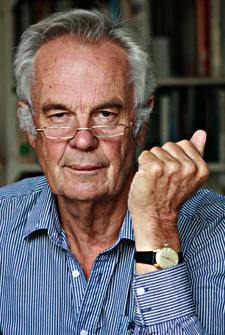
By Johan Galtung

On the table are some old clippings mainly from that remarkable paper; in my mind the International Herald Tribune, IHT, from 1857 and a part of my reality for about fifty years. Maybe an addiction? Hard to live without. The recent name change to International New York Times was understandable but too specific geographically, not global. The Honolulu papers, well located, are often more global.

Why homage? Not for the news coverage; usually the news “fit to print”. The news that do not contradict too openly the world views carried by US and Israeli foreign policies, even if this has improved considerably recently. Nor for the editorials, they are usually on the same line and also, sorry, frankly, often boring.

No, the homage is for the articles, essays even, at a very high level in what is after all a newspaper, a paper with news. Those essays often carry discourses that are wide ranging, way back into the past, far into the future. We are not talking about agree-disagree but about broadness, openness, even globally.

Take William Safire 30 September, 1991Read More »

TFF PressInfo: Sverige – inte längre aktör för en bättre värld

Av Jan Öberg
Dr.hc., direktör för TFF
4 maj 2014

Eliten i Sverige är mer lojal mot Nato, USA och EU än mot sitt folk

• Under de senaste 25-30 åren har Sveriges militära, säkerhets- och utrikespolitiska elit vridit Sveriges politik 180 grader.

• Dessa grundläggande förändringar inleddes av den socialdemokratiska regeringen under Göran Persson och utrikesminister Anna Lindh och har genomförts praktiskt taget utan offentlig debatt.

• Omsvängningen till interventionism, militarism och USA/Nato på alla områden har planerats gradvis, i smyg och ohederligt – kort sagt på ett sätt som är ovärdigt en demokrati.

• Denna elit är mer lojal mot Bryssel och Washington än mot svenskarna.

• Om din bild av Sverige är att det är ett progressivt, förnyande och fredsfrämjande land med global inställning som försvarar folkrätten så är den – tråkigt nog – föråldrad.

Hur Sverige har förändrats

Sverige är inte längre neutralt och det är bara formellt alliansfritt; det finns ingen mer närstående bundsförvant än USA/Nato. Landet har upphört att utveckla en egen politik och positionerar istället sig inom ramen för EU och Nato. Landet bidrar inte längre med betydelsefullt nytt tänkande – det sista var Olof Palmes kommission om gemensam säkerhet (1982).Read More »

TFF PressInfo: Sweden – no longer a force for good

Sweden’s elite more loyal with NATO, the US and EU than with its people

By Jan Oberg

May 2, 2014

• Over the last 25-30 years Sweden’s military, security and foreign policy elite has changed Sweden’s policy 180 degrees.

• These fundamental changes were initiated by the Social Democratic government under Goran Persson and foreign minister Anna Lindh and have been carried through virtually without public debate.

• The rapproachment with interventionism, militarism and US/NATO in all fields has been planned, incremental, furtive and dishonest; in short, unworthy of a democracy.

• This elite is more loyal with Brussels and Washington than with the Swedes.

• If your image of Sweden is that it is a progressive, innovative and peace-promoting country with a global mind-set and advocate of international law, it is – sad to say – outdated.

How Sweden has changed

Sweden is no longer neutral Read More »

The New World Order?

By Richard Falk

There is no more reliable guardian of entrenched conventional wisdom than The Economist. And so when its cover proclaims ‘the new world order,’ and removes any ambiguity from its intentions, by its portrayal of Putin as a shirtless tank commander with menacing features.

No such iconography accompanied the last notable invocation of the phrase ‘new world order’ by George H. W. Bush in mobilizing support for a forcible response to the Iraqi invasion and annexation of Kuwait in 1990, the dirty work of Saddam Hussein. Read More »

Moratorium on comments addressing the Israel/Palestine struggle

By Richard Falk

It has always been my intention to make the tiny fragment of the blogosphere that I inhabit a site for civil discourse on a wide spectrum of concerns, issue oriented interpretations of what is transpiring in the world.

Recently the comments sections has narrowed from this perspective into a dialogue between adversaries, several of whom seem preoccupied with, if not obsessed by, Israel, the Jewish experience, Zionism, and the Palestinian/Arab narrative and counter-narrative. Some of the contributions have been learned and sensitive to the reality that there are many diverse voices that need to be heard on this inflamed subject-matter, yet others have been intolerant, launched repeated personal attacks questioning motives and motivations, and have created a polemical aura at the site that has inhibited participation by those with other interests, concerns, and style.

For these reasons, I have decided to have a moratorium on all comments relating to this subject-matter until May 1, 2014.

I expect this might be troublesome for several faithful readers of my posts. Please bear with me, and understand this to be an effort to encourage more varied and less antagonistic exchanges.

I am suspending this portion of the comments section at a moment that coincides with the ending of my six-year term as Special Rapporteur on Palestine for the UN Human Rights Commission.

Let me add that I will continue to do my best to remain engaged in the struggle to find a just and sustainable peace for both peoples premised upon their equality.

TFF PressInfo: Kosovo 15 years later, a personal memory and a word about free research

By Jan Oberg

Lund, Sweden March 24, 2014

Media with a pro-Western bias usually remind us of 9/11 based on a victim narrative. We just passed 3/20 – the 11th Anniversay of the war on Iraq. Every year they forget 10/7 (Afghanistan) and 3/24, the destruction of Serbia-Kosovo in 1999.

What to do when NATO’s raison d’etre – the Warsaw Pact – had dissolved? Answer: Turn NATO into a humanitarian bombing organisation which in – fake – Gandhian style could say: We are bombing for a higher ethical humanitarian purpose to save lives and on this exceptionalist moral high ground we ignore international law.

Kosovo 15 years later

Kosovo remains a unique result of propaganda and mass killings to produce and independent state without a UN Security Council mandate – which doesn’t prevent Western politicians from teaching Russia international law these very days.

If Kosovo, why not Tibet, Taiwan, the Basque country, Korsica, Kurdistan, Palestine, or Crimea? The answer is: Kosovo was exceptional. But why? Oil and gas, perhaps, see later…Read More »

Putin and his Crimea speech

By Jonathan Power

March 25th 2014

President Vladimir Putin’s speech to both houses of the Russian parliament last week got bad notices. Anne Applebaum, the experienced Russian-watcher, wrote in her column in the Washington Post that it was “an imperial rant” and went on to say that “Nato should moves its forces from Germany to the alliance’s eastern borders”. Most Western governments also gave their own misleading interpretations of Putin’s speech.

In this column I’m not going to defend Putin up and down the hill. I profoundly reject the way the absorption of Crimea into Russia was carried out. One can’t mount a referendum on an issue as important as this with two weeks’ notice – the Scots have been discussing their planned referendum, set for later this year, for years.

Moreover, this referendum only had two questions: whether the voters wanted to go back to Russia or whether they wanted increased autonomy. It didn’t ask if voters wanted to remain part of Ukraine.Read More »

TFF PressInfo: Crimea – The referendum, the mote and the beam

By Jan Oberg

Lund, Sweden March 16, 2014

Of course it is illegal and of course it will be rigged, that referendum in Crimea today. And of course it is a ploy and comes only in the wake of Russia’s (read Putin’s) unprovoked aggression, used as a pretext to build a new Greater Russia.

That is, if you browse the mainstream Western media the last week and on this Sunday morning.

Referendum means referring an issue back to the people. It is – or should be – an important instrument in democracies. And it’s a much better instrument than war and other violence to settle complex conflicts.

Generally, citizens-decided conflict-resolution is likely to last longer and help healing wounds of the past than any type of solution imposed by outside actors.

In Switzerland citizens go and vote on all kinds of issues on many a Sunday throughout the year. Sweden has used it to decide about nuclear energy, Denmark about EU membership and – in 1920 – to solve the conflicts in Schleswig-Holstein and define the future border between Germany and Denmark. Referendums, binding as well as non-binding, are an accepted instrument in many countries.

Why did the West not use referendums?

The West likes to pride itself of its type of democracy whenever and wherever it can. But it doesn’t use the referendum instrument that often. Read More »

TFF PressInfo: Ukraine – What Would You Like to Know About It?

By Jan Oberg

I’m no expert on Ukraine, haven’t even visited it. Like millions of other citizens, I rely on media reports to understand at least some of what looks like potentially very serious developments.

Why do I feel so frustrated at what I get? Why do I have so many questions still after weeks of coverage? And how much will fellow-citizens who have just a few minutes per day to acquaint themselves with issues such as this understand (except that Putin is a bad guy)?

It’s a conflict, isn’t it?

I would like to know what are the internal Ukrainian dimensions, the regional East-West European and EU/NATO aspects and what has all this to do with global developments e.g. U.S. foreign policy, NATO’s expansion since the end of the Cold War, strategic interests of Russia and Russia-NATO relations. And where is China and BRICS countries in all this?

Internally, I’d like to learn about the ethnic composition and geography, the role of Russians and – not the least the Jews – and the historic relations between Russia and Ukraine.

In a shorter perspective, when did the West begin to see Ukraine as an interesting country? Why did George Bush Sr. and James Baker promise Mikhail Gorbachev that the West would never expand up to Russia’s border – and anyhow NATO began being an issue in Ukraine in 1995.

It would be great to learn from media about how – as everywhere else – economic mismanagement and overall crisis caused both neo-Nazism, rampant anti-Semitism and general dissatisfaction? And why is it that anti-Semitism is covered so little anywhere in the Western press

How come that important background aspects like these so easily translate into simplifying anti- versus pro-Russian attitudes?Read More »

Iran – P5+1 deal: Positive steps but hawks try to derail it

By Farhang Jahanpour

In his State of the Union Address on 28th February, President Barack Obama bluntly pointed out that if the hawks in Congress pushed for a bill to impose new sanctions on Iran he would veto that bill. This brave and almost unprecedented move by President Obama has silenced, at least for the time being, the opposition to the Joint Plan of Action that was agreed by Iran and the P5+1 (the five permanent Security Council members plus Germany) last November. This was a major setback for AIPAC (American Israeli Public Affairs Committee) and other pro-Israeli lobbies that had mobilized all their forces to block the deal.

In fact, some of the Democratic Senators that had sponsored the bill to impose additional sanctions on Iran have already distanced themselves from it. Furthermore, at least seventy Members of Congress are organizing a letter to the President supporting U.S.-Iran diplomacy and opposing new sanctions. (1)

New round of talks
Meanwhile, 20th January marked an historic turn in the Iranian nuclear dispute with the West, when both Iran and the West began to implement the terms of the agreement. The IAEA director general Yukiya Amano has said that he could report that “practical measures are being implemented as planned” by Iran, and that there would be new negotiations over the next phase on 8th February. Iran also has agreed to a new round of negotiations on 18th February with the P5+1. (2)


For his part, Iranian Foreign Minister Mohammad Javad Zarif has said: “What I can promise is that we will go to those negotiations with the political will and good faith to reach an agreement, because it would be foolish for us to only bargain for six months — that would be [a] disaster for everybody.”

Read More »