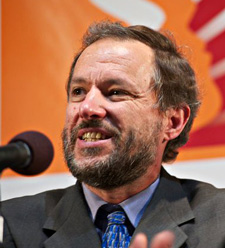
US policy weakens Iran’s pro-democracy movement

By Stephen Zunes

While the outcome of the Iranian elections scheduled for June 14 may be hard to predict, it will make little difference as long as power remains firmly in the hands of Ayatollah Khamenei and other hard-line clerics. Indeed, while there are contending factions vying for the country’s relatively weak presidency, the narrow ideological spectrum within which candidates are allowed to run for public office offers little hope for change — at least through the electoral system.

Following the 2009 election, in which the incumbent right-wing president Mahmoud Ahmadinejad was declared the winner despite his apparent loss to the popular reformist Mir-Hossein Mousavi, the people of Iran rose up in a popular civil insurrection, which was brutally crushed.

While it is hard to guess how soon democracy will come to Iran, the government’s theft of the election and subsequent crackdown — shattering the illusion many Iranians still held that they could work within a rigged political system — may have brought that day closer. Read More »

Midest backlashes yet to come

By Sharmine Narwani

The Middle East is treading water these days. Two years of rhetoric about ousting dictators, revolution, freedom, honor, dignity, and democracy – without result – has people on edge, their disillusionment now demanding an outlet.

There are no outlets though. Sensing the fast-growing disenchantment with undelivered promises, even the “bright new leaders” are tightening the reins and demanding compliance.

These new heads of state simply can’t deliver the goods for one main reason: they are just as caught up in global and regional power contests as were their predecessors. Nothing has changed with these uprisings. Nothing!Read More »

The Iran threat delusion

TFF PressInfo
May 8, 2013

Contacts for interviews as well as analytical sources below the statement.

Summary

Scores of Western politicians state that Iran is a threat to its neighbours or even the world. But before we end up in yet another cruel war based on wrong assumptions and delusion, somebody should ask them the simple question: How do you know?

– There is little, in fact, to back up these claims. Each time Iran spends 7 US$ on its military, the U.S. spends 700 US$, Israel 15,60 US$, Saudi-Arabia 44 US$ and the Arab Emirates 16 US$. Therefore, if Iran were to start a war, it would have to ignore the “balance of forces” of 1:110 with its basic opponents!

– “To construct Iran as a threat, one must assume that its leaders are lunatics or suicidal. There’s no evidence they are,” says Jan Oberg, director of TFF, The Transnational Foundation in Sweden*.

Argument

– False or exaggerated threat assertions are necessary to build up legitimacy among citizens before wars are started. Experts call it “fearology”: Instill fear in peoples’ minds and they accept, from left to right, their own governments’ taxpayer-funded wars.Read More »

A ray of hope in Iran’s next presidential election

By Farhang Jahanpour

The next crucial round of Iranian presidential elections will be held on 14 June 2013. It has just been officially reported that Hassan Rowhani has declared his candidacy for the election.(1) Rowhani is an influential reformist politician and cleric. He was the chief Iranian nuclear negotiator under President Mohammad Khatami, who negotiated successfully with the Troika of European countries, UK, France and Germany.

Under his supervision, his team agreed to temporarily suspend nuclear enrichment and reprocessing activities for two years during the course of the negotiations.(2) Uranium enrichment was resumed after his successor, Ali Larijani, who was appointed Iran’s nuclear negotiator on August 14, 2005 by President Mahmud Ahmadinejad shortly after assuming power, said that European countries had not lived up to their promises to help Iran with peaceful nuclear technology. Khatami’s government had threatened to resume enrichment if there was no progress in negotiations with the West, but the resumption of enrichment took place under Ahmadinejad’s government.

So far, the long, lackluster list of the candidates who have officially declared their candidacy is made up largely of the so-called Principlist wing of the Iranian politics. This term applies Read More »

As Obama greets Iranians on Nowruz, he’s made some medicines hard to afford

By Farhang Jahanpour

Nowruz, the Iranian New Year, is one of the oldest festivals celebrated in the world. In fact, the palace of Persepolis built in the sixth century BC was an audience hall for celebrating Nowruz. It takes the spring equinox (falling on 20 or 21 March each year) as the start of the year, and it is celebrated in Iran and in many other countries, including Afghanistan, Tajikistan, and other Central Asian states, as well as Arran (Republic of Azerbaijan) and some other countries in the Caucasus. It is celebrated by the Kurds in Iraq, Syria and Turkey and many other peoples who have a shared history with Iran. It is a time of renewal and rebirth. Continue here This link also contains Obama’s speech to the Iranian people.

Crying wolf over Iran’s nuclear program

By Farhang Jahanpour

Crying wolf – the evidence

After producing his comic diagram during his speech at the United Nations General Assembly last September, drawing a red line in order to stop Iran’s alleged imminent nuclear bomb, the Israeli Prime Minister Benjamin Netanyahu called for immediate action against Iran before it was too late.

However, as the result of President Barack Obama’s insistence that he wanted to resolve the dispute by peaceful means, the war fever subsided to some extent. However, on the eve of the meeting between Iran and the P5+1 in Almaty, Kazakhstan, and the forthcoming visit of President Obama to Israel, Netanyahu has once again started to press the panic button about Iran’s nuclear intentions.

Referring to Iran’s announcement that she was installing new centrifuges for enriching uranium, and undaunted by his earlier false predictions, Netanyahu once again claimed that the new centrifuges could cut by a third the time needed to create a bomb.1)

However, when Israel’s intense campaign to start a war with Iran stalled, Israeli officials said that their original assessment about the deadline for dealing with Iran had been false. As Jacques E. C. Hymans points out in his recent article in Foreign Affairs, Israeli intelligence officials have now downgraded their assessment of Iran’s ability to build a nuclear bomb.2) Now, they say: “Iran won’t be able to build a nuclear weapon before 2015 or 2016, pushing back by several years previous assessments of Iran’s nuclear ambitions.”3)Read More »

What’s The Problem With Iran?

TFF PressInfo 1-2013

On Tuesday February 26, in Kazakhstan, a new round of negotiations are due between Iran and the Five Permanent UN Security Council members + Germany. We’d like to bring the following expert statement to your attention.

Contacts for interviews as well as analytical sources below the statement.

Summary

The problem is not nuclear weapons, essentially. It’s strategic interests such as control of oil and gas and that requires a change of Iran’s ‘obstinate’ and ‘defiant’ regime.


The present US/NATO/EU policy is based on escalating threats without an exit strategy. This increases the risk of war, whether intended or not. If that is not the deliberate purpose, an entirely new Western policy vis-a-vis Iran must be developed.

The Transnational Foundation in Sweden – an independent think tank with 27 years of experience – provides you with the diagnosis, the prognosis and the proposals for improved relations built on trust.
 (See below.)Read More »

Room for optimism in Iran and the P5-plus-1 talks

By Farhang Jahanpour*

Iran and the P5-plus-1, which includes the United States, will meet again on 26 February in Kazakhstan. This is the first time that the two sides will meet in an atmosphere of continuing mutual suspicion since the third round of talks held in Moscow on 18-19 June 2012 ended in stalemate.

Iran believes that the West, particularly the United States, is using the talks as a pretext to increase the sanctions until Tehran bends to its will; whereas Washington holds that Iran is prolonging the talks in order to continue its uranium enrichment with the aim of producing a nuclear weapon. The fact of the matter is that neither side is sincere in their remarks and both sides are engaged in a cat and mouse game trying to use the talks for domestic purposes and for pursuing other goals, rather than finding a mutually acceptable solution to Iran’s nuclear program.Read More »

Iran and the Cuban nuclear missile crisis

By Jonathan Power

It’s always better to talk than be super-tough. But Iran’s supreme leader, Ayotollah Ali Khamenei, last week firmly rejected the US attempt to resume negotiations over its suspected nuclear bomb making.

This is nothing short of disastrous. The Ayotallah must know that now Barack Obama has been re-elected not only has he got much more room to compromise but he has effectively seen off the attempt of Benjamin Netanyahu, the Israeli prime minister, to persuade the US to attack Iran.

The Ayotallah probably thinks by going eyeball to eyeball with the US he is going to win more than even Obama is prepared to give. This is nonsense and the attitude of both sides reminds me of the negotiating tactics of President John Kennedy and Soviet Premier, Nikita Khrushchev, during the Cuban missile crisis in 1963 which nearly brought the superpowers to a nuclear war.Read More »
