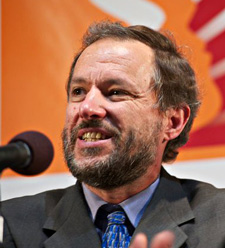
Breivik – A victim of collective psychosis (1)

By Johan Galtung

An individual psychosis setting him apart from others, also in daily life, does not seem to fit his case. But there is another form of psychosis that fits his narcissistic hatred and paranoid violence so removed from the average. His psychosis is produced and triggered by the polarization-escalation aspect of conflict, not easily captured by individualizing psychiatry as his daily life attitude and behavior may be (near) normal.

His psychosis is collective, shared. His ego is part of a real or imagined collectivity that may include those higher up; not an individual disorder associated with the deviant lower down. There is a class aspect to psychosis, marginalizing the individual cases, catapulting extremist collective psychopaths into top power.Read More »

Bipartisan assault on Middle East peace

By Stephen Zunes

Earlier this month, the House of Representatives passed a dangerous piece of legislation (H.R. 4133) which would undermine the Israeli-Palestinian peace process, weaken Israeli moderates and peace advocates, undercut international law, further militarize the Middle East, and make Israel ever more dependent on the United States.

The margin was an overwhelming 411-2, with eight abstentions.

House minority leader Steny Hoyer (D-MD) and Howard Berman (D-CA), the ranking Democrat on the House Foreign Affairs Committee, joined House Majority leader Eric Cantor (R-VA) and House Foreign Affairs Committee chair Ileana Ros-Lehtinen (R-FL) in co-sponsoring the bill, an indication of how closely the Democratic Party leadership aligns with the most right-wing Republicans when it comes to U.S. Middle East policy.Read More »

What is new in the Israel-Palestine conflict?

By Richard Falk

Undoubtedly transfixed by the extraordinary developments throughout the Arab world since Mohamed Boazizi’s self-immolation on December 17, 2010: from Tahrir Square to the NATO intervention in Libya to bloody confrontations in Syria, Yemen, Bahrain to the eerie quiet in Algeria to the relative and temporary calm in Morocco, few have noticed that the Israeli/Palestine conflict has changed its character in fundamental respects during the last couple of years.

For some the first of these transformative developments may have been realized for somewhat longer, but now almost everybody knows, except for those in high places, especially in Washington and Tel Aviv who seem to have a political need not to know. Read More »

The Nakba 2012

By Richard Falk

The recent parallel hunger strikes in Israeli prisons reignited the political imagination of Palestinians around the world, strengthening bonds of ‘solidarity’ and reinforcing the trend toward grassroots reliance on nonviolent resistance Israeli abuses.

The crisis produced by these strikes made this year’s observance of Nakba Day a moral imperative for all those concerned with attaining justice and peace for the long oppressed Palestinian people whether they be living under occupation or in exile. The Palestinian mood on this May 14th, inflamed by abuse and frustration, but also inspired by and justly proud of exemplary expressions of courage, discipline, and nonviolent resistance on the part of imprisoned Palestinians who are mounting the greatest challenge of organized resistance that Israel has faced since the Second Intifada.Read More »

Reflections on the great Palestinian prison strike of 2012

By Richard Falk

Ché Guevera was once asked what was at the root of his revolutionary commitment. His response, which we should all take some moments to reflect upon, “it is about love.” Reading the words of Khader Adnan (‘Open Letter to the People of the World’) and Thaer Halahleh (‘Letter to my Daughter’), or the comments of Hana Shalabi’s mother and sister, or Bilal Diab’s father, led me to recall Guevera’s illuminating comment. Only those with closed minds can read such words of devotion without feeling that the animating hunger of these Palestinians is for peace and justice, for love and dignity, and that their heroic strikes would have impossible without cherishing life and future freedom for the people of Palestine.

The nature of extreme self-sacrifice, provided it is autonomous and nonviolent, is an inherently spiritual undertaking even when its external appearance is political. For Christians, and others moved to tears by the life of Jesus, the Crucifixion exemplifies this encounter between the political and the spiritual.

We can only marvel at the duplicitous double standards of the media. Without the Internet and Al Jazeera the West, especially the United States, would have rendered invisible these challenges to Israeli abuses of human rights and international humanitarian law. Only the settlement of the strike, and to some extent fear of Palestinian unrest should one of these hunger strikes die while in detention, was deemed somewhat newsworthy by the Western press.Read More »

Rational conflict resolution: What stands in the way?*

By Johan Galtung

We are facing six conflicts, four current, one past and one future are shaping our present reality. Conflict is a relation of incompatibility between parties; not an attribute of one party. It spells danger of violence and opportunity to create new realities.

Thus, to understand the shoa the narratives of unspeakable German atrocity and infinite Jewish suffering are indispensable. But so are the narratives of German-Jewish relations, Germans to others, Jews to others. Failure to do so blocks rationality: if conflict is in the relation, then the solution is in a new relation. This is not blaming the victim. What matters most is changing the relation. Are we able?Read More »

Historic hunger strikes: Lightning in the skies of Palestine

By Richard Falk

There is ongoing militant expression of Palestinian resistance to the abuses of Israel’s 45 years of occupation and de facto annexation of the West Bank and East Jerusalem, and five year blockade of Gaza taking the form of a series of hunger strikes. Recourse to this desperate tactic of courageous self-sacrifice is an extreme form of nonviolence, and should whenever and wherever it occurs be given close attention.

Palestinians have protested by hunger strikes in the past but failed to inspire the imagination of the wider Palestinian community or shake the confidence of Israeli officialdom. Despite the averted gaze of the West, especially here in North America, there are some signs that this time the hunger strikes have crossed a historic threshold of no return.

These strikes started by the individual exploit of a single person, Khader Adnan, at the end of 2011. Dragged from his home in the village of Arraba near Jenin by a night raid by dozens of Israeli soldiers, humiliated and roughed up in the presence of his two- and four-year old daughters, carried away shackled and blindfolded, roughly interrogated, and then made subject to an administrative decree for the eighth time in his young life, Adnan’s inner conscience must have screamed ‘Enough!’ and he embarked on an open-ended hunger strike.Read More »

The 1300 Palestinians on hunger strike in Israeli prisons: Where is the media attention?

By Richard Falk

Can anyone doubt that if there were more than 1300 hunger strikers in any country in the world other than Palestine, the media in the West would be obsessed with the story? It would be featured day after day, and reported on from all angles, including the severe medical risks associated with such a lengthy refusal to take food.

At this time two Palestinians who were the first to start this current wave of resistance, Thaer Halaheh and Bilal Diab, entering their 64th day without food, are reported by the prisoner protection association, Addameer, and the NGO, Physician for Human Rights-Israel, to be in critical condition with their lives hanging in the balance. Despite this dramatic state of affairs there is scant attention in Europe, and literally none in North America.Read More »

Israel: UN human rights expert raises alarm over Palestinian prisoners on hunger strike in Israeli prisons

By Richard Falk

UN Press Release—HUMAN RIGHT COUNCIL–2 May 2012

GENEVA (30 April 2012) – UN Special Rapporteur on the situation of human rights in the Palestinian territories occupied since 1967, Richard Falk on Monday said he was appalled by the “continuing human rights violations in Israeli prisons,” amid a massive wave of hunger strikes by Palestinian prisoners.Read More »

Iran & Israel: What the West should and can do

By Jan Oberg (951 words)

IPS COLUMNIST SERVICE, APRIL 2012 © IPS and the author
Editor’s note:

The overall picture has turned much worse over the last few months. In particular, the Western demands to Iran made public prior to the Istanbul consultations on April 14, bodes ill for the next round of talks in Baghdad. Everyone has stated views, used rhetoric and taken concrete steps that bring us all closer to the abyss called ‘War on Iran’. While it is easy and dangerous to escalate a conflict, it is difficult ­without losing face­ to de-escalate and make peace, writes Jan Oberg, director and co-founder of the Transnational Foundation (TFF) in Lund, Sweden.

Among these counterproductive steps are the Western halting of imports of oil from Iran on July 1, 2012 and the tightening of sanctions that already suffocate Iranian society. It is believed – ­falsely­ – that sanctions are somehow “soft weapons”. In Iraq, with one-third of the population of Iran, Western sanctions caused roughly one million Iraqi deaths.

What is indicative of a will to promote future peace among the parties? Well, the following are not: pre-negotiation demands, threats to destroy, an oil embargo, sanctions directed at citizens, condescending rhetoric to and about a nation with one of the oldest civilisations in the world, murdering its scientists, providing military training to its dissident terrorists abroad, telling it to abstain from what you have yourself done and requiring inspections there but not with the nuclear-armed “other side”. These are methods to make Tehran consider obtaining nukes although Iran’s highest leader has pronounced repeatedly that nuclear weapons are haram, i.e. strictly prohibited according to Islam (a fact never reported in Western media).

The world needs conflict-resolution capacity, knowledge and training. Those who run these matters steer their policies like unlicenced drivers. Under such conditions, accidents will happen and people will die. There is a huge spectrum of options between doing nothing and smashing up countries by military means.

This article offers plenty of constructive proposals.Read More »