If Obama stayed in power?

By Jonathan Power

November 8th 2016.

An interesting question is what would happen to American foreign policy if President Barack Obama were allowed to have another four year term in office?

It would be a less interventionist presidency than what is about to become. This is not to say that I think the way Obama has handled the war in Afghanistan has been successful. Nor do I believe the attack on Libya was a sensible idea. Nor do I think the way he dealt with Russia and Ukraine in the last four years has been anything but counterproductive.

But I do believe the world would be an even messier place if he had not been president. Syria would have been invaded with ground troops. Iraq would have been replicated.

I think confrontation with China over the ownership of the contested islands in the South China and East China seas would have been more serious than it has been.

There would have been no bringing back Cuba in from the cold. (Cuba was the home of the missile crisis of 1962 when the world came terrifyingly near to a nuclear war.)

Most important, there would have been no nuclear deal with Iran. Iran’s research which could have led to the making of a nuclear bomb (not that I think it had any intention of going that far) would have continued.

At some point Israel would have bombed Iran’s reactors Read More »

US hypocrisy: Bombing of Aleppo is no worse than what happened in Gaza and Iraq

By Gareth Porter

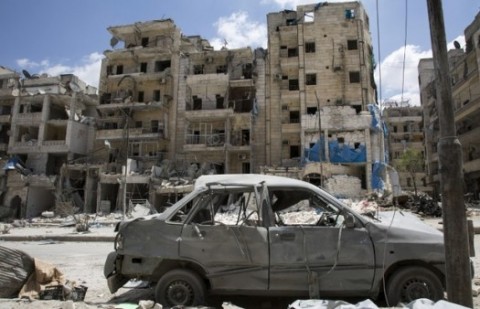
The Russian-Syrian bombing campaign in eastern Aleppo, which has ended at least for the time being, has been described in press reports and op-eds as though it were unique in modern military history in its indiscriminateness.

In an usual move for a senior US official, Secretary of State John Kerry called for an investigation of war crimes in Aleppo.

As terrible as that toll of civilian lives is, the United States should drop the stance of moral superiority.

The Al-Quds hospital building on 28 April 2016, a day after air strikes (AFP)

The discussion has been lacking in historical context, however. Certainly the civilian death toll from the bombing and shelling in Aleppo has been high, but many of the strikes may not be all that dissimilar from the major US bombing campaign in Iraq in 2003, nor as indiscriminate as Israel’s recent campaigns in densely populated cities.

The impression that the bombing in Aleppo was uniquely indiscriminate was a result of news reporting and commentary suggesting, by implication, that there are no real military targets in east Aleppo.

Continue reading here…

TFF PressInfo # 392: Just how grey are the White Helmets and their backers?

By Jan Oberg

Added at the bottom on November 23, 2016:

The – bizarre – White Helmet Mannequin Challenge video;

The Swedish Institute of International Affairs’s event with the White Helmets on November 24;

The Right Livelihood Award Foundation’s Award Ceremony to take place on November 25

While thousands of humanitarian organisations around the world are struggling fiercely with diminishing support from governments and the public, one has achieved a surprising amount of support from Western governments in a surprisingly short period of time and gained a surprising attention from mainstream media and ditto political elites: The Syrian Civil Defence or White Helmets.

Their name of course makes you think of the UN’s Blue Helmets and white is the colour of those who should be protected in harm’s way – and the colour of innocence. However, for many years there has been an Argentinian relief organisation with the same name.

The SCD or White Helmets counts nearly 3.000 rescue workers who operate in very dangerous areas in rebel-held territories in Syria and claims that it has, in three years, rescued about 70.000 lives according to its Twitter account (or 65 per day).

Contrary to what you might think, it isn’t a Syrian organisation because Syria has its own organisation, incidentally also called Syria Civil Defence, which was established in 1953 and is registered with ICDO, the International Civil Defence Organisation, since 1972.

The White Helmets seems to have an annual budget of US$ 30 million and has raised a total support of well over US$ 100 million. And it seems that they operate exclusively in war zones in which the fighting against the Syrian government and the Syrian Arab Army takes place, i.e. in ‘liberated’ areas where hundreds of groups and some 80 countries, mainly NATO members, Gulf states and Saudi-Arabia, operate.

On the White Helmets’ briefing page it is stated that “funding for their humanitarian relief work is received from the aid budgets of Japan, Denmark, the Netherlands, the United Kingdom and the United States.”

Here is how the Foreign Ministry in Copenhagen explains the roughly US$ 9 million to the White helmets from Denmark, a country that bombs in both Iraq and Syria.

Other civil society and humanitarian organisations inside Syria have not been so fortunate. You’ve probably not heard that much about the Syrian Arab Red Crescent and its work? How much/little support have they received from Western humanitarian-concerned governments? And in general, civil society organisations in Syria – women, peace, human rights, culture, etc. – have received nothing like US$ 100 million in a few years and no one has such a flashy media appearance as the White Helmets.

Photo from the White Helmets’ homepage

The White Helmets was started in 2013 by James Le Mesurier who seems to have tried a little of everything everywhere, including the grey zones of special forces and intelligence in virtually all NATO wars, Yugoslavia in particular. He later set up a foundation in Holland to gather the funds. Here is a recent account by Scott Ritter, former US Marine Corps intelligence officer and weapons inspector in Iraq with tremendous knowledge of things Middle East:

“The organizational underpinnings of the White Helmets can be sourced to a March 2013 meeting in Istanbul between a retired British military officer, James Le Mesurier—who had experience in the murky world of private security companies and the shadowy confluence between national security and intelligence operations and international organizations—and representatives of the Syrian National Council (SNC) and the Qatari Red Crescent Society. Earlier that month, the SNC was given Syria’s seat in the Arab League at a meeting of the league held in Qatar.

At that meeting, the SNC assumed Syria’s seat, and the Arab League authorized member states to actively provide support, including arms and ammunition, to the Syrian rebels. The Qataris, working through the SNC, helped assemble for Le Mesurier $300,000 in seed money from Japan, the United States and the United Kingdom for a seven-day course designed to train and equip a 25-person rescue team, recruited by the SNC, for duty in so-called “liberated areas” of Syria. The SNC made available a pair of Syrian activists—Raed Saleh and Farouq Habib—to assist Le Mesurier in this work.

The group is – as will be seen below – treated as uncontroversial in virtually all Western mainstream media. However, there is enough material with documentation to merit caution. Read More »


Den nye verden

Af Jan Øberg

Den nuværende periode i menneskehedens historie vil blive svær at forklare for fremtidens historikere – hvis der da findes nogle.

Hvordan kunne det gå så skridt så hurtigt og på alle fronter for dén Vestverden, der efter 2. verdenskrig stod med alle kortene på hånden? Hvordan kunne det amerikanske imperium, der byggede på frihed og demokrati, overhovedet styrte sammen dér tilbage i 2026?


Den vestlige NATO-baserede verden kunne ånde lettet op da Sovjetunionen og Warszawapagten var blevet opløst i 1989. Den havde vundet ideologisk – ingen ville siden have sovjetkommunisme – og økonomisk – Rusland producerede ingen attraktive forbrugsvarer – og militært.

Ruslands militærudgifter var bare 8% af NATOs mod Warszawapagtens 75% af NATO førhen.

Den Kolde krig forsvandt lykkeligt nok uden Varm Krig eller atomvåbenbrug. En ny verden blev mulig. Ondskabens imperium, som præsident Reagan havde kaldt Kreml-systemet, var borte. Alle talte om fredens ”dividende”.

Men kun godt 25 år senere var verden gennemsyret af angst,Read More »

Trump visits Putin

By Jonathan Power

October 25th 2016

I have a fantasy. Donald Trump wins. He goes to Moscow on his first trip as president and gives President Vladimir Putin a bear hug and they go hunting in the forest, Soviet style.

When they emerge they have shot a couple of bears and have had a good lunch laid out for them by acolytes at which they have discussed the matters of the world.

They give a press conference. They have decided to re-start negotiations on major nuclear arms reductions and both say they unilaterally are immediately ridding themselves of a 1000 missiles each.

They have found a way to implement autonomy for eastern Ukraine, as done in Scotland, which Trump with his Scottish golf courses knows well. Ukraine can work towards both a trade agreement with the EU and the Russian-backed Eurasian Economic Union. Russia was always happy about such an arrangement, but many Ukrainians weren’t and only wanted an EU arrangement. This was the trigger for the uprising in Kiev and Western support for the powerful revolutionary movements that had a fascist pedigree.

Dealing with Syria is both simpler and more difficult – difficult because of the intensity of the fighting and the multi-nation interests and easier because neither Russia nor the NATO powers want to see a clash over a relatively small part of the global population – Syria’s population is 9 million, about the same as one of America’s eastern states.

In the forest they agreed to stop using Russian warplanes backing President Bashar al-Assad, the US to stop aiding anti-Assad guerrillas and both to concentrate on defeating ISIS. In return the US would invite Russia to share its airbase in Qatar. The civil war opponents would be left alone to fight. UN mediation would continue.

Trump has a point in wanting rapprochement with Russia.

At the moment Read More »

Israel’s self-obsession

By Jonathan Power

October 4th 2016.

The many world leaders who gathered in Jerusalem last week for the funeral of Shimon Peres, the former president of Israel, are safely ensconced back home. They will not bother much to think about Israel again until the next Palestinian uprising. But the Israelis will continue to only think about themselves.

The Israelis are obsessed with themselves, with their history, with the present time and with their destiny. Every nation has some of this but Israeli navel gazing is something else. At this level of intensity it makes compromise difficult and condemns Israel to political paranoia and limitless inflexibility.

The Israeli notion that they can have this land and no one else can is so anachronistic by any contemporary standards that it is amazing that outside powers, whether they be the US, the EU or Russia, have given its arguments the time of day.

If every ethnic group in the world asserted so vigorously truly ancient yearnings to exclusive possession the world would become totally chaotic in short time. Where would the white North Americans or South Americans be?

Should Russia return to the rule of Mongolia, the seat of Genghis Khan’s Mongols? It was they who laid down the boundaries, more or less, of the modern Russian state. What if China grabbed back Taiwan?

If the Israelis want to believe that Temple Mount Read More »

The Russians are coming…….to Israel and Palestine.

September 13th 2016.

By Jonathan Power

Russia announced last week that it has decided to go where angels fear to tread – into the whirlpool of negotiations between Palestine and Israel. Long a preserve of the Americans and the French, the attempt to bring peace between the two and to make a final settlement on boundaries has frustrated them for decades.

Can Russia do better?

Russia comes on the scene at a time when the script is perhaps about to be re-written in a radical way. After decades of negotiating around the premise that the only solution was a two-state arrangement with an independent Jewish state and an independent Palestinian state existing cheek by jowl, opinion in Palestine is shifting.

The talk now, especially among younger people like the businessman Tareq Abbas, the son of the President of Palestine, Mahmoud Abbas, is quite different than their parents. They are saying Palestinians should give up pursuing what the Israelis will never concede and should stop the endless, unproductive effort, to negotiate a two-state solution.

Instead, they should accept that Israel has the whip hand over both Israel and Palestine, in both the parts it occupies and the parts it allows the Palestinians themselves to govern, the rest of the West Bank and Gaza.

So the focus of the negotiations should be changed to concentrate on demanding civil rights within Israel – a Greater Israel containingRead More »