Is ISIS on the wane?

By Jonathan Power

Within a matter of days a self-appointed ISIS “lone wolf”, Omar Mateen, with no actual links to home office Isis has created mayhem in Orlando, Florida, with his killing of 49 people in a gay club, and the Iraq army has pushed Isis troops out of most of the important city of Falluja.

Maybe it is an exaggeration to say that ISIS is on the run its bailiwicks of Iraq and Syria but it is certainly taking very bad hits. Two years after sweeping through northern Iraq and capturing the oil city of Mosul in 2014 they are now on the defensive. ISIS has lost nearly half of the Iraqi territory it held. (i.e. an area about half that of the UK). It has lost much of its oil infrastructure.

It is taking lots of casualties. In Syria it is fighting on two contradictory fronts – the regime in Damascus, supported by Iran and Russia and against the non-Islamist rebels, supported by the US and the Arab states.

Meanwhile the flow of foreign fighters on which it has depended is slowing up and large numbers are returning home. Funding is drying up.

This indeed is why Mateen, the lone wolf, is so important to ISIS. ISIS spokesman, Abu Muhammad al-Adnani, has asked ISIS sympathisers to stay where they are. “The smallest action you do in the heart of [your] land is better and more enduring to us than what you would do if you were with us.”

Is this a switch in tactics? We do not know yet.

What we do know is Read More »

TFF PressInfo # 378: A new Cold War between Russia and the West?

By Jonathan Power

June 7th. 2016.

The second article in the TFF Series on The New Cold War

George Orwell, the author of “Animal Farm” and “1984”, was the first person to use the phrase “Cold War” in a 1945 newspaper article, written just after the nuclear bombing of Hiroshima and Nagasaki. He argued that “the surface of the earth is being parceled off into three great empires, each self-contained and cut off from contact with the outer world, and each ruled, under one disguise or another, by a self-elected oligarchy. He counted the US and Western Europe as one, the Soviet Union as the second and China as the third. He concluded that, “the atomic bomb is likeliest to put an end to large-scale wars at the cost of prolonging indefinitely a peace that is no peace”.

I think he got it nearly right – or so it seems as a new Cold War erupts between the West and Russia and China spars with the US over the South China Sea and its islands.

Of course it’s more complicated than that. China and Russia have a fair relationship. China and the US are perhaps doing nothing much more than annoying each other and the bonds of commerce and student exchanges bind both the elites and the populaces close together.

To me a new Cold War is nonsense on stilts. Even more than the original one.

George Kennan, the US former ambassador to Moscow and the author of how to contain the Soviet Union, always insisted that Stalin had no intention of rolling his tanks into Western Europe. As Robert Legvold summarizes Kennan’s views in his interesting new book, “Cold War”, “The threat the Soviet Union posed was political, a threat accentuated by these countries’ vulnerability to Soviet subversion because of their economic frailty and political instability – a threat requiring a political and economic response, not a military one”.

In 1948 Kennan wrote, as he observed the creation of Nato, “Why did they [Western leaders] wish to divert attention from a thoroughly justified and promising program of economic recovery by emphasizing a danger which did not actually exist but which might be brought into existence by too much discussion of the military balance and by the ostentatious stimulation of military rivalry?”Read More »

What to do about ISIS

By Jonathan Power

May 24th 2016

“ISIS is not an existential threat to the United States”, President Barack Obama told Jeffrey Goldberg of The Atlantic magazine recently.

What becomes clear in this long article, much of it Obama’s own words, is that Obama shies away from the idea that war can make bad things good. The unquenchable wars that he inherited – Iraq and Afghanistan – were set alight by his predecessor, George W. Bush, and no amount of Obama fire engines have been able to douse them with enough water to put them out.

As for the rest of the waterfront of foreign affairs, he argues that after a period of uncertainty he decided that the US should not militarily involve itself in the civil war in Syria. He decided that Ukraine is not a core American interest, although it is a Russian one, and he was convinced that Iran would agree through peaceful negotiation to renounce the dangerous parts of its nuclear program.

As for the toppling of Muammar Gaddafi and the mess that followed he agrees that he made a bad mistake when he put on one side his own philosophy of not intervening militarily in a situation that was not a core US interest.

In the Atlantic article, Obama says believes he has broken with what he calls, derisively, the “ playbook”. “It’s a playbook that comes out of the foreign-policy establishment. The playbook prescribes responses to different events, and these responses tend to be militarized”.Read More »

China’s Silk geopolitics

By Johan Galtung

China is changing world geography, or at least trying to do so.

Not in the sense of land and water like the Netherlands, but in the sense of weaving new infrastructures on land, on water, in the air, and on the web. It is not surprising that a country with some Marxist orientation would focus politics on infrastructure–but as means of transportation-communication, not as means of production.

Nor is it surprising that a country with a Daoist worldview focuses politics on totalities, on holons and dialectics, forces and counter-forces, trying to tilt balances in China’s favor. How this will work depends on the background, and its implications.

Two recent books, Valerie Hansen, Silk Road: A New History (Oxford University Press, 2012) and Peter Frankopan, The Silk Roads: A New History of the World (Knopf, 2015) see them as arteries connecting the world, globalization, before that term became a la mode. Not that loads of goods moved all the way in both directions, parts of the way, maybe further. Europe had much less to offer in return; however:

“Viking traders from–Norway–coarse, suspicious men, by Arab account–were moving down the great rivers of Russia–trading honey, amber and slaves–as early as the ninth century–returning home to be buried with the silks of Byzantium and China beside them”. (Frankopan)

The Silk Roads – so named by the German geographer von Richthofen in 1877 – connected China and Europe (Istanbul) over land from -1200; more precisely from Xi’an to Samarkand by a northern and southern road (Hansen for maps). And the Silk Lanes connected East China and East Africa (Somalia) from +500 till +1500 when Portuguese-Spanish and English naval expansion started a Western takeover by colonization.

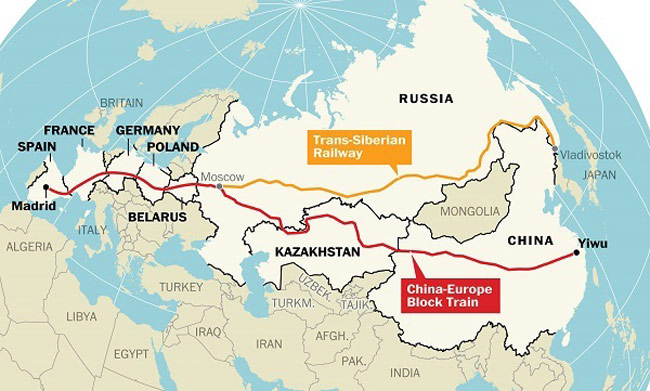
The modern Silk Road East-West, Yiwu/China to Madrid/Spain. Although the transit time for goods or people to transit the route is 21 days, this is 30 days faster than a ship and is 1/10 the cost of shipping freight. See www.bulwarkreview.com

For long periods run by Buddhists in the East and Muslims in the West; Islam using them to expand, from Casablanca to the Philippines. Frankopan sees the high points in the Han dynasty (-207-220, capital Xi’an for West Han), the Tang dynasty (618-902, capital mainly Xi’an) and under Mongolian, Yuan rule–for goods, ideas, faiths, inventions.

Xi’an, 3,000 years old, served as a starting point, both for Silk Roads and for the Silk Lanes, traveling the Yangzi River, or over land, to the East China Sea coast. Till the military uprising against the Tang emperor in 755 (Hansen, Ch. 5, “The Cosmopolitan Terminus on the Silk Road”); but Xi’an is destined always to play major roles.

China is now reviving the past, adding Silk Railroads from East China to Madrid via Kazakhstan-Russia-Belarus-Poland-Germany-France, to Thailand, from East to West Africa–from the Indian Ocean to the Atlantic–from North to South Africa. Silk Flights. And Silk Web.

A silky cocoon is being woven, by worms in China. Too much?

Two features stand out in this approach to geopolitics.Read More »

Mass migration, the EU and European nationalisms

By Johan Galtung

Antwerpen & Alfaz

We are dealing with mass migration, basically into EU, and European nationalisms, many in favor of exits from the EU.

Why this mass migration, maybe to the point of Völkerwanderung, mainly into EU – but then what kind of EU? – and why the European nationalisms now found one way or the other in many member states?

The forecast for migration from Africa into Italy in 2016 is about 100,000; 28,000 already arrived in the first quarter, with 1,000 drowning in the Mediterranean (INYT, 6 May 2016). Big numbers. They knew the risks they were taking, so the push away from Africa and the pull towards Italy, and beyond, must have been considerable.

Better think in terms of 50 million migrants over 50 years, from regions considered uninhabitable to inhabitable regions. There seem to be five major causes underlying this basic world asymmetry:

Slavery, four centuries, depriving societies particularly of able-bodied males, by Arabs, then Westerners, cross-Atlantic transportation mainly by the English (Liverpool);

Colonialism, by Muslims after the death of the prophet in 632, from Casablanca to Southern Philippines, till the end of the 15th century, close to nine centuries, then by Christians close to five centuries, till colonialism was officially ended in the 1960s;

Robbery Capitalism, stealing or paying next to nothing for resources processed into manufactured goods, pocketing the value added;

Wars, mainly initiated by the West, killing millions (the USA more than 20 million in 37 countries after WWII), destroying property;

Ecological Factors, like depletion-pollution, often toxic for humans or nature, erratic climate partly due to climate gases, NOX, CO2, CH4.

These are the causes of poverty in some parts of the world but also of wealth in others; Read More »

About (pre-)Fascism: Israeli and US style

By Richard Falk

Recently I participated in a conference on global inequality and human rights held at the University of Texas in Austin, a lively quite cosmopolitan city. During the lunch break I was talking with a young PhD student from Israel who had just presented an informative paper on inequality in the Philippines. I asked her about her career plans and how it was like to be living in Israel these days. She told me that she was married to an Israeli and planned to return to finish her studies in Tel Aviv after a fellowship year at UT.

I tried to engage her in conversation about evolving Israeli attitudes toward the Palestinians and the related failed diplomacy, but she seemed rather uninformed and perhaps even disinterested as if the peace agenda was not really present in her active consciousness. Then all at once she said something that surprised me. “I am not looking forward to returning to Israel, it is becoming a fascist state.”

What made this strong statement surprising was that it contrasted with the blandness of everything that had preceded it. I asked inquisitively, neither agreeing nor disagreeing, “What makes you say that?”

She pondered the question as if it had come to her from the wild blue yonder. It seemed as if she had never thought about it before, and maybe it was just a spontaneous assertion that she was articulating for the first time. After a pause, she answered somewhat hesitantly: “Because the army is the most powerful and admired institution in Israel, and the government controls everything, it is acting as a totalizing force.”

I suppose that gets you to Franco-style fascism that prevailed for so long in Spain, but not the more virulent forms of fascism associated with Mussolini’s Italy and especially Hitler’s Germany.

I agreed with the young woman about the hegemony of the armed forces, both institutionally and psychologically, but I was less sure about the totalizing reach of the government. Read More »

Review of Jeff Halper’s “War Against The People: Israel, the Palestinians and Global Pacification”

By Richard Falk

Prefatory Note
The review below was published in the current issue of Journal of the Society for Contemporary Thought and Islamic World. I am posting it here because I believe that Jeff Halper’s book deserves the widest possible reading. It explains clearly and convincingly one of the deepest and least understood roots of Israel’s diplomatic support throughout the world, which is its role as a niche arms supplier and influential tactical specialist in waging wars against peoples who dare offer resistance to state power as variously deployed against them.
The Israeli experience in exerting oppressive control of the Palestinian people provides the foundation of Israel’s international credibility and perceptions of effectiveness in disseminating for economic and political profit its hardware and software associated with managing and suppressing the resistance of popular movements fighting for their rights.
The Israeli stress on pacification rather than victory exposes the true nature of what Halper identifies so vividly and comprehensively as the distinctive character of waging ‘war against the people.’

Jeff Halper
War Against the People: Israel, the Palestinians and Global Pacification
Pluto Press, 2015, 296 pp.,
$25.00 US (pbk), ISBN 9780745334301.

Jeff Halper is an unusual hybrid presence on both the scholarly and political scene. He describes himself as an “activist-scholar” (6), which adopts a controversial self-identification. The conventional stance erects a high wall between scholarship and activism.

To his credit and for our benefit, Halper excels almost equally in both roles. He is one of the most lucid speakers on the lecture circuit combining clarity with wisdom and a rich fund of information and firsthand experience, and his work as a writer is influential and widely known.

His activist credentials have been built up over many years, especially in his work as co-founder and leader of the Israeli Committee Against House Demolitions, which has bravely confronted Israeli demolition crews and IDF soldiers, helped Palestinians on multiple occasions to rebuild their destroyed homes, thereby responding humanely to one of Israel’s cruelest occupation practices, an instance of unlawful collective punishment.

Halper has estimated that less than 2% of demolitions can lay claim to a credible security justification (the respected Israeli human rights NGO, B’Tselem, estimates 1.3% of demolitions are justified by security, while the rest are punitive or 621 of 47,000 since 1967). As an author his main prior book makes an unsurprisingly strong pitch for activism as the most reliable foundation for analysis and prescription.

His important and incisive title gave the theme away – An Israeli in Palestine: Resisting Dispossession, Redeeming Israel.1 This earlier book remains valuable as testimony by a progressive Zionist in Israel that with good faith Jews and Palestinians might yet learn to live together, including finding a formula for sharing the land.

Halper’s own life experience makes this blend of scholarship and activism particularly compelling. He is an American born Jew who grew up in the Midwest and studied anthropology in Wisconsin, taught at a Quaker university for several years, and then moved to Israel where he married an Israeli and has three grown children. What particularly sets Halper apart from most other principled Jews in the ranks of critics of Israel is the striking combination of the radicalism of his opposition to the policies and practices of the Israeli state together with his evident commitment to remain in Israel no matter how far right the governing process drifts.

Most other prominent Jewish critics of Israel have remained outside the country throughout their life (e.g. Noam Chomsky) or were born in Israel and then chose to become expatriate critical voices (e.g. Daniel Levy, Ilan Pappé, Gilad Azmun). There are a few internationally prominent Israeli journalists and cultural figures who have sustained sharply critical commentary (e.g. Gideon Levy, Amira Hass) and kept their Israeli residence despite harassment and threats.

In the book under review Halper broadens his own distinctive identity while enlarging the apertures of perception by which he views the Israeli state.

He focuses attention on the Israeli arms industry, security doctrines, and policies, and examines Israel’s acquisition of formidable diplomatic influence grossly disproportionate to its size and capabilities. It is this gap between Israel’s significant impact on current world history and the modest scale of its territorial reality and its outsider status in most global settings that is the core mystery being explicated by Halper.

He starts the book with some provocative questions that put the underlying puzzle before us in vivid language: “How does Israel get away with it? In a decidedly post-colonial age, how is Israel able to sustain a half-century occupation over the Palestinians, a people violently displaced in 1948, in the face of almost unanimous international opposition” (1)?

He indicates that this phenomenon cannot be adequately “explained by normal international relations” nor by the strength of the Israel lobby in the United States nor by strong Israeli pushback to discredit critics by invoking the Holocaust as an indefinite source of impunity (3).

What the book demonstrates very persuasively is that Israeli influence is a result of its extraordinary, partially hidden and understated role as arms supplier to more than 130 countries and as an increasingly significant mentor of national police forces and counter-terrorist operations and practices in many countries, including the United States.

Israel as Arms Merchant and Pacification Ideologue

Without exaggeration, War Against the People, is really three books in one.Read More »

A nonkilling, nonviolent world is not unrealistic – We can choose!

By Mairead Maguire

Address by Mairead Maguire, Nobel Peace Laureate and TFF Associate, to Rome Conference on NATO
Friday 29th January, 2016.

Dear Friends,
I believe we, the human family, have no less a task before us, than transforming our thinking and mind-sets of violence and war, and moving to a demilitarized Europe and World. Einstein once said that everything has changed but our thinking. However, there is hope as indeed our thinking is changing and there is a growing consciousness that violence, whether it comes from State or non-state actors, is wrong, violence does not work, violence is not the way.

However, around the world, we, the people, are in danger of being overpowered and dis-spirited by increasing violence, militarism and war. Many people can see that many Political Leaders can no longer imagine a just peace, and under the guise of allegedly ‘just wars’ and unbounded preparation for war, they are leading us into repeated cycles of violence profoundly counter to the spirit of love and friendship residing in the heart of humanity.

But there is Hope and it resides with the People, who are great and are mobilizing and uniting across the Globe to bring about much needed change, and rejecting violence and war.

The World Health Organization has said that ‘Violence is a preventable disease’ and people are not born violent, rather we all live in cultures of violence. This can be changed through nonviolent peacemaking and the pursuit of ‘just peace’ and nurturing of cultures of peace. Using active nonviolence, based on love of enemies and nonkilling, can bring about a real peace that is just, inclusive and sustainable.

In Northern Ireland we faced violence from all sides, for over thirty years, as we lived in a deep ethnic/political conflict. This violence only ended when everyone acknowledged that militarism and para-militarism could not solve our human problems, and only through unconditional, all inclusive dialogue and negotiations could we reach a political agreement based on nonviolence, forgiveness, compromise and co-operation.

We spoke to ‘our enemies’ and made peace with them, because we recognized that without Peace nothing is possible, and with Peace, everything is possible.

We also began to tackle the root causes of our violence, by making painful policy changes.

Today in Belfast, it is good for all its citizens to live in a City at Peace, but we all acknowledge that our Peace process is a work in progress and we continue to work on justice forgiveness and reconciliation.

We meet at a time when, I believe, Europe is facing a cross-roads and hard choices regarding policies and priorities have to be made by all. Today’s refugees, migrant challenge, has shown the best and the worst of European values, via television beamed onto our screens to the world.

The best have been the compassionates response Read More »