John Avery’s CV

John Scales Avery

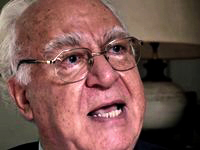
John Scales Avery received a B.Sc. in theoretical physics from MIT and an M.Sc. from the University of Chicago. He later studied theoretical chemistry at the University of London, and was awarded a Ph.D. there in 1965.

He is now Lektor Emeritus, Associate Professor, at the Department of Chemistry, University of Copenhagen.

Fellowships, memberships in societies
Since 1990 he has been the Contact Person in Denmark for Pugwash Conferences on Science and World Affairs. Member of the Danish Peace Commission of 1998. Technical Advisor, World Health Organization, Regional Office for Europe (1988- 1997). Chairman of the Danish Peace Academy, April 2004-.

You’ll find a lot about this eminent scholar at Wikipedia. Avery is also a leading peace researcher and activist – “Since 1990, Avery has been the Contact Person for Denmark the Pugwash Conferences on Science and World Affairs. In 1995, Avery was part of a group that shared in the Nobel Peace Prize for their work in the 1990s in organizing the Pugwash Conferences on Science and World Affairs.

In 1998, Avery was elected to the Danish Peace Commission. During the years 1988-97, Avery was the Technical Advisor at the World Health Organization, Regional Office for Europe. In 2004, Avery became the Chairman of the Danish Peace Academy.

In his usual humble and plain style John tells the story of his life – his personal life, his scholarly life and his peace life – here.

Publications
Dr. Avery seems to have ben writing day and night throughout his life – here is his amazing list of books, chapters and articles on world affairs.

In early 2016, Irene Publishing – run by TFF Associates Jørgen Johansen and Majken Jul Sørensen – published Avery’s Collected Essays as well as The Need For A New Economic System.

John joined TFF as TFF Associate in March 2016.

Danmark skal heller ikke bombe i Syrien – 6 artikler

Af Jan Øberg

Posted on 18 April, 2016 on Jan Oberg’s blog

Den 19. april 2016 havde Folketinget 2. behandling af forslaget om også at bombe og indsætte specialstyrker i Syrien.

Jeg mener at sagen er fundamentalt vigtig for Danmark, danskerne og vor fremtidige rolle og ‘image’ ude i verden.

Desuden finder jeg at beslutningsgrundlaget, mediedækningen og den offentlige debat giver anledning til den største bekymring.

At gå i krig er den vigtigste beslutning en regering kan tage og en befolkning bakke op om. Men det er som om dette at deltage i krig stort set rager både ministre, folketingsmedlemmer, journalister og befolkning en forårsblomst.

Med en vis fortvivlelse skrev jeg derfor 6 artikler med forskellige temaer og producerede en video, der også foreslår hvad vi kunne gøre i stedet.

Jeg ville have disse ting sagt og spredt inden beslutningen blev taget.

Herunder findes de én for én som jeg har skrevet dem med en lille kommentar til publiceringsprocessen, som også i et vist omfang vidner – for mig i hvert fald – om mærkelige prioriteringer hvad angår tidspunkt og længde.

Alt andet lige bliver redaktionerne ikke oversvømmet af kvalificerede, kritiske og konstruktive artikler af denne type – men det er dog kun meget korte ting, man kan få ind. Om overhovedet…

1. Dansk krigsdeltagelse i Syrien vil være landsskadelig

Politiken 16. april 2016. Problemfri publicering.

Den 19. april skal folketinget have 2. behandling af forslaget om at Danmark skal deltage i krigen over Syrien og endog have specialstyrker på landjorden.

Det vil i så fald være sjette krigsdeltagelse siden 1999 – Serbien, Afghanistan, Irak 2003-2007, Libyen, Irak igen.

Der synes desværre at være flertal for krigspolitikken uanset det faktum at samtlige krige har været fiaskoer på deres egne præmisser og ud fra et fredsskabende synspunkt.

Politikere og andre mennesker, der støtter det krigsførende Danmark gang på gang, må vel efterhånden kunne blive stillet til ansvar for deres holdning til massedrab på uskyldige. Kan det være rigtigt at dette er så uproblematisk som den ringe offentlige debat tyder på at det er så let at beordre mord på andre mennesker?

Internationale rapporter gør gældende at den vestlige verden kan have dræbt op til 4 millioner muslimer siden 1990.Read More »

Concocting lies before the Iraq war

By Jonathan Power

April 19th, 2016.

President Barack Obama has observed, “ISIL – Islamic State – is a direct outgrowth of Al Qaeda in Iraq that grew out of our invasion – which is an example of unintended consequences – which is why we should generally aim before we shoot”.

Many of us, looking at the horror of the Iraq war, waged by the US and the UK against the regime of Saddam Hussein when 200,000 civilians died and a total of 800 billion US dollars was spent on the campaign, need little to be persuaded that there was a Machiavellian plot to find an excuse to make war. Yet there are many in the circles of power in Washington who believe the US should shoot on sight and to kill whenever danger is thought to have appeared- in Iraq, Syria, Libya and, before that, in Vietnam.

The so-called “justification” for going to war in Iraq 13 years ago was based on a 93 page classified CIA document that allegedly contained “specific information” on Saddam Hussein’s weapons of mass destruction programs and his close links with Al Qaeda.

The document has now been declassified thanks to the work of the investigative journalist, Glenn Greenwald. His findings have just been published in the on-line magazine, VICE.

The document, before published with a large number of deletions, is available for everyone to read in its entirety. It reveals that there was zero justification for the war. It reveals that there was “no operational tie between Saddam Hussein and Al Qaeda” and no weapons of mass destruction programs.

President George W. Bush’s secretary of defence, Donald Rumsfeld, claimed that the US had “bulletproof evidence” linking Saddam Hussein to the terrorist group. “We do have solid evidence Read More »

TFF PressInfo # 369 – A Sunni-Salafist-Zionist Coalition Changing Middle East?

By Jan Oberg

Please try Google “Gulf states want nuclear weapons against Iran – Israel “ and only one Western mainstream media will appear, an excellent article by The Telegraph’s Raf Sanchez in Jerusalem.

The only other media carrying the story is Russia Today and Vigilant Citizen and MintPress News also carries the story and offers a wider background

What is this about?A new coalition?

So the usual Western media filter, meaning it must be interesting. And it is a quite sensational story: Saudi Arabia and Israel are up to a nuclear mischief against a country that has just been prevented from acquiring nuclear weapons by means of a huge legally binding document, UN Security Council endorsement and extremely tight monitoring mechanism. What’s it about?

It’s about Israel’s defence minister Moshe Ya’alon saying in public at the recent Munich conference that Arab states are “not willing to sit quietly with Iran on the brink of a nuclear bomb”.

He thinks that Iran was liable to break the agreement as their economic situation improves with the lifting of international sanctions. Ya’alon is quoted as saying that “I speak about the Gulf states and North African states too…For them, Iran and the Muslim Brotherhood are the enemy. Iran is the bad guy for us and for the Sunni regimes. They are not shaking hands [with Israelis] in public, but we meet in closed rooms.”

So not only Jordan’s monarchy and Egypt’s dictatorship but also Gulf and North African states: A coalition lead by Saudi Arabia and Israel – Israel as the only nuclear weapons power in the region and Saudi Arabia as the most likely next nuclear weapons state.

For much too long the world’s attention has been on Iran’s imagined nuclear weapons, not on the dozens or hundreds real nukes that Israel possesses as a non-member of which is the Non-Proliferation Treaty (NPT).

One can say that Israel and Saudi Arabia lost the political battle against the nuclear deal with Iran concluded with the five permanent UNSC members and Germany last year – and now will do their utmost to use Iran’s non-nuclear weapons status as a pretext for others going nuclear against, predominantly, Iran.

Propaganda hysteria dominates in an age where knowledge plays a diminishing role

The problem for them, however, is that Iran will be difficult to sell as a real threat – but we live of course in Read More »

TFF PressInfo # 368: Reflections after Brussels

Lund, Sweden, March 29, 2016

Recommended reading…

The general post-Brussels mainstream media discourse has shown the same profile as virtually all others since September 11, 2001:

• Emphasis on who did it, the circumstances where it happened and how the crime was carried out;

• The fate of the victims, the mourning of the nearest relations and the memorial;

• Much larger coverage than more devastating attacks outside the West.

• Absence of relevant and intellectually challenging questions related to the big WHY – Why do some people hate us so intensely, willing to die for it?

• And absence of discussions about possible historical causes and action-reaction perspective – the only reason offered is that they are evil people/Muslims and evil acts must be met with force – Francois Hollande who never misses an opportunity to puff himself up talks about all of Europe being hit – 35 people killed out of 508 million to be precise.

• The underlying, tacit ‘narrative’ of course is that we Europeans are simply innocent victims – more important, that is, than the roughly 1 million Iraqis who died thanks to the European participation in 13 years of sanctions and an illegal war and occupation led by the US. And, as is well-known, victim psychology often legitimates disproportionate responses – to be seen.

• Finally, the complete loss of perceptive proportions in a war that has resulted so far in 350.000 dead Syrians, 4,6 million Syrian refugees and 6,6 million Syrian internally displaced and destruction of yet another Middle Eastern country and its culture – among other things thanks to arms trade to all fractions and thousands upon thousands of bombing sorties – the far majority of which orchestrated by the US/NATO/EU countries over the last 5 years.

We believe there are different perspectives that deserve our attention – based on complex analyses, a moral standpoint and an intense desire to help stop this – for all self-defeating – vicious spiral.

We invite you to browse these and share them in your circles:Read More »

Iranian elections: Another milestone in reformist advance

By Farhang Jahanpour

Since the latest Iranian elections held on 26th February 2016 for the 290-seat parliament (Majles) and the 88-member Assembly of Experts there have been many negative comments about the election results from the usual suspects.

Some people who are fundamentally hostile to Iran, criticize everything that Iran does, regardless of outcome. When the leading Iranian reformist candidate Mohammad Khatami won a landslide election in 1997 and initiated a series of important reforms at home and advocated a dialog of civilizations and even made a remarkable offer to the United States to reach a grand bargain over all the issues of contention, some pro-Israeli groups dismissed him, saying that he had no power.

However, when President Mahmud Ahmadinezhad made a number of outrageous comments, not only were his statements taken out of context and exaggerated, it was said that he posed an existential threat to Israel and the West.

Some people are at least honest about their real motives. During the controversial election in 2009 when Ahmadinezhad was declared the winner over the reformist candidate Mir-Hoseyn Moussavi, some American neoconservatives and Israeli commentators openly said that they preferred Ahmadinezhad because they could demonize him more easily.

“Just because Moussavi is called a moderate or a reformist doesn’t mean he’s a nice guy. After all he was approved by the Islamic leadership,” said Ephraim Inbar, director of the Begin Sadat Center at Bar Ilan University. “If we have Ahmadinejad, we know where we stand. If we have Moussavi we have a serpent with a nice image.” The then Mossad Chief, Meir Dagan, told a panel of Israeli lawmakers: “If the reformist candidate Moussavi had won, Israel would have had a more serious problem, because it would need to explain to the world the danger of the Iranian threat.”

Recently, the staunchly anti-Iranian lobby, The Israel Project (TIP), produced a promotional video showing the leader of the terrorist group, the Mojahedin-e Khalq, denouncing the latest Iranian elections. This is despite the fact that before some right-wing pro-Israeli groups had decided to promote this terrorist group as a popular opposition group, in 2011 TIP director Josh Block had described the group as a terrorist organization. (1) Nevertheless, now his organization calls upon the same group to denounce the Iranian elections.

However, despite all this negative propaganda, the results of the latest Iranian elections exceeded all expectations. The elections set another milestone in the desire of the Iranian people for change and reform following the 2013 presidential election that resulted in the victory of the centrist candidate Hassan Rouhani.

Ever since the victory of the Islamic revolution, the government has held flawed, but competitive and relatively free and fair elections. In order to appreciate the significance of the election results, we should look at some of the obstacles that had been placed on the path of the reformists and moderates.

The right-wing Guardian Council, formed by six clerics appointed by Iran’s Supreme Leader Ayatollah Ali Khamenei and six appointed by the head of the judiciary, who is himself appointed by Khamenei, has the job of vetting all the candidates who run for high office in Iran. In the absence of organized political parties, anybody can declare himself or herself a candidate in presidential or parliamentary elections, and normally many unqualified people do so.

Therefore, there is a need for a vetting organization, but the criticism against the Guardian Council is that it does not act in a fair and impartial manner.

During the recent elections,Read More »

TFF PressInfo # 367: Will the EU become a criminal union tomorrow?

By Jan Oberg

The EUropean Union – a criminal? The EU that has peace as it’s top goal and received Nobel’s Peace Prize? The EU with Schengen and Dublin? The EU with “European” values, humanism and mission civilisatrice that tells others how to live in accordance with international law and in respect for human rights?

We live in times where little shall surprise us anymore. The answer to the question – will EU become a criminal in international law terms? – will be answered on March 17 and 18 when the EU Council meets to decide whether or not to carry through the agreement with Turkey about how to handle refugees.

Amnesty International knows what it is all about. AI uses words such as “alarmingly shortsighted”, “inhumane”, “dehumanising”, “moral and legally flawed” and “EU and Turkish leaders have today sunk to a new low, effectively horse trading away the rights and dignity of some of the world’s most vulnerable people.”

And “By no stretch of imagination can Turkey be considered a ‘safe third country’ that the EU can cosily outsource its obligations to,” says Iverna McGowan, Head of Amnesty International’s European Institutions Office.

When Amnesty International expresses itself this way, we should listen very very carefully. I do and I’ve signed Amnesty’s Open Letter to Swedish prime minister Löfvén protesting that Sweden too may join this inhuman and law-violating agreement with Turkey. Hurry up, it is tomorrow!

Behind every refugee stands an arms trade, stands militarism. Read More »

TFF PressInfo # 366: Russian Withdrawal from Syria: Could it be the beginning of the end?

By Farhang Jahanpour

On Monday 14 March, in a surprise move and without any warning to Western leaders, President Vladimir Putin ordered the withdrawal of the “main part” of Russian forces from Syria, and instructed his diplomats to speed up the push for peace. “The effective work of our military created the conditions for the start of the peace process,” he said. “I believe that the task put before the defense ministry and Russian armed forces has, on the whole, been fulfilled.”

He added that with the participation of the Russian military, Syrian armed forces “have been able to achieve a fundamental turnaround in the fight against international terrorism.”

According to Western reports, Russian forces are already being prepared for flights back to Russia and equipment is being loaded onto cargo planes.

Although President Putin’s sudden announcement has given rise to a great deal of surprise and some false assumptions in the mainstream Western media and among political pundits, his decision is a timely, bold and constructive move that may result in some positive developments in the long-running catastrophe in Syria.

One of the reasons for the negative and cynical comments about the Russian move is that in five months President Putin has achieved more in halting the advance of the terrorists in Syria than the West had achieved in five years, if indeed it had been the West’s real intention to defeat the terrorists.

The Syrian uprising started with demonstrations on 28 January 2011 in Damascus and Aleppo in the wake of the “Arab Spring” in Tunisia and Egypt.Read More »

A pope, a patriarch, a spiritual revolution

By Johan Galtung

The first editorial here at Transcend of March 3 2008, “50 Years of Fidel Castro” celebrated a political revolution that changed the world, and spelt the end of US-Western imperialism. This editorial celebrates a spiritual revolution that may also change the world, spelling the end of Western materialism, and spread from there.

We are talking about processes, not events, and of structures and cultures more than of actors.

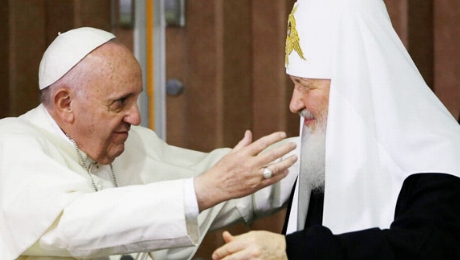
Again, Cuba played a major role, as meeting place between two major parts of Christianity, Catholic and Orthodox. In the Great Schism of 1054 they had excommunicated each other; and the Roman empire had split Catholic/Orthodox in 395. Fidel’s Catholic brother and successor Raúl was a condition for this historic meeting for peace; so was the meeting between Putin–an Orthodox Christian–and Francis in June 2015. However, not many pairs of brothers rival the two Castros in shaping history.

They met, Pope Francis of the Catholic Church and Patriarch Kirill of Moscow and all Russia – after earlier meetings between popes and the patriarch of Constantinople – with a Joint Declaration on 12 Feb 2016 in 30 articles. There were 17 quotes from the Bible; showing that they are “brothers in the Christian faith”, “pained by the loss of unity”, “divided by wounds caused by old and recent conflicts”. Not from the Bible are the many references to “the Most Holy Mother of God, Virgin Mary, and the saints we venerate”. Problematic for Protestants.

The bulk of the Joint Declaration is about the fate of Christians in the Middle East, meaning mainly Orthodox; like “the Metropolitans of Aleppo, Paul and John Ibrahim, who were taken in April 2013, to make every effort to ensure their prompt liberation”. However, together they “invite our Churches in Ukraine to work towards social harmony”.

They also jointly argue strongly against abortion and euthanasia, and in favor of “respect for the dignity of the individual called into being according to the Creator’s plan”. Do not destroy God’s creation.Read More »