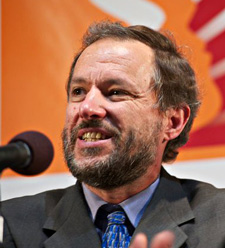
No to US military intervention in Syria

By Jonathan Power

The fog of war in Syria descends. Alliances on the ground come and go. America wobbles. Europe wrings its hands. Russia ups its military commitment, fearful of an arc of Sunni militancy that will make common cause with Russia’s own fundamentalists in Chechnya and Dagestan. Much of the rest of the world looks on with half shut eyes.

The debate swirls. Can the West have any profound impact on the Syrian civil war? Can it help depose the Assad regime? Does it really think it can influence the making of a democratic, multi-ethnic, multi-religious, Syria? Is President Barack Obama, after months of resisting the sirens calling for military support of the rebels, beginning to think it can play a more important part than hitherto? With the direct provision of American (and British and French) arms is he coming to believe that this will tilt the balance in the insurgents’ favour?Read More »

Blog ethics and politics

By Richard Falk

During this apprentice period as a blogger I have learned and relearned how difficult it is to reconcile my interest in constructive dialogue on highly contested subject-matters with sustaining a tone of civility. Especially with respect to the Palestine/Israel struggle I have periodically failed, angering especially those who feel that their support of Israel is either inappropriately rejected or ignored. This anger is turned in the direction of personal insults directed either at me or at writers of comments, which induces those at the receiving end to reply in kind, and the result is a loss of civility, which alienates many other readers who tire of such futile and mean-spirited arguments.

By way of clarification, let me acknowledge that I regards two types of interaction as satisfying my goal of ‘constructive dialogue’: conversations between like-minded on matters of shared interest; exchange of views between those who adopt antagonistic positions on an array of concerns ranging from cultural assessment to political analysis. To favor conversations with like-minded means favoring those who share my convictions with respect to the themes addressed in posts, and is viewed as ‘bias’ by those who do not share these convictions. I feel unapologetic about this encouragement of conversation among the like-minded.

Some of my harshest critics complain that I am one-sided or stifle the freedom of expression of those whose comments I exclude on grounds of civility, Read More »

Gaza: 7th year of unlawful blockade

By Richard Falk

Prefatory Note: I am posting a press release of yesterday, 14 June 2013, to take note of the start of the seventh year of the Israeli blockade. After the Mavi Marmara incident, 31 May 2010 and the more recent November ceasefire agreement between Israel and the Gaza government there was an undertaking to ease the blockade with respect to the flow back and forth of people and goods, but the situation remains desperate for the civilian population of Gaza that remains essentially locked into the Gaza Strip where economic destitution has reached epidemic extremes and where the water is mostly unfit for human consumption. The international community, and its main leaders, have commented adversely on the blockade, but nothing happens! It is this sense of powerlessness that is undermining the legitimacy and relevance of the United Nations to the suffering of the Palestinian people, and with particular relevance to the extreme ordeal of the civilian population of Gaza.

Continue…

Special Rapporteur’s report on Occupied Palestine

By Richard Falk

Prefatory Note: What follows below is the text of the report presented on 10 June 2013 to the Human Rights Council. It offers an overview of the situation from the perspective of human rights and international humanitarian law in occupied Palestine. Both Israel and the United States boycotted the session, presumably to express their displeasure with the report and my role as Special Rapporteur. UN Watch distributed a defamatory resolution calling for my dismissal from the position, and the United States delegate, Ambassador Donahue, called for my resignation. No government formally endorsed the UNW resolution, and so it was never acted upon, while I took the occasion of the press conference to confirm my unwillingness to resign, and on the contrary, to continue to do my best to reflect as honestly as possible the realities confronting the Palestinian people from the perspective of international law. In the open debate the European Union represented criticized what was called the inappropriate failure to limit my report to ‘law and facts,’ pointing particularly to what was described as ‘the political’ in paragraph 7. In that paragraph the report offers some comments on the futility of securing the Palestinian right of self-determination by way of resuming direct negotiations; by expressing such skepticism about the diplomatic track, the EU apparently regarded the assessment as political, but to my mind it was an appropriate comment on why the prospects for protecting and realizing Palestinian fundamental rights under international law are likely to remain in total eclipse.

The text below can be read in its formal context by using the link to the actual document to be found on the Human Rights Council website.
Continue…

Why Arabs need Iran

By Sharmine Narwani

In 2011, when Arab revolts began to sweep the Middle East and North Africa, the view from Washington and its closest allies was one of concern. How would the removal of mostly pro-Western dictatorships affect the balance of power in the region? More importantly – how to prevent these events from boosting Iran’s influence?

Two years on, the regional competition for influence is in full throttle. In its sights – among many other developments – are recent efforts by Iran and Egypt to upgrade their relationship.

The spoilers will have none of it. Said Steven A. Cook last week on the website of that most prestigious of US institutions, the Council on Foreign Relations (CFR): “Other than some quick cash and subsidized energy, there is nothing that Tehran can offer Cairo that will, in the long run, be to Egypt’s benefit.”

He has it entirely wrong. “Quick cash and subsidized energy” can only be used to describe the superficial offerings of countries like Saudi Arabia and Qatar, both vying for influence in this new Egypt.

There is no contest whatsoever between that kind of assistance and what Iran can bring to the table. Iran has achieved its economic independence the hardest way imaginable…

Continue

Turkey getting stuck again?

By Johan Galtung

From Istanbul

Turkey did the impossible, moving almost without violence from a military secular dictatorship to a civilian Sunni majority democracy. Turkey got unstuck. Sarkar’s circulation of elites at work: military elites, then religious-intellectuals, then business, then ordinary people–and once again the military. Second cycle.

Big Business would knock at the door, as it did in the Thatcher-Reagan revolution of the mid-1980s. Hence, not surprising that a big mall was one of the projects, together with an opera, a mosque and a monument from the Ottoman period for the Taksim Square-Gezi Park project. Every element a gift for Istanbul’s 14 million inhabitants. But, at the expense of a park, green nature, lungs, in that part of Istanbul.

Whether it escalated from this point to an extra-parliamentary confrontation between the winners (Justice and Development Party-AKP) and losers (Republican People’s Party-CHP) of the last two elections – the losers carrying much of the infelicitous past – or the other way round, or both, can be and is debated here.

Other processes are going on. Syria. Read More »

Whose ‘Two State’ solution? End game or intermission?

By Richard Falk

From many sources there is a widespread effort to resume a peace process that has in the past led to failure, frustration, and anger, and often to renewed violence. The newly appointed American Secretary of State, John Kerry, is about to make his fifth trip to Israel since the beginning of 2013, insisting that the two sides try once more to seek peace, and warning if this doesn’t happen very soon, the prospects for an agreed upon solution will be postponed not for just a year or two, but for decades.

Kerry says if this current effort does not succeed, he will turn his attention elsewhere, and that the United States will make no further effort. So far, aside from logging the air miles, seems perversely to be responsive to Tel Aviv’s demands for land swaps to allow settlement blocs to be incorporated into Israel and to promote further Palestinian concessions in relation to security arrangements, and totally unresponsive to Ramallah’s demands for some tangible signs from the Israeli government that resumed negotiations will not be another slammed door. In this vein, Kerry’s most ardent recent plea was at the Global Forum, an annual event organized under the auspices of the American Jewish Committee. Kerry told this audience that they possessed the influence to make the peace talks happen.

Somewhat surprisingly, even Marwan Barghouti writing from prison, Read More »

US policy weakens Iran’s pro-democracy movement

By Stephen Zunes

While the outcome of the Iranian elections scheduled for June 14 may be hard to predict, it will make little difference as long as power remains firmly in the hands of Ayatollah Khamenei and other hard-line clerics. Indeed, while there are contending factions vying for the country’s relatively weak presidency, the narrow ideological spectrum within which candidates are allowed to run for public office offers little hope for change — at least through the electoral system.

Following the 2009 election, in which the incumbent right-wing president Mahmoud Ahmadinejad was declared the winner despite his apparent loss to the popular reformist Mir-Hossein Mousavi, the people of Iran rose up in a popular civil insurrection, which was brutally crushed.

While it is hard to guess how soon democracy will come to Iran, the government’s theft of the election and subsequent crackdown — shattering the illusion many Iranians still held that they could work within a rigged political system — may have brought that day closer. Read More »

Yara Abbas in her own words

By Sharmine Narwani

Today I try to honor a young woman who made an impact on me in one meeting long ago. Syrian journalist Yara Abbas’ love for her country and the soldiers who protected her in combat zones humanized these young men for me, when it was altogether so easy to write them off with the rest of the media as killing machines.

I felt during our interview that she was out in the field protecting these boys as much as they were protecting her. And so she made me give them a second look. RIP.

Last week Yara Abbas was killed by a sniper. Here is Sharmine Narwani’s interview with her from last year. Yara was the 38th media casualty in the Syrian conflict…

Destroying Libya and world order

By Francis A. Boyle

DESTROYING LIBYA AND WORLD ORDER
The Three-Decade U.S. Campaign to Terminate the Qaddafi Revolution
by FRANCIS A. BOYLE
ISBN: 978-0-9853353-7-3
$18.95 / 212 pp. / 2013

It took three decades for the United States government—spanning and working assiduously over five different presidential administrations (Reagan, Bush I, Clinton, Bush II , and Obama)—to terminate the 1969 Qaddafi Revolution, seize control over Libya’s oil fields, and dismantle its Jamahiriya system. This book tells the story of what happened, why it happened, and what was both wrong and illegal with that from the perspective of an international law professor and lawyer who tried for over three decades to stop it.Read More »