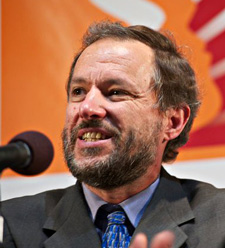
Mourad Dhina, a light in the Algerian darkness, arrested

By Johan Galtung

Galtung here focuses on a human rights case which – like the terrible mass slaughter in Algeria in the 1990s – have attracted little attention in the West. Please circulate the letter to the French prime minister below.

Syria is horrible. Assad should step down immediately, a coalition government should come into being, and a thousand mediators should talk with the many parties, maybe with a federation in view. But Algeria is even worse.Read More »

What the Arab League report on Syria also stated – but you hardly knew from the media

By Michel Chossudovsky

We publish this post right after China and Russia have vetoed the UN SC Resolution draft. Perhaps the situation in Syria is a bit more complex than you are generally told?

I’d like to bring to the attention of our readers the Observers’ Mission Report of the League of Arab States (AL = Arab League) to Syria.

The report acknowledges the existence of “an armed entity” involved in the killings of civilians and police as well as the conduct of terrorist acts, which in turn have contributed to triggering actions by government forces.Read More »

Iran, the EU and what we should have learned by now*

By Jan Oberg

On Monday the 23rd of January 2012, the EU’s 27 members unanimously decided to stop their oil import from Iran on July 1 this year. That sort of policy is considered benign in comparison with warfare. It won’t be when seen in the long run.

Sanctions usually have the opposite consequences of those “intended”. Secondly, as we know from the Iraq case, they are part and parcel of a build-up to war and will have, in the longer run, devastating, cruel consequences for innocent civilians whose lives are already hard.

How come EU leaders seem not to see the counterproductivity of their decisions? Do they not know that they contribute to a build up to a war that will be much more catastrophic than that on Iraq both for the region, for themselves and for the economy they otherwise try to keep from even deeper crisis?

Virtually everyone speaking on behalf of their country or the EU as a whole point out the risks of escalating the conflict; it may eventually lead to a spiral, one or more counter measures by Iran and a tit-for-tat dynamics that could – could – go out of hand. The next they therefore say, as if to soothe their own fears, is that war must be avoided and that, rather, sanctions and other types of pressures serve only one purpose: to get the Iranians to the negotiation table.

Don’t they know the basics of psychology?

This is pathetic and militates against everything one knows about psychology.Read More »

No proof that Iran wants the bomb

By Jonathan Power

Many of us doubt that Iran is on the way to build a nuclear bomb. Trying to find the truth is not easy. It was a bit of a one sided conversation since I don’t know the inner workings of the International Atomic Energy Agency, the UN body that monitors nuclear developments. But Robert Kelly, a nuclear energy engineer and ex-department director at the IAEA, has brought me up to speed.

According to him the evidence described in a widely quoted report issued in November 2011 by the Director General of the IAEA, Yukiya Amano, is sketchy.Read More »

Unarmed resistance is Syria’s best hope

By Stephen Zunes

The Syrian pro-democracy struggle has been both an enormous tragedy and a powerful inspiration. Indeed, as someone who has studied mass nonviolent civil insurrections in dozens of countries in recent decades, I know of no people who have demonstrated such courage and tenacity in the face of such savage repression as have the people of Syria these past 10 months.Read More »

Nuclear-free Middle East: Desirable, necessary and impossible

By Richard Falk

Finally, there is some argumentation in the West supportive of a nuclear free zone for the Middle East. Such thinking is still treated as politically marginal, and hardly audible above the beat of the war drums. It also tends to be defensively and pragmatically phrased as in the NY Times article by Shibley Telhami and Steven Kull (January 15, 2012) with full disclosure title, “Preventing a Nuclear Iran, Peacefully.”Read More »

Nya hot ökar risken för krig mot Iran

Av Sören Sommelius

EU förbjuder all oljeimport från Iran, och Iran hotar med att som svar blockera all trafik av olja genom Hormuzsundet. Till TT uttrycker utrikesminister Carl Bildt viss skepsis inför beslutet, risken är att vi ”glider in i en konfrontation som ytterst kan sluta i krig – och dit vill ingen”.

På sin blogg Alla dessa dagar är Bildt ännu mera kritisk till sanktionerna, som han menar möjligen kan påverka Irans ekonomi men knappast landets politik.

Men varför deltar Sverige då i beslutet??Read More »

Stop warmongering in the Middle East

By Richard Falk

A critique of western policies vis-à-vis Iran and two pro-peace proposals

The public discussion in the West addressing Iran’s nuclear program has mainly relied on threat diplomacy, articulated most clearly by Israeli officials, but enjoying the strong direct and indirect backing of Washington and leading Gulf states. Israel has also engaged in covert warfare against Iran in recent years, somewhat supported by the United States, that has inflicted violent deaths on civilians in Iran.

Many members of the UN Security Council support escalating sanctions against Iran, and have not blinked when Tel Aviv and Washington talk menacingly about leaving all options on the table, which is ‘diplospeak’ for their readiness to launch a military attack. Read More »

The US, Middle East and Libya – players on a stage

By Mariam Abuhaideri

“All the world’s a stage, 
and all the men and women merely players;
 They have their exits and their entrances;
 And one man in his time plays many parts.”

Sounds familiar? What Shakespeare penned down in ‘As You Like It’ is more than mere words. The monologue captures the essence of international relations since early ages. Read More »