Impressions of Damascus and its amazing, kind people

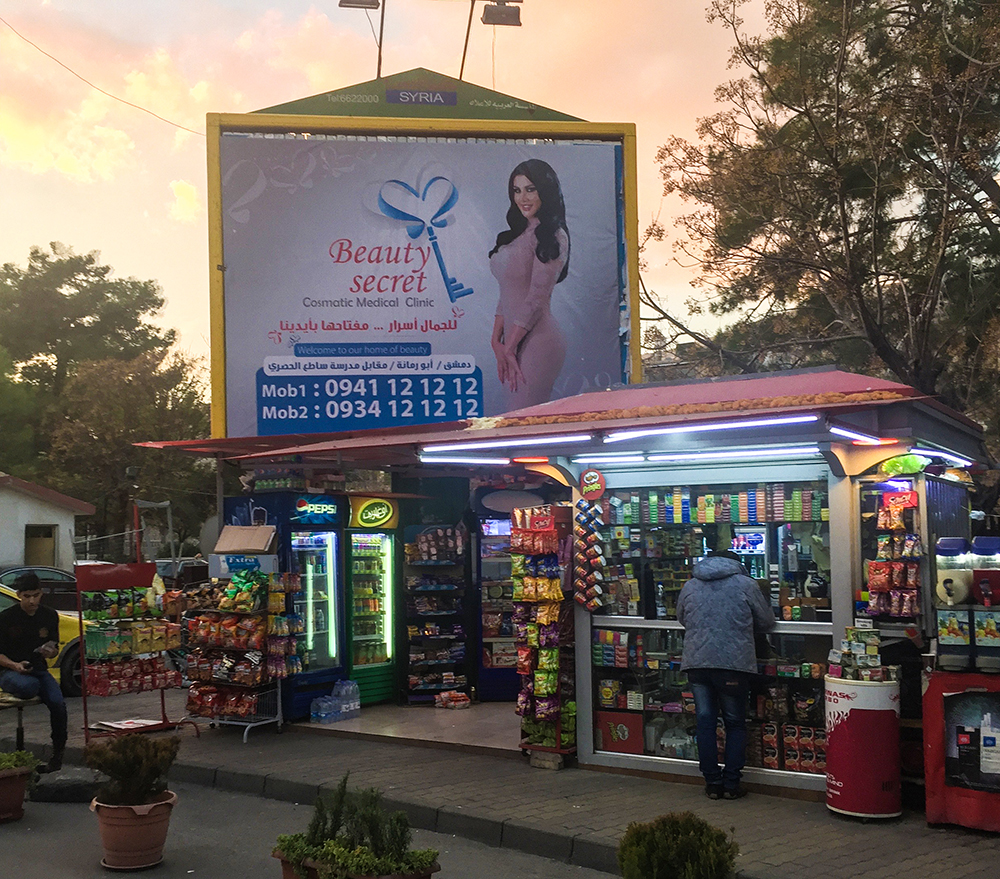
There is plenty of goods in Damascus' shops and women getting "beauty" surgery

TFF Conflict and Peace Report Syria # 2

I’ve only passed through Damascus once before, in 2002 on my way to Baghdad. What meets you today is a beautiful city with checkpoints all over the place, your car trunk will be opened and papers checked. Seemingly useless explosives detectors are used – useless because they don’t catch that many drivers here today have a revolver or hand-grenade under their seat.

But you’d probably be surprised, like I was, at how normal it otherwise feels. At the surface.

Traffic is intense, pollution thick, shops are filled with goods, I see fewer beggars here than in Lund, Sweden. People enjoy excellent food (I haven’t had such good meals for long) at restaurants with live music and entertain themselves at the omnipresent cafés.

As everywhere else in war zones, people whose lives have been shattered in many ways – and there are few here in Damascus who have not been hit one way or the other by the war – do their best to maintain some kind of normality.

I’ve seen it elsewhere such as in Sarajevo – the women in particular dress up elegantly and often sexily in the public space, hang out with friends, drink cappuccinos and check their mobiles incessantly to be and to appear as someone in control although life is close to unbearable. Human pride and determination comes out very strongly in war zones – as much, I would say, as human evil.

That said, for the less privileged life is extremely hard. Prices on many basic good have gone up 10x over the last 5 years. Salaries haven’t followed. A soldier gets about USD 50 a month, people working in offices perhaps US$ 70. Many citizens live on UN food packages.

In short, the same totally inhuman consequences of sanctions – the allegedly “soft” instrument – as in Iraq: only hitting innocent people, destroying the middle class and boosting the already rampant corruption. (More about this later when I know more).

What will surprise you is Read More »

TFF Peace and Conflict Mission to Syria # 1

By Jan Oberg

Damascus, Syria, December 9, 2016


I’m writing to you from war-torn Syria where the suffering of the people is beyond comprehension, heart-breaking.

The war in and on Syria has been started in spring 2011 – the underlying conflicts much much earlier.

What our media have shown us is snipers, bombings, killings, ruins, dead bodies and press conferences with Western politicians.

But did you “see” the underlying conflicts?

Get an understanding of what the problems standing between the parties are?


Did you get the impression that weapons is the only thing “they” understand?

Did you feel hopeless about it all? Confused? Depressed because of all the human suffering?

That peace is impossible?

If so it’s because we are missing a huge part of the picture. We need something else.

Small everyday joys in Damascus


We need to switch from – repetitive and depressive – war and violence reporting to conflict and peace reporting.

We need a focus on issues, history and structures instead of appointing one side and one person as the problem.

We must supplement the focus on weapons and fighters and focus on human potentials.

We must scrap the garbage theory that peace is about good guys winning and bad ones losing.

We must listen to all the parties, not just out own politicians and media.

And we must look at common interests and ways out of the violence and ask: Who can do what for a better Syria in the future, a Syria with people at peace with each other and the world.

Are you interested in new ways of understanding conflicts?

Then – being in Syria until Christmas – I am available.

In two ways:

1. I will post short articles based upon these other approaches at the TFF Associates blog.

2. I have been here in beautiful, historical Damascus the last 5 days and will go to several places – Aleppo on Saturday.

I’m available to media and others who take interest in what is going on here in a conflict and peace perspective.


Contact:

janoberg@mac.com

Swedish iPhone +46 738 52 52 00

Syrian mobile +963 941 35 36 52

Facebook: https://www.facebook.com/janoberg.se – for updates, messaging and phone.

Skype: janoberg

And it is soon Christmas in this multi-confessional, secularised place

The rich get richer. So do the poor

By Jonathan Power

December 6th 2016

President-elect Donald Trump is about to make the American rich even richer with his plan to cut their taxes. A cause for shame. Nevertheless, the history of America is that poorer people have done better than is commonly thought over the last two centuries.

Today they have indoor plumbing, heating, electricity, smallpox and tuberculosis-free lives, adequate nutrition, much lower child and maternal mortality, doubled life expectancy, increasingly sophisticated medical attention, the availability of contraception, secondary level schooling for their children and a shot at university, buses, trains and bicycles, much less racial prejudice, longer retirement, a rising quality of the goods they buy, better working conditions and the vote.

Once these were luxuries that only the richer could experience. It has been shown by many studies that happiness increases fast as poorer people get better off but that beyond a certain point – an income of $15,000 per person per year- extra happiness increases very slowly. Read More »

TFF PressInfo # 394: The State of the World Right Now: A Macro View

By Johan Galtung

“View” meaning not only a glimpse from above, but a position taken on the world on which the US electorate is now dumping Donald Trump.

That world is today basically multi-polar, maybe with 8 poles: 1) Anglo-America, 2) Latin America-Caribbean, 3) African Unity, 4) Islam-OIC from Casablanca to Mindanao, 5) European Union, 6) Russia more region than state, 7) SAARC from Nepal to Sri Lanka, 8. ASEAN, Australia-New Zealand. [See list of abbreviations with links to the mentioned organisations under the article]

And thre is the multi-regional Shanghai Cooperation Organization, SCO, with China and Russia, Islamic countries, India and Pakistan.

There is a waning state reality, smaller states being increasingly absorbed into regions.

There is a waxing region reality with the above eight; adding West Asian, Central Asian and Northeast Asian regions, maybe eleven.

There is a global reality based on IGOs, inter-governmental organizations, with the United Nations on top; TNCs, the transnational corporations, with the US-based on top so far; and INGOs, international non-governmental organizations, with religions on top.

Now, insert into all of that something concrete from William Blum’s Anti-Empire Report #146 and his Rogue State.

From WWII, the USA has:Read More »

Frightening: Flynn’s “Field Of Flight”

By Farhang Jahanpour

I have just spent a couple of miserable hours reading General Michael Flynn’s and Michael Ledeen’s book, The Field Of Flight. He will be President Trump’s national security adviser. And, frankly, I don’t know where to begin.

As someone who is opposed to the regime of the mullahs and would like to see the end of that regime through peaceful and democratic means, I truly cannot understand the reason for what one can call the irrational hostility and the depth of hatred of people like Flynn and Michael Ledeen towards Iran. Of course they are entitled to their feelings of hatred and hostility towards Iran and Muslims as a whole, but they are not entitled to their facts.

It is really amazing to see how without any concern for the facts Flynn jumps from one subject to another,Read More »

Moralizing military intervention

By Richard Falk

I am republishing my review essay that appeared in International Dialogue: A Multilateral Journal of World Affairs 6:2016.

It discusses two excellent studies of humanitarian intervention, a post-colonial trope allowing the United States and West Europeans to feel morally satisfied while projecting military power to distant lands, often with devastating consequences for the people being protected, and sometimes, even being rescued from tyranny and brutal repression.

In some respects, what progressive critics call ‘regime-change’ the champions of such policy like the terminology of ‘humanitarian intervention,’ or even better, ‘Responsibility to Protect’ or R2P.

Donald Trump interestingly portrayed Hillary Clinton accurately as a regime-change advocate, and pledged not to make such mistakes if elected. We will wait, see, and hope that at least this time, he means what he says.

The Middle East has been the testing ground for this ‘new geopolitics’ but its antecedents can be traced back several centuries as the Klose edited collection of essay clearly demonstrates.

Both studies are notable for highlighting the non-humanitarian motivations that accompany such undertakings, which are often hidden from public view, and need to be highlighted to comprehend this latest twist in the conduct of international relations.]

Fabian Klose (ed).
The Emergence of Humanitarian Intervention: Ideas and Practice from the Nineteenth Century to the Present
Cambridge University Press, 2016. 364pp.

Rajan Menon
The Conceit of Humanitarian Intervention
Oxford University Press, 2016. 235pp

Continue to Richard Falk’s article here.

International Women’s boat to Gaza

By Mairead Maguire
Thursday 29th September, 2016 – Wed.,5th October, 2016

Participant on board Zaytoouna-Oliva boat

A few weeks ago, the US Government agreed to give Israel $38 billion dollars, the largest military funding package the U.S. has given any Nation. This $38 billion in military and other type of Aid, will be used to imprison the Palestinians of Gaza, and continue Israel’s military occupation, and imposition of an apartheid state, upon the Palestinian people.

This money will be used in the training fields of Israeli military which are in Gaza, where military experiments are done, using US military weaponry, by the Israeli Occupation Forces.

The U.S. military and Government is complicit in the crimes against the people of Gaza and the Palestinian occupied territory by the use of military hardware given by USA and the training that the Israelis give USA and USA gives to them.

It is also estimated that some 70% of European humanitarian aid to Palestine ends up in Israeli pockets.

Gaza continues to suffer from the continuing Israeli blockade, naval and land, and this 25-mile-long tiny strip, 5 miles wide, with l.9 million people, living in it, is a brutal blockade and Israel controls everything including, all the electricity, the food, etc. Indeed, everything which comes into Gaza comes through Israeli hands. Gaza’s only airport was completely destroyed in 2002 by Israeli jets and ground forces.

Egypt continues to be a part of this blockade as they have blocked Gaza’s southern border and Egypt continues to receive USA military funding. Medical authorities have reported that the time for operations in Gaza now goes up to 2025 as so many are awaiting health care, and the increasing issues around food, water, sewage, electricity, all of these mounting problems have led the U.N. to declare in their latest Report, that by the year 2020 Gaza will be uninhabitable. What hope is there for the Palestinians of Gaza, the vast majority of whom are young people.?

In order to give Hope to the people of Gaza by showing solidarity and support the Women’s Boat to Gaza sailed to Gaza in September, 2016.

Also we sailed in order to challenge this illegal and immoral blockade and occupation of Palestine by Israel, and draw international attention to the fact that under Geneva conventions it is illegal to punish civilians, which is what Israeli government policies continues to do. Read More »

Imagine a Middle East with no weapons

Here a few comments on Erdogan’s recent attack on the West for supplying arms to the Kurds.

Funny that Turkey’s president should accuse someone else for weaponizing a conflict. At the same time as Turkey does it and is also involved in two wars outside itself – Iraq and Syria – and one inside against the Kurds.

In this short interview I seek to raise the imagination: Since the weaponization of conflicts is a cancer on the world, imagine that a God-like magnetic force that could suck up each and every weapon in the Middle East, what would happen?

They would be forces to sit down and talk!

And one more point I did not get around to say: The world’s cancerous arms industry and criminal arms traders – governmental as well as private – would go out of business and many end up behind bars.

In short, a much better world.