End Game in Ukraine?

By Jens Jorgen Nielsen

Written September 25, 2014

It should never have come to this horrible situation in Ukraine. The local population of Donetsk, Lugansk, Slavyansk and other eastern Ukrainian cities is living through a true nightmare. Residential areas are being bombed, shelled and burned. Non-combatants i.e. elder, women and children are lying dead in the streets. We’re talking about thousands of deaths. No water supply, no heating, no security – this is the grim reality for the population.

700.000 Eastern Ukrainians have already escaped from the war scene, most of them are living in refugee camps in Russia. It is worth noting that they have not fled to Kiev or elsewhere to the west.

Surprisingly the Western media hardly pay any attention to the horrors in Eastern Ukraine.

But that is not all. Ukraine is in total disruption socially, politically and not least economically and financially. Furthermore, the mental scars in Ukraine will continue for at least one generation ahead.

But again that is not all. The European Union suffers as well – in several ways. Read More »

TFF PressInfo 282: Instead of bombing ISIS – Concrete proposals (Part B)

By Jan Oberg, TFF

Jan Oberg

Lund, Sweden October 7, 2014

Part A – Some principles (yesterday) here

This two-part PressInfo offers a pro-peace perspective on the present war on ISIS in Iraq and Syria.

First some principles to stimulate another discourse, another way of thinking that is not militarist – and then the concrete proposals below – 27 in all for your deliberation, discussion with friends and perhaps to share through your social and other media.

The proposals are not numbered – there is no linearity, some of it can be done simultaneously.

How to make the bombing and wars irrelevant

Stop the financing of ISIS – sadly it is non-democratic allies of the West – Saudi-Arabia, Qatar, UAE etc – that seem to pay its bills. Joe Biden apologised – for being truthful.

Allegedly, ISIS has an income of US$ 3 million per day from oil resources they now control. Oil fields should have been protected at an early stage. Fire your intelligence service leaders if they did not see this coming.

Instead of starting out with war, declare yourself willing to talk with some representatives of ISIS and other conflict parties. Some of them have been trained by the U.S. so they are obviously possible to talk with. And if not, you take it from there.

Recognise – even apologise – for wrong deeds and mistakes and brutalities you have yourself committed. In the case of Iraq this is particularly relevant because the invasion, occupation and 13 years of world history’s most brutal sanctions have killed about 1 million innocent Iraqis and made 4 millions to flee their homes.

Danish poet and philosopher Piet Hein has said it beautifully: ”The nobel art of losing face may one day save the human race and turn into eternal merit what weaker minds would call a disgrace.” Don’t be that weaker mind – because, if so, you will over time become a mirror image of those terrorists you are fighting – a disgrace.

Deploy a robust, impartial, globally composed UN-led force Read More »

TFF PressInfo 281: Instead of bombing IS (Part A)

By Jan Oberg

Jan Oberg

PressInfo 281 – Part A here.

This two-part article offers a pro-peace perspective on the present war on ISIS in Iraq and Syria.

First some principles to stimulate another discourse, another way of thinking that is not militarist – and then some concrete proposals – 27 in all for your deliberation, discussion with friends and perhaps to share through your social and other media.

Neither war nor doing nothing

The principle of ”An eye for an eye will one day make the whole world blind” – said Mohandas K. Gandhi who was born on October 2 145 years ago. Since then, human civilisation has not advanced much when it comes to handling conflict.

Let’s recognise that it is a difficult situation – the Middle East is in a mess and the West is deeply co-responsible if you look at the last roughly 100 years – Sykes-Picot, Balfour, coup d’etats, occupations, bombings, bases, oil greed etc.

So, there are no easy solutions.

However, three simple principles will help us all:
A) Be aware of the West’s co-responsibility,
B) Don’t make everything even worse – and
C) Remember that violence begets hate, wish for revenge and more violence – blowbacks.

Unfortunately, A to C is totally ignored by the bombing nations – the US, France, Britain, Belgium and my native Denmark together with some small Arab states which paradoxically have financed ISIS – Al-Qaeda in Iraq – for years.

It is easy to be for war. Read More »

TFF PressInfo 276 – Ceasefire in Eastern Ukraine: Now withdrawal by Russia, the UN in and NATO out

By Jan Oberg, TFF co-founder

Jan Oberg

Lund, Sweden September 3, 2014 – 11:30 CET.

As announced just a few minutes ago, the Ukrainian and Russian president have agreed to what the first reports call a permanent ceasefire in Eastern Ukraine.
That’s indeed the best piece of news from that region.

It places the NATO Summit in Wales this Thursday and Friday in a new light.

The ceasefire must be solidified
However, an agreement over a phone is only a beginning; the devil is in the details. Secondly, there is no mention – yet – of the East Ukrainian fighters are on board this agreement.

Time for UN peacekeeping
Third, a credible ceasefire should be monitored by neutral observers and competent people. The only ones who can do that is the UN peace-keepers – perhaps with some staff also from Russia and Ukraine.Read More »

TFF PressInfo: Cold War warnings 1998 – 2014

By Jan Oberg

Jan Oberg

Lund, Sweden August 11, 2014

Quality research leads to better predictions

One criteria of quality research is that it predicts the future better than incompetent research.

Because TFF is independent of governments and coroporations it doesn’t have to take political considerations or exclude certain theories, concepts or values. This free research enabled it over the years to make fairly precise predictions about for instance former Yugoslavia, the Iraq war and East-West relations.

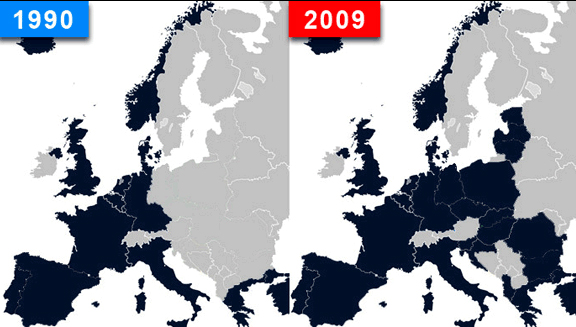
In 1998 – 16 years ago – we warned that NATO’s expansion would lead to future problems with Russia. Read it here.

NATO should never have been expanded

We backed this prediction up with 46 arguments and argued that so many other things would be wiser than containing Russia from the Baltic republics to Georgia – a strategy pursued by Bill Clinton in contravention of all promises given to the Soviet Union/Russia at the end of the Cold War about ten years earlier.

That counterproductive and insensitive expansion has now hit Ukraine. A new Cold War is gathering over Europe. It should have been predicted by advisers, intelligence agencies, big research institutes and columnists.

But it wasn’t.

At the end of the Cold War, NATO/the West got everything it could ever wish – and without war. But it wanted more: keeping Russia down, making NATO bigger and “peace-making” as well as finding new enemies to keeping its Military-Industrial-Media-Academic Complex (MIMAC) alive and well: Saddam, Milosevic, the Muslim world, terrorism and – now re-cycling – Russia.Read More »

Cruelties of ceasefire diplomacy

By Richard Falk

Richard Falk

Prefatory Note

The post below is a revised text of an article published in AlJazeera America on July 26, 2014. Devastation and violence has continued in Gaza, with Palestinians deaths now numbering over 1000 (overwhelmingly civilians) and Israeli deaths latest reported at being 43 (almost all military personnel).

Such casualty figures and disparities raise questions of state terrorism in a stark manner. Also, it should be appreciated that if Israel were to do what it is required by international law to do there would be no rockets directed at its population centers – lift the blockade, negotiate peace on the basis of the 2002 Arab proposals and Security Council 242. Yet this would require Israel to give up once and for all its expansionist vision embedded in the settlement phenomenon and the version of Zionism embraced by its leaders and reigning political parties.

The best that the UN has been able to do is to call for an “immediate and unconditional ceasefire” to allow the delivery of humanitarian aid at an emergency meeting of the UN Security Council; such an unseemly balancing act is not what the UN Charter had in mind by aligning the international community in opposition to states that break the peace and act aggressively in disregard of international law; a victimized people deserves protection, not some sort of display of deforming geopolitical symmetry.

So far, the diplomatic effort to end the violence in Gaza has failed miserably, Read More »

TFF PressInfo: Use Malaysia’s MH17 to make peace instead

By Jan Oberg, TFF director

Jan Oberg

Tragic misuse of a tragedy

The government of Ukraine as well as the separatists, NATO/U.S. and very many leading Western mainstream media seem all to know who has caused the tragedy. Putin believes it was caused indirectly by the West.

Given the fact that very few, if any, people or institutions can know who did it with enough details, data and precision to accuse anyone, the MH17 tragedy has been misused to an extent that can itself only be termed tragic.

The misuse is tragic because it is a catastrophe for close to 300 people, their relatives and friends. Silence – of both verbal and military weapons – and empathy would have been appropriate.

Anyone pointing fingers and calling it a terrorist act at this point is irresponsibly or should present convincing evidence.

Secondly, the blame game makes the necessary road to peace and security even more difficult.

An All Party Peace Process should come out of MH17 and the civil war

It would have been so much more civilised to use the MH 17 tragedy to say:Read More »

Five Palestinian futures

By Richard Falk

For years, perhaps going back as far as the Madrid Peace Conference of 1991, influential international debate on the future of Palestine has almost exclusively considered variations on the theme of a two-state solution. The American Secretary of State, John Kerry, stampeded the Palestinian Authority and Israel into negotiations that ‘failed’ even before they started a year ago. At least Kerry was prudent enough to warn both sides that this was their do or die moment for resolving the conflict.

It was presumed without dissent in high places anywhere that this two-state outcome was the one and only solution that could bring peace. Besides the parties themselves, the EU, the Arab League, the UN all wagered that a resolution of the conflict required the establishment of a Palestinian state. Even Benjamin Netanyahu became a reluctant subscriber to this mantra in his 2009 speech at Bar-Ilan University, although always in a halfhearted spirit.Read More »

TFF PressInfo: The manufactured story about Iran’s nuclear program

By Farhang Jahanpour

As Iran and the world powers resume nuclear talks in Vienna with the hope of reaching a comprehensive agreement over Iran’s nuclear program by mid-July, the Israelis and their lobbyists in Washington are intensifying their efforts to scuttle the talks. In addition to all the efforts in the US Congress to impose additional sanctions on Iran, thus bringing the talks to a premature end, there are indications that Israel and her friends are continuing with various acts of sabotage against Iranian nuclear facilities.

In 2010, the so-called Stuxnet virus temporarily disrupted the operation of thousands of Iranian centrifuges. At least five Iranian nuclear scientists have been assassinated. Iran has also said that it has discovered tiny timed explosives planted on centrifuges but has disabled them before they could go off. On Monday 17 March 2014, Iran said that an alleged attempt to sabotage one of its nuclear facilities had involved foreign intelligence agencies that had tampered with imported pumps. However, in addition to all those acts of sabotage, there seems to be an intensive effort to manufacture a crisis by means of false intelligence.

Prior to the devastating Iraq war that destroyed the country and killed upwards of half a million people, not to say anything of thousands of Coalition forces who were killed and the two trillion dollars that was spent, a number of neocons bent on the invasion of Iraq manufactured various false reports in order to mislead the public and pave the way for the war.

On September 8, 2002, Michael R. Gordon and Judith Miller published a story in the New York Times that openly alleged that Saddam Hussein had intensified his quest for a nuclear bomb. They wrote: “In the last 14 months, Iraq has sought to buy thousands of specially designed aluminum tubes, which American officials believe were intended as components of centrifuges to enrich uranium… Bush administration officials say the quest for thousands of high-strength aluminum tubes is one of several signs that Mr. Hussein is seeking to revamp and accelerate Iraq’s nuclear weapons program.”

The unsuspecting public was misled by that false intelligence and the result was one of the longest and most disastrous wars in US history.

How the manufactured crisis was manufactured

In his latest groundbreaking book, entitled A Manufactured Crisis: The Untold Story of Iran Nuclear Scare, the historian and investigative journalist Gareth Porter catalogs a long list of false reports manufactured by Israeli intelligence agencies in order to mislead the public and pave the way for a war against Iran. (1)

Read More »

Iran – P5+1 deal: Positive steps but hawks try to derail it

By Farhang Jahanpour

In his State of the Union Address on 28th February, President Barack Obama bluntly pointed out that if the hawks in Congress pushed for a bill to impose new sanctions on Iran he would veto that bill. This brave and almost unprecedented move by President Obama has silenced, at least for the time being, the opposition to the Joint Plan of Action that was agreed by Iran and the P5+1 (the five permanent Security Council members plus Germany) last November. This was a major setback for AIPAC (American Israeli Public Affairs Committee) and other pro-Israeli lobbies that had mobilized all their forces to block the deal.

In fact, some of the Democratic Senators that had sponsored the bill to impose additional sanctions on Iran have already distanced themselves from it. Furthermore, at least seventy Members of Congress are organizing a letter to the President supporting U.S.-Iran diplomacy and opposing new sanctions. (1)

New round of talks
Meanwhile, 20th January marked an historic turn in the Iranian nuclear dispute with the West, when both Iran and the West began to implement the terms of the agreement. The IAEA director general Yukiya Amano has said that he could report that “practical measures are being implemented as planned” by Iran, and that there would be new negotiations over the next phase on 8th February. Iran also has agreed to a new round of negotiations on 18th February with the P5+1. (2)


For his part, Iranian Foreign Minister Mohammad Javad Zarif has said: “What I can promise is that we will go to those negotiations with the political will and good faith to reach an agreement, because it would be foolish for us to only bargain for six months — that would be [a] disaster for everybody.”

Read More »