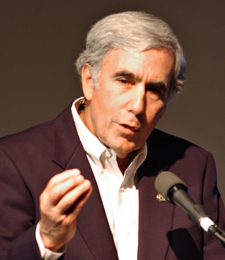
Marshallöarna utmanar kärnvapenstaterna

Av Gunnar Westberg

Marshallöarnas utrikesminister Tony de Brum berättade vid den pågående förberedelsekommitténs möte (Prep Com) i FNs-högkvarter i New York, den 28 april till 9 maj 2014 om avtalet mot kärnvapen, NPT, i New York, om sina upplevelser av kärnvapenprov:

Jag har varit vittne till kärnvapenexplosioner och mina minnen från Lipiep-atollen i norra Marshallöarna är starka. Jag bodde där som pojke under de 12 åren som kärnvapenproven pågick. Jag minns det bländande vita ljuset från Bravo-sprängningen på Bikini-atollen år 1954, tusen gånger starkare än den över Hiroshima.

Marshallöarna utsattes för 67 kärnvapenprov mellan 1946 och 1958, motsvarande 1,6 Hiroshima-sprängningar varje dag I tolv år. Följderna finns kvar hos oss som en börda som ingen nation, ingen befolkning, skulle behöva bära.

Marshallöarna förvaltades vid tiden för kärnvapensprängningarna av USA under FN-mandat. Nu är landet självständigt med namnet Republiken Marshallöarna, som omfattar ett stort antal öar med en befolkning av totalt endast 60 000 personer. Landet ar ett avtal med USA som bl a innebär att USA står för försvar och vissa sociala tjänster.

Marshallöarna tar nu strid för att inget land i världen skall utsättas för kärnvapen, inte testsprängningar men framför allt inte kärnvapenkrig. Read More »

Nonviolent Geopolitics: Law, Politics, and 21st Century Security*

By Richard Falk

In this short essay, my attempt will be to articulate a conception of a world order premised on nonviolent geopolitics, as well as to consider some obstacles to its realization. By focusing on the interplay of “law” and “geopolitics” the intention is to consider the role played both by normative traditions of law and morality and the “geopolitical” orientation that continue to guide dominant political actors on the global stage.

Such an approach challenges the major premise of realism that security, leadership, stability, and influence in the 21st century continue to rest primarily on military power, or what is sometimes described as “hard power” capabilities. [1]

From such a perspective international law plays a marginal role, useful for challenging the behavior of adversaries, but not to be relied upon in calculating the national interest of one’s own country. As such, the principal contribution of international law, aside from its utility in facilitating cooperation in situations where national interests converge, is to provide rhetoric that rationalizes controversial foreign policy initiatives undertaken by one’s own country and to demonize comparable behavior by an enemy state. This discursive role is not to be minimized, but neither should it be confused with exerting norms of restraint in a consistent and fair manner.

My intention is to do three things:

• to show the degree to which the victors in World War II crafted via the UN Charter essentially a world order, which if behaviorally implemented, would have marginalized war, and encoded by indirection a system of nonviolent geopolitics; in other words, the constitutional and institutional foundations already exist, but inert form;

• to provide a critique of the realist paradigm that never relinquished its hold over the imagination of dominant political elites, and an approach has not acknowledged the obsolescence and dangers associated with the war system;

• and, finally, to consider some trends in international life that make it rational to work toward the embodiment of nonviolent geopolitics in practice and belief, as well as in the formalities of international law.Read More »

TFF PressInfo: The manufactured story about Iran’s nuclear program

By Farhang Jahanpour

As Iran and the world powers resume nuclear talks in Vienna with the hope of reaching a comprehensive agreement over Iran’s nuclear program by mid-July, the Israelis and their lobbyists in Washington are intensifying their efforts to scuttle the talks. In addition to all the efforts in the US Congress to impose additional sanctions on Iran, thus bringing the talks to a premature end, there are indications that Israel and her friends are continuing with various acts of sabotage against Iranian nuclear facilities.

In 2010, the so-called Stuxnet virus temporarily disrupted the operation of thousands of Iranian centrifuges. At least five Iranian nuclear scientists have been assassinated. Iran has also said that it has discovered tiny timed explosives planted on centrifuges but has disabled them before they could go off. On Monday 17 March 2014, Iran said that an alleged attempt to sabotage one of its nuclear facilities had involved foreign intelligence agencies that had tampered with imported pumps. However, in addition to all those acts of sabotage, there seems to be an intensive effort to manufacture a crisis by means of false intelligence.

Prior to the devastating Iraq war that destroyed the country and killed upwards of half a million people, not to say anything of thousands of Coalition forces who were killed and the two trillion dollars that was spent, a number of neocons bent on the invasion of Iraq manufactured various false reports in order to mislead the public and pave the way for the war.

On September 8, 2002, Michael R. Gordon and Judith Miller published a story in the New York Times that openly alleged that Saddam Hussein had intensified his quest for a nuclear bomb. They wrote: “In the last 14 months, Iraq has sought to buy thousands of specially designed aluminum tubes, which American officials believe were intended as components of centrifuges to enrich uranium… Bush administration officials say the quest for thousands of high-strength aluminum tubes is one of several signs that Mr. Hussein is seeking to revamp and accelerate Iraq’s nuclear weapons program.”

The unsuspecting public was misled by that false intelligence and the result was one of the longest and most disastrous wars in US history.

How the manufactured crisis was manufactured

In his latest groundbreaking book, entitled A Manufactured Crisis: The Untold Story of Iran Nuclear Scare, the historian and investigative journalist Gareth Porter catalogs a long list of false reports manufactured by Israeli intelligence agencies in order to mislead the public and pave the way for a war against Iran. (1)

Read More »

60 years of nuclear pain – and not a word in the media

By David Krieger

As the trustee of the United Nations Trust Territory of the Pacific Islands, the United States had an obligation to protect the health and welfare of the Marshallese Islanders. Instead, the U.S. conducted 67 nuclear tests in the Marshall Islands between 1946 and 1958. These 67 nuclear tests had an explosive power equivalent to 1.6 Hiroshima bombs daily for 12 years. In short, the U.S. used these islands shamefully, and the Marshallese people continue to suffer today as a result.

Continue reading here

TFF PressInfo: Institute a course for all on what confront humanity in the 21st century

Open Letter to College and University Presidents Re: Global Security 101

By David Krieger

You are in a unique position of leadership to influence today’s youth to achieve a better tomorrow for America and the world. I am writing to enlist your help in educating young people to understand the survival challenges that face humanity in the 21st century.
Education is driven by values. Young people must learn to live with reverence for life, as did Albert Schweitzer, and to support equitable and nonviolent solutions to social problems, as did Gandhi and Martin Luther King, Jr. Young people must be imbued with compassion, commitment and courage. They must learn to use their imaginations to find creative and cooperative solutions to the great issues of our time. And they must find joy in the process and take time to celebrate the miracle of living on the only planet we know of in the universe that supports life. Continue here…

North Korea and the Iran nuclear deal

By Jonathan Power

The agreement just signed by Iran, the US, the EU and Russia is more than a milestone, it changes the world. Perhaps.

It is bitterly opposed by Israel. Prime Minister Benjamin Netanyahu seems determined to be the spoiler. Apparently Israel’s threat to bomb Iran’s nuclear facilities remains a serious option, even though such an attack would only have a limited effect and would provoke Iran to raise the ante against Israel.

But that is not the only worry. There are two other things. Read More »

A tale of two speeches: Rouhani and Netanyahu at UN General Assembly

By Farhang Jahanpour*

With the progress of the talks in Geneva between Iran and the six world powers (the so-called P5+1) on 15 and 16 October, there is growing optimism about a lasting solution to Iran’s nuclear program and to the resumption of relations between Iran and the United States after 34 years of estrangement. After an hour-long power-point presentation by the Iranian Foreign Minister Mohammad Javad Zarif, which he called “closing unnecessary crisis, and opening new horizons”, Michael Mann, the spokesman for EU foreign policy chief Catherine Ashton who is leading the talks for the P5+1 group, described the Iranian proposal as “very useful” and said: “For the first time, very detailed technical discussions took place.” (1)

The exact choice of words was also repeated by a senior US official taking part in the talks. After the formal talks between the two sides, there was another US-Iran bilateral meeting between the chief US representative in the talks, Ms. Wendy Sherman, and Iranian Deputy Foreign Minister Abbas Araqchi who led the Iranian delegation after the Iranian foreign minister’s original presentation. This was the second time after the meeting of Iranian and US foreign ministers in New York that senior officials from the two sides had had a bilateral meeting.Read More »

Time overdue to cut nuclear weapons

By Jonathan Power

At the time of the “Cuban Missile Crisis” in 1962 when the Soviet Union secretly shipped into Cuba nuclear weapons and the US, under President John Kennedy, threatened to bomb them, the world came as close to nuclear war as it ever has. Robert McNamara, the US Secretary of Defence, wondered if he would ever see another sunset. At universities students marched. The crisis ended when Kennedy agreed – with only a handful of his inner circle knowing this – to remove US nuclear missiles in Turkey which, with their short flight times, threatened Russia as much as the Cuban missiles threatened the US.

Many years later in June 1982, after only modest progress in mutually reducing nuclear weapons on each side, around three-quarters of a million demonstrators gathered in New York’s Central Park demanding a freeze on nuclear weapon production. The New York Times reported that “it was the largest demonstration in American history”.

But in 2013, despite more cutting, the Cold War over, the two old adversaries still have 6,400 nuclear weapons. Read More »

Nukes are nuts !

By David Krieger
Krieger is one of the three TFF Associates nominated for the 2013 Nobel Peace Prize

When asked by a reporter why nuclear weapons are useless, Colin Powell, former US secretary of state and four-star general said: “Because they’re such horrible weapons. And so no sane leader would ever want to cross that line to using nuclear weapons. And, if you are not going to cross that line, then these things are basically useless.” In other words, one could say, nukes are nuts.

There are innumerable global security issues that need to be addressed, some of which are poverty, terrorism, the climate crisis, pollution of the oceans, loss of biodiversity and forest depletion. Not one of these issues can be addressed with nuclear weapons. In fact, nuclear weapons draw much-needed resources away from solving these global problems. Nukes are nuts.

Nuclear weapons are justified by their possessors for nuclear deterrence, but nuclear deterrence is only a hypothesis about human behavior. Read More »

Lessons from the U.S.-Korea nuclear crisis

By David Krieger

The high-profile nuclear crisis on the Korean Peninsula, pitting the reigning heavyweight nuclear champion, the United States, against the bantamweight nuclear contender, North Korea, is not finished and is deadly serious. The posturing and exchanges that the world has been witnessing are capable of spiraling out of control and resulting in nuclear war. Like the Cuban Missile Crisis more than half a century ago, this crisis demonstrates that nuclear dangers continue to lurk in dark shadows across the globe.

This crisis, for which the fault is shared by both sides, must be taken seriously and viewed as a warning that nuclear stability is an unrealistic goal. The elimination of nuclear weapons, an obligation set forth in the Non-Proliferation Treaty and confirmed by the International Court of Justice, must be a more urgent goal of the international community. The continued evasion of this obligation by the nuclear weapon states makes possible repeated nuclear crises, nuclear proliferation, nuclear terrorism and nuclear war.

Lessons can be drawn Read More »