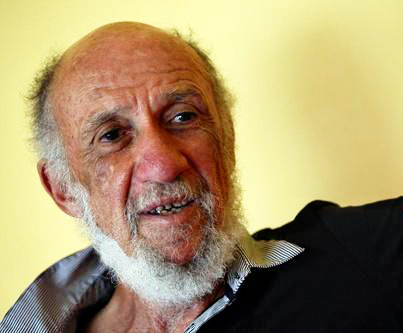
John Avery’s CV

John Scales Avery

John Scales Avery received a B.Sc. in theoretical physics from MIT and an M.Sc. from the University of Chicago. He later studied theoretical chemistry at the University of London, and was awarded a Ph.D. there in 1965.

He is now Lektor Emeritus, Associate Professor, at the Department of Chemistry, University of Copenhagen.

Fellowships, memberships in societies
Since 1990 he has been the Contact Person in Denmark for Pugwash Conferences on Science and World Affairs. Member of the Danish Peace Commission of 1998. Technical Advisor, World Health Organization, Regional Office for Europe (1988- 1997). Chairman of the Danish Peace Academy, April 2004-.

You’ll find a lot about this eminent scholar at Wikipedia. Avery is also a leading peace researcher and activist – “Since 1990, Avery has been the Contact Person for Denmark the Pugwash Conferences on Science and World Affairs. In 1995, Avery was part of a group that shared in the Nobel Peace Prize for their work in the 1990s in organizing the Pugwash Conferences on Science and World Affairs.

In 1998, Avery was elected to the Danish Peace Commission. During the years 1988-97, Avery was the Technical Advisor at the World Health Organization, Regional Office for Europe. In 2004, Avery became the Chairman of the Danish Peace Academy.

In his usual humble and plain style John tells the story of his life – his personal life, his scholarly life and his peace life – here.

Publications
Dr. Avery seems to have ben writing day and night throughout his life – here is his amazing list of books, chapters and articles on world affairs.

In early 2016, Irene Publishing – run by TFF Associates Jørgen Johansen and Majken Jul Sørensen – published Avery’s Collected Essays as well as The Need For A New Economic System.

John joined TFF as TFF Associate in March 2016.

TFF PressInfo # 370: If Obama visits Hiroshima (Part 1)

By Richard Falk

There are mounting hopes that Barack Obama will use the occasion of the Group of 7 meeting in Japan next month to visit Hiroshima, and become the first American president to do so.

It is remarkable that it required a wait of over 60 years until John Kerry became the first high American official to make such a visit, which he termed ‘gut-wrenching,’ while at the same time purposely refraining from offering any kind of apology to the Japanese people for one of the worse acts of state terror against a defenseless population in all of human history.

Let’s hope that Obama goes, and displays more remorse than Kerry who at least deserves some credit for paving the way.

The contrast between the many pilgrimages of homage by Western leaders, including those of Germany, to Auschwitz and other notorious death camps, and the absence of comparable pilgrimages to Hiroshima and Nagasaki underscores the difference between winning and losing a major war. This contrast cannot be properly accounted for by insisting on a hierarchy of evils that the Holocaust dominates.

The United States, in particular, has a more generalized aversion to revisiting its darker hours, although recent events have illuminated some of the shadows cast by the racist legacies of slavery.

The decimation of native Americans has yet to be properly addressed at official levels, and recent reports of soaring suicide rates suggests that the native American narrative continues to unfold tragically.

The New York Times in an unsigned editorial on April 12 urged President Obama to make this symbolic visit to Hiroshima, and in their words “to make it count” by doing more than making a ritual appearance. Recalling accurately that Obama “won the Nobel Peace Prize in 2009 largely because of his nuclear agenda” the editorial persuasively criticized Obama for failing to follow through on his Prague vision of working toward a world free of nuclear weapons.

A visit to Hiroshima is, in effect, a second chance, perhaps a last chance, to satisfy the expectation created early in his presidency.

When it came to specifics as to what Obama might do the Times offered a typical arms control set of recommendations of what it called “small but doable advances”: canceling the new air-launched, nuclear-armed cruise missile and ensuring greater compliance with the prohibition on nuclear testing by its endorsement coupled with a recommendation that future compliance be monitored by the UN Security Council.

The Times leaves readers with the widely shared false impression that such measures can be considered incremental steps that will lead the world over time to a nuclear-free world. Such a view is unconvincing, and diversionary.

In opposition, I believe these moves serve to stabilize the nuclear status quo have a negative effect on disarmament prospects. By making existing realities somewhat less prone to accidents and irresponsibly provocative weapons innovations, the posture of living with nuclear weapons gains credibility and the arguments for nuclear disarmament are weakened even to the extent of being irrelevant.

I believe that it is a dangerous fallacy to suppose that arms control measures, even if beneficial in themselves, can be thought of as moving the world closer to nuclear disarmament.

Instead, what such measures do, and have been doing for decades, is to reinforce nuclear complacency by making nuclear disarmament either seem unnecessary or utopian, and to some extent even undesirably destabilizing. In other words, contrary to conventional wisdom, moving down the arms control path is a sure way to make certain that disarmament will never occur!

As mentioned, many arms control moves are inherently worthwhile. It is only natural to favor initiatives that cancel the development of provocative weapons systems, disallow weapons testing, and cut costs. Without such measures there would occur a dangerous erosion of the de facto taboo that has prevented (so far) any use of nuclear weaponry since 1945.

At the same time it is vital to understand that the taboo and the arms control regime of managing the nuclear weapons environment does not lead to the realization of disarmament and the vision of a world without nuclear weapons.

Let me put it this way, if arms control is affirmed for its own sake or as the best way to put the world on a path of incremental steps that will lead over time to disarmament, then such an approach is nurturing the false consciousness that has unfortunately prevailed in public discourse ever since the Nonproliferation Treaty came into force in 1970.

The point can be express in more folksy language: we have been acting for decades as if the horse of disarmament is being pulled by the cart of arms control. In fact, it is the horse of disarmament that should be pulling the cart of arms control, which would make arms control measures welcome as place holders while the primary quest for nuclear disarmament was being toward implementation.

There is no reason to delay putting the horse in front of the cart, and Obama’s failure to do so at Prague was the central flaw of his otherwise justly applauded speech.

Where Obama went off the tracks in my view was when he consigned nuclear disarmament to the remote future, and proposed in the interim reliance on the deterrent capability of the nuclear weapons arsenal and this alleged forward momentum of incremental arms control steps.

What is worse, Obama uncritically endorsed the nonproliferation treaty regime, lamenting only that it is being weakened by breakout countries, especially North Korea, and this partly explains why he felt it necessary back in 2009 to consider nuclear disarmament as a practical alternative to a continued reliance on nonproliferation, although posited disarmament more as a goal beyond reach and not as a serious present political option.

He expressed this futuristic outlook in these words: “I am not naïve. This goal will not be reached quickly – perhaps not in my lifetime.” He never clarifies why such a goal is not attainable within the term of his presidency, or at least its explicit pursuit.

In this regard, and with respect to Obama’s legacy, the visit to Hiroshima provides an overdue opportunity to disentangle nuclear disarmament from arms control.

Part 2

TFF PressInfo # 369 – A Sunni-Salafist-Zionist Coalition Changing Middle East?

By Jan Oberg

Please try Google “Gulf states want nuclear weapons against Iran – Israel “ and only one Western mainstream media will appear, an excellent article by The Telegraph’s Raf Sanchez in Jerusalem.

The only other media carrying the story is Russia Today and Vigilant Citizen and MintPress News also carries the story and offers a wider background

What is this about?A new coalition?

So the usual Western media filter, meaning it must be interesting. And it is a quite sensational story: Saudi Arabia and Israel are up to a nuclear mischief against a country that has just been prevented from acquiring nuclear weapons by means of a huge legally binding document, UN Security Council endorsement and extremely tight monitoring mechanism. What’s it about?

It’s about Israel’s defence minister Moshe Ya’alon saying in public at the recent Munich conference that Arab states are “not willing to sit quietly with Iran on the brink of a nuclear bomb”.

He thinks that Iran was liable to break the agreement as their economic situation improves with the lifting of international sanctions. Ya’alon is quoted as saying that “I speak about the Gulf states and North African states too…For them, Iran and the Muslim Brotherhood are the enemy. Iran is the bad guy for us and for the Sunni regimes. They are not shaking hands [with Israelis] in public, but we meet in closed rooms.”

So not only Jordan’s monarchy and Egypt’s dictatorship but also Gulf and North African states: A coalition lead by Saudi Arabia and Israel – Israel as the only nuclear weapons power in the region and Saudi Arabia as the most likely next nuclear weapons state.

For much too long the world’s attention has been on Iran’s imagined nuclear weapons, not on the dozens or hundreds real nukes that Israel possesses as a non-member of which is the Non-Proliferation Treaty (NPT).

One can say that Israel and Saudi Arabia lost the political battle against the nuclear deal with Iran concluded with the five permanent UNSC members and Germany last year – and now will do their utmost to use Iran’s non-nuclear weapons status as a pretext for others going nuclear against, predominantly, Iran.

Propaganda hysteria dominates in an age where knowledge plays a diminishing role

The problem for them, however, is that Iran will be difficult to sell as a real threat – but we live of course in Read More »

Iranian elections: Another milestone in reformist advance

By Farhang Jahanpour

Since the latest Iranian elections held on 26th February 2016 for the 290-seat parliament (Majles) and the 88-member Assembly of Experts there have been many negative comments about the election results from the usual suspects.

Some people who are fundamentally hostile to Iran, criticize everything that Iran does, regardless of outcome. When the leading Iranian reformist candidate Mohammad Khatami won a landslide election in 1997 and initiated a series of important reforms at home and advocated a dialog of civilizations and even made a remarkable offer to the United States to reach a grand bargain over all the issues of contention, some pro-Israeli groups dismissed him, saying that he had no power.

However, when President Mahmud Ahmadinezhad made a number of outrageous comments, not only were his statements taken out of context and exaggerated, it was said that he posed an existential threat to Israel and the West.

Some people are at least honest about their real motives. During the controversial election in 2009 when Ahmadinezhad was declared the winner over the reformist candidate Mir-Hoseyn Moussavi, some American neoconservatives and Israeli commentators openly said that they preferred Ahmadinezhad because they could demonize him more easily.

“Just because Moussavi is called a moderate or a reformist doesn’t mean he’s a nice guy. After all he was approved by the Islamic leadership,” said Ephraim Inbar, director of the Begin Sadat Center at Bar Ilan University. “If we have Ahmadinejad, we know where we stand. If we have Moussavi we have a serpent with a nice image.” The then Mossad Chief, Meir Dagan, told a panel of Israeli lawmakers: “If the reformist candidate Moussavi had won, Israel would have had a more serious problem, because it would need to explain to the world the danger of the Iranian threat.”

Recently, the staunchly anti-Iranian lobby, The Israel Project (TIP), produced a promotional video showing the leader of the terrorist group, the Mojahedin-e Khalq, denouncing the latest Iranian elections. This is despite the fact that before some right-wing pro-Israeli groups had decided to promote this terrorist group as a popular opposition group, in 2011 TIP director Josh Block had described the group as a terrorist organization. (1) Nevertheless, now his organization calls upon the same group to denounce the Iranian elections.

However, despite all this negative propaganda, the results of the latest Iranian elections exceeded all expectations. The elections set another milestone in the desire of the Iranian people for change and reform following the 2013 presidential election that resulted in the victory of the centrist candidate Hassan Rouhani.

Ever since the victory of the Islamic revolution, the government has held flawed, but competitive and relatively free and fair elections. In order to appreciate the significance of the election results, we should look at some of the obstacles that had been placed on the path of the reformists and moderates.

The right-wing Guardian Council, formed by six clerics appointed by Iran’s Supreme Leader Ayatollah Ali Khamenei and six appointed by the head of the judiciary, who is himself appointed by Khamenei, has the job of vetting all the candidates who run for high office in Iran. In the absence of organized political parties, anybody can declare himself or herself a candidate in presidential or parliamentary elections, and normally many unqualified people do so.

Therefore, there is a need for a vetting organization, but the criticism against the Guardian Council is that it does not act in a fair and impartial manner.

During the recent elections,Read More »

TFF PressInfo # 363: Can we give meaning to the destruction of Syria?

By Jan Oberg

Five years ago

In 2011 when it all began, an educated conflict analyst or otherwise conflict competent person would have said about the conflict in Syria that it was a very complex thing, caused by history, environment, traumas, external factors, the economic situation, etc. And that al-Assad and his government was certainly an important reason but far from the only one.

The conflict expert would have warned against at last four ways of thinking:

a) any interpretation that put all the good people on one side and all the bad people on the other – because there are no conflicts in the world with only two such parties;

b) any idea that the conflict could be solved by siding with the presumed good ones and going against the bad one(s);

c) every attempt to ‘weaponise’ the conflict and increase the level of violence, the duration of the conflict and the human suffering;

d) any and every idea that foreigners would know better than the Syrians themselves – government, opposition and citizens in civil society – what should be a solution.


Finally – the professional conflict and peace worker would have maintained that you can’t make peace by asking one person – not even brilliant ones like Kofi Annan or Staffan di Mistura – with a small team around him and some shuttle diplomacy to succeed with facilitation, consultations, brainstorming, proposal-making, mediation and, finally, some kind of negotiations leading to a peace agreement in what is undoubtedly one of the most complex and ‘hard’ conflicts on earth.

Peace-making requires a completely different approach to not just be a pawn in the wider war game – a game that according to Al-Jazeera today encompasses some 900 military groups – add to that government forces and all the political and civil groups that don’t carry weapons: 1500?

Five years later – at least 250.000 dead people, 3 million refugees and 6,5 million internally displaced people, cities, economy, cultural heritage destroyed – anyone can see that no one listened to such simple conflict rules of thumb.

Conflict and peace illiteracy

The self-appointed and completely un-educated, peace-makers of the international community – presidents, prime and foreign ministers of the US, NATO, Russia, etc. – did about everything else.

It seems to not even occur to them or to the media that Read More »

TFF PressInfo # 362: Iran’s elections and the nuclear deal

By Dr. Farhang Jahanpour
TFF Board member

Lund, Sweden, February 24, 2016

Two general elections are to be held in Iran this coming Friday the 26th – to the parliament (Majles) for the next 4 years and to the Assembly of Experts for the next 8 years.

Their results will be of utmost importance for the Iranian society and politics, for its foreign policy and the Middle Eastern region and – in the light of the nuclear deal – for the world too.

We are pleased to send you some links to essential analyses of these issues by Iranian-born scholar Dr. Farhang Jahanpour, Oxford University and TFF Board member.

Elections in Iran – A test for the regime

Is Iran the most stable country in the Mideast 37 years after its revolution?

Iran is leaning neither towards the West nor the East
Interview with Tehran Times also available here.

The nuclear deal implementation day: A win-win agreement

Views split in both Iran and the US on nuclear deal implementation

Iran moves fast: Can the nuclear deal survive elections in Iran and the US?

These articles exemplify one of three project aims TFF has for it’s multi-year engagement in Iran since 2013 – namely to increase the knowledge about Iran and thereby help change the hitherto unreasonably negative image of it in the West.

Simply put, where knowledge and understanding replace stereotypes and enemy images, the chance of confidence and peace-building increases.

The second sub-project is to help establish academic peace and conflict research at Tehran’s University, and the third is to create an art photography book from various parts of Iran.

On NATO S-G Stoltenberg’s wish for dialogue and NATO’s 2015 report

By Jan Oberg

February 9, 2016

Commenting on NATO S-G Jens Stoltenberg’s wish for dialogue with Russia – a bit odd after all the other provocative initiatives he has spearheaded the last good year or so.

I felt like saying something more general about this outdated paradigm – and why it is dangerous for us all – referring also to the Russell-Einstein Manifesto of 1955.

You may also see it as my statement countering the NATO Annual 2015 Report which lacks every intellectualism, theoretical/conceptual clarity, empathy, peace thinking and – naively – equates military build-up with ‘security’.

Around the world: Problems and remedies

By Johan Galtung

Let us have a look, and see what can be done.

[1] Economies. NYSE is falling; China is consuming, with problems; the West blames China, not itself, for all. The truth is over-reliance on one commodity, oil-gas, hitting vulnerable economies doubly. Steep fall in price: $120-130 to $30-20, close to 1973 from $1 to $10. Steep fall in demand for that globally toxic product; a sign of rationality (but, the other globally toxic product, derivatives for speculation?) The currencies of oil-producers tumble. stocks fall; in Norway to the tune of half the state budget in three weeks (Finansavisen 21Jan 2016).

And over-reliance on trade with vulnerable economies.

Remedies: To become less vulnerable, through [1] more self-reliance nationally and locally, indeed for basic needs like food, [2] fully-fledged economies with primary-secondary-tertiary-quaternary (care for people and nature) sectors. Simple, sustainable rules.

Beyond that: import-export, but with a wide range of countries.

[2] Inequality: The Master, Atkinson’s, analysis of the catastrophic consequences, both high up and low down, is the best. Spiritual aspect is hopelessness, apathy with no project low down; high up ego-centrism devoid of solidarity as project. Sick societies. In 2010 388 persons owned as much as half of humanity, in 2014 80, end 2015 62 (Oxfam).

Remedies: Lift the bottom up, FDR New Deal, welfare states, the Chinese way. Publish the ratio CEO:workers earnings; make above 10:1 illegal, punish, boycott. More cooperatives with CEO-workers rotation.

[3] The third industrial revolution: robotization. Frankenstein’s monster is coming. Another consequence will be massive unemployment.

Remedies: Humans, sapiens-faber-ludens, are creative, productive and playful. We are all three. But we may need life-long guaranteed income for all, covering all basic needs. Humans will reconquer the production, wrestle it from unnecessary-unwanted robots, and enjoy life.

[4] Davos. There they are, those who brought us these problems. Read More »

TFF PressInfo # 354: Open Letter – Political responsibility in the Nuclear Age

By Richard Falk, David Krieger and Robert Laney

Prefatory Note
What follows here is An Open Letter to the American People: Political Responsibility in the Nuclear Age. It was jointly written by Richard Falk in collaboration with David Krieger and Robert Laney. The three of us have been long connected with the Nuclear Age Peace Foundation, NAPF.

The NAPF focuses its effort on the menace posed by nuclear weaponry and the urgency of seeking nuclear disarmament. The nuclear agreement with Iran and the North Korean nuclear test explosion are reminders of the gravity of the issue, and should serve as warnings against the persistence of complacency, which seems to be the prevailing political mood judging from the policy debates that have taken place during the early stages of the 2016 presidential campaign.

This complacency is encouraged by the media that seems to have forgotten about nuclear dangers since the end of the Cold War, except for those concerned with proliferation of the weaponry to countries hostile to the United States and the West (Iran, North Korea).

Our letter proceeds on the assumption that the core of the problem is associated with the possession, development, and deployment of the weaponry, that is, with the nine nuclear weapons states. The essence of a solution is to eliminate existing nuclear weapons arsenals through a phased, verified process of nuclear disarmament as legally mandated by Article VI of the Non-Proliferation Treaty (1968).

We would be grateful if you could help us reach the widest possible audience through reposting and dissemination via social media networks.*

• •

Dear fellow citizens:

By their purported test of a hydrogen bomb early in 2016, North Korea reminded the world that nuclear dangers are not an abstraction, but a continuing menace that the governments and peoples of the world ignore at their peril. Even if the test were not of a hydrogen bomb but of a smaller atomic weapon, as many experts suggest, we are still reminded that we live in the Nuclear Age, an age in which accident, miscalculation, insanity or intention could lead to devastating nuclear catastrophe.

What is most notable about the Nuclear Age is that we humans, by our scientific and technological ingenuity, have created the means of our own demise. The world currently is confronted by many threats to human wellbeing, and even civilizational survival, but we focus here on the particular grave dangers posed by nuclear weapons and nuclear war.

Even a relatively small nuclear exchange between India and Pakistan, with each country using 50 Hiroshima-size nuclear weapons on the other side’s cities, could result in a nuclear famine killing some two billion of the most vulnerable people on the planet. A nuclear war between the U.S. and Russia could destroy civilization in a single afternoon and send temperatures on Earth plummeting into a new ice age.

Such a war could destroy most complex life on the planet. Despite the gravity of such threats, they are being ignored, which is morally reprehensible and politically irresponsible.

We in the United States are in the midst of hotly contested campaigns to determine the candidates of both major political parties in the 2016 presidential faceoff, and yet none of the frontrunners for the nominations have even voiced concern about the nuclear war dangers we face. This is an appalling oversight. It reflects the underlying situation of denial and complacency that disconnects the American people as a whole from the risks of use of nuclear weapons in the years ahead.

This menacing disconnect is reinforced by the media, Read More »