Nukes are nuts !

By David Krieger
Krieger is one of the three TFF Associates nominated for the 2013 Nobel Peace Prize
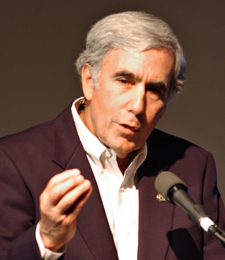
When asked by a reporter why nuclear weapons are useless, Colin Powell, former US secretary of state and four-star general said: “Because they’re such horrible weapons. And so no sane leader would ever want to cross that line to using nuclear weapons. And, if you are not going to cross that line, then these things are basically useless.” In other words, one could say, nukes are nuts.

There are innumerable global security issues that need to be addressed, some of which are poverty, terrorism, the climate crisis, pollution of the oceans, loss of biodiversity and forest depletion. Not one of these issues can be addressed with nuclear weapons. In fact, nuclear weapons draw much-needed resources away from solving these global problems. Nukes are nuts.

Nuclear weapons are justified by their possessors for nuclear deterrence, but nuclear deterrence is only a hypothesis about human behavior. Read More »

TFF nominated for the Nobel Peace Prize

TFF PressInfo, September 12, 2013

Summary

The Transnational Foundation for Peace and Future Research (TFF), founded on September 12, 1985 – today 28 years ago – is nominated for the Nobel Peace Prize 2013 and so are three TFF Associates:

Richard Falk, professor in international law at Santa Barbara and Princeton, the UN S-G’s envoy for the Occupied Territories;
David Krieger, founder (1982) and president of The Nuclear Age Foundation devoted to nuclear abolition;
Jan Oberg, co-founder and director of TFF.

Background

World renown expert on the Nobel Peace Prize, Norwegian lawyer Fredrik Heffermehl*, says:

– Nobel dedicated his prize to “the “champions of peace” (not to “peace” in general). Not that many of those we know from open sources are nominated this year are qualified, but a select few are eligible, like the American Professor Richard Falk, Norwegian Ambassador Gunnar Garbo, American David Krieger of the Nuclear Age Peace Foundation, the former Director General of UNESCO Federico Mayor, Spain, Swedish peace scientist and organizer Jan Oberg, as well as American Professor of peace education Betty Reardon.

– These clearly are the kind of “champions of peace” described in Nobel’s will, working for global disarmament based on global law.Read More »

B61 – A pork barrel bomb*

By Gunnar Westberg

There are at present about 180 B-61 nuclear bombs in Europe, in Germany, Italy, Turkey, The Netherlands and Belgium. There used to be about three times as many but under pressure from both governments and peace movements most have been returned to their owner, the United States.

We have always been told that these “Nato bombs” were of no military value. Read More »

Russia’s power is not weapons, it’s culture

By Jonathan Power

Observers say that what drives President Vladimir Putin is to make Russia respected. But perhaps Putin overestimates how much power Russia already has. He has overlooked which trumpets to blow – it is not his “hang tough” policies in international affairs, especially vis-a-vis the United States. It is Russia’s culture.

These thoughts were prompted by watching the opening of the new, quite beautiful, extension of the Mariinsky theatre in St Petersburg on Mezzo television, the French cable station for classical music. (You can see it on U-Tube.)

The Mariinsky is run by Valery Gergiev and he arranged a show (and conducted it) so rich and of such supreme achievement that it overshadowed in my memory all the great performances I’ve seen, whether in London, New York, Paris or Moscow. Each segment lasted a bare 4 minutes and it alternated between opera, ballet and two solo violinists and one pianist. It went on for two hours or more with the greatest stars of the Russian firmament, plus two or three Western performers.

Putin was in the audience, not in the official box but down in the middle of the stalls. Was he aware of the political power of an event like this? I doubt it. Nor of the power of the rest of Russia’s great inheritance.Read More »

Lessons from the U.S.-Korea nuclear crisis

By David Krieger

The high-profile nuclear crisis on the Korean Peninsula, pitting the reigning heavyweight nuclear champion, the United States, against the bantamweight nuclear contender, North Korea, is not finished and is deadly serious. The posturing and exchanges that the world has been witnessing are capable of spiraling out of control and resulting in nuclear war. Like the Cuban Missile Crisis more than half a century ago, this crisis demonstrates that nuclear dangers continue to lurk in dark shadows across the globe.

This crisis, for which the fault is shared by both sides, must be taken seriously and viewed as a warning that nuclear stability is an unrealistic goal. The elimination of nuclear weapons, an obligation set forth in the Non-Proliferation Treaty and confirmed by the International Court of Justice, must be a more urgent goal of the international community. The continued evasion of this obligation by the nuclear weapon states makes possible repeated nuclear crises, nuclear proliferation, nuclear terrorism and nuclear war.

Lessons can be drawn Read More »

On Barack Obama’s re-election

By Richard Falk

We share with your editorial (Nov. 11, 2012) the view that one of President Obama’s “singular contributions has been his vision of a world without nuclear weapons.” We would go further, and suggest that realizing this vision would ensure Mr. Obama a legacy of honor, not only for American, but for the world. Your editorial adds a caveat that nuclear disarmament “is a lofty goal that would not be achieved in his second term, or maybe for years after this.”

We dissent from this bit of conventional wisdom that almost always accompanies the affirmation of the goal, almost taking back what was so grandly proposed. In our view there has rarely been a better time to initiate a negotiated process of phased nuclear disarmament, and there is no reason that such a process should be stretched out over a long period. Read More »

There is no alternative but to negotiate with North Korea

By Jonathan Power

The diplomats and pundits were right: transition after the death of Kim Jong-il in North Korea, they said, might well produce an unstable and frightening situation. Kim Jong-un, his son, is a cut off the old block.

But they forget too easily America’s stance in the negotiations that began during the presidency of Bill Clinton. It led to major progress and the unprecedented visit to Pyongyang by his Secretary of State, Madeline Albright, which was meant to pave the way for Clinton’s own visit which was likely to lead to major changes in the relationship. (The demands of the Camp David Israel-Palestine-US negotiations in the last days of his administration meant it couldn’t be fitted in.)

After seven years of erratic US policies under President George W. Bush – met by equally erratic and bellicose North Korean ones – the Bush Administration’s negotiations ended up achieving almost the same as Clinton’s, albeit with no plan to take the final, big step, as Clinton had planned.Read More »

Crying wolf over Iran’s nuclear program

By Farhang Jahanpour

Crying wolf – the evidence

After producing his comic diagram during his speech at the United Nations General Assembly last September, drawing a red line in order to stop Iran’s alleged imminent nuclear bomb, the Israeli Prime Minister Benjamin Netanyahu called for immediate action against Iran before it was too late.

However, as the result of President Barack Obama’s insistence that he wanted to resolve the dispute by peaceful means, the war fever subsided to some extent. However, on the eve of the meeting between Iran and the P5+1 in Almaty, Kazakhstan, and the forthcoming visit of President Obama to Israel, Netanyahu has once again started to press the panic button about Iran’s nuclear intentions.

Referring to Iran’s announcement that she was installing new centrifuges for enriching uranium, and undaunted by his earlier false predictions, Netanyahu once again claimed that the new centrifuges could cut by a third the time needed to create a bomb.1)

However, when Israel’s intense campaign to start a war with Iran stalled, Israeli officials said that their original assessment about the deadline for dealing with Iran had been false. As Jacques E. C. Hymans points out in his recent article in Foreign Affairs, Israeli intelligence officials have now downgraded their assessment of Iran’s ability to build a nuclear bomb.2) Now, they say: “Iran won’t be able to build a nuclear weapon before 2015 or 2016, pushing back by several years previous assessments of Iran’s nuclear ambitions.”3)Read More »

What’s The Problem With Iran?

TFF PressInfo 1-2013

On Tuesday February 26, in Kazakhstan, a new round of negotiations are due between Iran and the Five Permanent UN Security Council members + Germany. We’d like to bring the following expert statement to your attention.

Contacts for interviews as well as analytical sources below the statement.

Summary

The problem is not nuclear weapons, essentially. It’s strategic interests such as control of oil and gas and that requires a change of Iran’s ‘obstinate’ and ‘defiant’ regime.


The present US/NATO/EU policy is based on escalating threats without an exit strategy. This increases the risk of war, whether intended or not. If that is not the deliberate purpose, an entirely new Western policy vis-a-vis Iran must be developed.

The Transnational Foundation in Sweden – an independent think tank with 27 years of experience – provides you with the diagnosis, the prognosis and the proposals for improved relations built on trust.
 (See below.)Read More »

Envisioning a world without nuclear weapons

By Richard Falk

Book Review

ZERO: THE CASE FOR NUCLEAR WEAPONS ABOLITION
By David Krieger (published in 2013 by the Nuclear Age Peace Foundation); $14.95

I have known David Krieger for the past twenty-five years, and he has never wavered, even for a day, from his lifelong journey dedicated to ridding the world of nuclear weapons and the threat of nuclear war. If I were given to categorization, I would label such an extraordinary engagement with a cause as an instance of ‘benign fanaticism.’

Unfortunately, from the perspective of the human future, it is a rather rare condition, posing the puzzle as to why Krieger should be so intensely inclined, given his seemingly untraumatized background. He traces his own obsession back to his mother’s principled refusal to install a bomb shelter in the backyard of their Los Angeles home when he was 12 years old. He comments in the Preface to ZERO that even at the time he “hadn’t expected” her to take such a stand, which he experienced as “a powerful lesson in compassion,” was especially moved by her unwillingness “to buy into saving herself at the expense of humanity.” (xiv).

Nine years later after Krieger graduated from college his mother was again an instrumental force, giving him as a graduation present a trip to Japan to witness first-hand “what two nuclear weapons had done to the cities of Hiroshima and Nagasaki.” (xiv) The rest is, as they say, ‘history.’ Or as Krieger puts it in characteristic understatement, “[t]hose visits changed my life.” (xiv)Read More »
