Danmark skal heller ikke bombe i Syrien – 6 artikler

Af Jan Øberg

Posted on 18 April, 2016 on Jan Oberg’s blog

Den 19. april 2016 havde Folketinget 2. behandling af forslaget om også at bombe og indsætte specialstyrker i Syrien.

Jeg mener at sagen er fundamentalt vigtig for Danmark, danskerne og vor fremtidige rolle og ‘image’ ude i verden.

Desuden finder jeg at beslutningsgrundlaget, mediedækningen og den offentlige debat giver anledning til den største bekymring.

At gå i krig er den vigtigste beslutning en regering kan tage og en befolkning bakke op om. Men det er som om dette at deltage i krig stort set rager både ministre, folketingsmedlemmer, journalister og befolkning en forårsblomst.

Med en vis fortvivlelse skrev jeg derfor 6 artikler med forskellige temaer og producerede en video, der også foreslår hvad vi kunne gøre i stedet.

Jeg ville have disse ting sagt og spredt inden beslutningen blev taget.

Herunder findes de én for én som jeg har skrevet dem med en lille kommentar til publiceringsprocessen, som også i et vist omfang vidner – for mig i hvert fald – om mærkelige prioriteringer hvad angår tidspunkt og længde.

Alt andet lige bliver redaktionerne ikke oversvømmet af kvalificerede, kritiske og konstruktive artikler af denne type – men det er dog kun meget korte ting, man kan få ind. Om overhovedet…

1. Dansk krigsdeltagelse i Syrien vil være landsskadelig

Politiken 16. april 2016. Problemfri publicering.

Den 19. april skal folketinget have 2. behandling af forslaget om at Danmark skal deltage i krigen over Syrien og endog have specialstyrker på landjorden.

Det vil i så fald være sjette krigsdeltagelse siden 1999 – Serbien, Afghanistan, Irak 2003-2007, Libyen, Irak igen.

Der synes desværre at være flertal for krigspolitikken uanset det faktum at samtlige krige har været fiaskoer på deres egne præmisser og ud fra et fredsskabende synspunkt.

Politikere og andre mennesker, der støtter det krigsførende Danmark gang på gang, må vel efterhånden kunne blive stillet til ansvar for deres holdning til massedrab på uskyldige. Kan det være rigtigt at dette er så uproblematisk som den ringe offentlige debat tyder på at det er så let at beordre mord på andre mennesker?

Internationale rapporter gør gældende at den vestlige verden kan have dræbt op til 4 millioner muslimer siden 1990.Read More »

How ought we treat each other?

By Johan Galtung

Upon receiving the Gandhi-King-Ikeda Community Builder Prize

Atlanta, 31 Mar 2016

Dear President, dear Dean of Morehouse College, Ladies and Gentlemen,

I am deeply honored by the prize from a college in Georgia, in the US South, that has been and is a beacon in the struggle from dominion to dignity in race relations. The civil rights movement is an American Revolution, like the feminist movement it inspired–aiming at parity and dignity for all. To refuse sharing the spoils of exploiting Reds and Blacks and poor Whites with London was far from a revolution.

This college shaped Dr Martin Luther King Jr. I had the honor of meeting him twice here in Atlanta in 1960–working on desegregation without violence in Charlottesville, VA–and in 1964 in Oslo when he received the Nobel Peace Prize. This College made him use Gandhi’s clinging to truth through nonviolent struggle, satyagraha, lifting 20 million Blacks into dignity. There is a backlash: Blacks are again shot at, and used as slave labor in prisons. The struggle continues.

Building communities. There are at least two of them, the community of people, and the community of states. I will deal with both and share with you in this speech the basic ideas of TRANSCEND mediation – an NGO of more than 500 invited members, comfortable with our mantra, “Peace by Peaceful Means”. Transcend means going beyond.

Let us approach answering the question through some words on how we ought not treat each other.

It is all in our thought habits, the deep culture of our thinking. In the West we think in simple dichotomies, like positive/negative, good/bad, even evil. Either one or the other, not in-between, neither-nor, both-and. And we very easily fall into the trap of seeing ourselves as only good, and someone else as only bad, steered by God or Satan. The road to narcissism, self-love and paranoia, seeing threats everywhere, is short. Victory! not solution.

AND Narcissism + Paranoia = Psychosis, the psychiatric diagnosis.

To escape from this thought habit use ancient Chinese habits. Yin/Yang. They also think positive/negative, good/bad; but add more levels, like the positive and negative in the positive and negative, the good and bad in the good and bad. That opens for identifying the negative in Self and the positive in Other; for positive-peaceful, not negative-violent relations. Not either-or; but both-and, neither-nor.

The TRANSCEND formula: focus on the positive, good in everybody including yourself; but keep the negative, bad in the back of the mind to improve it and as possible danger, to Self and-or Other.

Then create projects linking good with good; first as vision, then reality.Read More »

TFF PressInfo # 369 – A Sunni-Salafist-Zionist Coalition Changing Middle East?

By Jan Oberg

Please try Google “Gulf states want nuclear weapons against Iran – Israel “ and only one Western mainstream media will appear, an excellent article by The Telegraph’s Raf Sanchez in Jerusalem.

The only other media carrying the story is Russia Today and Vigilant Citizen and MintPress News also carries the story and offers a wider background

What is this about?A new coalition?

So the usual Western media filter, meaning it must be interesting. And it is a quite sensational story: Saudi Arabia and Israel are up to a nuclear mischief against a country that has just been prevented from acquiring nuclear weapons by means of a huge legally binding document, UN Security Council endorsement and extremely tight monitoring mechanism. What’s it about?

It’s about Israel’s defence minister Moshe Ya’alon saying in public at the recent Munich conference that Arab states are “not willing to sit quietly with Iran on the brink of a nuclear bomb”.

He thinks that Iran was liable to break the agreement as their economic situation improves with the lifting of international sanctions. Ya’alon is quoted as saying that “I speak about the Gulf states and North African states too…For them, Iran and the Muslim Brotherhood are the enemy. Iran is the bad guy for us and for the Sunni regimes. They are not shaking hands [with Israelis] in public, but we meet in closed rooms.”

So not only Jordan’s monarchy and Egypt’s dictatorship but also Gulf and North African states: A coalition lead by Saudi Arabia and Israel – Israel as the only nuclear weapons power in the region and Saudi Arabia as the most likely next nuclear weapons state.

For much too long the world’s attention has been on Iran’s imagined nuclear weapons, not on the dozens or hundreds real nukes that Israel possesses as a non-member of which is the Non-Proliferation Treaty (NPT).

One can say that Israel and Saudi Arabia lost the political battle against the nuclear deal with Iran concluded with the five permanent UNSC members and Germany last year – and now will do their utmost to use Iran’s non-nuclear weapons status as a pretext for others going nuclear against, predominantly, Iran.

Propaganda hysteria dominates in an age where knowledge plays a diminishing role

The problem for them, however, is that Iran will be difficult to sell as a real threat – but we live of course in Read More »

TFF PressInfo # 366: Russian Withdrawal from Syria: Could it be the beginning of the end?

By Farhang Jahanpour

On Monday 14 March, in a surprise move and without any warning to Western leaders, President Vladimir Putin ordered the withdrawal of the “main part” of Russian forces from Syria, and instructed his diplomats to speed up the push for peace. “The effective work of our military created the conditions for the start of the peace process,” he said. “I believe that the task put before the defense ministry and Russian armed forces has, on the whole, been fulfilled.”

He added that with the participation of the Russian military, Syrian armed forces “have been able to achieve a fundamental turnaround in the fight against international terrorism.”

According to Western reports, Russian forces are already being prepared for flights back to Russia and equipment is being loaded onto cargo planes.

Although President Putin’s sudden announcement has given rise to a great deal of surprise and some false assumptions in the mainstream Western media and among political pundits, his decision is a timely, bold and constructive move that may result in some positive developments in the long-running catastrophe in Syria.

One of the reasons for the negative and cynical comments about the Russian move is that in five months President Putin has achieved more in halting the advance of the terrorists in Syria than the West had achieved in five years, if indeed it had been the West’s real intention to defeat the terrorists.

The Syrian uprising started with demonstrations on 28 January 2011 in Damascus and Aleppo in the wake of the “Arab Spring” in Tunisia and Egypt.Read More »

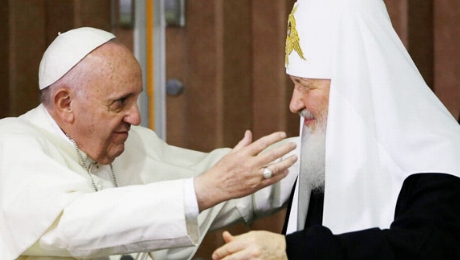
A pope, a patriarch, a spiritual revolution

By Johan Galtung

The first editorial here at Transcend of March 3 2008, “50 Years of Fidel Castro” celebrated a political revolution that changed the world, and spelt the end of US-Western imperialism. This editorial celebrates a spiritual revolution that may also change the world, spelling the end of Western materialism, and spread from there.

We are talking about processes, not events, and of structures and cultures more than of actors.

Again, Cuba played a major role, as meeting place between two major parts of Christianity, Catholic and Orthodox. In the Great Schism of 1054 they had excommunicated each other; and the Roman empire had split Catholic/Orthodox in 395. Fidel’s Catholic brother and successor Raúl was a condition for this historic meeting for peace; so was the meeting between Putin–an Orthodox Christian–and Francis in June 2015. However, not many pairs of brothers rival the two Castros in shaping history.

They met, Pope Francis of the Catholic Church and Patriarch Kirill of Moscow and all Russia – after earlier meetings between popes and the patriarch of Constantinople – with a Joint Declaration on 12 Feb 2016 in 30 articles. There were 17 quotes from the Bible; showing that they are “brothers in the Christian faith”, “pained by the loss of unity”, “divided by wounds caused by old and recent conflicts”. Not from the Bible are the many references to “the Most Holy Mother of God, Virgin Mary, and the saints we venerate”. Problematic for Protestants.

The bulk of the Joint Declaration is about the fate of Christians in the Middle East, meaning mainly Orthodox; like “the Metropolitans of Aleppo, Paul and John Ibrahim, who were taken in April 2013, to make every effort to ensure their prompt liberation”. However, together they “invite our Churches in Ukraine to work towards social harmony”.

They also jointly argue strongly against abortion and euthanasia, and in favor of “respect for the dignity of the individual called into being according to the Creator’s plan”. Do not destroy God’s creation.Read More »

TFF PressInfo # 363: Can we give meaning to the destruction of Syria?

By Jan Oberg

Five years ago

In 2011 when it all began, an educated conflict analyst or otherwise conflict competent person would have said about the conflict in Syria that it was a very complex thing, caused by history, environment, traumas, external factors, the economic situation, etc. And that al-Assad and his government was certainly an important reason but far from the only one.

The conflict expert would have warned against at last four ways of thinking:

a) any interpretation that put all the good people on one side and all the bad people on the other – because there are no conflicts in the world with only two such parties;

b) any idea that the conflict could be solved by siding with the presumed good ones and going against the bad one(s);

c) every attempt to ‘weaponise’ the conflict and increase the level of violence, the duration of the conflict and the human suffering;

d) any and every idea that foreigners would know better than the Syrians themselves – government, opposition and citizens in civil society – what should be a solution.


Finally – the professional conflict and peace worker would have maintained that you can’t make peace by asking one person – not even brilliant ones like Kofi Annan or Staffan di Mistura – with a small team around him and some shuttle diplomacy to succeed with facilitation, consultations, brainstorming, proposal-making, mediation and, finally, some kind of negotiations leading to a peace agreement in what is undoubtedly one of the most complex and ‘hard’ conflicts on earth.

Peace-making requires a completely different approach to not just be a pawn in the wider war game – a game that according to Al-Jazeera today encompasses some 900 military groups – add to that government forces and all the political and civil groups that don’t carry weapons: 1500?

Five years later – at least 250.000 dead people, 3 million refugees and 6,5 million internally displaced people, cities, economy, cultural heritage destroyed – anyone can see that no one listened to such simple conflict rules of thumb.

Conflict and peace illiteracy

The self-appointed and completely un-educated, peace-makers of the international community – presidents, prime and foreign ministers of the US, NATO, Russia, etc. – did about everything else.

It seems to not even occur to them or to the media that Read More »

TFF PressInfo # 361: The real news about Nobel’s Peace Prize is here, and it isn’t Trump

By Jan Oberg

Lund, Sweden, February 11, 2016

Thanks to tabloidization – a concept rapidly integrated into even quality mainstream media – you’ve probably heard that Donald Trump has been nominated for the Nobel Peace Prize 2016.

Well, that prize has been thrown out to so many who didn’t qualify according Alfred Nobel’s will – not even with a very liberal interpretation.

But there are two things you may not have seen which have very far-reaching implications and are much more news worthy.

Court case against the Nobel Foundation

One is that three individuals and an NGO filed a brief to open a court case against the Nobel Foundation – and thus implicitly the Nobel Committee in Oslo – to the Stockholm District Court in December 2015 – all about it here.

It’s never happened before and is the result of 8 years of intensive research and public information that you can read about at the Nobel Peace Prize Watch – NPPW.

Its focal case is the prize awarded to the EU about which Desmond Tutu and others have stated that the EU was “obviously not one of champions of peace that Nobel had in mind.”

Open list of nominees for 2016 who do qualify

The other one is that a list has been published of 25 qualified nomineesRead More »

On NATO S-G Stoltenberg’s wish for dialogue and NATO’s 2015 report

By Jan Oberg

February 9, 2016

Commenting on NATO S-G Jens Stoltenberg’s wish for dialogue with Russia – a bit odd after all the other provocative initiatives he has spearheaded the last good year or so.

I felt like saying something more general about this outdated paradigm – and why it is dangerous for us all – referring also to the Russell-Einstein Manifesto of 1955.

You may also see it as my statement countering the NATO Annual 2015 Report which lacks every intellectualism, theoretical/conceptual clarity, empathy, peace thinking and – naively – equates military build-up with ‘security’.

Around the world: Problems and remedies

By Johan Galtung

Let us have a look, and see what can be done.

[1] Economies. NYSE is falling; China is consuming, with problems; the West blames China, not itself, for all. The truth is over-reliance on one commodity, oil-gas, hitting vulnerable economies doubly. Steep fall in price: $120-130 to $30-20, close to 1973 from $1 to $10. Steep fall in demand for that globally toxic product; a sign of rationality (but, the other globally toxic product, derivatives for speculation?) The currencies of oil-producers tumble. stocks fall; in Norway to the tune of half the state budget in three weeks (Finansavisen 21Jan 2016).

And over-reliance on trade with vulnerable economies.

Remedies: To become less vulnerable, through [1] more self-reliance nationally and locally, indeed for basic needs like food, [2] fully-fledged economies with primary-secondary-tertiary-quaternary (care for people and nature) sectors. Simple, sustainable rules.

Beyond that: import-export, but with a wide range of countries.

[2] Inequality: The Master, Atkinson’s, analysis of the catastrophic consequences, both high up and low down, is the best. Spiritual aspect is hopelessness, apathy with no project low down; high up ego-centrism devoid of solidarity as project. Sick societies. In 2010 388 persons owned as much as half of humanity, in 2014 80, end 2015 62 (Oxfam).

Remedies: Lift the bottom up, FDR New Deal, welfare states, the Chinese way. Publish the ratio CEO:workers earnings; make above 10:1 illegal, punish, boycott. More cooperatives with CEO-workers rotation.

[3] The third industrial revolution: robotization. Frankenstein’s monster is coming. Another consequence will be massive unemployment.

Remedies: Humans, sapiens-faber-ludens, are creative, productive and playful. We are all three. But we may need life-long guaranteed income for all, covering all basic needs. Humans will reconquer the production, wrestle it from unnecessary-unwanted robots, and enjoy life.

[4] Davos. There they are, those who brought us these problems. Read More »

TFF PressInfo 355: The deeper reason Syria negotiations are doomed

By Jan Oberg

Negotiations were supposed to start in Geneva today, January 25. The media is full of analyses of why it won’t happen and how virtually everybody disagrees with everybody else about who should be there and who should not. That’s all surface, however.

Objectively speaking is it of course hugely difficult. No one would envy chief UN envoy, Italian-Swedish diplomat Staffan de Mistura. That said, a totally different perspective may be helpful:

It has to do with a simple distinction that few still in the international community are able to make – that between the conflict and the violence in the conflict zone. Almost all conflicts can be mitigated or solved – but the more violence infused into the conflict (and the longer it lasts), the more difficult it will be to find a solution – because on top of the original conflict you build anger, sorrow, wish for revenge, traumas and justifications for counter-violence.

It’s a simple as that.

Everybody confuses the two – the underlying conflict that should have been addressed from Day One and the violent means that should not have been delivered from outside in the shape of arms, ammunition and bombings.

However, the world’s decision-makers continue – seemingly unable to learn – to put weapons before peace.

The Syrian conflict had to do with peaceful demonstrations, an authoritarian human rights violating national leadership, an environmental crisis that had made people migrate into cities; it had to do with an immensely complex history, society with many groups and fractions – and with the interests of neighbouring countries. And it came in the wake of failed wars and weaponization/wars of Afghanistan, Iraq and Libya.

And all conflicts have to do with grievances, incomptaible goals and wishes, fears, trauma, economic and other structures as shaped through history – and they have to do with the West’s historical influence – most violent and detrimental – in the region.

All of it is left aside. The focus is on nine other amateurish, superficial matters – see below.

So, yes, turmoil all over the place – but also something somebody somewhere should have learned something from. They did not. They put the outdated military “security and stability” before peace – and lost it all.

The Western world – read US/NATO, Russia joining later – un/anti-intellectually brought it all on the old hopelessly false and counterproductive formula’s 9 elements: Read More »