TFF PressInfo # 354: Open Letter – Political responsibility in the Nuclear Age

By Richard Falk, David Krieger and Robert Laney

Prefatory Note
What follows here is An Open Letter to the American People: Political Responsibility in the Nuclear Age. It was jointly written by Richard Falk in collaboration with David Krieger and Robert Laney. The three of us have been long connected with the Nuclear Age Peace Foundation, NAPF.

The NAPF focuses its effort on the menace posed by nuclear weaponry and the urgency of seeking nuclear disarmament. The nuclear agreement with Iran and the North Korean nuclear test explosion are reminders of the gravity of the issue, and should serve as warnings against the persistence of complacency, which seems to be the prevailing political mood judging from the policy debates that have taken place during the early stages of the 2016 presidential campaign.

This complacency is encouraged by the media that seems to have forgotten about nuclear dangers since the end of the Cold War, except for those concerned with proliferation of the weaponry to countries hostile to the United States and the West (Iran, North Korea).

Our letter proceeds on the assumption that the core of the problem is associated with the possession, development, and deployment of the weaponry, that is, with the nine nuclear weapons states. The essence of a solution is to eliminate existing nuclear weapons arsenals through a phased, verified process of nuclear disarmament as legally mandated by Article VI of the Non-Proliferation Treaty (1968).

We would be grateful if you could help us reach the widest possible audience through reposting and dissemination via social media networks.*

• •

Dear fellow citizens:

By their purported test of a hydrogen bomb early in 2016, North Korea reminded the world that nuclear dangers are not an abstraction, but a continuing menace that the governments and peoples of the world ignore at their peril. Even if the test were not of a hydrogen bomb but of a smaller atomic weapon, as many experts suggest, we are still reminded that we live in the Nuclear Age, an age in which accident, miscalculation, insanity or intention could lead to devastating nuclear catastrophe.

What is most notable about the Nuclear Age is that we humans, by our scientific and technological ingenuity, have created the means of our own demise. The world currently is confronted by many threats to human wellbeing, and even civilizational survival, but we focus here on the particular grave dangers posed by nuclear weapons and nuclear war.

Even a relatively small nuclear exchange between India and Pakistan, with each country using 50 Hiroshima-size nuclear weapons on the other side’s cities, could result in a nuclear famine killing some two billion of the most vulnerable people on the planet. A nuclear war between the U.S. and Russia could destroy civilization in a single afternoon and send temperatures on Earth plummeting into a new ice age.

Such a war could destroy most complex life on the planet. Despite the gravity of such threats, they are being ignored, which is morally reprehensible and politically irresponsible.

We in the United States are in the midst of hotly contested campaigns to determine the candidates of both major political parties in the 2016 presidential faceoff, and yet none of the frontrunners for the nominations have even voiced concern about the nuclear war dangers we face. This is an appalling oversight. It reflects the underlying situation of denial and complacency that disconnects the American people as a whole from the risks of use of nuclear weapons in the years ahead.

This menacing disconnect is reinforced by the media, Read More »

Improving democracy

By Johan Galtung

Democracy is rule–decision-making–by the consent of the people, the demos. There is a very good argument: the people will suffer the consequences. Hence rule of, by, and for the people.

But the problem is: which level dominates the decision-making?

Level [4] national (government-parliament-courts); [3] regional (provinces-departments), [2] local (LAs, municipalities), level [1] individuals?

In theory [1] is primary, basic, sovereign; in practice level [4]. Through elected representatives, packaged in electoral districts; representing individual preferences, packaged in party programs.

Comment, from Germany: “The sovereignty comes from the people – and never comes back” (“vom Volke raus, und kommt niemals zurück“).

The representatives kindly open a window every 4 years or so, 8-12 hours, 1-2 days, for the people to confirm or disconfirm the government. so the degree of democracy looks like 1-2 days out 4 x 365 = 1460 (+1): around 1 per mille.Read More »

The West should get out of the Middle East

By Jonathan Power

The year’s first major atrocity – Saudi Arabia’s execution by beheading on Sunday of 47 people, including an important Shia ayotallah who led Shia protests against discrimination by the Sunni majority but never committed an act of violence.

Even the Islamic State doesn’t behead 47 in one day. Although beheading is swift it strikes most of us as being grotesque as well as medieval. The Saudis are aware of their image in the outside world but nevertheless persist, as if they want to tell the rest of the world: “Back off. Our Wahhabi (ultra puritanical) morality is our morality. We are a belief system unto ourselves.”

They exported the political convictions that have evolved out of Wahhabism to Afghanistan (with money for guns along with the theology), first to fight the Russians, then to arm the Taliban and later to allow them to “ignore” that the Taliban was giving refuge to Al-Qaeda.

Over the last three years rich Saudis, for lack of policing, have been allowed, in effect, to fund IS.

Saudi Arabia not only has a political and judicial system capable of repulsive acts it is also got a foreign policy that the West should have no part of. Along with Israel itRead More »

Twenty pious wishes for 2016: Mind the minds

By Johan Galtung

According to UNESCO, wars start in the minds of men. Well, something–like unsolved conflicts and unconciled traumas–passes minds on the way to war. But UNESCO got the unintended focus on male humans right.

Minds matter, above all pre-programmed minds. This New Year 2016 editorial minds minds and mind-sets, the set minds. For peace culture.

1. A case: New York Times editorial 30 Dec 2015, “The Importance of Retaking Ramadi”. Being the capital of a governorate–IS uses them as building blocks–this was a major military victory. However, the mind-set of the writer confuses retaking space with retaking minds. Sunni Arab minds. “Liberated” by a Shia army and infidel US bombs? They might even be against both. The military come and go. Minds often stay.

2. Can we map minds? Well, to standard world maps with 200 states at least add maps of 2000 nations, showing those who would like to be more together, like in federations and confederations, and less, more apart, like in states. Nations are more cultural. Closer to “mind”.

3. The military have maps of hardware capability; “hammers in search of nails”. An example of intention: Pentagon had in the early 1960s “Project Camelot” to map with public opinion data revolutionary ideas. At least add maps of capacity for doing good to others, not only harm.Read More »

Despair and hope for 2016

Richard Falk

W.H. Auden wrote these suggestive lines in the poem ‘Lament for a Lawgiver’ that can be found in his Age of Anxiety:

‘The gods are wringing their great worn hands

for their watchman is away, their world engine

Creaking and cracking…’

If we pause to look about the world, we will observe many signs of creaking and cracking.

Among the most alarming forms of creaking and cracking is the appalling failure of political leadership. Where are the Roosevelts, DeGaulles, Chou En-Lais, Sukarnos, Titos, and Nehrus? Is the dumbing down of political leadership a consequence of the reordering of the world economy in ways that constrain and corrupt the role of governments?

Or has the technology of control, surveillance, and destruction become so overwhelming as to make the moral and political imagination seem irrelevant, giving exclusive historical agency to those who propose doing nothing while the fires ravaging the earth burn out of control?

Or even propose pouring more and more oil on the fires? In this respect, should we not regard the ‘climate denier’ as the true hero of our time, he that worships that which destroys, and so distresses the wearying gods.

Or should we blame the structures that have evolved to constitute modernity, especially the fragmenting impact of the sovereignty of states as reinforced by the passions of tribalizing nationalisms?

This optic of the national tribalized self that controls our visionary capabilityRead More »

China versus Russia versus USA: Xi versus Putin versus Obama

By Johan Galtung

From very high up three major countries-states stand out clearly: China, the most populous; Russia, the largest; USA, the most military. With three leaders, Xi, Putin, Obama, with much power on their hands.

And here is the key hypothesis, presumably more right than wrong: China-Xi: positive peace; Russia-Putin: negative peace; USA-Obama: war.

We have in mind China – also a region – building relations for reasonably mutual and equal benefit with China all over the world, spinning Asia-Europe-Africa together in a road-rail-ship-air Silk network available to all (with major mistakes in the South China Sea).

We have in mind Russia – itself also a region – calling to Russia leaders in violent conflict from all over the world, seeking cease-fires and accommodation (making itself a major mistake in Syria).

And we have in mind USA – more than a state, less than a region – since WWII ended killing more than 20 million people in 37 countries:

Afghanistan, Angola, Argentina, Bangladesh, Bolivia, Brazil, Cambodia, Chad, Chile, China, Colombia, Cuba, Democratic Republic of Congo, Dominican Republic, East Timor, El Salvador, Grenada, Guatemala, Haiti, Honduras, Hungary, Indonesia, Iran, Iraq, Israel-Palestine, Korea North-South, Laos, Nepal, Nicaragua, Pakistan, Panama, Paraguay, Sudan, Vietnam, Yugoslavia Not included: daily USA mass shootings.

And weaving the world together with the incredible internet (making a major mistake, using it for spying, betraying us all).Read More »

The clouds are dark and getting darker

By Johan Galtung

The process has now gone full circle, from Sykes-Picot Agreement negotiated from 1915 to 16 May 1916, about control of the Ottoman Empire, when beaten, to England now joining France in bombing Syria. “Violence In and By Paris” two weeks ago was wrong about England wanting to stay out: the House of Commons on 02 Dec 2015 voted 397 to 223 for bombing; 56 Labor MPs for, only 7 Conservative MPs against.

Russia played a minor role in Sykes-Picot as now also in bombing maybe mainly the opposition to Assad.

As Robert Savio points out, “They all fight to the last Syrian.”

The likelihood of an atrocious Paris 13 November type violence in London went up many points. And Russia had a civilian plane bombed.

The USA is as addicted to bombing as a hammer to a nail, not only to use allies and train locals. James A. Lucas, “The United States has killed more than 20 million people in 37 nations since WWII”, in 1945 (jlucas511@woh.rr.com) seems not to be enough; they just go on and on. More than a million Muslims killed in West Asia mainly by the USA since 1991. In San Bernardino, somebody may have killed 14 in revenge.

The new name for what they fight, after jihadism, is the Islamic State, calling it sometimes IS, ISIS, ISIL. What is it, this Daesh?

There seem to be heavy elements of Saddam’s army, the Baath secular party (also Assad’s), and the Tikrit clan from the recent past–now adding maybe ten fighters for each killed by the West. Daesh seems toRead More »

Responding to Megaterrorism after Paris

By Richard Falk

Prefatory Note
The article below is based on an opinion piece published by Middle East Eye on December 1, 2015 under the title “A Different Response to ISIS after Paris.” My modified text places its focus on the originality of megaterrorism and its distinctive challenges, suggesting that the choice of response needs to be extended beyond the iron cage of militarism and vengeance. Also, it is essential for analysts and leaders to envision the response to the response as well as being preoccupied with how best to hit back. Increasingly, American politicians treat the challenge as if playing poker whereas the realities of the situation call for a chess players’ natural disposition to think ahead as many moves as possible. Finally, given the religious and civilizational dimensions of current versions of megaterrorism, it is vital to guard against various manifestations of Islamophobia.

What separates megaterrorism from other more customary forms of terrorism is the theme of this post. It is not possible to give a precise definition of megaterrorism by pointing to a threshold of casualties or the magnitude of response. Each megaterrorist event is decisively shaped by its distinctive sociopolitical and psychological context.

The focus here is to take account of this radical new category of threat posed in a variety of settings, critique the ‘war’ reflex and the war/crime binary, briefly consider alternate paths of response, and recommend risk and cost assessments that take into account adversary responses to the prescribed response. The 21st century experience with responding to megaterrorist events does not create confidence in either most conceptualizations of the challenges being posed or the responsive strategies chosen to be implemented.

The horrific Paris attacks of November 13th challenge the West more deeply in some ways than did the 9/11 attacks 14 years ago. Read More »

TFF PressInfo # 351: The Nobel Foundation taken to court on the Peace Prize

Lund, December 10, 2015

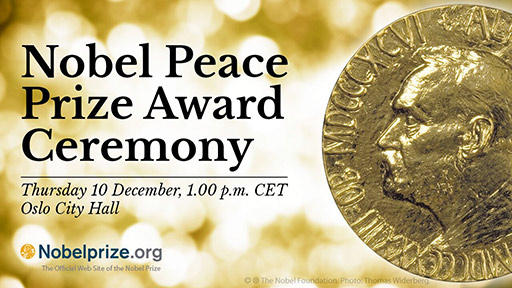
On the day of the Nobel Peace Prize Award Ceremony at Oslo City Hall

To whom it may concern, including the media

We know – and Alfred Nobel knew – how devastating war and arms races are, and how little security we get for all the money we spend on military forces.

The campaign to reclaim the Nobel Peace Prize is first and foremost a campaign to revive the idea that global peace requires global cooperation on disarmament and replacing the law of force with the force of law. Every day more and more of us see, from the Middle East warfare, from the refugee crisis, and many other chilling reminders, the mandatory urgency of a change in world politics.

Alfred Nobel decided to give one fifth of his fortune for a prize to promote disarmament and resolution of all conflicts through negotiations and legal means, never through violence.

Can such a prize, with a so clearly stated goal, be turned to serve the opposite idea and be given again and again to recipients who promote arms races and believe in militarism and war?

This question will soon be answered, after Mairead Maguire, Jan Oberg, Davis Swanson, and Lay Down Your Arms took the case to the Stockholm District Court on Friday 4th of December 2015. Here is the full text of the summons.
and all other relevant information is available at the Nobel Peace Prize Watch.

Test case: the award to the European Union in 2012

The court case will test one of the most obvious violations of the Nobel idea Read More »

Peace journalism – is it working?

By Johan Galtung

Short answer: No. The Paris event triggered war journalism; no peace journalism was observed. To doubt that anti-IS violence will work is not peace journalism, only war journalism with question marks.

Peace journalism was conceived in the 1960s as a reaction to foreign news negativism, and focus on actors and elite people/countries. Not as advocacy of peace, but as journalism about peace; like war journalism is not advocacy of war, but indispensable journalism about war, reporting what happens, and who is winning. It can be done well or not, and often becomes propaganda for one side, in national more than local and global media (with Anglo-American accent, however).

Thus, peace journalism was never a substitute for war journalism. The idea was to have both, complementing each other. Read More »