TFF PressInfo: Cold War warnings 1998 – 2014

By Jan Oberg

Jan Oberg

Lund, Sweden August 11, 2014

Quality research leads to better predictions

One criteria of quality research is that it predicts the future better than incompetent research.

Because TFF is independent of governments and coroporations it doesn’t have to take political considerations or exclude certain theories, concepts or values. This free research enabled it over the years to make fairly precise predictions about for instance former Yugoslavia, the Iraq war and East-West relations.

In 1998 – 16 years ago – we warned that NATO’s expansion would lead to future problems with Russia. Read it here.

NATO should never have been expanded

We backed this prediction up with 46 arguments and argued that so many other things would be wiser than containing Russia from the Baltic republics to Georgia – a strategy pursued by Bill Clinton in contravention of all promises given to the Soviet Union/Russia at the end of the Cold War about ten years earlier.

That counterproductive and insensitive expansion has now hit Ukraine. A new Cold War is gathering over Europe. It should have been predicted by advisers, intelligence agencies, big research institutes and columnists.

But it wasn’t.
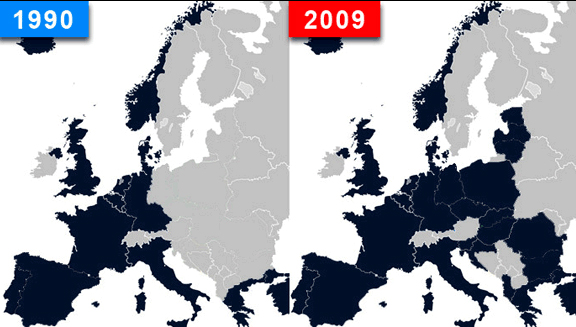
At the end of the Cold War, NATO/the West got everything it could ever wish – and without war. But it wanted more: keeping Russia down, making NATO bigger and “peace-making” as well as finding new enemies to keeping its Military-Industrial-Media-Academic Complex (MIMAC) alive and well: Saddam, Milosevic, the Muslim world, terrorism and – now re-cycling – Russia.Read More »

TFF PressInfo: Nuclear abolition now !

By TFF’s Board

Lund, Sweden August 6, 2014 – Hiroshima Day

The Nuclear Age – risk of omnicide and our new responsibilities

Nuclear weapons came into the world and were used for the first time in 1945. Their specific feature as weapons of mass destruction and “omnicide” – able to kill us all – has changed what it means to be alive on this earth and to be responsible for its existence.

Until nuclear weapons, human beings could not decide whether or not to end project humankind and project planet earth.

Today we know that the arsenals and missile projection methods are such that a few decision-makers, or a technical malfunction, could blow up enough of the world to make the living – if any – envy the dead.

We live in the Nuclear Age. It means living with the permanent daily threat of extinction.Read More »

TFF PressInfo: It’s doable: Peace Israel-Palestine (1)

By Jan Oberg, TFF director

Jan Oberg

Lund, Sweden July 25, 2014

Violence is a dead end

Look at the violence in Gaza today, DR Congo (6 million dead), Iraq, Libya, Afghanistan, Somalia etc: Isn’t it obvious that the world needs a completely new approach to conflicts?

We’ll never rid the world of conflicts, conflicts is part of human and social life. Conflict-prevention is a meaningless term.

But we can rid the world of most of its violence. If we want, if we educate each other and if economic and other interests stopped supporting killing as a tool in conflict-management.

Unrealistic? Hopelessly idealistic? Well, look at the places above and try to find the realism and hope there.

Look at the conflict not at the parties and the violence

It requires almost no intellectual effort to take sides in a conflict between A and B. If both parties use violence, that means endorsement of the violence – the justification both need: “They threaten and kill us, therefore we threaten and kill them.”

Those who support a conflict party who use violence also support violence. As long as violence continues, there will be no process towards peace – only more hate, traumas, suffering, wish for revenge and destruction.

Violence – not the conflict – becomes the main thing and tit-for-tat the rule of the game, with an increase in the violence for each round. Scorpions in a bottle, feeding each other.

Both those who are outside a conflict and debate it – for instance, 99% of the media debates – and the conflicting parties on the ground feed on violence. If A did not use violence against B, how would B justify its own killings?

Gaza today – both parties lose

This is where we are in Gaza today when reports tell that around 800 civilians have been killed without any positive effect, both losing.

It’s not about evil, it’s about desperation coupled with traumas coupled with a lack of insight and education.

This wrong-headed attitude is indicative of conflict and peace illiteracy: among the parties, our media and our decision-makers. Innocent people on both or all sides normally pay the price for it.

The world needs a completely different approach. It’s embedded in the UN Charter and called peace by peaceful means.Read More »

Structural violence re-explored

By Johan Galtung

Johan Galtung

The essay “Galtung’s Structural Violence and the Sierra Leone Civil War c. 1985-1992” by Philip Leech [TMS-Analysis 14 Jul 2014],–of all the commentators the deepest–is a very welcome opportunity to clarify and develop further some of the underlying thinking. By and large his comments, based on Peace by Peaceful Means (PBPM, SAGE, 1996); the concepts have been developed further in A Theory of Peace) are very positive. I focus on the questioning and critical, and not on Sierra Leone, having no direct mediation experience. Leech is familiar with the conflict.

Leech says repeatedly something that meets with my full agreement: “No theoretical concept can tell the whole story”. Indeed, how could a string of words match the ever evolving complexity of reality? A sharp edge–by a Marx (means vs modes) or a Toynbee (challenge vs response)–may reveal some deep aspects but never “the whole story” which, in addition, is revised all the time–with new sharp edges.

In my efforts toward nothing less than a new culture to come to grips–diagnosis, prognosis, therapy–with conflict, violence and peace, structural violence is only one component. Read More »

TFF PressInfo: Use Malaysia’s MH17 to make peace instead

By Jan Oberg, TFF director

Jan Oberg

Tragic misuse of a tragedy

The government of Ukraine as well as the separatists, NATO/U.S. and very many leading Western mainstream media seem all to know who has caused the tragedy. Putin believes it was caused indirectly by the West.

Given the fact that very few, if any, people or institutions can know who did it with enough details, data and precision to accuse anyone, the MH17 tragedy has been misused to an extent that can itself only be termed tragic.

The misuse is tragic because it is a catastrophe for close to 300 people, their relatives and friends. Silence – of both verbal and military weapons – and empathy would have been appropriate.

Anyone pointing fingers and calling it a terrorist act at this point is irresponsibly or should present convincing evidence.

Secondly, the blame game makes the necessary road to peace and security even more difficult.

An All Party Peace Process should come out of MH17 and the civil war

It would have been so much more civilised to use the MH 17 tragedy to say:Read More »

Aage Bertelsen (1901 – 1980) – Danish educator for peace

By Jan Oberg & Johan Galtung*

Lund and Kuala Lumpur, July 2014

Introduction

He was a tall man and a great man, a visionary, pacifist, civil resister, educator and philosopher. He took life more seriously than most and he could be playful and fun like a child. His life’s guiding principle was ”Engage in your time!” and while he wrote and talked a lot he also did it. His name was Aage Bertelsen, he was born in Denmark in 1901 and died on August 15, 1980.

Bertelsen’s imprint on history is two-fold. First, with his wife Gerda he was a prime mover of one of the groups, the Lyngby Group, which organised the rescue of altogether 7.220 Danish Jews into safety in Sweden in October 1943 during the German occupation of Denmark – more here. The Lyngby Group – Lyngby is north of Copenhagen – got about 1.000 of these in safety by organising their nightly transport onboard small fisher boats over the Sound between Denmark and Sweden.

In this he deserves a place in international contemporary history for its humanity, civil courage and as an example of non-violent struggle against occupation.

Secondly, Bertelsen was an educator of and for peace. His life work educational efforts included his family and friends, his pupils over 22 years at the Aarhus Cathedral School in Aarhus, Denmark, the general public as well as national and international leaders.

He lived in pre-Internet times and very little is publicly available today about this renaissance man. From two rather different, but compatible, perspectives we’ve taken it upon us to remind the world about him – friends and colleagues of his as we happen to be.

Headmaster Aage Bertelsen in 1961 Photo: Elfeldt, Copenhagen


Why now, over 30 years after his death? Read More »

Harsh incivility in defence of Israel

By Richard Falk

Blog despair

Richard Falk’s blog “Global Justice in the 21st Century”

Once again I feel deeply frustrated by the lack of civility in the flow of comments on this website, especially relating to Israel-Palestine, and the broader relations between Islam and Judaism. And again I feel that those who seem to have chosen as a vocation the validation of Israeli behavior however far it strays from international law and minimal ethical standards are determined to personalize the debate via the submission of defamatory and demonizing comments.

There are also disingenuous attempts to engage me in senseless discussion where a cascade of questions will follow upon whatever responses I try to provide to the initial inquiry. I have been down that weary road before, and don’t intend to be so foolish as to attempt once more to explain what is self-evident to those committed to unconditionally justifying whatever Israel chooses to do or to claim.

My interest is in dialogue, not argument or polemics. And I must say Read More »

Seven Roads to Happiness

By Johan Galtung

… Would be the title in English of a book this author just published in Norwegian, Syv veier til lykke (Oslo: Kolofon 2014); with excellent photos by Aase Marie Faldalen. And, very befitting for a book with that title: the book quickly made it to the Top 10 on a best-seller list, of course as No. 7. There will be translations but have a peek here and now.

Why does a peace researcher, concerned with peace theory and practice, write a “how-to” book about happiness, well-being? Read More »

Five Palestinian futures

By Richard Falk

For years, perhaps going back as far as the Madrid Peace Conference of 1991, influential international debate on the future of Palestine has almost exclusively considered variations on the theme of a two-state solution. The American Secretary of State, John Kerry, stampeded the Palestinian Authority and Israel into negotiations that ‘failed’ even before they started a year ago. At least Kerry was prudent enough to warn both sides that this was their do or die moment for resolving the conflict.

It was presumed without dissent in high places anywhere that this two-state outcome was the one and only solution that could bring peace. Besides the parties themselves, the EU, the Arab League, the UN all wagered that a resolution of the conflict required the establishment of a Palestinian state. Even Benjamin Netanyahu became a reluctant subscriber to this mantra in his 2009 speech at Bar-Ilan University, although always in a halfhearted spirit.Read More »

The world right now: A Mid-Year Report

By Johan Galtung

Time to take stock. The shot in Sarajevo 100 years ago inspires narratives of 19-year old Gavrilo Princip killing the successor to the throne of an empire and his pregnant wife as the event unleashing mutual mass murder (INYT, FAZ 28-29 June 2014). Not the empire annexing Bosnia-Herzegovina on October 6, 1908 (Art. 25 of the 1878 Berlin Congress of “great powers”).

Maybe the inhabitants did not like it?

Moral of that stock-taking: watch out for terrorism, not for empires and occupation-colonialism; and protect leaders, not people.

ISIS (Islamic State of Iraq and the Levant, alternatively translated as Islamic State of Iraq and Syria and Islamic State of Iraq and al-Sham) comes up. TIME 30 June: The End of Iraq. Maybe Iraq – that highly artificial English colonial entity encasing Shia Arabs, Sunni Arabs and Sunni Kurds–never started?

Like its French colonial neighbor Syria – adding Alawite Arabs, Christians, Jews and others? Ever heard about Sykes-Picot and their czarist Russian allies?

Can such crimes just pass, with no counter-forces?

Watch out, a key point about ISIS – now comprising a major part of IS – is as a bridge over the English-French colonial divide, in favor of a Sunni Arab caliphate. Like it or not, these are very strong forces from the past in the daylight of the present. Read More »