Den nye verden

Af Jan Øberg

Den nuværende periode i menneskehedens historie vil blive svær at forklare for fremtidens historikere – hvis der da findes nogle.

Hvordan kunne det gå så skridt så hurtigt og på alle fronter for dén Vestverden, der efter 2. verdenskrig stod med alle kortene på hånden? Hvordan kunne det amerikanske imperium, der byggede på frihed og demokrati, overhovedet styrte sammen dér tilbage i 2026?


Den vestlige NATO-baserede verden kunne ånde lettet op da Sovjetunionen og Warszawapagten var blevet opløst i 1989. Den havde vundet ideologisk – ingen ville siden have sovjetkommunisme – og økonomisk – Rusland producerede ingen attraktive forbrugsvarer – og militært.

Ruslands militærudgifter var bare 8% af NATOs mod Warszawapagtens 75% af NATO førhen.

Den Kolde krig forsvandt lykkeligt nok uden Varm Krig eller atomvåbenbrug. En ny verden blev mulig. Ondskabens imperium, som præsident Reagan havde kaldt Kreml-systemet, var borte. Alle talte om fredens ”dividende”.

Men kun godt 25 år senere var verden gennemsyret af angst,Read More »

The simple act of pushing a button

By David Krieger

“Since the appearance of visible life on Earth, 380 million years had to elapse in order for a butterfly to learn how to fly, 180 million years to create a rose with no other commitment than to be beautiful, and four geological eras in order for us human beings to be able to sing better than birds, and to be able to die from love.

It is not honorable for the human talent, in the golden age of science, to have conceived the way for such an ancient and colossal process to return to the nothingness from which it came through the simple act of pushing a button.”


I recently came across this quotation by the great Colombian novelist Gabriel Garcia Marquez, the author of One Hundred Years of Solitude and recipient of the 1982 Nobel Prize for Literature. The quotation is from a 1986 speech by Garcia Marquez entitled “The Cataclysm of Damocles.”

In the short quotation, he captures what needs to be said about nuclear weapons succinctly, poetically and beautifully. With a few deft literary brushstrokes, he shows that the journey of life from nothingness to now could be ended with no more than “the simple act of pushing a button.”


The button is a metaphor for setting in motion a nuclear war, which could Read More »

Living longer, but less meaningful lives?

By Johan Galtung
On UN Day and his own 86th birthday

The last one hundred years life expectancy has increased by about 25%-from near 80 to near 100-in some countries. But, instead of increasing playful childhood, education, work and retirement by 25%, the age of retirement has moved much less than the age at death. That deprives masses of older people with experience and wisdom of productive work, of being useful, meeting others constructively; reducing them to being playful–bridge or golf as case may be–and just keeping alive.

Homo sapiens as homo ludens not homo faber. Longer, but emptier lives.

A crime against humanity if there ever was any. However, with two clear remedies: continue working self-employed with pension as salary, or find meaning in dedication to something beyond oneself, some cause, volunteer work. That should be planned well in advance before entering a “career” that peaks before, or at, retirement; the rest being downhill even steeply.

Life is expansion from a fertilized egg to a mature human being and contraction to ever narrower space around oneself till time is up. Western history has many narratives about expansion from some little point to a full-blown empire and contraction to ever narrower spaces. The two model each other with empire expansion giving meaning to life, and contraction, death of empires making life meaningless, with waves of massive suicide ending the Habsburg, Nazi, Apartheid empires. Hitler, in 1940 the head of the largest European empire ever, in 1945 only of his bunker, may have been a suicide model. But it was deeper.

We are now living the accelerating history of the end of the US empire,Read More »

U.S. nuclear weapons – two very different world views

By Jan Oberg

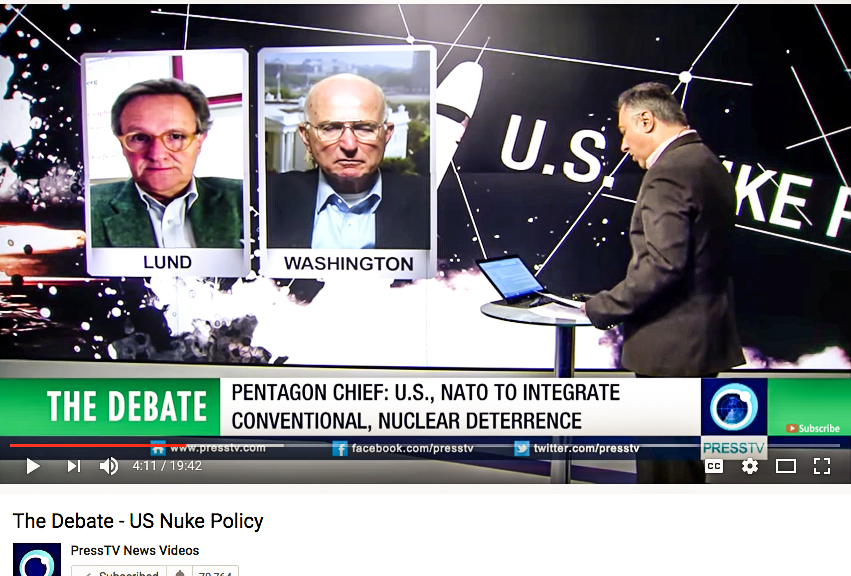
Last night I had the opportunity to discuss nuclear weapons with an experienced, high-ranking security analyst who has been both a military, a scholar, an assistant secretary of defence, presidential adviser, a corporate man and now a think tank member, Lawrence J. Korb.

We were discussing the issues touched upon in this and this article.

I would assume that the debate – facilitated by Iran’s PressTV in an excellent manner – is illustrative of the degree to which the world can be seen from different perspectives and how different we can perceive words such as law, legality, ethics, security, deterrence and peace.

I assume also that the debate illustrates the difference between a systems-embedded interpretation of the world and an independent or free perception, including what can and must be changed and what doesn’t have to change to make the world a better place.

Enjoy!

The Future of Europe: The capacity to integrate, for dialogue and to generate

By Maired Maguire

“War is illegal and immoral, it has to end and it can be ended.’

Speech at the international meeting “Thirst For Peace”, Assisi September 18-20, 2016. Promoted by Community of Sant Egidio and Diocese of Assisi and Franciso Families.

Dear Friends,

I am happy to be here at this International Meeting and I would like to thank our hosts, for their invitation to attend. I have always been inspired by the lives of St. Francis and St. Clare, whom I believe are Icons of Christian Gospel Peace and Nonviolence.

Francis the man of action, steeped in empathy and love for all, and Clare a woman of prayer, whose love of God led her into the depth of mysticism and peace.

Francis and Clare lived in a time of violence and war, yet they choose to live the nonkilling/nonviolence of Jesus. Francis as a youth fighting in his local military, knew well how to wield a sword, yet he choose to follow the command of Jesus to Peter, when he told him to put up his sword and healed the Soldier’s ear.

He left the military to live in poverty and service, and together with Clare, and his followers refused to take up arms. Francis and Clare, in the midst of much feudal violence, choose to follow the Christian nonviolence manifesto ‘the Sermon on the Mount’.

For many people in Europe and the world, challenged by growing violence and injustice, the lives of these two great 13th century Saints gives us hope and inspiration.

Pope Francis, following in the steps of St. Francis, gives us all hope as he challenges us to work for the abolition of the death penalty, ending poverty, the arms race, nuclear weapons, and environmental destruction, etc.,

However, I believe we need a clear renunciation of the ‘just war’ theory (a phoney piece of morality in the words of the late Fr. John L. McKenzie) and I add my voice to those appealing to Pope Francis for an Encyclical on Peace and Nonviolence, calling Christians to rejection militarism and war and to follow a Peace theology in keeping with the teachings of the Nonviolent Jesus.

This would give great Spiritual leadership not only to Europe but to Humanity.

I believe Europe todayRead More »

The state of the world – by journalists

By Johan Galtung

Journalists, physicians and mediators have one thing in common: they are expected to ask questions. Having worked as a journalist for some time for the Norwegian Broadcasting Corporation, having a medical family background, and having worked nearly 60 years as a mediator, my obvious conclusion has been for journalists to ask the kind of questions mediators ask, like:

• What does the Middle East look like where you would like to live?
• What is the situation right now?
• Was there a good time, what went wrong, what could have been done?
• What is the worst that happened, and the worst that could happen?

Journalists should not mediate – they are not trained for that. But they could make the world more ready for mediation, also by readers-listeners-viewers.

People will answer, and give interesting answers.

Of decision-makers journalists could also ask questions like:…

Continue reading here…

The Global Right and Left and Immanuel Wallerstein

By Johan Galtung

Immanuel Wallerstein is unique. Nobody else has presented such a coherent theory of what he calls the modern world-system, from “the long 16th century” up till today; essentially capitalist. There are ups and downs during those four centuries. He is very much at home in the economic Kondratiev cycles–A for up, B for down, but not that much down–and in the political-military hegemonic cycles of the would-be hegemons in the same period.

Read Immanuel Wallerstein and become wiser.

He warns against the Global Right “Lampedusa tactic” of “changing things so that they remain the same”. And insists on Liberty, Equality and Fraternity for the Global Left–but sees the French Revolution more as normalizing change than as people’s sovereignty. Like faith in the middle classes: they are actually helping the Global Right, when in minority they are enlarged by the majority working classes, when in majority they neglect the working class minority left behind.

Right now Wallerstein sees capitalism in crisis with no remedy – of which I am not so sure – and the US hegemony also in a crisis with no remedy – a view I share – as the fall of an empire with local elites killing for them; now they have to do most of the killing themselves.

The Global Right, in power for a long time, is now faltering. Time for the Global Left?

Or, does Zizek’s brilliant formula “the left never misses a chance to miss a chance” apply?

Wallerstein offers six Global Left proposals:Read More »

Islam Right Now

By Johan Galtung

Editorial, 5 September 2016

Nº 445 – TRANSCEND Media Service

Watching Christianity nearly a century–fundamentalist Christians fighting ritualistic Christians fighting secularism, generally moving fundamentalism–>ritualism–>secularism–maybe the same for Islam? Their similarities make “Islam right now” a repetition of Christianity; their differences shout, Watch Out! Let us see where this leads us.

Violence-prone fundamentalist evangelical Christians are still on top of the USA and some Nordic countries; but much less in ritualistic Catholic-Orthodox Christianity, meaning by far most of Europe. Beauty of worship, the psychology of confession, less verbalism; all help.

Secularism makes faith so metaphorical for many that Christianity becomes only a ritual for Christmas-Easter, baptism-marriage-funeral (if there are no secular alternatives). Result: empty churches.

Our secular age makes literal faith in dogmas difficult, and that tears at the faith. But this is where two major differences enter:

Islam is much less dogmatic, there is much less to tear at, only the readily acceptable shahada, faith in one Alla’h and his prophet Muhammad;
If that faith turns metaphorical, Islam has the other four pillars of Islam to fall back upon: prayer together, sharing, fasting, pilgrimage, every day, a whole month every year, once a life.
The point of gravity in Islam moves more easily from faith to practice; and may stop there. There is much built-in outer practice that will survive a decrease in inner faith. Result: full mosques.

Moreover, the four pillars are compatible with key secular values….

Continue here at Transcend Media Service, TMS. – where you’ll also find some comments and debates.

Criminalize the arms trade into hotspots

Jan Oberg comments on PressTV to Noam Chomsky’s criticism of Western support to terrorist groups in the Middle East.

Oberg maintains that the War on Terror is stupid in the sense of producing more of what it is supposed to combat and that arms traders – private as well as state – should be held accountable for their crimes, not only politicians and militaries.

Arms deliveries into hot spots ought to be criminalized too.