
On June 15, 2016 – Jan Oberg participated in a discussion on CCTV America – the global Chinese channel in the US with up to 75 million viewers – with Michael O’Hanlon of the Brookings Institution, a discussion lead by Anand Naidoo. See it here.
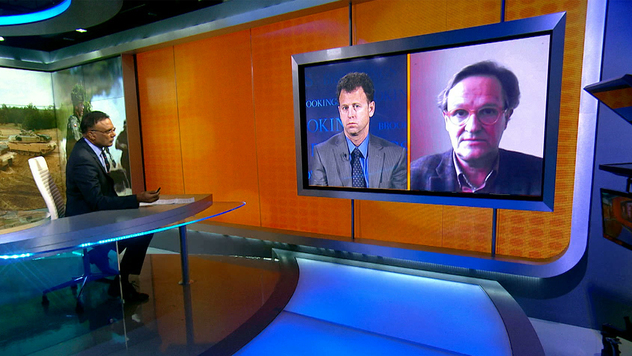
On June 15, 2016 – Jan Oberg participated in a discussion on CCTV America – the global Chinese channel in the US with up to 75 million viewers – with Michael O’Hanlon of the Brookings Institution, a discussion lead by Anand Naidoo. See it here.

By Johan Galtung
Kyoto, Japan
An East Asia of 6 states, 5 from the 6-Party Talks + Taiwan. The 6 in East Asia divide into South Korea-Taiwan-Japan in the US-led alliance AMPO+ (USA-Japan Security Treaty+); North Korea; China-Russia with others in SCO (Shanghai Cooperation Organization). AMPO+ with US “nuclear umbrella”, the other two may acquire nukes; North Korea with nukes; and SCO with two nuclear powers. Put it all together: A nuclear arms race.
Arms races may deter, but often end with wars. Wars mean trauma for losers and glory for winners. PTSD – post trauma stress disorder – may lead to thirst for revenge, and PGED – post glory exuberance disorder – to thirst for more glory. War, war, war. Worse than ever since WWII.
East Asia badly needs another approach.
As a minimum, the four tasks in the TRANSCEND peace formula: the negative peace of conciling traumas and solving conflicts; the positive peace of cooperation for mutual and equal benefit-equity-and harmony based on empathy.
Unconciled traumas and unsolved conflicts:
Japan/USA over FDR provoking Japan into war, Pearl Harbor, fire-bombing/nuclear genocide (Obama fell far short of Willy Brandt genuflexing in Warsaw for the genocide on Jews); Japan/Russia over Russian expansionism and the war; Japan/Taiwan-Korea-parts of China for uninvited, not colonialism, but japanization; Japan/SK – a carbon copy of Japan – with hysterically anti-Japanese policies (not in Pyonyang) demanding ever more apology and money. But Japan-SK “comfort women”, like Japan-China Nanjing, are complex; international commissions may sort facts from fiction.
Japan/China slave labor seems solved (Japan Times 2 Jun 2016).
NK/USA-SK: normalization-nuclear free Korea vs NK collapse.
Then Japan vs Russia, Chinas, Koreas over the contested islands.
Then USA polarizing East Asia, more tension, micro-managing.
Most problematic: Japan, USA; least: Russia. Read More »
Af Claus Kold
Fra Månen kan man ikke se Danmark, lige meget hvor godt man kigger. Det kan man ikke, fordi Danmark er en kulturlig konstruktion, som er inde i danskernes hoveder, og som derfor ikke kan ses. Man kan heller ikke se Rusland, USA eller Indien.
Disse stater er nemlig også kun inde i hovederne på de mennesker, der tilfældigvis er født og opvokset i det, de har valgt at kalde fx Israel. Danmark er m.a.o. en tilfældighed. Det kunne lige så godt ikke eksistere, eller ligge et andet sted eller danskerne kunne tale et andet sprog, som de godt nok ville kalde dansk, men som ikke lød dansk – for os, de rigtige danskere.
Stater og statssystemer har ikke altid eksisteret, og op gennem tiden har de, der eksisterede, haft meget forskellige form. De har været religiøse, familieeje, enemandsvælder, étpartistater – i dag er det dominerende ideal territorialt afgrænsede demokratiske stater, hvor befolkningerne helt principielt skal inddrages i beslutningsprocesserne. De forskellige demokratiske stater, der udgør hovedparten af det internationale samfund i dag er dog langt fra ens, og det kan derfor være svært for staterne at forstå hinandens motiver og handlinger.
Til det tilfældige system af tilfældige stater hører lige så tilfældigt menneskeskabte systemer som politik, territorie, økonomi, sikkerheds- og forsvarspolitik, konkurrence, etc. Systemer som kunne være anderledes, men som i dag er bundet til sine egne logikker, som de er blinde for og derfor ikke sætter sig ud over. Systemer kan typisk ikke se og tænke ud over sig selv. Blindheden er farlig, for der tegner sig i stigende grad et billede af at disse tilfældige menneskelige systemer står i kviksand og kæmper med hinanden, uden at opdage at de synker dybere og dybere i, ligesom det heller ikke opdages at konflikterne ikke er nødvendige men systemskabte, kulturlige. Der er nok af globaliserede udfordringer: global opvarming, udryddelse af plante- og dyrearter, krige, terror og flygtninge.
Det statslige system, vi lever med i dag, blev til under helt andre befolkningsstørrelser, livs- og forbrugsformer, økonomier og teknologier end dem, der dominerer i dag. Overfor de globale udfordringer er disse stater på samme tid for store til hverdagens små problemer og for små til de globale udfordringer. I deres forsøg på at forholde sig til globale udfordringer, betjener politikere sig således af forældede instrumenter, og forsøgene på at forholde sig til de globale problemer falder tilbage på politikerne, der fremstår som utroværdige, som musikerne på Titanics stadig mere hældende dæk. Read More »
By Johan Galtung
Jeju Peace Forum, Kwangju National University, Seoul; South Korea
Like the Israel-Palestine conflict, the world has gotten tired of it, “what, the two Koreas still unable to sort it out”? Also, like Israel-Palestine, the USA is in it; making the situation complicated.
Never has the situation been so tense after the end of the war in Korea more than 60 years ago. Not only because of the nuclear bomb with missiles in North Korea, and the hawkish pro-nuke reaction in South Korea and Japan, but because of no moves forward to solve the underlying conflict. And where is that conflict? Not between North and South Korea, but between North Korea and USA that after 140+ years of victorious warfare had to accept armistice, not victory, in Korea.
Conflict means incompatible goals. Travel to Pyongyang and find that their goals are peace treaty, normalization of relations, and a nuclear free Korean Peninsula.
And the US goal is the collapse of the present NK regime; failing that, status quo. Given the threat of a major war, even nuclear war, that goal is untenable. Some points.
Why does NK have nuclear capability?
Because NK is threatened by the USA-South Korea alliance in general and their “Team Spirit” in particular to deter conventional, or nuclear attacks; failing that to fight back, and particularly against where the attack might come from: US bases in Okinawa-RyuKyu, and from Japan proper. Militarily trivial.
AND to have a bargaining chip in any denuclearization that of course has to be monitored; given the US cheating in connection with Austrian neutralization in 1955 focused particularly on that one.
AND to show that we are not collapsing, we are capable of making nuclear bombs and the missiles to carry them; far from collapsing.Read More »

By Jonathan Power
Lund, Sweden, May 26, 2016
Introduction
By Jan Oberg
President Barack Obama visits Hiroshima on May 27; it’s the first time since the U.S. used nuclear weapons on Hiroshima and Nagasaki in August 1945 that a sitting U.S. president visits Hiroshima
It is known that he will not apologize for the crime that killed and crippled about a quarter of a million innocent people.
Disturbingly, the White House has also announced that he will “not have the time” to meet any victims, the Hibakusha.
According to Time he shakes off the ethical dimension of this unique mass killing by stating that “it is important to recognize that in the midst of war, leaders make all kinds of decisions”(!)
His commitment to peace and a nuclear weapons-free world has been an utter failure, according to TFF Associate Jonathan Power.
And it seems that Obama will not use this unique opportunity to show any moral leadership or this last chance to announce even the smallest step in the direction of what the huge majority of the world’s people want: living in a more peaceful world with fewer and, eventually, no nuclear weapons.
Jonathan Power starts out in Hiroshima
“We were standing in Hiroshima looking at a stone wall. All there was to see was a shadow of a man. Read More »
By Jonathan Power
May 24th 2016
“ISIS is not an existential threat to the United States”, President Barack Obama told Jeffrey Goldberg of The Atlantic magazine recently.
What becomes clear in this long article, much of it Obama’s own words, is that Obama shies away from the idea that war can make bad things good. The unquenchable wars that he inherited – Iraq and Afghanistan – were set alight by his predecessor, George W. Bush, and no amount of Obama fire engines have been able to douse them with enough water to put them out.
As for the rest of the waterfront of foreign affairs, he argues that after a period of uncertainty he decided that the US should not militarily involve itself in the civil war in Syria. He decided that Ukraine is not a core American interest, although it is a Russian one, and he was convinced that Iran would agree through peaceful negotiation to renounce the dangerous parts of its nuclear program.
As for the toppling of Muammar Gaddafi and the mess that followed he agrees that he made a bad mistake when he put on one side his own philosophy of not intervening militarily in a situation that was not a core US interest.
In the Atlantic article, Obama says believes he has broken with what he calls, derisively, the “ playbook”. “It’s a playbook that comes out of the foreign-policy establishment. The playbook prescribes responses to different events, and these responses tend to be militarized”.Read More »
By Johan Galtung
China is changing world geography, or at least trying to do so.
Not in the sense of land and water like the Netherlands, but in the sense of weaving new infrastructures on land, on water, in the air, and on the web. It is not surprising that a country with some Marxist orientation would focus politics on infrastructure–but as means of transportation-communication, not as means of production.
Nor is it surprising that a country with a Daoist worldview focuses politics on totalities, on holons and dialectics, forces and counter-forces, trying to tilt balances in China’s favor. How this will work depends on the background, and its implications.
Two recent books, Valerie Hansen, Silk Road: A New History (Oxford University Press, 2012) and Peter Frankopan, The Silk Roads: A New History of the World (Knopf, 2015) see them as arteries connecting the world, globalization, before that term became a la mode. Not that loads of goods moved all the way in both directions, parts of the way, maybe further. Europe had much less to offer in return; however:
“Viking traders from–Norway–coarse, suspicious men, by Arab account–were moving down the great rivers of Russia–trading honey, amber and slaves–as early as the ninth century–returning home to be buried with the silks of Byzantium and China beside them”. (Frankopan)
The Silk Roads – so named by the German geographer von Richthofen in 1877 – connected China and Europe (Istanbul) over land from -1200; more precisely from Xi’an to Samarkand by a northern and southern road (Hansen for maps). And the Silk Lanes connected East China and East Africa (Somalia) from +500 till +1500 when Portuguese-Spanish and English naval expansion started a Western takeover by colonization.
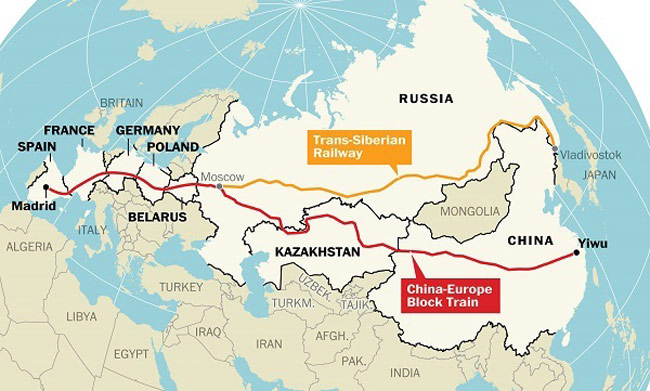
The modern Silk Road East-West, Yiwu/China to Madrid/Spain. Although the transit time for goods or people to transit the route is 21 days, this is 30 days faster than a ship and is 1/10 the cost of shipping freight. See www.bulwarkreview.com
For long periods run by Buddhists in the East and Muslims in the West; Islam using them to expand, from Casablanca to the Philippines. Frankopan sees the high points in the Han dynasty (-207-220, capital Xi’an for West Han), the Tang dynasty (618-902, capital mainly Xi’an) and under Mongolian, Yuan rule–for goods, ideas, faiths, inventions.
Xi’an, 3,000 years old, served as a starting point, both for Silk Roads and for the Silk Lanes, traveling the Yangzi River, or over land, to the East China Sea coast. Till the military uprising against the Tang emperor in 755 (Hansen, Ch. 5, “The Cosmopolitan Terminus on the Silk Road”); but Xi’an is destined always to play major roles.
China is now reviving the past, adding Silk Railroads from East China to Madrid via Kazakhstan-Russia-Belarus-Poland-Germany-France, to Thailand, from East to West Africa–from the Indian Ocean to the Atlantic–from North to South Africa. Silk Flights. And Silk Web.
A silky cocoon is being woven, by worms in China. Too much?
Two features stand out in this approach to geopolitics.Read More »
By Jonathan Power
During the Cold War barely a week went by without some reportage or debate on nuclear weapons. Not today. Yet most of the nuclear weapons around then are still around.
It would be alright if they were left to quietly rust in their silos. But they are not. When in 2010 President Barack Obama made a deal with Russian President Dimitri Medvedev to cut their respective arsenals of strategic missiles by one-third the Republican-dominated US Congress, as the price for its ratification of the deal, decreed that Obama and future presidents be made to spend a trillion dollars on updating and modernizing America’s massive arsenal.
Now that chicken is coming home to roost – and a few other chickens too.
President Barack Obama’s unexpected legacy is that he has presided over an America that has been at war longer than any previous president. Moreover, of recent presidents, apart from Bill Clinton, he has cut the US nuclear weapon stockpile at the slowest rate.
The Republican’s extreme right clipped Obama’s wings. Of that there is no doubt, making it impossible thus far, to negotiate with Russia any further cuts.
At the same time the counterproductive US/EU confrontation with Russia over Ukraine pushed President Vladimir Putin into the foolish tactic of talking about the possible use of nuclear weapons and deploying intimidating flights over the airspace of the Baltic Sea. When Putin was asked a year ago if Russia was prepared to bring nuclear weapons into play in the confrontation over Crimea, he replied, ”We were ready”.
Yet not all can be pinned on Congress or Putin. Obama’s vision of a nuclear-free world Read More »
By Richard Falk
Message to President Barack Obama with respect to forthcoming Hiroshima visit
Prefatory Note
I sent the following message to the White House today, and encourage readers of this blog to do the same
This symbolic visit by Obama creates a major opportunity to advance a denuclearization agenda, and we should take as much advantage as possible. I am against the mainstream advice that suggests that the best way to give meaning to the event would be to announce the adoption of arms control measures such as suspending development of a new nuclear cruise missile.
These measures, while intrinsically valuable, have the downside of stabilizing the nuclear weapons status quo.
What would be most helpful would be a step, as suggested below, that gives primacy to nuclear disarmament instead of continuing the deceptive practice of taking prudent steps to cut risks of accidental use and curtail provocative developments and deployments.
These steps take the public eye off the supposed target of nuclear disarmament. The only was to honor the memory of Hiroshima and Nagasaki is by moving toward Nuclear Zero, and President Obama is one of the few persons on the planet that has this precious chance to aim at the true target.
Of course, it would be appropriate, and long overdue, to apologize to the Japanese public for the ghastly suffering inflicted by the atomic attacks, but that is more than we can reasonably expect a cautious president to do.
Message to President Barack Obama upon the announcement of his intended Visit to Hiroshima
Mr. President:
I applaud your decision to visit Hiroshima during your upcoming visit to Japan.
I would encourage you to supplement your acknowledgement of a MORAL responsibility of the U.S. in your 2009 Prague Speech with an acknowledgement of a LEGAL responsibility to seek in good faith nuclear disarmament, a point unanimously asserted by the International Court of Justice in its Advisory Opinion of 1996. Such a move would also recognize the legal obligation embedded in Article 6 of the NPT.
Making such an historic affirmation would give new life to the pledge to give real meaning to the vision of a world without nuclear weapons, and act to heighten your legacy in this vital area of your presidency. It would put legal, as well as moral, pressure on all nine nuclear weapons states to comply with their obligations under international law, and in the American case, since the since the NPT is a duly ratified treaty, to act in accordance with the Constitution’s recognition of treaties as ‘the supreme law of the land.’
Respectfully,
Richard Falk
By Johan Galtung
Antwerpen & Alfaz
We are dealing with mass migration, basically into EU, and European nationalisms, many in favor of exits from the EU.
Why this mass migration, maybe to the point of Völkerwanderung, mainly into EU – but then what kind of EU? – and why the European nationalisms now found one way or the other in many member states?
The forecast for migration from Africa into Italy in 2016 is about 100,000; 28,000 already arrived in the first quarter, with 1,000 drowning in the Mediterranean (INYT, 6 May 2016). Big numbers. They knew the risks they were taking, so the push away from Africa and the pull towards Italy, and beyond, must have been considerable.
Better think in terms of 50 million migrants over 50 years, from regions considered uninhabitable to inhabitable regions. There seem to be five major causes underlying this basic world asymmetry:
Slavery, four centuries, depriving societies particularly of able-bodied males, by Arabs, then Westerners, cross-Atlantic transportation mainly by the English (Liverpool);
Colonialism, by Muslims after the death of the prophet in 632, from Casablanca to Southern Philippines, till the end of the 15th century, close to nine centuries, then by Christians close to five centuries, till colonialism was officially ended in the 1960s;
Robbery Capitalism, stealing or paying next to nothing for resources processed into manufactured goods, pocketing the value added;
Wars, mainly initiated by the West, killing millions (the USA more than 20 million in 37 countries after WWII), destroying property;
Ecological Factors, like depletion-pollution, often toxic for humans or nature, erratic climate partly due to climate gases, NOX, CO2, CH4.
These are the causes of poverty in some parts of the world but also of wealth in others; Read More »
 TFF Associates Blog 2011-2017