Marx and Freud, Daoism and Gandhi

By Johan Galtung

Johan Galtung

The two giants did something unusual for Western thinkers: they were very holistic. Nothing less than the whole society and the world, and much more than the economy, for Marx; nothing less than the whole body-mind complex, with excursions into culture, for Freud.

Equally unusual: they were very dialectical. There were forces and counter-forces. Means vs modes of production for Marx, simplified to Capital vs Labor; Super-ego vs Id, values from the outside vs drives from the inside for Freud. For Marx the dialectic was inside Structure–of Culture and Nature there was little–for Freud between Culture and Nature–of Structure there was little.

Holism and dialectics are the pillars of daoist thought, giving rise to a dynamic theory of organic systems like societies and humans. Calling the forces yin and yang, over time they will both be vexing and, waning, the dominant will recede and the dominated will grow. In this process there may be some balance point, but it is not stable. Nothing is stable in this perspective, nor is anything–Nazi Germany, Soviet Union, USA–monolithic with only one force. There is yin/yang everywhere, also inside yin and yang, and new dialectics emerging.

Here the great Westerners show their limitations. Marx was an optimist seeing conscious and organized Labor break the shackles of Capital, moving on to socialism and communism; Freud was a pessimist seeing “reality” (his word for structure?) as unchanging, impeding compromises between Super-Ego and Id. They used only the dialectic of their primary contradictions; beyond that they became deterministic.

Moreover, with two forces there are five outcomes: one or the other prevails, neither-nor–like in social or individual death–a compromise is identified–social capitalism, capi-communism, Freud’s maturity–and both-and, transcending, beyond the compromise. They, however, saw only one outcome, the triumph of Labor, or the compromise.

Whatever happens it will be unstable. For stability a stabilizer is needed, but even so any equilibrium is unstable. The State is the social stabilizer freezing the dialectic in favor of Capital, Labor, neither, a compromise or both; but where is the individual stabilizer?Read More »

TFF PressInfo: Cold War warnings 1998 – 2014

By Jan Oberg

Jan Oberg

Lund, Sweden August 11, 2014

Quality research leads to better predictions

One criteria of quality research is that it predicts the future better than incompetent research.

Because TFF is independent of governments and coroporations it doesn’t have to take political considerations or exclude certain theories, concepts or values. This free research enabled it over the years to make fairly precise predictions about for instance former Yugoslavia, the Iraq war and East-West relations.

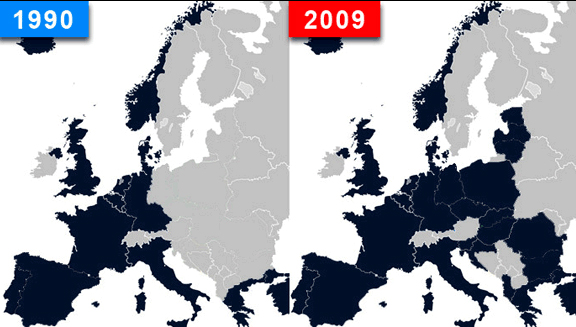
In 1998 – 16 years ago – we warned that NATO’s expansion would lead to future problems with Russia. Read it here.

NATO should never have been expanded

We backed this prediction up with 46 arguments and argued that so many other things would be wiser than containing Russia from the Baltic republics to Georgia – a strategy pursued by Bill Clinton in contravention of all promises given to the Soviet Union/Russia at the end of the Cold War about ten years earlier.

That counterproductive and insensitive expansion has now hit Ukraine. A new Cold War is gathering over Europe. It should have been predicted by advisers, intelligence agencies, big research institutes and columnists.

But it wasn’t.

At the end of the Cold War, NATO/the West got everything it could ever wish – and without war. But it wanted more: keeping Russia down, making NATO bigger and “peace-making” as well as finding new enemies to keeping its Military-Industrial-Media-Academic Complex (MIMAC) alive and well: Saddam, Milosevic, the Muslim world, terrorism and – now re-cycling – Russia.Read More »

Aage Bertelsen (1901 – 1980) – Danish educator for peace

By Jan Oberg & Johan Galtung*

Lund and Kuala Lumpur, July 2014

Introduction

He was a tall man and a great man, a visionary, pacifist, civil resister, educator and philosopher. He took life more seriously than most and he could be playful and fun like a child. His life’s guiding principle was ”Engage in your time!” and while he wrote and talked a lot he also did it. His name was Aage Bertelsen, he was born in Denmark in 1901 and died on August 15, 1980.

Bertelsen’s imprint on history is two-fold. First, with his wife Gerda he was a prime mover of one of the groups, the Lyngby Group, which organised the rescue of altogether 7.220 Danish Jews into safety in Sweden in October 1943 during the German occupation of Denmark – more here. The Lyngby Group – Lyngby is north of Copenhagen – got about 1.000 of these in safety by organising their nightly transport onboard small fisher boats over the Sound between Denmark and Sweden.

In this he deserves a place in international contemporary history for its humanity, civil courage and as an example of non-violent struggle against occupation.

Secondly, Bertelsen was an educator of and for peace. His life work educational efforts included his family and friends, his pupils over 22 years at the Aarhus Cathedral School in Aarhus, Denmark, the general public as well as national and international leaders.

He lived in pre-Internet times and very little is publicly available today about this renaissance man. From two rather different, but compatible, perspectives we’ve taken it upon us to remind the world about him – friends and colleagues of his as we happen to be.

Headmaster Aage Bertelsen in 1961 Photo: Elfeldt, Copenhagen


Why now, over 30 years after his death? Read More »

Harsh incivility in defence of Israel

By Richard Falk

Blog despair

Richard Falk’s blog “Global Justice in the 21st Century”

Once again I feel deeply frustrated by the lack of civility in the flow of comments on this website, especially relating to Israel-Palestine, and the broader relations between Islam and Judaism. And again I feel that those who seem to have chosen as a vocation the validation of Israeli behavior however far it strays from international law and minimal ethical standards are determined to personalize the debate via the submission of defamatory and demonizing comments.

There are also disingenuous attempts to engage me in senseless discussion where a cascade of questions will follow upon whatever responses I try to provide to the initial inquiry. I have been down that weary road before, and don’t intend to be so foolish as to attempt once more to explain what is self-evident to those committed to unconditionally justifying whatever Israel chooses to do or to claim.

My interest is in dialogue, not argument or polemics. And I must say Read More »

TFF PressInfo: “The human price of the war on Iraq” Hearing Statement

Comments by Hans-C. von Sponeck
Former UN Assistant Secretary General, UN Humanitarian Coordinator for Iraq & TFF Associate


Hearing at the UK House of Commons, London June 10, 2014

Intro
1. HoC/HoL have repeatedly held Iraq hearings as have British NGOs such as CASI (Campaign Against Sanctions on Iraq) and Stop the War Coalition/UK. In Europe these are considered models for responsible public action.

2. My contribution at this hearing is not about the crimes of dictatorship or the details of Iraqi suffering. For both well researched data is available. The objective of my participation is to make two detailed observations about externally-driven Iraq politics during the period 1990-2014.

Observation 1

3. Today’s tragic Iraq reality can only be understood if the additive impact of the years before and the years following the US/UK Governments’ illegal invasion and occupation is fully taken into account.Read More »

Seven Roads to Happiness

By Johan Galtung

… Would be the title in English of a book this author just published in Norwegian, Syv veier til lykke (Oslo: Kolofon 2014); with excellent photos by Aase Marie Faldalen. And, very befitting for a book with that title: the book quickly made it to the Top 10 on a best-seller list, of course as No. 7. There will be translations but have a peek here and now.

Why does a peace researcher, concerned with peace theory and practice, write a “how-to” book about happiness, well-being? Read More »

Five Palestinian futures

By Richard Falk

For years, perhaps going back as far as the Madrid Peace Conference of 1991, influential international debate on the future of Palestine has almost exclusively considered variations on the theme of a two-state solution. The American Secretary of State, John Kerry, stampeded the Palestinian Authority and Israel into negotiations that ‘failed’ even before they started a year ago. At least Kerry was prudent enough to warn both sides that this was their do or die moment for resolving the conflict.

It was presumed without dissent in high places anywhere that this two-state outcome was the one and only solution that could bring peace. Besides the parties themselves, the EU, the Arab League, the UN all wagered that a resolution of the conflict required the establishment of a Palestinian state. Even Benjamin Netanyahu became a reluctant subscriber to this mantra in his 2009 speech at Bar-Ilan University, although always in a halfhearted spirit.Read More »

Prosecuting Syrians for war crimes now

By Richard Falk

A major undertaking of the victorious powers in World War II was to impose individual criminal accountability upon political and military leaders for alleged crimes committed during wartime before a tribunal convened by the victors that gave those accused a fair opportunity to present a defense.

This application of this idea of accountability to German and Japanese surviving leaders at trials held in Nuremberg and Tokyo was hailed at the time as a major step in the direction of a ‘just peace.’

International law was treated as binding upon sovereign states and those that represented the government, conceived to be a major step in the direction of a global rule of law. The final decisions of these tribunals also produced a narrative as to why World War II was a necessary and just war. Such an outcome was both a vindication of the victory on the battlefield and a punitive repudiation of those who fought and lost. Significantly, this criminal process was formally initiated only after the combat phase of the war had ended and Germany and Japan had surrendered.Read More »

Mexico: 50 Peaceful Peace Policies

By Johan Galtung & Fernando Montiel

Toluca, Estado De México; Workshop on Drug Traffic and Violence

Background
300.000 kg of cocaine to USA via Mexico annually; 60% of marijuana producers had lived in misery, US$ 2/day; the drug traffic profit in Mexico was US$ 59 billion, 5% of GNP; 80% was spent on corruption; 125,000 were arrested since 2006; with an impunity of 98%.

Background
2,000 weapons from USA to Mexico daily; 5.5 million legal and 20 million illegal arms in Mexico; 100,000 have died in the “war on drugs” from 2006; 30,000 disappeared; 42+ journalists killed (more than in Afghanistan); 50,000 military troops involved by 2006, 130,000 by 2009, 50,000 in 2012, 32,000 in 2013; US$ 16.6 billion spent on insecurity and violence, 1.34% of GNP.

Conclusion
Due process of law and violence did not reduce drug traffic and violence; a drug-arms-violence-police-military complex had evolved. No general prevention, maybe not even individual prevention. A discourse-change took place: the perpetrators were seen less as evil and more as products of the domestic and regional contexts. The new approach was prevention by eliminating causes. The goal is reduction of drug traffic and of violence, and even if related they were seen as two different goals not necessarily served by the same means.

Question
Which are these means, causes to be handled?Read More »

TFF PressInfo: Psyko-politik i tiden för imperiets nedgång

Av Jan Öberg

Lund , Sverige – 23 maj 2014

Tiden för rationell politik, om begreppet någonsin funnits, är över .

”Realpolitik” har blivit en blandning av marknadsförda ord, propaganda och ledare som gör uttalanden som gränsar till absurd teater. Tunnare och tunnare länkar till Realiteten.

Detta är vad som händer när man förnekar nedgången.

Alla imperier går ner. Det amerikanska imperiet är på nedgång. Makrohistoriker (se t.ex. British Arnold Toynbee’s 12–volymarbete 1934-1961) berättar att det finns många skäl till att imperier faller:

• militarism med konstant krigföring;

• överutvidgning – försöka kontrollera mer än vad du kan hantera;

• förlust av legitimitet i andras ögon;

• strukturella ekonomiska kriser;

• moraliskt förfall;

• förlust av intellektuell och teknisk innovation;

• andra maktstrukturer ökar i styrka över tid och göra saker på nya, kreativa sätt .

Efter 1945 ansågs USA vara starkt på en rad olika maktdimensioner: militär, ekonomi, politik, legitimitet, kultur, innovation. Idag är de bara nummer ett på den militära dimensionen. När alla andra indikationer går ner, blir militären en stor börda som bara accelererar nedgången.

USA är på tillbakagång och i förnekelse. Så är även de flesta av dess allierade och sympatisörer .

Deras utrikes politiska beslutsfattare verkar tro att allt är bra och de kan ändå leda och forma världen enligt deras intresse och världsbild. Det är fortfarande i grunden en missionär .

Här är några delar av vad den består av:Read More »