Shadows of Doom

By Gunnar Westberg

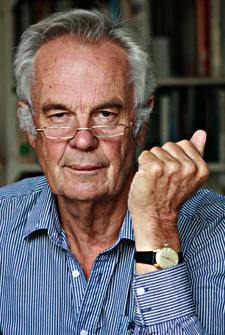
During the years since the end of the Cold War, Peter Handberg – a writer and translator – has travelled many times in the Baltic states, Estonia, Latvia and Lithuania. He has visited many sites where nuclear weapons were kept at the time, ready to destroy the world.

Handberg has also spoken to military officers who once watched over these instruments of Armageddon. He has written an important book on the subject, Undergångens skuggor (Shadows of Doom). The book is not translated but a documentary film is planned.

He has just led a group of people from Sweden to some of these bases, abandoned since 1987. We were about ten physicians from the Swedish section of International Physicians for the Prevention of Nuclear War (IPPNW) and ten others – historians, people with an interest in the Baltic states, etc..

I learnt three important facts, from the book and be visiting these sites:

1. The size of the Soviet nuclear complex in these small Baltic states was enormous; there were at least 35 bases.

2. The officers who watched over the missiles were, especially in 1983, convinced that an American attack would come and they expected to launch their missiles.

3. There were at some of these bases, in the sixties but also much later, short distance missiles with a range of not more than 600 km, enough to reach Southern Finland and Eastern Sweden only. They carried a large number of bombs, mostly of 100 kt effect, or about six Hiroshima bombs.

The reason “neutral” Sweden was targeted was that a US attack with bomb planes carrying nuclear weapons was expected to come also over Sweden, possibly using Swedish airfields.

Maybe that was correct: Sweden would have been used as a platform for an American nuclear attack on the Soviet Union. Such a scenario is described by Thomas Reed, once head of US Air Force, in his book At the Abyss.

Reed was a US defence analyst who in the eighties participated in the selection of enemy targets in the strategic plane called SIOP.

I can not avoid comparing this piece of history to the situation today: Sweden’s government is moving ever closer to NATO and has – through the Host Country Agreement – prepared for NATO bases in the country and thereby – potentially at least – for an attack to be carried out by NATO from Swedish territory.

We Swedes are making ourselves a target.

TFF PressInfo #381: Much stronger than during the First Cold War. Why is NATO so irrational?

By Jan Oberg

The third article in the TFF series on The New Cold War

We are witnessing a remarkable increase in tension between the US/NATO and Russia these years – and it can not only be explained by whatever we choose to think happened in Ukraine and Crimea. We find a totally new effort on both sides to use social and other media to tell how dangerous “they” are to “us”. There is a clear tendency to “fearology” – to instill fear in the citizens on both sides about the capabilities and intentions of the other side.

We find deeply concerned articles about the possibility of war between the two parties – a quarter of a century after the Berlin Wall tumbled.

Why is the new tension rising in Europe between US/NATO and Russia so manifestly dangerous and – with the exception of the Cuban Missile Crisis worse than during the First Cold War?

On a series of indicators, the political Western world – US/NATO/EU and Christian (Orthodox, Protestant, Catholic with sects) – is becoming weak relative to other players in the global society.

The West has engaged in a series of wars that turned into very costly fiascos – from what followed from Sykes-Picot which turned 100 in May 2016 over Vietnam to the destruction of Afghanistan, Iraq, Libya and Syria.

The West is still the largest economic bloc and the 28 NATO members cover about 70% of the world’s mind-boggling US $ 1700 billion military expenditures. Africa as a continent, BRICS countries – China in particular – are making progress, also in fields where the West has failed; for instance, China has lifted 400 million Chinese out of poverty in a couple of decades. The wealthy West has done nothing of the sort over centuries but produced a grotesquely, perversely unequal income distribution.

Take a look at the graphs linked to this summary page from SIPRI. They will tell you how world military expenditures in constant prices have risen since 1996 even though the Warsaw Pact had been dissolved. In 2015, the US alone stands for 36% of the world’s military expenditures, China for 13% and Russia for4%.

President Obama stated recently that the US military is stronger than the next 8 – here is what he said in his State of the Union Address on January 12th, 2016:

“I told you earlier all the talk of America’s economic decline is political hot air. Well, so is all the rhetoric you hear about our enemies getting stronger and America getting weaker,” Obama said in his last annual State of the Union address Jan. 12, 2016. “Let me tell you something: The United States of America is the most powerful nation on Earth. Period. Period. It’s not even close. It’s not even close. We spend more on our military than the next eight nations combined.”

In spite of these fact that prove the overwhelming and increasing superiority of today’s NATO, we see a constantly increasing propaganda coming out of NATO circles to the effect that NATO is getting weaker and that Russia a formidable, unreliable power just waiting for the next opportunity to invade some country in the West.

Let’s take a look back in time.Read More »

TFF PressInfo # 380: Brex’it. So Be’it – And now what?

By Johan Galtung

The vote turned out like the two referenda held in Norway in 1972 and 1994. And much for the same reason: Protestant break with Rome – Catholic, imperial – Henry VIII made himself head of the Anglican Church in 1534.

Religion was not the only reason, there are Protestant Nordic members of EU, closer to the continent and closer to Russia. World history, a short while after Pope Francis – Patriarch Kirill also made world history, bridging the Catholic-Orthodox 395-1054 gap.

The Disunited Queendom is now London with surroundings; England. The implications are enormous, for UK-GB and the British Isles in general, for EU and Europe in general, USA and the world in general.

The US Trojan horse decided to leave the EU on 23 June 2016.

UK-GB and the British Isles in general:

Goodbye United Kingdom, UK, we may get United Ireland, UI, instead.

Goodbye Great Britain, GB, we may get Scotland in EU instead.

Welcome to Britain of England-Wales, if they care for that vocabulary.

Welcome to new-born England, 23 June being the Day of Independence.

Independence?

Washington, having lost its inside-EU ally,Read More »

TFF PressInfo # 379: The Brexit Shock – Now all is up in the air!


By Jan Oberg

The UK, Europe and the rest of the world will be affected. But there has been no planning for this anywhere. It’s now all up in the air what this Brexit vote will be the starting point of. All we can safely predict is that we are in for interesting times!

Why did it happen?

Arrogant corporate and other elites continuously enriching themselves against all common social sense and ignoring the legitimate needs and concerns of ordinary citizens, women in particular – so, class and gender.

So too that more highly educated people tended to vote for Remain and older people voting Leave – more interesting sociological analysis here.

Interestingly, the whole art world supported Remain – and now fear for the effects of Brexit on Britain’s cultural development.

An EU that has failed to create a new, better way of doing politics, merely growing its original democratic deficit – so, lack of real democracy.

An EU that has had a woefully inadequate, cynical response to a refugee crisis caused by leading EU member states’ warfare – so, (mis)management and lack of leadership.

Significantly, the leading Muslim Association of Britain, MAB, supported Remain with the argument that ”Exit from the EU runs the risk of perpetuating rifts in British society, which would increase levels of hate crimes against British Muslims.” So, Islamophobia.

A general sense (but sometimes denial) of insecurity about the future all over the Western world, Read More »

Is ISIS on the wane?

By Jonathan Power

Within a matter of days a self-appointed ISIS “lone wolf”, Omar Mateen, with no actual links to home office Isis has created mayhem in Orlando, Florida, with his killing of 49 people in a gay club, and the Iraq army has pushed Isis troops out of most of the important city of Falluja.

Maybe it is an exaggeration to say that ISIS is on the run its bailiwicks of Iraq and Syria but it is certainly taking very bad hits. Two years after sweeping through northern Iraq and capturing the oil city of Mosul in 2014 they are now on the defensive. ISIS has lost nearly half of the Iraqi territory it held. (i.e. an area about half that of the UK). It has lost much of its oil infrastructure.

It is taking lots of casualties. In Syria it is fighting on two contradictory fronts – the regime in Damascus, supported by Iran and Russia and against the non-Islamist rebels, supported by the US and the Arab states.

Meanwhile the flow of foreign fighters on which it has depended is slowing up and large numbers are returning home. Funding is drying up.

This indeed is why Mateen, the lone wolf, is so important to ISIS. ISIS spokesman, Abu Muhammad al-Adnani, has asked ISIS sympathisers to stay where they are. “The smallest action you do in the heart of [your] land is better and more enduring to us than what you would do if you were with us.”

Is this a switch in tactics? We do not know yet.

What we do know is Read More »

TFF PressInfo # 378: A new Cold War between Russia and the West?

By Jonathan Power

June 7th. 2016.

The second article in the TFF Series on The New Cold War

George Orwell, the author of “Animal Farm” and “1984”, was the first person to use the phrase “Cold War” in a 1945 newspaper article, written just after the nuclear bombing of Hiroshima and Nagasaki. He argued that “the surface of the earth is being parceled off into three great empires, each self-contained and cut off from contact with the outer world, and each ruled, under one disguise or another, by a self-elected oligarchy. He counted the US and Western Europe as one, the Soviet Union as the second and China as the third. He concluded that, “the atomic bomb is likeliest to put an end to large-scale wars at the cost of prolonging indefinitely a peace that is no peace”.

I think he got it nearly right – or so it seems as a new Cold War erupts between the West and Russia and China spars with the US over the South China Sea and its islands.

Of course it’s more complicated than that. China and Russia have a fair relationship. China and the US are perhaps doing nothing much more than annoying each other and the bonds of commerce and student exchanges bind both the elites and the populaces close together.

To me a new Cold War is nonsense on stilts. Even more than the original one.

George Kennan, the US former ambassador to Moscow and the author of how to contain the Soviet Union, always insisted that Stalin had no intention of rolling his tanks into Western Europe. As Robert Legvold summarizes Kennan’s views in his interesting new book, “Cold War”, “The threat the Soviet Union posed was political, a threat accentuated by these countries’ vulnerability to Soviet subversion because of their economic frailty and political instability – a threat requiring a political and economic response, not a military one”.

In 1948 Kennan wrote, as he observed the creation of Nato, “Why did they [Western leaders] wish to divert attention from a thoroughly justified and promising program of economic recovery by emphasizing a danger which did not actually exist but which might be brought into existence by too much discussion of the military balance and by the ostentatious stimulation of military rivalry?”Read More »

TFF PressInfo # 377- Intro to a series: The New Cold War

By Farhang Jahanpour

The first article in a TFF Series on The New Cold War

There are many ominous signs that dark clouds are gathering over international relations, from the South China Sea, Taiwan, Vietnam, Japan and South Korea to the Middle East, and to Ukraine and the Baltics. We are entering a new and perhaps a more ominous Cold War.

This is something that will affect all our lives and will plunge us into a new era of East-West confrontation that none of us wants and that all of us should try hard to prevent.

Many young people were born after the end of the Cold War or were too young to remember its horrors, and how the world was on a knife’s edge about a possible global confrontation between the two superpowers with thousands of nuclear weapons whose use could have ended human civilization. We, who remember those days, should make sure that we do not see a repetition of that dark period in human history.

Yet, sadly, a Cold War mentality is once again creeping back into political discourse.

The Second World War that killed more than 60 million people and devastated many countries had hardly ended when new hostilities emerged. The dropping of the atomic bombs on Hiroshima and Nagasaki was not so much the final act in the Second World War as the opening shot in the Cold War. Contrary to the stated justifications for the dropping of the bombs as a means of forcing Japan to surrender, it is now clear that Japan was ready to surrender before the use of those awful weapons.

Many historians believe that the real reason for the use of nuclear weapons was to prevent Japan falling into the hands of the Soviet Union, as the Red Army was poised to take on Japan’s remaining army in Manchuria, thus forcing Japan to surrender to Russia. Furthermore, it was a clear signal of the West’s possession of the new devastating weapons.

For instance, the scientist Leo Szilard who met with US Secretary of State James F. Byrnes in May 1945, reported later: “Byrnes did not argue that it was necessary to use the bomb against the cities of Japan in order to win the war … Mr. Byrnes’ view was that our possessing and demonstrating the bomb would make Russia more manageable.” (1)

Therefore, far from wanting to save lives, the use of nuclear weapons was to demonstrate America’s overwhelming military might, and to issue a warning to Russia.

The war had hardly ended when in a speech in the British House of Commons on 16 August 1945 Winston Churchill referred to “the iron curtain which at the moment divides Europe in twain.”

It was in view of those ominous events that mankind decided to create international organizations that would “save succeeding generations from the scourge of war, which twice in our lifetime has brought untold sorrow to mankind.” The Charter of the United Nations aimedRead More »

Kärnvapen och andra vapen

Av Erni & Ola Friholt

Margot Wallström har utropat en feministisk utrikespolitik för Sverige. Inom den tecknades nyss ett värdlandsavtal med Nato, världens utan jämförelse starkaste militärallians. Avtalet permanentar flera gånger årligen återkommande militärmanövrer i stora delar av vårt lands luftrum, på landytan och i territorialvattnen. Sverige bekostar nödvändiga infrastrukturan-läggningar.

Militärmanövrerna samtrimmar svensk militär med Nato. Den underförstådda motståndaren är Ryssland, ständigt utpekat som aggressivt och hotfullt. Med den förklaringen flyttar Nato ständigt fram sina positioner mot Rysslands gränser. Eftersom Ryssland känner sig hotat utvecklas ett spel som leder till ökad spänning och krigsrisk, vilket i sin tur ger anledning att upprusta båda sidor.

Kapprustningen tar resurser från det civila samhället och skapar oro även där. Närmast ska det torkdrabbade Gotland utrustas med nya anläggningar, vapen och manskap. Kapprustning med ständigt nya vapen har bara ett slut: fattigdom och krig.

I denna situation önskar Sveriges regering förhandla fram ett förbud mot kärnvapen, det vapen som kärnvapenmakternas säkerhetstänkande ytterst vilar på och är det sista de skulle avstå från. Detta erinrar om myten om Sisyfos, mannen som dömts att baxa ett stenblock uppför en sluttning och som varje gång han nått toppen får se blocket rulla ner igen till utgångspunkten.

Den svenska regeringens feministiska Sisyfosarbete bortser ihärdigt ifrån att det är alla de andra vapnen som startar utarmande kapprustning och krigshot. De så kallade konventionella vapnen skördar dagligen och stundligen dödsoffer och skadade. Hur befängt det än kan låta, måste väl illusionen om säkerhet och fred genom de andra vapnen ha lockat till värdlandsavtalet med Nato?

Regeringen väljer att betala och samarbeta med ”de stora grabbarna”, de som i Serbien, Afghanistan, Irak, Libyen, Syrien, Jemen och Somalia med militära konventionella ”insatser” dödat över två miljoner människor på femton år och skadat ännu fler.

Deras svar på konflikter är endast ett: bombningar till underkastelse.

Därför får vi som svar ett evigt s k terrorhot.

Om den feministiska utrikespolitiken vore allvarligt menad, vore den givna politiken nedrustning, samtal och utbyte med den utpekade fienden, allt för avspänning i enlighet med Palmes kommission om gemensam säkerhet, alltså även motsidans säkerhet, och en verklig alliansfrihet.

Nu går färden åt motsatt håll, med kontraproduktiv handelsbojkott och anslutning till Natos våldsdoktrin.

Du lever farligt, Margot!

ERNI & OLA FRIHOLT