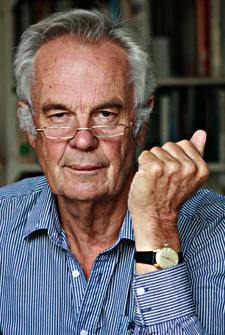
Walkers of the World Unite!

By Jonathan Power

When first running for president Barack Obama was made to feel uncomfortable on national television when an inquisitor attempted to pin him down on the inconsistencies of his non-smoking pledge. Clearly Obama had some trouble in not, as he put it, ”falling off the wagon”.

But, maybe, he should get completely off the wagon. It was reported that in the inauguration parade gas-guzzling SUVs were not used. But why did he not go a little bit further and insist that everyone walk?

Here is a man who likes to go to the gym every day, but a 45 minutes walk would do the job just as well and set a car-crazed world the example it needs. We have had bicycling heads of state or government before – look at Queen Beatrix of Holland and today David Cameron, the prime minister of Britain, when he was leader of the opposition cycled to the House of Commons. So why not a walker? That is what Cameron has now become.Read More »

Losing control: A blogger’s nightmare

By Richard Falk

When I started this blog a couple of years ago, the thought never entered my mind that I would need to defend the terrain. Although I knew my views were controversial on some issues, I assumed that those who disagreed strongly would stay away, losing interest, or express their disagreements in a spirit of civility.

To a large extent this has been true, with the glaring exception of Israel/Palestine. Here my problems are two-fold: (1) very nasty personal attacks that challenge the integrity, balance, judgment, and overall demeanor of myself and those that agree with me; (2) very insistent and determined requests to engage my views from highly divergent standpoints, so divergent that I can find no useful meeting ground or value in such exchanges.

By and large, I have excluded defamatory comments from the first group to the extent I have taken the time to monitor the comments section of the blog. I neither feel any obligation to give space on the blog to those who wish me ill, nor do I wish to respond to such allegations unless it seems absolutely necessary to do so. My recent Open Letter to CRIF was an illustration of such a necessity. I have refrained from responding to the UN Watch campaign despite a strong temptation to explain their distortions and deny their falsehoods, which are clearly intended to bring me harm.Read More »

An open letter on my 82nd birthday

By Richard Falk

Exactly two years ago I wrote my first blog. Throughout this period it has been a bittersweet experience consisting of work, play, challenge, and occasional consternation. Many warm and generous responses have given me an appreciation of the distinctive satisfactions of cyber connectivity.

Such pleasures have been somewhat offset by hostile commentary and related monitoring, not mainly for disagreements as to substance, but to find discrediting material, usually torn from context, that might induce me to resign or be dismissed from my unpaid UN position as Special Rapporteur for Occupied Palestine on behalf of the Human Rights Council. What is most distressing is not the attacks that are well known to come with this territory, but the degree to which important government officials in the United States and at the UN so easily become willing accomplices in such malicious campaigns of defamation, and do so without ‘due diligence.’

Of course, someone more prudent than I, would have long ago abandoned the blogosphere, Read More »

Hope, wisdom, law, ethics, and spirituality in relation to killing and dying: Persisting Syrian dilemmas

By Richard Falk

In appraising political developments most of us rely on trusted sources, our overall political orientation, what we have learned from past experience, and our personal hierarchy of hopes and fears. No matter how careful, and judicious, we are still reaching conclusions in settings of radical uncertainty, which incline our judgments to reflect a priori and interpretative biases.

As militarists tends to favor reliance on force to resolve disputes among and within sovereign states, so war weary and pacifist citizens will seek to resolve even the most extreme dire conflict situations by insisting on the potentialities of non-violent diplomacy.

In the end, even in liberal democracies most of us are far too dependent on rather untrustworthy and manipulated media assessments to form our judgments about unfolding world events. How then should we understand the terrible ongoing ordeal of violence in Syria? Read More »

Peace studies by peaceful means

By Johan Galtung

Peace studies matter; same as health studies. We are born with the inclination to reject suffering, be it from violence or disease, and to seek wellbeing, call it peace, call it health. But we are not born with the knowledge and skills, theory and practice.

We have found causes and conditions for health in the body-mind-spirit context, as in the World Health Organization’s focus on health as physical, mental and social wellbeing. We rejected illness as divine punishment for the sick person’s Evil and explored pathogens–factors carrying diseases–such as traumas (also from violence, wars), contagious diseases, stress diseases (cardio-vascular, malignant tumors, mental disorders), chronic diseases that we can learn to live with, etc. To be adamantly against disease and in favor of health was seen as necessary – adding human will to the healthy as a sanogen, a factor carrying health. But health studies were needed. Knowledge and skills were needed. Theories were as indispensable for good health practice as vice versa.Read More »

Istanbul: A modest proposal

By Richard Falk

An earlier version of this short essay was published a few days ago in Al Jazeera English online as an opinion piece. My most trusted Turkish friends felt that it grossly exaggerated Istanbul’s credentials as a possible future world capital, and in deference, I will tone down some of the language, and call attention to some problematic features of the Turkish political landscape that should not be ignored in proposing such a status for Istanbul.

At the same time in the Swiftian nature of ‘modest proposals’ to be immodest! I think it was an American comedian who said “if you haven’t gone too far, you haven’t gone far enough.” Or when Jean-Paul Sartre at the end of his life was asked about what he regretted most about his overall public role, he responded, to the effect that he had sometimes been too cautious, not sufficiently extreme. Norman O. Brown, who did much in the 1960s to inspire the study of human consciousness, once said in the course of a lecture that in psychoanalysis “only the exaggerations are valuable.” Read More »

Beyond language: Reflections on the Arakan tragedy

By Richard Falk

Yesterday I listened to the wife of the Prime Minister, Emine Erdogan, speak about her recent harrowing visit to the Rohingya people in the the federal state of Arakan (mainly known in the West as Rakhine) who are located in northwestern Myanmar (aka Burma).
The Rohingya are a Muslim minority numbering over one million, long victimized locally and nationally in Burma and on several occasions over the years their people have been brutally massacred and their villages burned. She spoke in a deeply moving way about this witnessing of acute human suffering shortly after the most recent bloody episode of communal violence in June of this year. She lamented that such an orgy of violence directed at an ethnic and religious minority by the Buddhist majority is almost totally ignored by most of the world, and is quietly consigned by media outlets to their outermost zones of indifference and irrelevance. Read More »

Was it wrong to support the Iranian Revolution in 1978 – because it turned out badly?

By Richard Falk

I have often reflected upon my own experience of the Iranian Revolution. In the aftermath of the Vietnam War I believed that the United States would face its next major geopolitical challenge in Iran: partly because of its role via CIA in overthrowing the Mohammad Mosaddegh elected constitutional government so as to restore the repressive Shah (Mohammad Reza Pahlavi) to power in 1953, partly because there were 45,000 American troops deployed in Iran along with a network of strategic assets associated with Cold War anti-Soviet priorities, partly because there was a generation of young Iranians, many of whom studied abroad, who had experienced torture and abuse at the hands of the SAVAK, Tehran’s feared intelligence service, partly by the intense anti-regime opposition of an alienated middle class in Iran that was angered by the Shah’s reliance on international capital in implementing the ‘White Revolution,’ and partly because the Shah pursued a regionally unpopular pro-Israel and pro-South Africa (during apartheid) policy.

Against this background, and on the basis of my decade long involvement in opposing the American role in Vietnam, I helped form and chaired a small, unfunded committee devoted to promoting human rights and opposing non-intervention in Iran. I was greatly encouraged to do this by several students who were either Iranian or political activists focused on Iran.Read More »

Passenger information: Open letter to my blog – with addendum

By Richard Falk

I have been disturbed by the recent exchanges of personal attacks in the comments section of my blog. I realize that the subject-matter, and my views, are controversial, and attract strong responses for and against. I have tried to be broadly receptive to this broad range of opinions, and have excluded only those that have no substantive serious content. From my perspective some of these views are quite extreme, and as such provocative and deeply objectionable to those who see things differently. This tension among readers of the posts, not surprisingly, is mainly in relation to the Israel/Palestine conflict, and relates to both my views and to those of some of those who take the trouble to submit comments.

I had the hope that the comment section could serve as a dialogic channel for the exchange of views, but I increasingly realize that this was an unrealistic wish.Read More »

Beyond words: Poet’s lament

By Richard Falk

Poetry at its finest stretches the expressiveness of language beyond its prior limits, not necessarily by its choice of words, but through the magical invocation of feelings embedded deeply within consciousness. Yes even poetry has its own frontiers that if crossed lead to a word-less terrain littered with corpses of atrocity, what Thomas Merton and James Douglass have soulfully identified for us as the realm of ‘the unspeakable,’ and then are brave enough to explore forbidden terrain.

When we do not respect the unspeakable by our silence we domesticate the criminality of the horror that human beings are capable of inflicting on one another, and give way to the eventual emergence of normalcy as has happened with nuclear weapons detached from the happenings of Hiroshima and Nagasaki.Read More »