U.S. nuclear weapons – two very different world views

By Jan Oberg

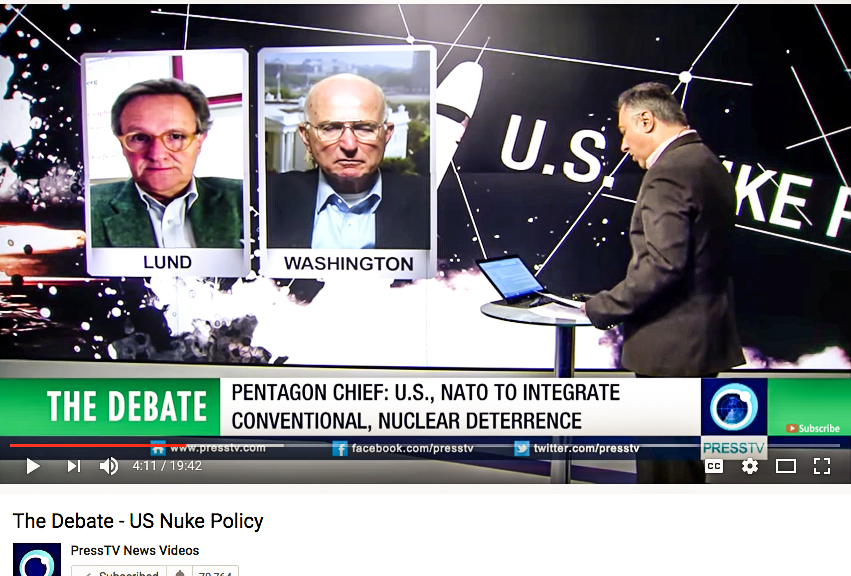
Last night I had the opportunity to discuss nuclear weapons with an experienced, high-ranking security analyst who has been both a military, a scholar, an assistant secretary of defence, presidential adviser, a corporate man and now a think tank member, Lawrence J. Korb.

We were discussing the issues touched upon in this and this article.

I would assume that the debate – facilitated by Iran’s PressTV in an excellent manner – is illustrative of the degree to which the world can be seen from different perspectives and how different we can perceive words such as law, legality, ethics, security, deterrence and peace.

I assume also that the debate illustrates the difference between a systems-embedded interpretation of the world and an independent or free perception, including what can and must be changed and what doesn’t have to change to make the world a better place.

Enjoy!

TFF PressInfo # 389: Ukraine as the border of NATO expansion

And why Russia doesn’t have to be a threat to the West

By Jan Oberg

TFF Series ”The New Cold War” # 7

If the Ukraine conflict is the centerpiece of the new 2nd Cold War, it is essential to ask: What really happened? What did NATO countries do to cause it? What did Russia do to cause it?
And – if you live in the West, in particular: Did we really have to end in this situation given Russia’s significant weakness over 25 years?
This article argues that the superior West could have played its cards differently and it’s time for self-critical soul-searching and just a little living yourself into the shoes of the other.
If peace rather than war is your true aim.

There was a beginning and a framework

The Ukraine conflict has a 25-years history. Instead of dissolving NATO, the alliance was expanded. Relieved from there being a Soviet Union and a Warsaw Pact, the alliance went as fast it could to do all it wanted. Remember, a series of WW III scenarios has been written in which that war would start with some uncontrollable event in Yugoslavia. Now it could be chopped up – freely and without risk. Serbia was bombed and Kosovo carved out without a UN mandate whatsoever (1999).

How did they think about that in the Kremlin at the time, one must wonder?

Clinton literally did not give a damn about all the promises made to Soviet leader Gorbachev by US leaders such as Bush, James Baker and German leaders including Hans-Dietrich Genscher. (Yes, they were not written down but confirmed by those involved and present).

He began the expansion of NATO in 1994 – in Georgia (see what I refer to elsewhere in this series). All around a Russia on its knees Americans were placed in the offices of prime ministers, defence and foreign ministers – I saw it myself in former Yugoslavia – and met CIA people in Croatia disguised as humanitarian workers. And had a long conversation with the representative of the US in Tblisi in 1994. Historical moment!

The bad Christians, the Orthodox, were the Serbs and Russians and Greeks – all should be antagonized and the good guys in Yugoslavia were those who had been on the fascist side in WWII – the leaderships in Croatia, Muslims in Bosnia and the Kosovo Albanians. The Serb minority that had lived 400 years as a minority in the Croatian republic were, in the common Western discourse, invaders masterminded by strongman Slobodan Milosevic – whom Clinton without hesitation called the new ’Hitler of Europe’.

Ukraine was – and remains – what its name says: the border areas (like Krajina in Croatia). This is where NATO can establish itself as little as Chruschev could get away with deploying nukes in Cuba – considerably further away from the US, but anyhow.

Imagine – with a little bit of empathy (not necessarily sympathy) how Washington would react if today Putin’s Russia was 12 times stronger militarily than the alliance-free US (NATO dissolved 25 years ago) and tried with his alliance of 27 other members to make Canada or Mexico the 29th member. Perhaps most people in the US and Europe would have some sympathy for the negative reaction of Washington. Rand remember, Trump wants to build a wall to Mexico…

The main reason, it is stated again and again, in the Western press, NATO and other political circles is: Ukraine and Crimea. The lie about Putin’s aggression on Ukraine is told so many times that it is becoming the truth. Just see these two recent articles by Newsweek as two of hundreds of articles.

Here’s the chosen story in politics and media alike

The narrative is simplified beyond recognition and goes like this:

Putin (there is always just one top guy in Western eyes and it is one leader at the top like Milosevic, Mohamed Farah Aideed, Saddam Hussein, Moammar Khaddafi, al-Assad) is a bad guy and you know that because out of the blue his suddenly annexed Crimea. By that he changes the borders of Europe and then he gets his disguised soldiers into Eastern Ukraine – a Ukraine that we, in contrast to Bush Senior, care very very much about today.

We care so much about it that Read More »

TFF PressInfo # 388: The War On Terror – A predictable fiasco

By Jan Oberg

This coming Sunday marks the 15th anniversary of what could be called the most counter-productive, if not stupid, war in modern history: The War On Terror. Today that war is much much more dangerous to the world’s future than the terrorists it is allegedly supposed to hunt down. And it has caused thousands of times more suffering, death and destruction – at least a million innocent people killed.

It’s not a war on terrorism but on terrorists and that is as smart as trying to fight all diseases by killing patients. It’s a war fought without any consideration of the one big question: Why did they do it and why do they do it? Media and politics only asking: Who did it? How was it done? Where? How to respond?

Without an intelligent, comprehensive diagnosis of 9/11 it could only go wrong. And it has.

The next problem was that ‘terrorism’ was suddenly defined by states as anything non-state that threatens society and states. Governments and the UN (which consists of them) conveniently omitted terrorism as a term for what states do and have done on a regular basis and on a much larger scale. Such as the nuclear balance of terror.

About 400 people were killed annually and worldwide before 9/11 according to US State Department statistics – reporting of that stopped in 2004 when figures soared after the War On Terror gained momentum. However, according to the 2015 Global Terror Index – the number is now 32,000 – and the far majority killed outside the West. So, the problem has increased exactly 80 times(!)

And the Western leaders who continue this war has no idea about how to stop it or do something more productive and intelligent to the world. Primitive tit-for-tat and disproportional responses has substituted what was once called statesmanship.

And it was predictable that it would be a fiasco!

Many both inside and outside the U.S. came up with Read More »

America, the threatened?

By Jonathan Power

September 6th 2016

The French ambassador to the US from 1902 to 1924, Jean-Jules Jusserand, observed that distant powers could not easily threaten the US because “On the north, she has a weak neighbour; on the south, another weak neighbour; on the east fish and on the west, fish”.

The coming of the submarine-based nuclear missile has not changed that. Apart from the fact that no enemy would dare use them for fear of retaliation, and that there is no country in the world that feels that hostile to America (accept North Korea), the fact is America is too big and too far away to be invaded and dominated. There could not be a blitzkrieg by a foreign army across the mid-west or a Vichy America.

The real tragedy of 9/11 is just as a majority of the US electorate had settled into a post-Cold War comfort zone with the new president, George W. Bush, not being overly pushy or confrontational in foreign affairs, America was jolted so badly that a large proportion of its electorate – maybe half – has been paranoid ever since. Enemies are once again seen under the bed.

Enough of the electorate have persuaded themselves that they are insecureRead More »

NATO:s nya, mer aggressiva kärnvapenpolicy

By Gunnar Westberg

Formuleringen “”NATO:s nya, mer aggressiva kärnvapenpolicy” har två grunder, nämligen de nya vapnen och de nya formuleringarna av doktriner.

Jag föreslår att vi, när vi talar om NATO och kärnvapen, använder formuleringar liknande den första meningen. Vill man förklara sig ger andra meningen ett svar. Men det är under alla omständigheter bra om man har tillgång till nedanstående argument:

De gamla B61 var symboliska vapen. De skulle, enligt ofta upprepade försäkringar, inte användas. De var en pant på att USA inte skulle överge Europa vid ett sovjetiskt/ryskt anfall. USA har föreslagit att dessa vapen skulle tas bort, men öst-europeiska NATO-medlemmar och framför allt Frankrike (!) har starkt reagerat emot.

De nya vapnen är B 61-12. Denna bomb skiljer sig från tidigare versioner av B61 som var ”gravity bombs”, d v s föll fritt från bombplanet. B 61-12 är styrbart och har därför en träffsäkerhet inom 30 m radie. B 61-12 har en variable laddning på 0,3-340kt. Bomben förefaller vara kapabel att penetrera mer än 3 m vanlig jord innan den detonerar. Effekten på djupet blir därför flera gånger större än en bomb av motsvarande laddning skulle ge utan penetrerande förmåga.

B 61-12 blir alltså ett effektivt vapen mot vissa underjordiska mål. Bomberna har sannolikt en plats i nya, ännu inte offentliga doktriner om kärnvapen-användning, i motsats till avskräckning. Read More »

The sky above Turkey has much blue in it

By Richard Falk

August 10, 2016

Prefatory Note
An earlier version was published by Middle East Eye on August 10, 2016. It seems so important at this time for the sake of the future of Turkey that the West look at the country and its political circumstances in a far more balanced way than how the situation has been portrayed since the coup. How to explain this imbalance is another matterthat should be explored at some point, but for now is largely put aside.

Much uncertainty remains in Turkey, but there is enough evidence of positive tendencies to raise a tentative banner of hope. Being a witness to the political atmosphere in Turkey that has emerged after the failed coup of July 15th puts me at odds with the secular consensus in the West, which looks up at the sky and sees only dark, ominous clouds of human rights abuse and autocratic leadership.

What I have experienced and observed so far is quite different, a sky with much blue in it.

There are two opposed, although overlapping, tendencies present that seemed to be responsive to the political priorities that top the post-coup government agenda: sustaining the anti-coup unity by shifting political gears within the AKP leadership circles in the direction of “inclusive democracy” and pragmatism, and with it, a retreat from the polarizing claims of “majoritarian democracy” that greatly intensified after the 2011 national elections and were particularly evident in the clumsy, unacceptable way the Turkish government handled the Gezi Park demonstrations two years later.

The most important concrete embodiment of this post-15 July move toward inclusiveness has been a series of initatives intended to create a common front between the three leading political parties in the country, including the CHP (secular mainstream) and MHP (nationalist rightest) opposition parties.

This has been reinforced by several other developments,Read More »

The global power imbalance

By Johan Galtung

Dear Reader: This editorial 444 – the number calls for attention – is dedicated to a global overview, the world “right now”, so unstable with imbalances everywhere that what we are living is fluxes and jumps.

Let us start with two major relations: Nature-human, the US-the Rest.

Look at the human-nature relations.

We are used to being on top, killing and taming animals, protected against many of nature’s hazards including micro-organisms. But nature comes up with ever smaller viri, and larger, or more, tsunamis and earthquakes, and an erratic climate.

We oscillate between blaming ourselves, including military scheming, and the anthropomorphic “Mother Nature is angry” (Evo Morales).

If nature is angry, she has good reasons for a good riddance of us. And we are slow at a deeper human-nature relations respecting and enhancing both.

Nature is on top and our natural sciences are simply not good enough, taken by surprise all the time. Meteorology is good at covering the whole Beaufort wind range from 0-12; others not.

Maybe we have desouled nature and besouled ourselves too much to establish our own Herrschaft (rule, dominance), at the expense of Partnerschaft (partnership).

Unless this changes, imbalance with nature on top, and surprises, will continue.

Maybe the opposite holds for the US-Rest imbalance; that US exceptionalism serves USA as badly as humans above nature serves us?Read More »

TFF PressInfo # 385 – How did Western Europe cope with a much stronger Soviet Union and Warsaw Pact?

By Jan Oberg

TFF Series ”The New Cold War” # 6

How did Western Europe survive the much stronger Soviet Union & Warsaw Pact 30-40 years ago? A pact that had about 70% of NATO’s military expenditures where today’s Russia has 8%? How did we get on after the Soviet invasion of Hungary and Czechoslovakia – and a Union with much more global military and political influence?

Europe did so through a well-maintained military capacity, or superiority, technical superiority and, of fundamental importance to security – confidence-building measures (CBM).

And through a political leadership by personalities who knew what the 2nd World War had implied and why it must never happen again. One towering figure of course being Willy Brandt, the German chancellor who had himself been a refugee in Norway during the war.

CBMs were meant to both uphold a high level of war-fighting capacity while also seeking military early information/warning, attending each other’s military exercises, etc. They resulted in the establishment of the very important OSCE – Organisation for Security and Co-operation (then C for Conference) in Europe with the Helsinki Final Act of 1 August1975. It contained politico-military, economic, environmental and human rights dimensions – ’baskets’ that were seen as related to each other and which served as dialogue points between the two blocs.

The visionary President Urho Kekkonen of Finland was credited as the main architect of the CSCE – and his Finland was neutral but upheld a co-operation agreement with the Soviet Union.

Finland was also the only country in the European space that could show opinions polls according to which the people felt equidistant to both blocs.

The simple but brilliant idea was this: We need dialogue to feel secure. It was also called Detente. And it implied a disarmament dimension – negotiations about how to mutually scrap weapons in a measured and verifiable manner that both sides had decided they no longer needed.

These negotiations included not only conventional weapons but also the arsenals of nuclear weapons.

In the domain of nuclear weapons, the Non-Proliferation Treaty, NPT, was signed in 1970 and carried four very important provisions:

1) the world shall move towards general and complete disarmament and the nuclear weapons shall be abolished;
2) those who have nuclear weapons shall negotiated them down, in principle to zero and
3) as a quid pro quo for that all non-nuclear weapons shall abstain from obtaining nuclear weapons – and
4) countries who want nuclear energy shall be assisted to introduce this civilian energy technology.

All this happened in the era of Detente and CBM. How had that become possible? Read More »

The new Cold War

By Jonathan Power

August 9th 2016

Nearly everyone I talk politics to says the world is in a mess. But I live in a student town – Lund in Sweden – and most of them have nothing to measure their opinions against. They know not much about the Cold War, the Cuban missile crisis, Watergate or the great famines in Africa and India.

In many ways most of us live in the best of times, on better incomes than our parents, with longevity increasing all over the world, not least in the poorer countries and helped by inventions that our parents never dreamt were possible.

As for war, as each year goes by less people are killed, UN peacekeeping is more advanced and sophisticated than before, Russia and the West, although at loggerheads over Ukraine, worked together to get Iran to give up its nuclear plans and are talking now about how to cooperate against ISIS.

However, it is true overall things don’t look good in Syria, Ukraine, Egypt, Afghanistan, Saudi Arabia, Iraq, Turkey and Southern Sudan but the rest of the world looks reasonably peaceful. Russia and the US are overloaded with nuclear weapons and appear to have put future agreements on big reductions on the shelf. Nevertheless, they have already reduced the total number of nuclear-tipped missiles from 70,000 to 16,300 and placed limits on large standing armies in Europe.

Arguably the biggest problem in the world today is that the political elite and much of the media in both Russia and the US (less so in Europe) are gearing up for a new Cold War. A dispassionate conversation between the two sides becomes ever more difficult.Read More »

Europe right now – EU, Russia

By Johan Galtung

It does not look good. The key problem is not Brexit, the unlikely victory of older English longing back to the Land of Hope and Glory–not made invisible by a cloak of EU–against nothing less than the City of London using the EU for their purposes.

The Leavers are deceiving themselves; they will be more “special relationed” to USA than ever now that USA has lost their “link to the continent”. And the Remainders will find their ways, more of them will be operating out of Brussels, Luxembourg, Strasbourg and other key points in the EU.

The problem is, “Can Germany lead Europe alone?” (Anna Sauerbrey, INYT 5 Jul 2016). Her conclusion: “Germany may have to take command, after all… being at center stage, it might as well perform”.

But how?

The present EU structure has Germany on top, then the Nordic members weakened by Brexit, then the Latin countries with France and Ireland, then the Eastern European members of whom solidarity is demanded for the crimes of the others leading to mass migration, and at the bottom Greece tortured by EU. A Europe under German leadership was among the goals of both WW1 and 2.

On June 2 the German Parliament recognized the Armenian genocide; during WW1 when the German Empire was an ally of the Ottoman Empire. But no recognition of the German genocide of about 75,000 Herero-Nama in Namibia 1904-1908, by poisoning wells used by women and children.

A simple, crystal-clear case. The former is complex, with Turks also asking Kurds to get rid of Armenians by a death march for many through the desert to Lebanon in return for freedom for the Kurds. Which they did not get, but many live in Turkey where Armenians lived.

A Germany not coming to grips with its past cannot be trusted. And: “A sincere confrontation with the past makes a country stronger” (Colonialism Reparation-Newsletter Jul/16). As the Herero-Mama insist: “A lasting solution about us /cannot be negotiated/ without us.”

As to EU itself: the expansion in scope–membership–and domain–functions–did not work. Some contracting may work better. Brexit clears the ground for US-independent foreign military policy, for better and for worse. A two-speed EU may be on the horizon, tighter for some, looser for others. Better adjusted to realities.

But Europe is ridden by another age-old conflict looming large or larger: EU with Russia. Or, more basically, Catholic-Protestant Europe against Orthodox Europe, the borderline being inside Ukraine. Is there some way that out of several conflicts we may build peace?Read More »