Is ISIS on the wane?

By Jonathan Power

Within a matter of days a self-appointed ISIS “lone wolf”, Omar Mateen, with no actual links to home office Isis has created mayhem in Orlando, Florida, with his killing of 49 people in a gay club, and the Iraq army has pushed Isis troops out of most of the important city of Falluja.

Maybe it is an exaggeration to say that ISIS is on the run its bailiwicks of Iraq and Syria but it is certainly taking very bad hits. Two years after sweeping through northern Iraq and capturing the oil city of Mosul in 2014 they are now on the defensive. ISIS has lost nearly half of the Iraqi territory it held. (i.e. an area about half that of the UK). It has lost much of its oil infrastructure.

It is taking lots of casualties. In Syria it is fighting on two contradictory fronts – the regime in Damascus, supported by Iran and Russia and against the non-Islamist rebels, supported by the US and the Arab states.

Meanwhile the flow of foreign fighters on which it has depended is slowing up and large numbers are returning home. Funding is drying up.

This indeed is why Mateen, the lone wolf, is so important to ISIS. ISIS spokesman, Abu Muhammad al-Adnani, has asked ISIS sympathisers to stay where they are. “The smallest action you do in the heart of [your] land is better and more enduring to us than what you would do if you were with us.”

Is this a switch in tactics? We do not know yet.

What we do know is Read More »

TFF PressInfo # 378: A new Cold War between Russia and the West?

By Jonathan Power

June 7th. 2016.

The second article in the TFF Series on The New Cold War

George Orwell, the author of “Animal Farm” and “1984”, was the first person to use the phrase “Cold War” in a 1945 newspaper article, written just after the nuclear bombing of Hiroshima and Nagasaki. He argued that “the surface of the earth is being parceled off into three great empires, each self-contained and cut off from contact with the outer world, and each ruled, under one disguise or another, by a self-elected oligarchy. He counted the US and Western Europe as one, the Soviet Union as the second and China as the third. He concluded that, “the atomic bomb is likeliest to put an end to large-scale wars at the cost of prolonging indefinitely a peace that is no peace”.

I think he got it nearly right – or so it seems as a new Cold War erupts between the West and Russia and China spars with the US over the South China Sea and its islands.

Of course it’s more complicated than that. China and Russia have a fair relationship. China and the US are perhaps doing nothing much more than annoying each other and the bonds of commerce and student exchanges bind both the elites and the populaces close together.

To me a new Cold War is nonsense on stilts. Even more than the original one.

George Kennan, the US former ambassador to Moscow and the author of how to contain the Soviet Union, always insisted that Stalin had no intention of rolling his tanks into Western Europe. As Robert Legvold summarizes Kennan’s views in his interesting new book, “Cold War”, “The threat the Soviet Union posed was political, a threat accentuated by these countries’ vulnerability to Soviet subversion because of their economic frailty and political instability – a threat requiring a political and economic response, not a military one”.

In 1948 Kennan wrote, as he observed the creation of Nato, “Why did they [Western leaders] wish to divert attention from a thoroughly justified and promising program of economic recovery by emphasizing a danger which did not actually exist but which might be brought into existence by too much discussion of the military balance and by the ostentatious stimulation of military rivalry?”Read More »

East Asia: Four formulas for peace

By Johan Galtung

Kyoto, Japan

An East Asia of 6 states, 5 from the 6-Party Talks + Taiwan. The 6 in East Asia divide into South Korea-Taiwan-Japan in the US-led alliance AMPO+ (USA-Japan Security Treaty+); North Korea; China-Russia with others in SCO (Shanghai Cooperation Organization). AMPO+ with US “nuclear umbrella”, the other two may acquire nukes; North Korea with nukes; and SCO with two nuclear powers. Put it all together: A nuclear arms race.

Arms races may deter, but often end with wars. Wars mean trauma for losers and glory for winners. PTSD – post trauma stress disorder – may lead to thirst for revenge, and PGED – post glory exuberance disorder – to thirst for more glory. War, war, war. Worse than ever since WWII.

East Asia badly needs another approach.

As a minimum, the four tasks in the TRANSCEND peace formula: the negative peace of conciling traumas and solving conflicts; the positive peace of cooperation for mutual and equal benefit-equity-and harmony based on empathy.

Unconciled traumas and unsolved conflicts:

Japan/USA over FDR provoking Japan into war, Pearl Harbor, fire-bombing/nuclear genocide (Obama fell far short of Willy Brandt genuflexing in Warsaw for the genocide on Jews); Japan/Russia over Russian expansionism and the war; Japan/Taiwan-Korea-parts of China for uninvited, not colonialism, but japanization; Japan/SK – a carbon copy of Japan – with hysterically anti-Japanese policies (not in Pyonyang) demanding ever more apology and money. But Japan-SK “comfort women”, like Japan-China Nanjing, are complex; international commissions may sort facts from fiction.

Japan/China slave labor seems solved (Japan Times 2 Jun 2016).

NK/USA-SK: normalization-nuclear free Korea vs NK collapse.

Then Japan vs Russia, Chinas, Koreas over the contested islands.

Then USA polarizing East Asia, more tension, micro-managing.

Most problematic: Japan, USA; least: Russia. Read More »

TFF PressInfo # 377- Intro to a series: The New Cold War

By Farhang Jahanpour

The first article in a TFF Series on The New Cold War

There are many ominous signs that dark clouds are gathering over international relations, from the South China Sea, Taiwan, Vietnam, Japan and South Korea to the Middle East, and to Ukraine and the Baltics. We are entering a new and perhaps a more ominous Cold War.

This is something that will affect all our lives and will plunge us into a new era of East-West confrontation that none of us wants and that all of us should try hard to prevent.

Many young people were born after the end of the Cold War or were too young to remember its horrors, and how the world was on a knife’s edge about a possible global confrontation between the two superpowers with thousands of nuclear weapons whose use could have ended human civilization. We, who remember those days, should make sure that we do not see a repetition of that dark period in human history.

Yet, sadly, a Cold War mentality is once again creeping back into political discourse.

The Second World War that killed more than 60 million people and devastated many countries had hardly ended when new hostilities emerged. The dropping of the atomic bombs on Hiroshima and Nagasaki was not so much the final act in the Second World War as the opening shot in the Cold War. Contrary to the stated justifications for the dropping of the bombs as a means of forcing Japan to surrender, it is now clear that Japan was ready to surrender before the use of those awful weapons.

Many historians believe that the real reason for the use of nuclear weapons was to prevent Japan falling into the hands of the Soviet Union, as the Red Army was poised to take on Japan’s remaining army in Manchuria, thus forcing Japan to surrender to Russia. Furthermore, it was a clear signal of the West’s possession of the new devastating weapons.

For instance, the scientist Leo Szilard who met with US Secretary of State James F. Byrnes in May 1945, reported later: “Byrnes did not argue that it was necessary to use the bomb against the cities of Japan in order to win the war … Mr. Byrnes’ view was that our possessing and demonstrating the bomb would make Russia more manageable.” (1)

Therefore, far from wanting to save lives, the use of nuclear weapons was to demonstrate America’s overwhelming military might, and to issue a warning to Russia.

The war had hardly ended when in a speech in the British House of Commons on 16 August 1945 Winston Churchill referred to “the iron curtain which at the moment divides Europe in twain.”

It was in view of those ominous events that mankind decided to create international organizations that would “save succeeding generations from the scourge of war, which twice in our lifetime has brought untold sorrow to mankind.” The Charter of the United Nations aimedRead More »

Nordic family meets with Big Brother Obama in his nice White House

By Gunnar Westberg

Very pleasant meeting. We all agreed on everything. We follow you, Big Brother, in all your ventures, we are so happy you like us.

Reports and family pictures have appeared in media from a dinner with 350 guests. Nice laudatory speeches, not a disturbing critical word.

There is a final document on everything that was agreed, already beforehand.

I recommend no one to read the paper, you can’t, it is such a soporific (= tending to induce drowsiness or sleep).

No journalist has so far given an overview, they fell asleep too, I guess. The section on Environment and on Energy seems good, but nothing new. The failure of the USA in energy conservation is not allowed to disturb in this Feel good report.

The section on Defence and Security is, however, very depressing. Read More »

TFF PressInfo # 375 Close calls: We were closer to nuclear destruction than we knew (2)

By Gunnar Westberg

The proposition that nuclear weapons can be retained in perpetuity and never used – accidentally or by decision – defies credibility”.

Other serious close calls

In November 1979, a recorded scenario describing a Russian nuclear attack had been entered into the US warning system NORAD. The scenario was perceived as a real full-scale Soviet attack. Nuclear missiles and bombers were readied. After six minutes the mistake became obvious. After this incident new security routines were introduced.

Despite these changed routines, less that one year later the mistake was repeated – this time more persistent and dangerous. Zbigniew Brzezinski, the US national security adviser, was called at three o’clock in the morning by a general on duty. He was informed that 220 Soviet missiles were on their way towards the USA. A moment later a new call came, saying that 2,200 missiles had been launched.

Brzezinski was about to call President Jimmy Carter when the general called for a third time reporting that the alarm had been cancelled.

The mistake was caused by a malfunctioning computer chip. Several similar false alarms have been reported, although they did not reach the national command.

We have no reports from the Soviet Union similar to these computer malfunctions. Maybe the Russians have less trust in their computers, just as Colonel Petrov showed? However, there are many reports on serious accidents in the manufacture and handling of nuclear weapons.

I have received reliable information from senior military officers in the Soviet Union regarding heavy use of alcohol and drugs among the personnel that monitor the warning and control systems, just as in the USA.

The story of the “Norwegian weather rocket” in 1995 is often presented as a particularly dangerous incident. Russians satellites warned of a missile on its way from Norway towards Russia. President Yeltsin was called in the middle of the night; the “nuclear war laptop” was opened; and the president discussed the situation with his staff. The “missile” turned out not to be directed towards Russia.

I see this incident as an indication that when the relations between the nuclear powers are good, then the risk of a misunderstanding is very small. The Russians were not likely to expect an attack at that time.

Indian soldiers fire artillery in northernmost part of Kargil region

Close calls have occurred not only between the two superpowers. India and Pakistan are in a chronic but active conflict regarding Kashmir. At least twice this engagement has threatened to expand into a nuclear war, namely at the Kargil conflict in 1999 and after an attack on the Indian Parliament by Pakistani terrorists in 2001.

Both times, Pakistan readied nuclear weapons for delivery. Pakistan has a doctrine of first use: If Indian military forces transgress over the border to Pakistan, that country intends to use nuclear weapons.

Pakistan does not have a system with a “permissive link”, where a code must be transmitted from the highest authority in order to make a launch of nuclear weapons possible. Military commanders in Pakistan have the technical ability to use nuclear weapons without the approval of the political leaders in the country. India, with much stronger conventional forces, uses the permissive link and has declared a “no first use” principle.

The available extensive reports from both these incidents show that the communication between the political and the military leaders was highly inadequate. Misunderstandings on very important matters occurred to an alarming degree. During both conflicts between India and Pakistan, intervention by US leaders was important in preventing escalation and a nuclear war.Read More »

TFF PressInfo # 374: Close calls: We were closer to nuclear destruction than we knew (1)

By Gunnar Westberg

The proposition that nuclear weapons can be retained in perpetuity and never used – accidentally or by decision – defies credibility”.

This unanimous statement was published by the Canberra Commission in 1996. Among the commission members were internationally known former ministers of defense and of foreign affairs and generals.

The nuclear-weapon states do not intend to abolish their nuclear weapons. They promised to do so when they signed the Nuclear Non-Proliferation Treaty (NPT) of 1970.

Furthermore, the International Court in The Hague concluded in its advisory opinion more than 20 years ago that these states were obliged to negotiate and bring to a conclusion such negotiations on complete nuclear disarmament.

The nuclear-weapon states disregard this obligation. On the contrary, they invest enormous sums in the modernization of these weapons of global destruction.
It is difficult today to raise a strong opinion in the nuclear-weapon states for nuclear disarmament. One reason is that the public sees the risk of a nuclear war between these states as so unlikely that it can be disregarded.

It is then important to remind ourselves that we were for decades, during the Cold War, threatened by extinction by nuclear war. We were not aware at that time how close we were.

In this article I will summarize some of the best-known critical situations. Recently published evidence shows that the danger was considerably greater than we knew at the time.

The risk today of a nuclear omnicide – killing all or almost all humans – is probably smaller than during the Cold War, but the risk is even today real and it may be rising. That is the reason I wish us to remind ourselves again: as long as nuclear weapons exist we are in danger of extermination.

Nuclear weapons must be abolished before they abolish us.

Stanislav Petrov: The man who saved the world

1983 was probably the most dangerous year for mankind ever in history. We were twice close to a nuclear war between the Soviet Union and the USA. But we did not know that.

The situation between the USA and the Soviet Union was very dangerous. In his notorious speech in March 1983, President Reagan spoke of the “Axis of Evil” states in a way that seriously upset the Soviet leaders. The speech ended the period of mutual cooperation, which had prevailed since the Cuba Missile Crisis.

In the Soviet Union many political and military leaders were convinced that the USA would launch a nuclear attack. Read More »

China’s Silk geopolitics

By Johan Galtung

China is changing world geography, or at least trying to do so.

Not in the sense of land and water like the Netherlands, but in the sense of weaving new infrastructures on land, on water, in the air, and on the web. It is not surprising that a country with some Marxist orientation would focus politics on infrastructure–but as means of transportation-communication, not as means of production.

Nor is it surprising that a country with a Daoist worldview focuses politics on totalities, on holons and dialectics, forces and counter-forces, trying to tilt balances in China’s favor. How this will work depends on the background, and its implications.

Two recent books, Valerie Hansen, Silk Road: A New History (Oxford University Press, 2012) and Peter Frankopan, The Silk Roads: A New History of the World (Knopf, 2015) see them as arteries connecting the world, globalization, before that term became a la mode. Not that loads of goods moved all the way in both directions, parts of the way, maybe further. Europe had much less to offer in return; however:

“Viking traders from–Norway–coarse, suspicious men, by Arab account–were moving down the great rivers of Russia–trading honey, amber and slaves–as early as the ninth century–returning home to be buried with the silks of Byzantium and China beside them”. (Frankopan)

The Silk Roads – so named by the German geographer von Richthofen in 1877 – connected China and Europe (Istanbul) over land from -1200; more precisely from Xi’an to Samarkand by a northern and southern road (Hansen for maps). And the Silk Lanes connected East China and East Africa (Somalia) from +500 till +1500 when Portuguese-Spanish and English naval expansion started a Western takeover by colonization.
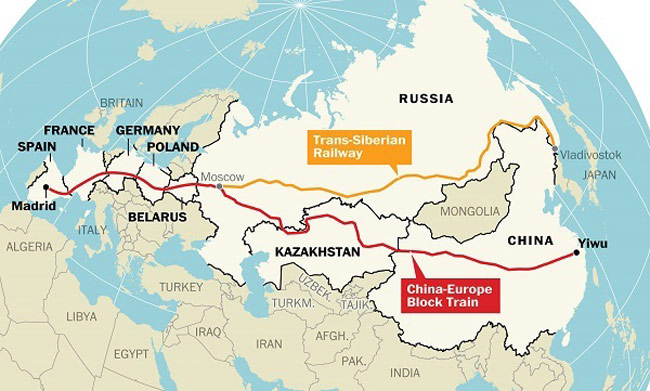
The modern Silk Road East-West, Yiwu/China to Madrid/Spain. Although the transit time for goods or people to transit the route is 21 days, this is 30 days faster than a ship and is 1/10 the cost of shipping freight. See www.bulwarkreview.com

For long periods run by Buddhists in the East and Muslims in the West; Islam using them to expand, from Casablanca to the Philippines. Frankopan sees the high points in the Han dynasty (-207-220, capital Xi’an for West Han), the Tang dynasty (618-902, capital mainly Xi’an) and under Mongolian, Yuan rule–for goods, ideas, faiths, inventions.

Xi’an, 3,000 years old, served as a starting point, both for Silk Roads and for the Silk Lanes, traveling the Yangzi River, or over land, to the East China Sea coast. Till the military uprising against the Tang emperor in 755 (Hansen, Ch. 5, “The Cosmopolitan Terminus on the Silk Road”); but Xi’an is destined always to play major roles.

China is now reviving the past, adding Silk Railroads from East China to Madrid via Kazakhstan-Russia-Belarus-Poland-Germany-France, to Thailand, from East to West Africa–from the Indian Ocean to the Atlantic–from North to South Africa. Silk Flights. And Silk Web.

A silky cocoon is being woven, by worms in China. Too much?

Two features stand out in this approach to geopolitics.Read More »

Mass migration, the EU and European nationalisms

By Johan Galtung

Antwerpen & Alfaz

We are dealing with mass migration, basically into EU, and European nationalisms, many in favor of exits from the EU.

Why this mass migration, maybe to the point of Völkerwanderung, mainly into EU – but then what kind of EU? – and why the European nationalisms now found one way or the other in many member states?

The forecast for migration from Africa into Italy in 2016 is about 100,000; 28,000 already arrived in the first quarter, with 1,000 drowning in the Mediterranean (INYT, 6 May 2016). Big numbers. They knew the risks they were taking, so the push away from Africa and the pull towards Italy, and beyond, must have been considerable.

Better think in terms of 50 million migrants over 50 years, from regions considered uninhabitable to inhabitable regions. There seem to be five major causes underlying this basic world asymmetry:

Slavery, four centuries, depriving societies particularly of able-bodied males, by Arabs, then Westerners, cross-Atlantic transportation mainly by the English (Liverpool);

Colonialism, by Muslims after the death of the prophet in 632, from Casablanca to Southern Philippines, till the end of the 15th century, close to nine centuries, then by Christians close to five centuries, till colonialism was officially ended in the 1960s;

Robbery Capitalism, stealing or paying next to nothing for resources processed into manufactured goods, pocketing the value added;

Wars, mainly initiated by the West, killing millions (the USA more than 20 million in 37 countries after WWII), destroying property;

Ecological Factors, like depletion-pollution, often toxic for humans or nature, erratic climate partly due to climate gases, NOX, CO2, CH4.

These are the causes of poverty in some parts of the world but also of wealth in others; Read More »