Peace State Iceland – Meaning what?

By Johan Galtung
May 2, 2016

Dear Members of the Iceland Allthing Foreign Affairs Committee,

I have been asked to come to Iceland to answer that question; thanks indeed for inviting me to address you. And to apologize, as a Norwegian, for our occupation of Iceland 1262-1386 instead of sending mediators to help settle your civil war. Our century long colonization does not become better because Denmark colonized you five centuries, 1386-1918; and more deeply. But you are now your own, with a wonderful language and literature; right now with a problematic economy and polity.

Reykjavík has a very good name internationally as the venue of the 11-12 October 1986 summit meeting of the Cold War superpowers. The meeting of US President Ronald Reagan and the Soviet Secretary General Mikhail Gorbachev at Höfdi did not by itself end with an agreement. But it was the beginning of the end of the Cold War three years later, and as such made world history.

So why not build on that, making a Reykjavik Mediation Center, RMC, politically and internationally independent, and on Iceland’s location between West and East, USA and Russia? Look at the map.

For Reykjavík to invite USA and Russia, with Kiev and Donetsk. Maybe also Brussels, in the sense of NATO and EU. Issue: the conflict in and around Ukraine–meaning “at the border”, between two nations, Catholic-Ukrainian and Orthodox-Russian; with much hatred and violence.

Very dangerous, some speak of a Third World War coming. Inviting them would be a signal of world concern, offering a venue for open talks without conditions. Iceland has little mediation capacity today, but Icelanders would be present and learn from the occasion.

Add to this an invitation to the UN to station UN Peacekeeping Forces in Iceland, using the vast vacant lands between Keflavík and Reykjavík for training. That would add peace as a source of income to fisheries and tourism, and lift Iceland out of its Third World economy.

A peace state helps itself by helping others. Nevertheless, two problems:

First, a peace state can neither be allied to a state that killed more than 20 million in 37 countries since WWII nor member of an offensive alliance. Either the USA and NATO become more defensive or Peace State Iceland has to distance itself, gradually, carefully; keeping good relations. Iceland’s security would be better served by using Keflavík for UNPKF than for USA-NATO, and by solving conflicts.

Second, if you want to help solving conflicts start with your own. Read More »

A nonkilling, nonviolent world is not unrealistic – We can choose!

By Mairead Maguire

Address by Mairead Maguire, Nobel Peace Laureate and TFF Associate, to Rome Conference on NATO
Friday 29th January, 2016.

Dear Friends,
I believe we, the human family, have no less a task before us, than transforming our thinking and mind-sets of violence and war, and moving to a demilitarized Europe and World. Einstein once said that everything has changed but our thinking. However, there is hope as indeed our thinking is changing and there is a growing consciousness that violence, whether it comes from State or non-state actors, is wrong, violence does not work, violence is not the way.

However, around the world, we, the people, are in danger of being overpowered and dis-spirited by increasing violence, militarism and war. Many people can see that many Political Leaders can no longer imagine a just peace, and under the guise of allegedly ‘just wars’ and unbounded preparation for war, they are leading us into repeated cycles of violence profoundly counter to the spirit of love and friendship residing in the heart of humanity.

But there is Hope and it resides with the People, who are great and are mobilizing and uniting across the Globe to bring about much needed change, and rejecting violence and war.

The World Health Organization has said that ‘Violence is a preventable disease’ and people are not born violent, rather we all live in cultures of violence. This can be changed through nonviolent peacemaking and the pursuit of ‘just peace’ and nurturing of cultures of peace. Using active nonviolence, based on love of enemies and nonkilling, can bring about a real peace that is just, inclusive and sustainable.

In Northern Ireland we faced violence from all sides, for over thirty years, as we lived in a deep ethnic/political conflict. This violence only ended when everyone acknowledged that militarism and para-militarism could not solve our human problems, and only through unconditional, all inclusive dialogue and negotiations could we reach a political agreement based on nonviolence, forgiveness, compromise and co-operation.

We spoke to ‘our enemies’ and made peace with them, because we recognized that without Peace nothing is possible, and with Peace, everything is possible.

We also began to tackle the root causes of our violence, by making painful policy changes.

Today in Belfast, it is good for all its citizens to live in a City at Peace, but we all acknowledge that our Peace process is a work in progress and we continue to work on justice forgiveness and reconciliation.

We meet at a time when, I believe, Europe is facing a cross-roads and hard choices regarding policies and priorities have to be made by all. Today’s refugees, migrant challenge, has shown the best and the worst of European values, via television beamed onto our screens to the world.

The best have been the compassionates response Read More »

How ought we treat each other?

By Johan Galtung

Upon receiving the Gandhi-King-Ikeda Community Builder Prize

Atlanta, 31 Mar 2016

Dear President, dear Dean of Morehouse College, Ladies and Gentlemen,

I am deeply honored by the prize from a college in Georgia, in the US South, that has been and is a beacon in the struggle from dominion to dignity in race relations. The civil rights movement is an American Revolution, like the feminist movement it inspired–aiming at parity and dignity for all. To refuse sharing the spoils of exploiting Reds and Blacks and poor Whites with London was far from a revolution.

This college shaped Dr Martin Luther King Jr. I had the honor of meeting him twice here in Atlanta in 1960–working on desegregation without violence in Charlottesville, VA–and in 1964 in Oslo when he received the Nobel Peace Prize. This College made him use Gandhi’s clinging to truth through nonviolent struggle, satyagraha, lifting 20 million Blacks into dignity. There is a backlash: Blacks are again shot at, and used as slave labor in prisons. The struggle continues.

Building communities. There are at least two of them, the community of people, and the community of states. I will deal with both and share with you in this speech the basic ideas of TRANSCEND mediation – an NGO of more than 500 invited members, comfortable with our mantra, “Peace by Peaceful Means”. Transcend means going beyond.

Let us approach answering the question through some words on how we ought not treat each other.

It is all in our thought habits, the deep culture of our thinking. In the West we think in simple dichotomies, like positive/negative, good/bad, even evil. Either one or the other, not in-between, neither-nor, both-and. And we very easily fall into the trap of seeing ourselves as only good, and someone else as only bad, steered by God or Satan. The road to narcissism, self-love and paranoia, seeing threats everywhere, is short. Victory! not solution.

AND Narcissism + Paranoia = Psychosis, the psychiatric diagnosis.

To escape from this thought habit use ancient Chinese habits. Yin/Yang. They also think positive/negative, good/bad; but add more levels, like the positive and negative in the positive and negative, the good and bad in the good and bad. That opens for identifying the negative in Self and the positive in Other; for positive-peaceful, not negative-violent relations. Not either-or; but both-and, neither-nor.

The TRANSCEND formula: focus on the positive, good in everybody including yourself; but keep the negative, bad in the back of the mind to improve it and as possible danger, to Self and-or Other.

Then create projects linking good with good; first as vision, then reality.Read More »

TFF PressInfo # 369 – A Sunni-Salafist-Zionist Coalition Changing Middle East?

By Jan Oberg

Please try Google “Gulf states want nuclear weapons against Iran – Israel “ and only one Western mainstream media will appear, an excellent article by The Telegraph’s Raf Sanchez in Jerusalem.

The only other media carrying the story is Russia Today and Vigilant Citizen and MintPress News also carries the story and offers a wider background

What is this about?A new coalition?

So the usual Western media filter, meaning it must be interesting. And it is a quite sensational story: Saudi Arabia and Israel are up to a nuclear mischief against a country that has just been prevented from acquiring nuclear weapons by means of a huge legally binding document, UN Security Council endorsement and extremely tight monitoring mechanism. What’s it about?

It’s about Israel’s defence minister Moshe Ya’alon saying in public at the recent Munich conference that Arab states are “not willing to sit quietly with Iran on the brink of a nuclear bomb”.

He thinks that Iran was liable to break the agreement as their economic situation improves with the lifting of international sanctions. Ya’alon is quoted as saying that “I speak about the Gulf states and North African states too…For them, Iran and the Muslim Brotherhood are the enemy. Iran is the bad guy for us and for the Sunni regimes. They are not shaking hands [with Israelis] in public, but we meet in closed rooms.”

So not only Jordan’s monarchy and Egypt’s dictatorship but also Gulf and North African states: A coalition lead by Saudi Arabia and Israel – Israel as the only nuclear weapons power in the region and Saudi Arabia as the most likely next nuclear weapons state.

For much too long the world’s attention has been on Iran’s imagined nuclear weapons, not on the dozens or hundreds real nukes that Israel possesses as a non-member of which is the Non-Proliferation Treaty (NPT).

One can say that Israel and Saudi Arabia lost the political battle against the nuclear deal with Iran concluded with the five permanent UNSC members and Germany last year – and now will do their utmost to use Iran’s non-nuclear weapons status as a pretext for others going nuclear against, predominantly, Iran.

Propaganda hysteria dominates in an age where knowledge plays a diminishing role

The problem for them, however, is that Iran will be difficult to sell as a real threat – but we live of course in Read More »

TFF PressInfo # 366: Russian Withdrawal from Syria: Could it be the beginning of the end?

By Farhang Jahanpour

On Monday 14 March, in a surprise move and without any warning to Western leaders, President Vladimir Putin ordered the withdrawal of the “main part” of Russian forces from Syria, and instructed his diplomats to speed up the push for peace. “The effective work of our military created the conditions for the start of the peace process,” he said. “I believe that the task put before the defense ministry and Russian armed forces has, on the whole, been fulfilled.”

He added that with the participation of the Russian military, Syrian armed forces “have been able to achieve a fundamental turnaround in the fight against international terrorism.”

According to Western reports, Russian forces are already being prepared for flights back to Russia and equipment is being loaded onto cargo planes.

Although President Putin’s sudden announcement has given rise to a great deal of surprise and some false assumptions in the mainstream Western media and among political pundits, his decision is a timely, bold and constructive move that may result in some positive developments in the long-running catastrophe in Syria.

One of the reasons for the negative and cynical comments about the Russian move is that in five months President Putin has achieved more in halting the advance of the terrorists in Syria than the West had achieved in five years, if indeed it had been the West’s real intention to defeat the terrorists.

The Syrian uprising started with demonstrations on 28 January 2011 in Damascus and Aleppo in the wake of the “Arab Spring” in Tunisia and Egypt.Read More »

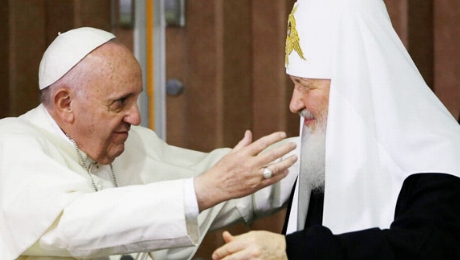
A pope, a patriarch, a spiritual revolution

By Johan Galtung

The first editorial here at Transcend of March 3 2008, “50 Years of Fidel Castro” celebrated a political revolution that changed the world, and spelt the end of US-Western imperialism. This editorial celebrates a spiritual revolution that may also change the world, spelling the end of Western materialism, and spread from there.

We are talking about processes, not events, and of structures and cultures more than of actors.

Again, Cuba played a major role, as meeting place between two major parts of Christianity, Catholic and Orthodox. In the Great Schism of 1054 they had excommunicated each other; and the Roman empire had split Catholic/Orthodox in 395. Fidel’s Catholic brother and successor Raúl was a condition for this historic meeting for peace; so was the meeting between Putin–an Orthodox Christian–and Francis in June 2015. However, not many pairs of brothers rival the two Castros in shaping history.

They met, Pope Francis of the Catholic Church and Patriarch Kirill of Moscow and all Russia – after earlier meetings between popes and the patriarch of Constantinople – with a Joint Declaration on 12 Feb 2016 in 30 articles. There were 17 quotes from the Bible; showing that they are “brothers in the Christian faith”, “pained by the loss of unity”, “divided by wounds caused by old and recent conflicts”. Not from the Bible are the many references to “the Most Holy Mother of God, Virgin Mary, and the saints we venerate”. Problematic for Protestants.

The bulk of the Joint Declaration is about the fate of Christians in the Middle East, meaning mainly Orthodox; like “the Metropolitans of Aleppo, Paul and John Ibrahim, who were taken in April 2013, to make every effort to ensure their prompt liberation”. However, together they “invite our Churches in Ukraine to work towards social harmony”.

They also jointly argue strongly against abortion and euthanasia, and in favor of “respect for the dignity of the individual called into being according to the Creator’s plan”. Do not destroy God’s creation.Read More »

TFF PressInfo # 365: Denmark to attack in Syria – too

By Jan Oberg

Something is rotten in the State of Denmark and the world will increasingly see it. It’s an unpleasant combination of Islamophobia, militarism and a peculiar ethical and intellectual self-destructive obedience to US/NATO all wrapped up in a pseudo-humanitarian flag.

It’s important that intellectuals criticise the policies of their native country and not only and politically correctly criticise that of others. In the case of Danish foreign and security policy it is fairly easy to do so provided you are supported neither by that country’s state nor its corporations.

Denmark to be aggressor in Syria – too

On March 4, 2016 a large majority of Danish political parties agreed to send F16s and special forces to Syria. The decision is likely to soon be confirmed by the Danish parliament.

The most important decision any government can take is the one to go to war. But that sort of thing is now routine in H.C. Andersen’s anything but idyllic rogue state. When the Danish MPs decided that Denmark should bomb in Libya an MP told me that they did so on the basis of 1,5 A4 pages memo drafted by the Ministry of Foreign Affairs.

So here Denmark is off again, this time to Syria. It’s the 6th time – Serbia in 1999, Afghanistan 10/7 2001, Iraq occupation power 2003-2007 – under non-convicted war criminal prime minister Anders Fogh Rasmussen who was rewarded by an academic title in the U.S. and then kicked upwards to the post of NATO’s S-G and in which capacity he took responsibility (without any later regret later for that or Iraq) for the pulverisation of Libya way beyond the UN mandate; then a second time in 2014-15 in Iraq bombing against ISIS/Daesh. And now Syria.

All these wars have been exemplary political and moral fiascos – if not deliberate killing missions for strategic and naked power reasons.

In none of these conflicts has Denmark that boasts an active foreign policy taken any constructive initiatives of the type that is needed – mediation, consultation, negotiations, large-scale humanitarian aid, violence-prevention, reconciliation or presented any innovative thoughts, peace plans or similar.

In no case has it argued for a large international peace-keeping presence, e.g. UN and/or regional organisations with predominantly civilian elements. And in no case has it dared criticise U.S. foreign policy in even the mildest of words.

Denmark’s humanitarianism flies F16

Prime minister Løkke Rasmussen’s argument for aggression on Syria now Read More »

TFF PressInfo # 363: Can we give meaning to the destruction of Syria?

By Jan Oberg

Five years ago

In 2011 when it all began, an educated conflict analyst or otherwise conflict competent person would have said about the conflict in Syria that it was a very complex thing, caused by history, environment, traumas, external factors, the economic situation, etc. And that al-Assad and his government was certainly an important reason but far from the only one.

The conflict expert would have warned against at last four ways of thinking:

a) any interpretation that put all the good people on one side and all the bad people on the other – because there are no conflicts in the world with only two such parties;

b) any idea that the conflict could be solved by siding with the presumed good ones and going against the bad one(s);

c) every attempt to ‘weaponise’ the conflict and increase the level of violence, the duration of the conflict and the human suffering;

d) any and every idea that foreigners would know better than the Syrians themselves – government, opposition and citizens in civil society – what should be a solution.


Finally – the professional conflict and peace worker would have maintained that you can’t make peace by asking one person – not even brilliant ones like Kofi Annan or Staffan di Mistura – with a small team around him and some shuttle diplomacy to succeed with facilitation, consultations, brainstorming, proposal-making, mediation and, finally, some kind of negotiations leading to a peace agreement in what is undoubtedly one of the most complex and ‘hard’ conflicts on earth.

Peace-making requires a completely different approach to not just be a pawn in the wider war game – a game that according to Al-Jazeera today encompasses some 900 military groups – add to that government forces and all the political and civil groups that don’t carry weapons: 1500?

Five years later – at least 250.000 dead people, 3 million refugees and 6,5 million internally displaced people, cities, economy, cultural heritage destroyed – anyone can see that no one listened to such simple conflict rules of thumb.

Conflict and peace illiteracy

The self-appointed and completely un-educated, peace-makers of the international community – presidents, prime and foreign ministers of the US, NATO, Russia, etc. – did about everything else.

It seems to not even occur to them or to the media that Read More »

TFF PressInfo # 362: Iran’s elections and the nuclear deal

By Dr. Farhang Jahanpour
TFF Board member

Lund, Sweden, February 24, 2016

Two general elections are to be held in Iran this coming Friday the 26th – to the parliament (Majles) for the next 4 years and to the Assembly of Experts for the next 8 years.

Their results will be of utmost importance for the Iranian society and politics, for its foreign policy and the Middle Eastern region and – in the light of the nuclear deal – for the world too.

We are pleased to send you some links to essential analyses of these issues by Iranian-born scholar Dr. Farhang Jahanpour, Oxford University and TFF Board member.

Elections in Iran – A test for the regime

Is Iran the most stable country in the Mideast 37 years after its revolution?

Iran is leaning neither towards the West nor the East
Interview with Tehran Times also available here.

The nuclear deal implementation day: A win-win agreement

Views split in both Iran and the US on nuclear deal implementation

Iran moves fast: Can the nuclear deal survive elections in Iran and the US?

These articles exemplify one of three project aims TFF has for it’s multi-year engagement in Iran since 2013 – namely to increase the knowledge about Iran and thereby help change the hitherto unreasonably negative image of it in the West.

Simply put, where knowledge and understanding replace stereotypes and enemy images, the chance of confidence and peace-building increases.

The second sub-project is to help establish academic peace and conflict research at Tehran’s University, and the third is to create an art photography book from various parts of Iran.